About Cancel Culture
15 de nov. de 2024 — Luis Paz
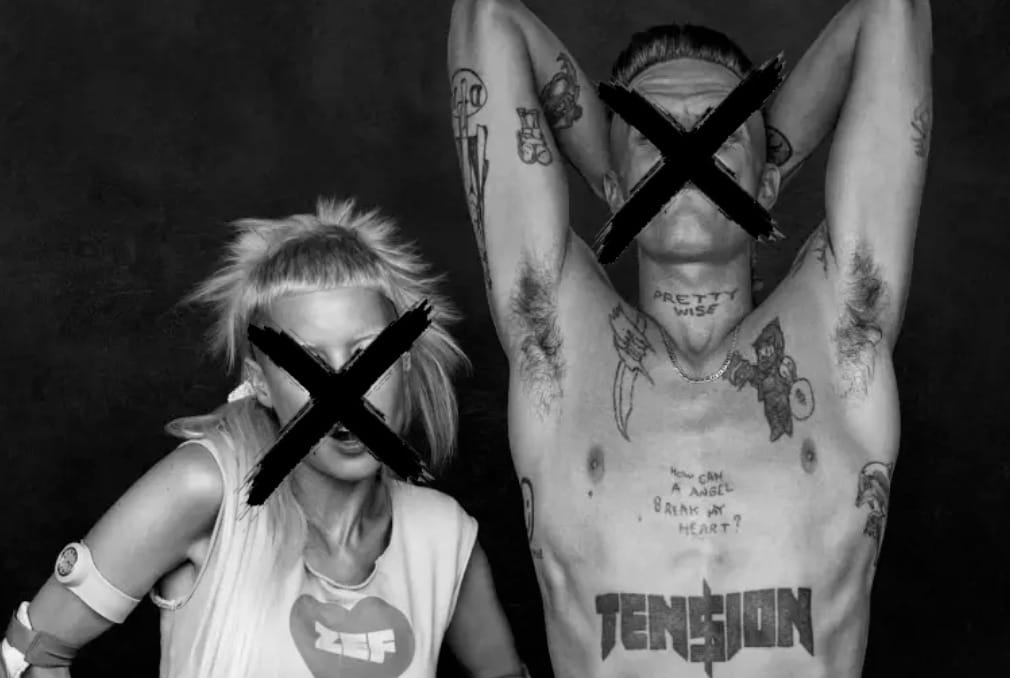
"You Can't Cancel the Fans," says Ninja onstage at C Complejo Art Media. It's the night of Tuesday, November 12, 2024, and it's the second visit to the country by the South African rap rave clan Die Antwoord. Or I should say "the South African rap rave clan accused by their adopted children of labor exploitation and sexual violence against them": Die Antwoord. Or maybe what I should say is "the South African couple of singers accused by their adopted children, by a female rapper, and by several collaborators, whom I nevertheless decided to go see live": Die Antwoord.
Like many, I discovered them between 2010 and 2011, when I saw the videos for Enter the Ninja and Evil Boy and was blown away by that unruly aesthetic, that grimy sound, and that way of rapping in a language I couldn't decipher. I became a pretty big fan during those years, and by 2012 I had convinced myself they were something remarkable. A few years later, in early 2015, I even went so far as to write this piece in Pagina|12 asking someone to bring them over. Finally, in 2016 they came to La Rural as part of the satellite programming for Lollapalooza 2016 and I was able to attend, accredited as press. The show was fine, lots of rap fitness raver stuff, Yolandi flashing her ass, Ninja being the tallest pile of white trash in the neighborhood. But their vibe had been losing my interest. By the pandemic, they were a retro indulgence that had aged like crap, unlike Hot Chip or MGMT, for instance, which had aged beautifully.
The thing is I got another press pass for the concert this Tuesday, for a piece I still haven't published because, several days later, the band still hasn't approved the available photographic material. I had listened at some point to the latest albums they released. Nothing had clicked, but I wanted to see them again. I also hadn't learned, until that very afternoon through a comment from my niece, that Ninja and Yolandi's own adopted children had accused them of child exploitation and various acts of violence, abuse, or exposure to situations on the sketchy end of the freak spectrum.
I felt uneasy the entire time the show lasted, and I still hesitate about what I'll end up writing for the paper --June 2025 update: I never ended up writing that piece--. I'm split between two inner voices, like when Ninja grabbed a kid from the audience who was passed up to him and put him on his shoulders onstage. The feeling was almost 50/50 between "how amazing this must be for that kid" and "you piece of shit, don't touch that kid."
I'm not very clear on where I stand regarding so-called cancel culture. In any case, I don't feel I need to be unanimous in my reactions to the accusations, the rumors, or the confirmations I hear or read out there. I know with absolute certainty that I condemn abuse and that I want it punished in all spheres and always. I especially propose that child abuse be punished with the harshest and most painful resources of condemnation available, and I put it in writing: no justice is enough for child rapists. But I don't quite know what to do about listening to albums by El Otro Yo, Die Antwoord, or Arcade Fire, for example. All accused, all canceled.
On Wednesday, while I was still chewing on all this, I stumbled upon the news that indie singer Miguel del Popolo had been sentenced to 27 years in prison for rape, abuse, and violence against several young women. The testimonies described a high level of sadism and perversion. I knew him as "Migue," from La ola que queria ser chau, a guy and a band I had shared several gig nights with about 15 years ago, in the early days of indie. A band that, as editor of the NO supplement at Pagina|12, I had decided to put on the cover. Just as I had also put El Otro Yo, Die Antwoord, and Arcade Fire on the cover at other times. From that wave of indie artists, accusations hit a bunch of them: the other high-profile case was that of Maxi Prietto, from Prietto viaja al cosmos con Mariano and Los Espiritus. But Del Popolo's case stood out above all for the brutality of the testimonies from three young women who reported violence and sexual assault, in one case repeatedly.
The method by which those young women publicly denounced everything in 2016, through videos on social media, marked an era and was part of the Me Too movement in Argentine rock. Around those days, youth cultures were also shaken by the deaths at the Argentine edition of UMF, Ultra Music Fest, which will be held again next year: sometimes it seems as if nothing ever happened.
As days, weeks, months, and years went by, many other Argentine musicians ended up being accused, publicly called out, or saying completely idiotic things (Cordera, Walas). Cristian Aldana, former singer of El Otro Yo, was the most visible perpetrator. He was sentenced to 22 years in prison for aggravated sexual abuse and corruption of minors, after accusations from seven women who stated he had raped them when they were under 18. Proven by the courts, Aldana is a child rapist. There is no possible universe where that isn't reprehensible. And yet, every now and then one of his choruses fires off in my mind.
It will always be easier to cancel someone who never gave you a good moment (a mosh pit, a song that moved you, a laugh in a movie). It will always be easier to cancel a villain. And, by pendulum logic, it will always be harder to cancel an idol. We all have someone we admire and whose devotion won't change, even if we find out about the worst atrocities committed by their hands or in their name. But we also all have women and children around us who have been abused or raped.
It's not made up; I buy that rhetorical figure: how is it possible that we all know a girl who's been abused and nobody knows an abuser? We're no longer talking about Chuck Berry, Puff Daddy, Nick Carter, Michael Jackson, or Bambino Veira, but about your creepy uncle who you like because he takes you to the stadium, the guitarist in your band, your desk mate in elementary school.
I say I don't know where I stand on cancel culture, but I also say that pretending to be evenhanded is the truly hypocritical stance. Cancellation is handed out based on acquired tastes. I'm not saying it should be that way, I'm saying that's how it works: it's easier to cancel Gustavo Cordera than others, because you already disliked him before or you think his music is crap. With Walas it's harder. And in any case, they both said stupid things. What's the parameter for cancellation based on saying stupid things? Well, maybe it's not giving them the microphone to say them as much, but I'm not sure if what they said is shitty enough to cancel them professionally. Now, the cases of Aldana and Del Popolo are entirely different. The case of Die Antwoord, apparently, is too.
I am convinced that other aspects of cancel culture strike me as downright idiotic. Everything having to do with censorship of violence in film or video games, everything about condemning authors for creating certain characters or making their albums, films, and books say certain things, everything about the outrage over artistic depictions of things like Nazism, everything about being alarmed by dark humor. There are people who die of literalness and we see it daily. Literally. Finally, there are also things that are irrelevant among my daily concerns, most likely because I'm a white cisgender male with formal employment and other privileges that, evidently, must make me a son of a bitch.
My immediate reaction, however, tends to be to cancel as well. I spend my life canceling people for being idiots, so of course I'm going to cancel a rapist. And abuse is so much a part of the everyday fabric of our society that it's impossible to sidestep cancellation: in politics, in entertainment, in art, in sports, every week you have to deal with some situation that forces you to, at the very least, not just carry on as if nothing happened.
As for the release of idiotic comments by artists, I try on a case-by-case basis to figure out where I draw my line as a person, as an audience member, as an editor, as a communicator. How far can I listen to your nonsense in order to listen to your brilliance. Is that the fairest option? No idea, pal. I suppose the inconsistency in the reaction is a privilege available to those of us who were never victims. But I still don't understand what to do with that privilege.