Alien: Jaws in Space

8 de oct. de 2025 — Juan Ruocco 🧙♂️

This is one of those articles that come straight out of an editorial meeting. In the heat of adjusting the calendar and the different tasks involved in running a media outlet every day, there's always a back-and-forth that, with two obsessives like Luis and Juanma, ends up becoming a potential article. While discussing various topics, at one point we realized that the first three Alien films had a trifecta, a lineup of directors that's hard to match: Ridley Scott, James Cameron, and David Fincher. It warranted an article.
Alien (1979)
The different accounts tell us that when Dan O'Bannon and Ronald Shusett (the film's screenwriters) had to pitch the movie to the studio, they told them it was "like Jaws in space". With the green light they got from Brandywine Productions, which then sold it to 20th Century Fox, they dove headfirst into making the film. For that, they set their sights on a (then) not very well-known director who only had one film to his name: The Duellists. It was none other than Ridley Scott, who over the years would become an obligatory reference in science fiction cinema in particular, and in mainstream cinema in general.
Alien would be the first installment of a very long saga that, unfortunately, would devolve into a "franchise", following the trajectory of every film that becomes one: exploitation, toys, and thousands of sequels, reboots, and even "series." I do salvage Prometheus and Covenant mostly for the expansion of the Engineers' story, the religious motifs, and a few other twists, even though as standalone films they don't add much to the saga. But when things weren't so intense yet -- or at least when I was a kid -- there were only three and nothing more. The first two, inevitably canonical. The third, up for debate.
Alien is the first film in the franchise, released in 1979. It was directed by Ridley Scott and starred Sigourney Weaver as Lieutenant Ripley. In the film it is the year 2122, and the crew of the commercial hauling vessel USCSS Nostromo interrupts their return trip to Earth upon receiving a distress signal from an unknown moon. While searching for the source of the signal, one of the crew members is attacked by an alien organism that attaches itself to his face and leaves him in a coma. The next day, an extraterrestrial embryo bursts from the crew member's chest and rapidly grows into a killing machine. As the alien stalks them inside the ship, the crew desperately tries to find a way to defend themselves.
This first installment of the saga is a kind of codifier for an extensive series of narrative tropes, but primarily that of space/body horror. The elements present in the 1979 Alien would undoubtedly set the course for the genre. The ship as a dramatic space, the unknown enemy of extraterrestrial origin, the space mythology of an extinct or incomprehensible technology as the framework in which the story unfolds (a Lovecraftian element). "In space, no one can hear you scream." The human body subjected to a process of constant mutilation. I think of successors in the genre: Event Horizon and Dead Space. Or how the Xenomorph would become a source of inspiration -- and outright copying -- for a multitude of similar creatures in fiction: the Zerg from Starcraft and the Genestealers from Warhammer 40K.
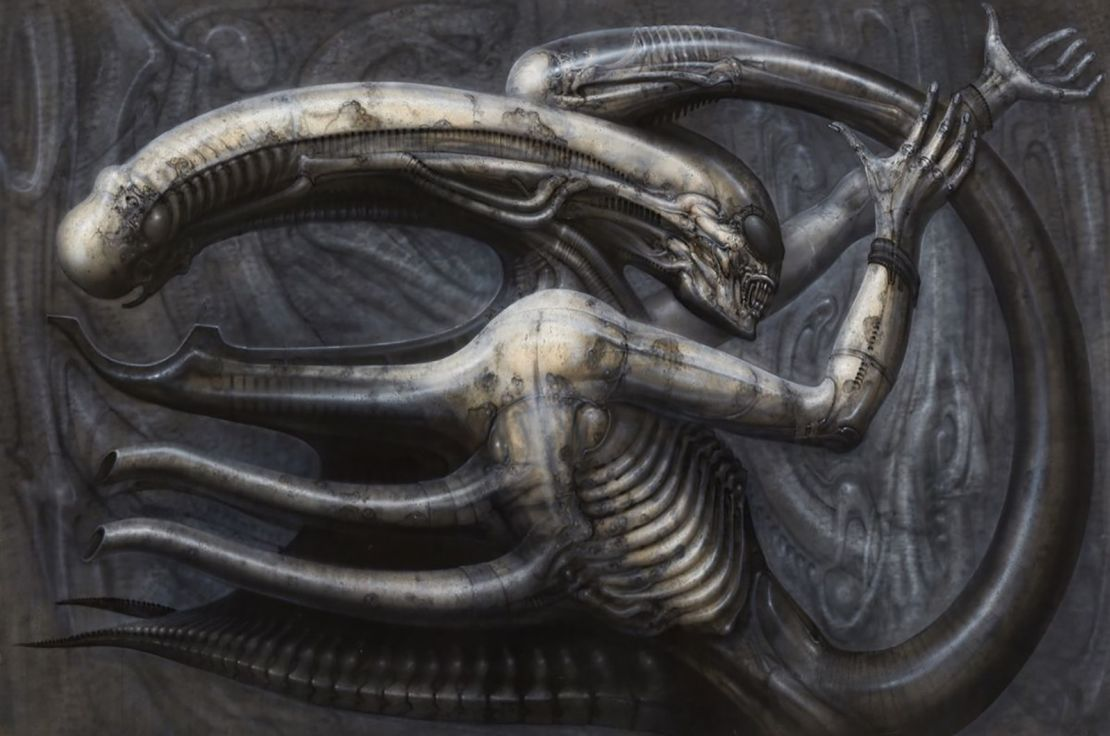
Without a doubt, the masterful elements of the film lie in the production design, the characters being essentially space truckers, the Lovecraftian encounter with the ineffable, the Xenomorphs, and all the biomechanical design of the Alien culture crafted by H.R. Giger, the mastery that Ridley Scott demonstrated in making the film, and the absolutely iconic scene of the chest bursting open from the newborn Alien. That the Xenomorph is indistinguishable from a tangle of cables, the design of the relentless yet blind monster, Ripley as a female protagonist. Simply truly brilliant. You only need to watch the first 10 minutes of the film to understand that everything is wrong and that what's coming is an absolute nightmare.
And where does Scott's mastery lie in this particular film? It's exactly what Spielberg did in Jaws. The construction of terror resides more in what's "off-screen" and the evolution of that constant threat than in the appearance of the creature, which amounts to less than 4 minutes of screen time; and which we only see in full body at the end, leaving a feeling similar to ALF. Literally, cinema. A film built entirely on atmosphere (hello, Super Metroid).
Aliens (1986)
Now then, if Alien is a masterpiece, what can we say about Aliens? The 1986 film was directed by none other than James Cameron, who had just come off filming Terminator and crafted a script good enough to secure the sequel project. But in this case, Cameron knew he couldn't repeat the same trick. So the film pivots toward action, maintaining the horror element in the relentlessness of the Xenomorphs. What could be more dangerous than a single Alien? A legion of Aliens. And that's when the film gets good.
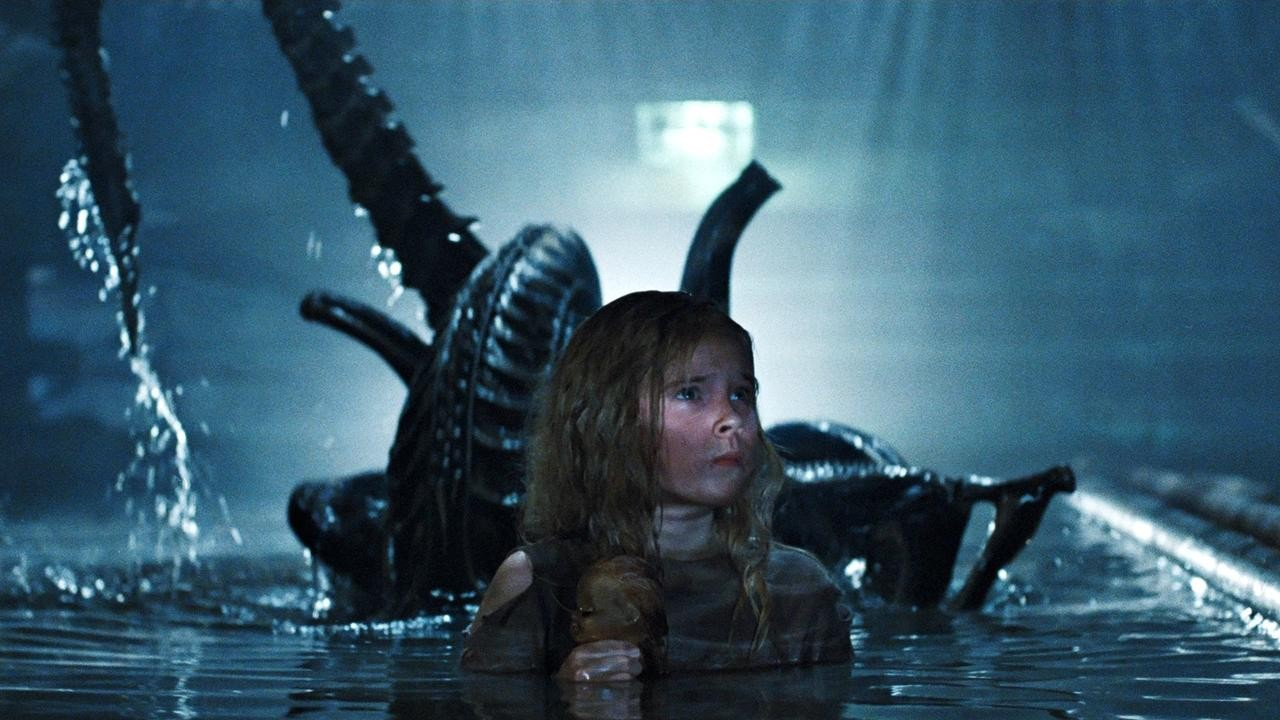
If Alien is about ordinary people facing an unknown and equally lethal creature, in Aliens what we have is a full platoon of American soldiers bringing the free market and democracy to a God-forsaken planet. Only to realize that they're actually just pawns in a corporate game where Weyland Corp. is trying to capture a Xeno to use as a biological weapon. SPOILER ALERT: in the later Alien installments directed by Ridley Scott, we learn a bit about how this was the beginning of the Aliens as such. Weaponized Xenos.
In this second installment we have a Lieutenant Ripley who wakes from cryogenic sleep, with nerves of steel, leading a squad of endearing jarheads who will do everything possible to clean up the planet. Meanwhile, the bureaucrat on duty tries to complete his psyop and take home a live Xenomorph. In this second installment we also learn about the hive-like organization to which the Aliens are bound. There is a Queen Alien that lays alien eggs from which the facehuggers emerge, infecting humans whose chests eventually burst open from mini-Aliens growing inside them until they reach standard size by Xenomorphic percentiles.
The mastery, in this case, of James Cameron lies in how he turned a horror film into an action film, where the weapons, at some point, become the protagonists. If the first film of the saga is "Jaws in space," this one can be considered "Platoon in space." A trope that, again, would become recurrent across different films and/or video games. We can think of the Catachan jungle troops from Warhammer 40K who literally live in a space Vietnam, or Starship Troopers, or Gears of War, or Helldivers. What better than space marines to face a plague of alien space bugs?
The total extermination of an alien population that is completely unreflective and dangerous to human beings unleashes one of the most recurrent masculine fantasies of all time: absolute and amoral warfare. Xeno genocide with no Compliance departments. Yes, for an instant we can play at being the IDF. The Xenomorph is the perfect Other: if you get close, it annihilates you. It has no cultural systems, it doesn't speak, it doesn't write, it doesn't do anything. The hive? Little more than a cockroach nest. It's a human-sized insect: a barrage of lead and move on.
Years later, James Cameron would retrace this path in Avatar, where -- oh, coincidence -- Sigourney Weaver would also star. But this time the portrayal of the illiterate space natives would fall within the realm of the moral, in a plot about the problems of the imperialist space advance in search of natural resources to keep terrestrial capitalism running. The shift from Vietnam to the invasion of Iraq and Afghanistan.
Additionally, Ripley develops her most affectionate side by bonding with Newt, an orphaned girl found in the Xenomorph-infested base, who will be kidnapped again by the aliens and rescued by Ripley toward the end of the film. Then, the survivors set off for Earth. Among them, Dwayne Hicks (played by Michael Biehn, the same actor as Kyle Reese in Terminator), the best soldier of the future that cinema has ever had; and what was left of Bishop, the android.
Alien³ (1992)
While I've never had trouble arbitrarily defining when a saga stops being canonically important -- in Terminator, at the second film -- a concept we'll eventually have to discuss, it so happens that Alien³ doesn't mark the end of the franchise but it does mark the death of its most important protagonist: Lieutenant Ripley (who would return in Alien: Resurrection but as a clone). But just as it kills one of the saga's pillars, the 1992 film also gives birth to David Fincher as a mainstream film director: after this installment, he would go on to direct Se7en, The Game, and Fight Club in quick succession. Without intending to -- or did he? -- Alien would end its first era by adding as its third director yet another titan of the modern film industry. Thus completing a trifecta hard to match: Scott, Cameron, Fincher.
Now, the result of this move in cinematic terms remains up for debate. As Mariano Castano taught me in the Filmmaking I course when I studied Cinema at IDAC: "Excuses don't get filmed." And while this might sound like an excuse, it's actually an explanation: throughout the entire shoot there was no script. With this in mind, we can better understand the mess that making Alien³ was, its uneven result, and the existence of two versions to watch: the theatrical cut, and the Assembly Cut that 20th Century Fox released years later to try to bring the film closer to "the director's vision."

Fincher flatly rejected any association with this project due to the mistreatment he suffered during the shoot and the release at the hands of the studio, making it clear throughout his life that he doesn't feel that film is "his" at all. In plain terms, he washed his hands of it. That's why, to analyze it in depth, we'd need to establish some comparison between both versions, but that's a lot for an article of this length, which aims -- at most -- to lay out what each director left behind for the saga.
Alien³ narrates the events immediately following Aliens. After the escape of the four survivors and their entry into hypersleep bound for Earth, the escape pod (Sulaco) doesn't reach its destination but instead crashes onto the surface of planet Fiorina 161, a prison planet inhabited only by extremely dangerous men. That is, an incel colony. Or a kind of futuristic monastery, if we want to be more metaphorical and generous with the film's theme.
Of course, Ripley doesn't travel alone -- she brings the damn plague with her. The film's great stroke lies in its setting, a kind of cross between a foundry (the inmates extract metals) and an abandoned space cathedral/monastery. Being a prison, none of the inmates are armed. The warden doesn't believe Ripley -- because he's an incel -- until he gets impaled by a Xenomorph, which uses a dog to complete its mutation. This small detail opened the door for Xenomorphs to invade other living organisms besides humans, which led to the infamous Predalien of the later spin-offs.
Parallel to Ripley's struggle with her army of incels/simps -- the simp is the shadow of the incel -- the Weyland Corporation catches on that Ripley is still alive and sends people to retrieve her. Because -- oh, surprise -- inside her, Ripley carries an Alien. But not just any Alien: the embryo of a Queen. From this sequence comes the iconic image that illustrates this article, of the Xenomorph sniffing Ripley without killing her. So, without weapons (or grudges), Ripley and the inmates devise a plan to trap the Xenomorph using various stratagems and bait.
Alien³ dodges almost every convention of the previous films: they're in an enclosed space but it's not a spaceship, they have no weapons whatsoever, and lastly, they're going to hunt the hunter. The moment of the Xenomorph's final defeat coincides with the arrival at the foundry of a human (or android?) identical to Bishop, who delivers a eulogy on Xeno biology and why it should be saved, studied, and replicated. Ripley chooses to put an end to this entire tragedy (Newt dead, Hicks dead, Bishop dead) and throws herself chest-first -- actually, back-first -- into the molten maelstrom of the foundry. Yes, in a finale nearly identical to Terminator 2, which had come out the year before. Unbelievable. But Ripley chooses to sacrifice herself for humanity, to give her life in exchange for the survival of the species and, in passing, to tell the entire Weyland Corp. to go straight to hell. Framed within her struggle against the evil she incubates, in a kind of space monastery, well, you get the picture.
And just like that, our journey through the original trilogy of the Alien saga and Lieutenant Ripley comes to an end -- possibly the only character in all of cinematic fiction to have been directed by three giants of the industry. Three who, moreover, had with these films nearly their cinematic debuts, or at least the saga that put them in the firmament of cinema. Even Cameron had already released Terminator, but he had only just started working on it by the time of production.