Arcanum: Steampunk, Class Struggle, and Magic in a Cult RPG
What happens when the Industrial Revolution collides with sorcery? Arcanum is a cult RPG, but also a harsh lesson in Marxism and steampunk, where the steam engine threatens to extinguish magic forever. Discover the game that reimagined the fantasy genre.

13 de mar. de 2026 — Rodrigo Illarraga
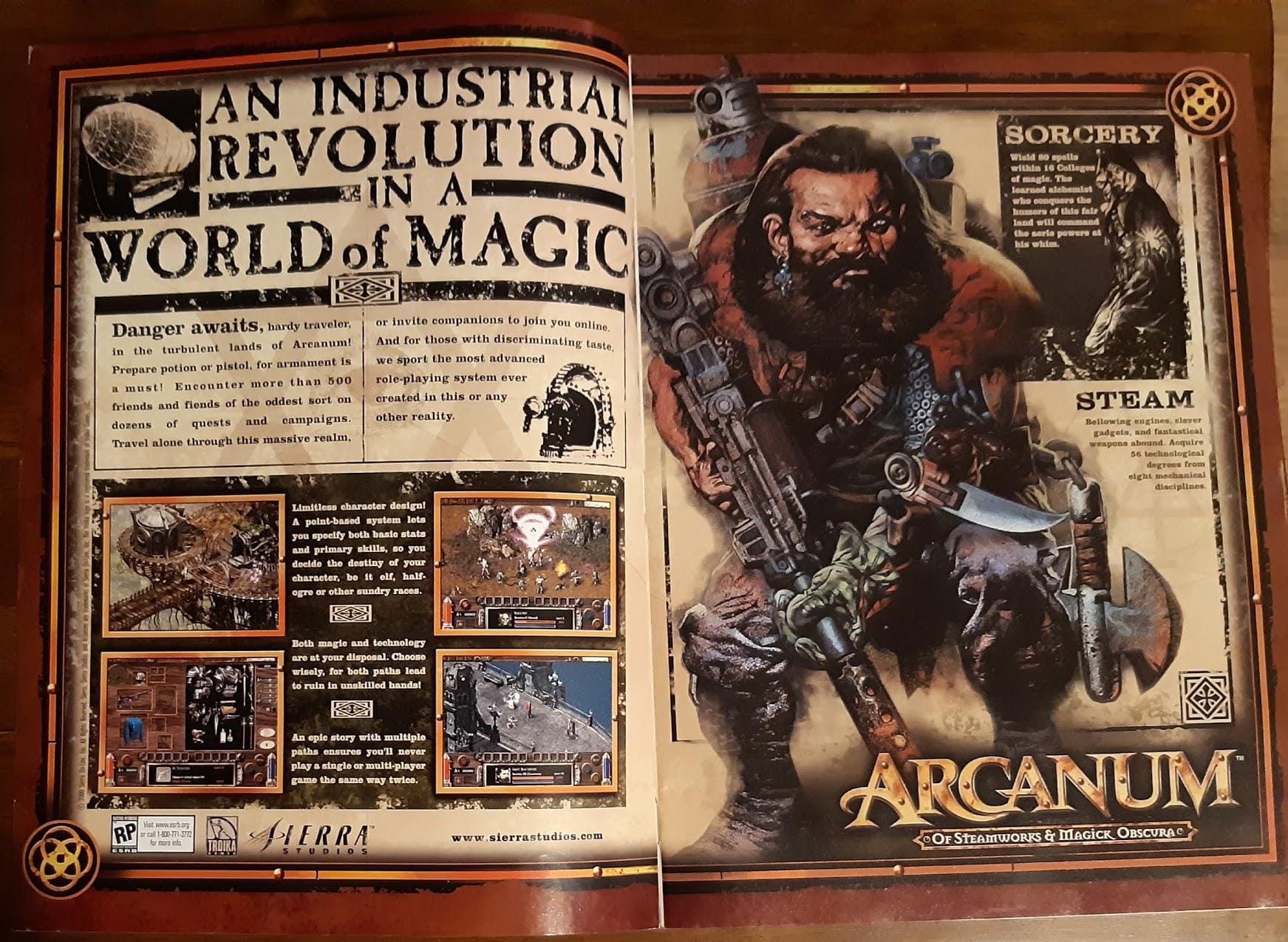
At the beginning of the 21st century, role-playing games for PC experienced their second golden age. With companies like Black Isle and Bioware, and titles such as Baldur’s Gate, Fallout, The Temple of Elemental Evil, Icewind Dale, Planescape: Torment, and Neverwinter Nights, we were able to play games with stories on par with any book or movie in the fantasy genre. Among this universe, there’s one that deserves special mention: Arcanum: Of Steamworks and Magick Obscura, released by Troika Games in 2001 (later known for Vampire: The Masquerade - Bloodlines, the adaptation of Vampire The Mascarade published by White Wolf).
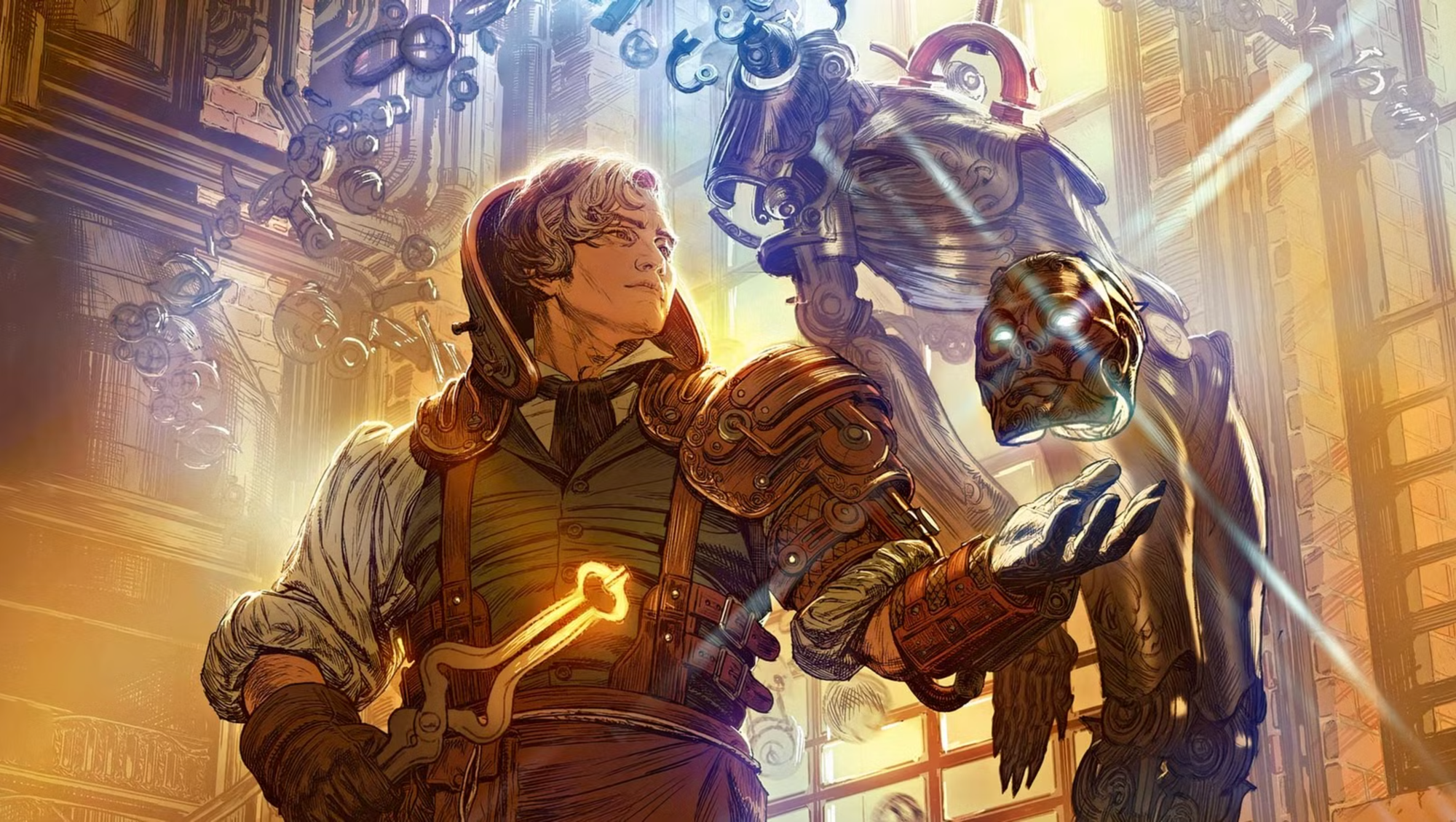
The premise of Arcanum puts a twist on the typical fantasy of magic, dwarves, and elves that comes from the multiverse of Dungeons and Dragons (the most famous tabletop role-playing game). In the fantastical world of Arcanum, just over 40 years ago, a man named Gilbert Bates invented the steam engine, sparking an industrial revolution. Thus, along with the films Wild Wild West (1999) and The League of Extraordinary Gentlemen (2003), the book Mortal Engines (2001), and the game Rise of Nations: Rise of Legends (2006), Arcanum stands as one of the earliest mass examples of the steampunk genre, influencing the creation of the setting Eberron for Dungeons and Dragons and directly impacting the aesthetic of Arcane (2021-2024).
But what was the Industrial Revolution? Understanding its ABCs can reveal the true essence of Arcanum. Broadly speaking, the Industrial Revolution was a series of radical transformations that resulted in the emergence of capitalist industry. It was such a significant mutation that Eric Hobsbawm, in his book The Bourgeois Revolutions, equates it with the French Revolution. “One day between 1780 and 1790, and for the first time in human history,” says the British historian, “the productive power of human societies was freed from its chains, making them capable of a constant, rapid, and, to this day, unlimited multiplication of people, goods, and services.” In England, the epicenter of this revolution, the old home-based or small workshop manufacturing gradually gave way to a new way of organizing work.
Karl Marx, one of the most insightful scholars of the changes at the end of the 18th century and the beginning of the 19th, identified two key elements in the emerging capitalism: alienation and surplus value. The Industrial Revolution gave rise to a production system where some owned the means of production (that is, the tools, land, and money necessary for living) while others did not, and thus, to access them, they had to sell the only thing they had left: their labor and time. Bourgeois, entrepreneurs, workers, and the dispossessed. For Marx, this is the basis of the famous “class struggle.” In this framework, employers pay workers less than what they produce (yes, even after accounting for investment expenses, risks, and costs, the employer still profits), and that is surplus value. Meanwhile, workers see what they create with their own hands as alien to them, as if it were the product of the company they work for: that is alienation.
Arcanum is one of the earliest mass examples of the steampunk genre, influencing the creation of the setting Eberron for Dungeons and Dragons and directly impacting the aesthetic of Arcane.
How did we come to have, on one hand, owners of the means of production and, on the other, a majority that must work to earn a wage? Marx refers to that process as “primitive accumulation,” which is the origin of capitalism. In England, this primitive accumulation occurred in a very direct way: the vast majority of villages in the English countryside had common lands shared among all the peasants, essential for their survival. These were common fields where they grazed their flocks or forests where they hunted and gathered firewood. But starting in the 17th century, the nobility began to appropriate those lands in a process known as enclosure (Enclosure Acts). Within a few years, English peasants could no longer use the common lands and realized that the only way to survive was to work in the emerging industries for a pittance. They became the first workers in capitalist history.
The forms that labor took are a fundamental component of the revolution: while work had always been controlled and measured in some way, with industrial capitalism, this was reinforced and became indispensable. Michel Foucault tells us that it is precisely from the Industrial Revolution that the task of surveillance becomes a defined function accompanying the entire production process. Clocks, time cards, bells, buzzers, and foremen—all of this existed in a time without labor rights, where more rigor meant more production. “Time is money.”
On the technical side, “steam engine” is usually the first thing that comes to mind when we think of those early industrial years. Boiling water that initially powered the textile industry and later, a century later, the railroads. This steam is what gives its name to steampunk, an aesthetic movement that constructs fictional worlds where the analog technology of the Victorian era is the norm: computers run on gears, war tanks run on coal, and giant zeppelins traverse continents. From a retrofuturistic perspective, where the technology of the Industrial Revolution mixes with the rebellious and dystopian touches of punk, steampunk offers a new way to interpret the relationship between humanity and technology. It’s not so much a conservative return to a glorious past, but a way of envisioning alternative paths for the development of humanity. Perhaps in 100 years, there will be microchipunk.
In Arcanum, technology and magic are irreconcilable opposites. (...) Magic is a gift, technology is a tool. Magic is for the few, technology is for everyone.
Arcanum: Of Steamworks and Magick Obscura is part of the steampunk movement in a universe where technology and magic intertwine, adding a new layer. “Intertwine” falls short: in Arcanum, technology and magic (magick) are irreconcilable opposites. Elf spells go awry when cast by mechanical dwarves. Gears break if magic is used nearby. Wizards must avoid traveling on the train that runs through the Unified Kingdom, the nation where the Industrial Revolution has erupted (yes, the United Kingdom, the Unified Kingdom). Magic is the ancient force (there’s talk of an Epoch of High Enchantment, 900,000 years in the past), while technology is the new. Magic is a gift, technology is a tool. Magic is for the few, technology is for everyone. That is perhaps the promise that technology brings, which is also the curse for magic: democratization, merit, an open race for talent. If magic depends on something indefinable we are born with and careful, deliberate education, technology is what is already available to all with its equalizing power. The cyborg fantasy: one day my mechanical legs, indistinguishable from human ones, will allow me to run as fast as the best Olympic sprinter.
The landscape of Tarant, the most industrial city in the world and capital of the Unified Kingdom, is a strange sight for those accustomed to fantasy. The poor of The Lord of the Rings or the Baldur’s Gate saga are the peasants ruined by a bad harvest. Tarant is different: there, poverty is structural. The lower classes, if they want to survive, must sell their labor to capitalists. In Tarant, impoverished wage workers mark the urban landscape and interactions, an unprecedented fact in the rest of the Arcanum landscape.
In the Unified Kingdom, industrial advances are, in principle, for everyone. Technology as the great equalizer. Magic is what separates the elven capital Qualinost from the town of Solace in the world of Dragonlance, what distinguishes Rivendel from Edoras within Middle-earth. In fantasy worlds, magical ability is a matter of race, birth, or natural aptitude. Technology, on the other hand, reaches everyone equally. Because in capitalism, things do not depend on blood or lineage: those who work hard can succeed. Of course, we know that this is relative: we can all see the latest model of phone or console, but few can afford it. It’s all there, so close yet so far. That simple and elemental pitch of capitalism is what unfolds in the magic-technology relationship of Arcanum: everyone can access technology; all who have the money to pay for it.
The game itself presents us with alternatives for facing a changing and new world. In Arcanum, the kingdom of Cumbria is in decline for refusing to embrace technology. Among the many possible endings of the game, there are two dedicated to Cumbria: one where the kingdom continues its decline, turning its back on modernity, and another where it regains its former greatness by integrating new advancements into magic. In these two paths lies a strong bet of the plot: while it does not hesitate to denounce the injustices of capitalism, Arcanum makes it clear that its denial can only lead to a slow and sad decline. Even if we believe that capitalism has inherent inequality written into its code, we must not forget the anti-romantic lesson of the game: one does not advance by moving backward. We must not fall into the mystification, ludditism, and anti-technological sentiment that idealizes a magic that is a gift and pride of a few chosen ones. The path may lie in the middle, uniting steamworks and magick obscura, a path where technology serves the sacred, that which we do in community.