Bitcoin: Fools' Gold

11 de may. de 2021 — Juan Ruocco 🧙♂️
Disclaimer | I originally published this article on May 11, 2021, on Substack. More than four years later, I'm sharing it again with some changes and a new addition at the end. Enjoy.
"Discussions of money drive social apes mad."
Nick Land
In recent months --once again--, words like bitcoin, ethereum, dogecoin, NFT or DeFi have become common currency. With Bitcoin at new all-time highs, those who previously didn't dare approach the cryptocurrency phenomenon are now jumping on the first thing they find so as "not to miss out."
When this article was first published, we had come through a year in which Bitcoin's price broke its historic ceiling of 20,000 USD and had begun trading "steadily" in the 50,000 to 60,000 USD range. Driven by that astronomical rise and its "trickle-down effect," cryptocurrencies or digital assets entered the mainstream and became part of public discourse.
In 2025, their apologists continue to highlight the virtues: Bitcoin has a limited supply, is not under the control of any company, state, or organization, and is resistant to censorship. Its detractors continue to wave, as well, the same series of counterarguments: it's a bubble, it's not sustainable, and it strips power from the state over each country's economy.
Standing with the first group, I believe the main benefit of the rise, boom, bubble(?) of cryptocurrencies is that it allows us to discuss the nature of money. While the unique role money plays in our society is undeniable, we know relatively little about it, at least compared to other artifacts we devote our time and curiosity to. And that's fair -- you can't know everything. But if we think for a second about the absurd amount of time we spend earning money, it's a bit odd that we don't know how it works. Coincidence? I don't think so.
This ignorance, in turn, has become the subject of a branch of self-help: the much-advertised "financial literacy." This content places too much emphasis on people's ignorance and how, ultimately, poverty is their own fault. That was the case in 2021 and it remains so in 2025. This is part of the ideology of global neoliberalism, which transferred, both symbolically and materially, the responsibility for upward mobility to individuals, while simultaneously cutting the mechanisms to achieve it.
It's curious, then, that behind a supposedly "emancipatory" message lie these small, far from innocent, ideological subtleties. In fact, most of the population goes through life oblivious to how the financial system, the economy, and money work. And that ignorance considerably increases the asymmetries between workers, who depend on their wages to live, and the companies, individuals, and organizations that own large amounts of capital.
The goal of this text is to show that it is possible to understand how the financial system works, use it in our favor to reduce the number of hours needed to earn money, without falling into the psychopolitical traps of neoliberalism. Freedom over the use of one's own time is the only true freedom.
Fiat money
We rarely have the opportunity to discuss money. That's why the world of cryptocurrencies represents something new. When I talk about Bitcoin with someone, the first question I face is "What's it backed by?" A super interesting question because it makes evident the belief that money has some kind of backing.
And then, right there, the epiphany occurs. Regular circulating money, known as fiat or fiduciary money (pesos, dollars, euros, yen, yuan), is worth something because the government accepts it as legal tender. Since 1971, when the 37th president of the United States, Richard Nixon, abandoned the gold standard (the old monetary system in which dollars were a reflection of a portion of gold stored in the Federal Reserve), money ceased to have any intrinsic value -- that is, value inherent to its characteristics.
In this regard, Paul Krugman, Nobel Prize in Economics laureate, made a rather revealing intervention that exposed the ideological operation that is always shown to us in opaque terms, while appearing on a television show:
You know, unlike those pieces of paper with dead presidents' faces on them, which are anchored in the fact that you can use them to pay taxes, Bitcoin has no anchor.
This quote says much more about fiat money than about Bitcoin. What Krugman is saying, and what the general public somehow doesn't know, is that modern money (post-Nixon) derives its value from the fact that the government recognizes it as the only possible means for paying taxes. Money is, in the end, a social convention whose value derives from the trust different people place in whoever prints that money; in our case, and in the case of the peso, the Argentine state.
Therefore, if an organization can generate enough trust and convince a certain number of people that something has value, that thing acquires value. Of course, that's much easier if the organization is called the United States and has, to back its position, the largest and best-equipped military on the planet. If the organization fails in its objective, it will then be labeled a bubble. Money as a social relation is therefore also shaped by -- I summon thee, ghost of Foucault -- power relations. Oh yes, we live in a society.
1 bitcoin = 1 bitcoin pic.twitter.com/7mUPzvYOj3
— 𝖚𝖈𝖎𝖝𝖌𝖊 40k🧙♂️🔮 (@realjuanruocco) May 21, 2025
Bitcoin operates in a similar way, except that "trust" is no longer placed in a central entity, such as the state or a bank, but is transferred to a decentralized cryptographic proof protocol. Clarifying this statement would take another article; for now, you can read this if the topic interests you.
Despite the "trust" argument, many people maintain that bitcoin's value doesn't reside solely in an arbitrary consensus but that this consensus derives from the asset's own characteristics: scarcity, utility (the ability to transfer value worldwide without intermediaries or prior requirements), and proper incentives. For those who believe this, Bitcoin is even superior to fiat money.
No gods, no state, no masters
Bitcoin's existence makes explicit the political nature of money and breaks the illusion of neutrality. In Argentina, despite living for at least ten years -- well, fifteen -- in a permanent economic crisis, talking about money (guita, plata, mosca, biyuya) is taboo. And this verbal prohibition, which weighs on personal finances, directly benefits those who run the financial system, as it produces an asymmetry -- of knowledge and therefore of power -- between them and ordinary citizens.
The realm of finance remains restricted to a privileged group that acts as intermediaries between money and the rest of the population. Those who don't know or understand how credit works, for example, may be more prone to falling into debt. Just as happens with credit cards -- not to mention personal loans and sketchy lending companies -- which, while appearing at first glance as a convenience for the vast majority, end up being the gateway to debt and an enormous business for banks. And for the system: constant debt is a more than efficient deterrent for going out to work every day.
If "managing money" is regarded as a high-risk operation, the need for intermediaries in any transaction appears: buying stocks on the exchange, setting up a fixed-term deposit, taking out a loan, building an investment portfolio. These mediators are, in a way, like priests charging a toll between God and men, functioning as interpreters of divine messages. In this case, God is money and the bank is a temple.
In the ancient rite of the Old Testament, only the high priest can enter the holiest part, the sancta sanctorum, the place where God manifests. The similarity between the holy place and the bank vault, accessible only to the chosen few, is curious. Ultimately, the entire religious apparatus, like the banking one, serves to conceal the obvious: the one who holds power is not God but the priest.
The financial world's best-kept secret is that money produces more money. While the vast majority of people trade their labor to obtain it, the financial world only needs to use available capital to multiply its capital. A worker needs twelve months of savings to go on vacation, while a stockbroker can obtain the same amount of money in a couple of financial operations. Of course, to have a small speculative capital, you need to have obtained it beforehand. That's why it's much easier for "rich" people to live or work less than someone from the middle or lower class: they already have a base that allows them to perform these operations.
Cryptocurrencies are a vehicle for narrowing that gap between an ordinary citizen and a professional speculator. Take the case not of Bitcoin, but of Ethereum. This cryptocurrency was trading near 100 USD in 2019. At the time this article was originally published, two years later, it was trading at 4,000 USD. While its value is lower now, during that period it multiplied its value 40 times in just two years. If we add the devaluation of the peso, the result was that in early 2019, one ETH was equivalent to 4,000 Argentine pesos and two years later it was equivalent to nearly 600,000 Argentine pesos. And acquiring this cryptocurrency -- or any other -- requires a procedure as simple as downloading an app, registering, and loading funds. Done.
Cryptocurrencies put into the hands of ordinary citizens the same tools for monetary multiplication that belong to the traditional financial system. In that sense, it somewhat replicates what happened during the Protestant Reformation: the priesthood as an institution loses its prominent place, since the relationship with God is guaranteed directly, without intermediaries.
In any case, for centuries, economics, the workings of money, and the banking system remained cloistered within a group of experts. The emergence of cryptocurrencies came to challenge that monopoly. In a way, Bitcoin represents a kind of "modern Prometheus" where the "fire" is stolen from the gods, with fire being money and the gods being bankers. If until 15 years ago all our commercial operations ultimately rested on the existence of central banks, private banks, and other financial entities, since Bitcoin there has been an alternative, managed by ordinary people, to avoid that intermediation in obtaining and using money.
It's not unreasonable to understand the fervor of the "early adopters" (the first users of the technology) who saw Bitcoin's potential to completely overturn the global financial system. That thesis is known as "maximalism" and represents only a small portion of Bitcoin users. But what really remained from that initial euphoria is the fact that ordinary people seized the means of monetary production.
In fact, this entire new economy depends on systems where bosses don't exist. The network's tasks are distributed according to necessary functions and based on economic incentives. The main objective of any community sustaining a cryptocurrency is to guarantee consensus: keeping the majority of users aligned on the same blockchain, that is, on the same transaction history. All of this, which is the foundation of any cryptocurrency's value, is done without any kind of authority, leadership, or bosses.
Crypto is a community organized autonomously, without hierarchies or bureaucracies. This, beyond Bitcoin's anarcho-capitalist origins, is a fact often overlooked by left-wing or progressive traditions when in reality it's a confirmation of several of their tenets. Cryptocurrencies are a still rather rudimentary form in which successful human organization without hierarchies is possible. Which is no small thing.
Theory of the permanent carnival
From that 2021 era, we can still highlight two paradigmatic cases: Dogecoin and Wall Street Bets. Dogecoin is a cryptocurrency that was born with the simple goal of paying tribute to a meme. But the meme was contagious and it grew. It reached a value of over 50 cents, and today it trades at nearly 25 cents. When it launched, since it was a coin nobody really took seriously, a bunch of people bought it just for fun, or as a joke. A couple of Elon Musk tweets later, it quickly became one of the highest-valued cryptocurrencies on the planet by market cap, a position it maintains in 2025. This is a sign of the total rupture of the previous values associated with money: seriousness, solemnity, and sacred aura. Dogecoin, unlike Bitcoin, does not have a limited supply, which makes it much more similar to fiat money. Today, money is, literally, a joke.
We can also look at the Wall Street Bets case, where something similar happened. With the appearance of user DeepFuckingValue and the level of memetic virality that his purchase of Gamestop shares generated -- betting against the investment funds that were shorting them -- they managed not only to make money but to mobilize an entire group of people to bet against Wall Street. This caused multimillion-dollar losses -- and presumably jobs -- for expert financiers at the feared neuralgic financial center of the most powerful country on the planet. All power to the forums.

Thus, the classic notions associated with the financial world are inverted. The world is turned upside down, and "the sacred" -- that is, money, capital -- becomes a joke. This subversion is bothersome, it generates discomfort, because it somehow undermines the notion of authority that the financial world has built. Want to make money flipping pancakes? You can. Want to make money messing around with a meme? You can. That is the current state of the global economy. And in these four years it hasn't changed, it has only deepened.
In conclusion, cryptocurrencies are not what the traditional left would call "revolutionary," since they don't attempt to abolish (not even discursively) private property, capital, and social classes. Rather, they invert the notions associated with these categories and turn the world upside down. They put financial tools in the hands of ordinary citizens, strip from the federal reserves, central banks, and the IMF the power to print money. And a few nerds replace the Wall Street yuppies.
It's not a change that seeks to eliminate capitalism but to horizontalize it to the extreme, eliminating the privileges held by the ruling oligarchy. Not changing the rules, but winning with the opponent's rules.
The unforgivable crime of cryptocurrencies is not proving that God doesn't exist, but showing that the holy place is empty.
Welcome to the present (update from 5/22/2025)
Four years have passed since the publication of this article. While reading it in retrospect I can see some naivety (for example, claiming that there is no hierarchy whatsoever within Bitcoin), I generally still stand by the argument. Bitcoin is unlike anything else; its horizontal and algorithmic nature opened a new era in the history of money, and the result of the successful implementation of its political-technological program is disruptive to the traditional financial system.
Beyond the fact that it has become quite commonplace, I'm still amazed that Bitcoin's current price is hovering near 111,000 USD, doubling the maximum price at which this article was written and reaching a new ATH (all-time high). Bitcoin is, for now, the routine of the extraordinary.
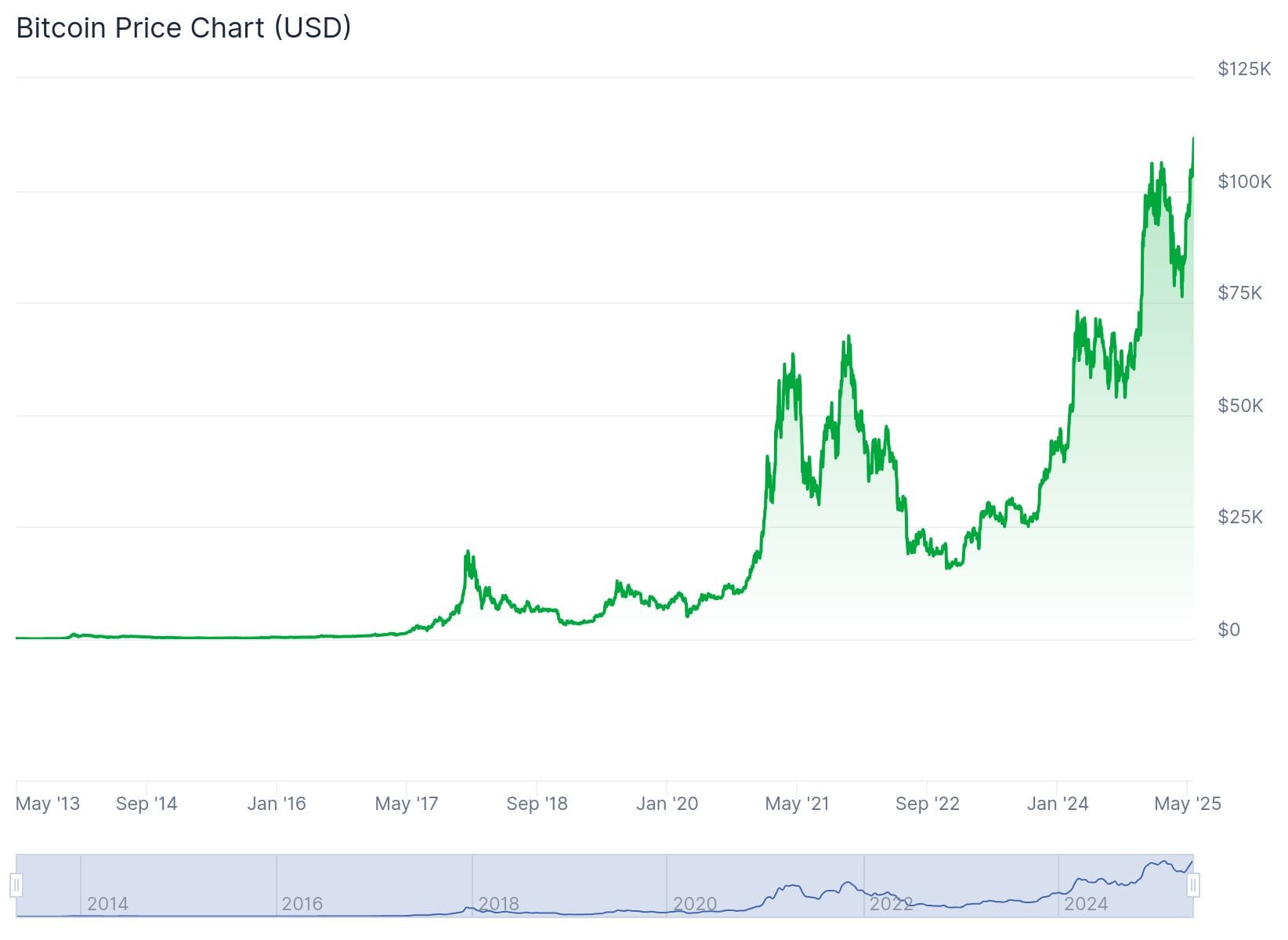
What this means is that if someone who read the article in 2021 put in 100 USD, they now have 200 USD. That is, a 100% gain in dollars over four years. Discounting all the storms in between, and compared to what a fixed-term deposit pays annually in dollars (between 4% and 8%, depending on the year), a complete idiot could have beaten any professional broker. We can do the same exercise with the various articles I've published over time.
But all of this is even secondary. The growing relevance of crypto over time has to do with the different levels at which the entire community, its technology, and its implications operate. In this sense, it's easy to think of it in blocks. For example, Bitcoin functions strictly as a store of value. Digital gold, all that stuff. Or as Francisco Strambini from Class Lambda puts it: an insurance policy against bad monetary policy and obsolete Western leadership.
BTC es la verdadera reaccion a la a la estupidez en la dirigencia occidental.
— Francisco Strambini 🟩 (@fran_aligned) May 21, 2025
Un activo de libre acceso y con politica monetaria invariante. https://t.co/HHPq0Pjpvt
Ethereum, on the other hand, continues in its evolution toward becoming the new international SWIFT network. An interoperable layer for the international financial system -- programmable, decentralized, but also compliant with the American legal order. In the best-case scenario -- in the bullish case, let's say -- it will be the new international banking infrastructure, with a certain level of independence from traditional financial institutions, but at the same time with the necessary guarantee that any money circuit on that network will be legally compliant and subject to law enforcement oversight. The only thing Ethereum needs to do to succeed here is achieve the most consistently low transaction cost. Something that Tron, Solana, and the entire saga of "Ethereum Killers" partially address.
And below all of that we have the playground networks, of which Solana is the main one. The home of memecoins, NFTs, and all the wild innovations that make the ecosystem "fun." And today it's Solana and tomorrow it could be whatever-coin. It doesn't matter. It's the functional role.
Without much more to add, I'll close this update with a short list of articles that are already linked in this piece, but ordered chronologically.
August 2017 - Altcoins (Monero)
November 2020 - Cryptocommunism
June 2023 - The Political Nature of Bitcoin