Carnotaurus: Argentina's Most Iconic Dinosaur
With tiny arms, bull horns, and a bulldog face, Carnotaurus is Argentina's most iconic dinosaur. How science deciphered its hunting technique and the mystery of its short arms, all from an exceptional fossil.

8 de mar. de 2026 — Flor Filippini
You probably recognize this dinosaur from its role as the main villain in the well-known Disney movie Dinosaur. While it was portrayed on the big screen as much larger than it actually was, its reputation as a fearsome predator is well-deserved. And being quite famous in movies, series, and documentaries, this Hollywood star has the peculiar distinction of also being an Argentinian dinosaur. In fact, it was already mentioned in previous notes.
Carnotaurus sastrei means "carnivorous bull of Sastre", referring to it being a horned carnivore and honoring Ángel Sastre. He was its discoverer and the uncle of the owner of the field in Chubut (Argentina) where the find occurred.
It all began one day in the early eighties while herding sheep. It is said that, out of frustration with an animal that wouldn’t follow the path, Sastre picked up what he thought was a stone to throw. However, he realized it had an unusual shape: upon closer inspection of the "rock," he noticed it wasn’t just sediment, it was a fossilized bone. That vertebra and a couple of other remains, rescued almost by chance, ended up stored in the family home for a while. It wasn’t until a geologist working in the area saw the remains that the true significance of the site came to light. After notifying the renowned Argentine paleontologist José Bonaparte, the expedition arrived swiftly in 1984. The team of just five people managed to extract the skeleton in only two weeks. The fossil was a specimen with an almost complete skeleton, preserved in an exceptional manner with an intact skull, revealing to the world one of the strangest carnivores to ever walk the Earth.
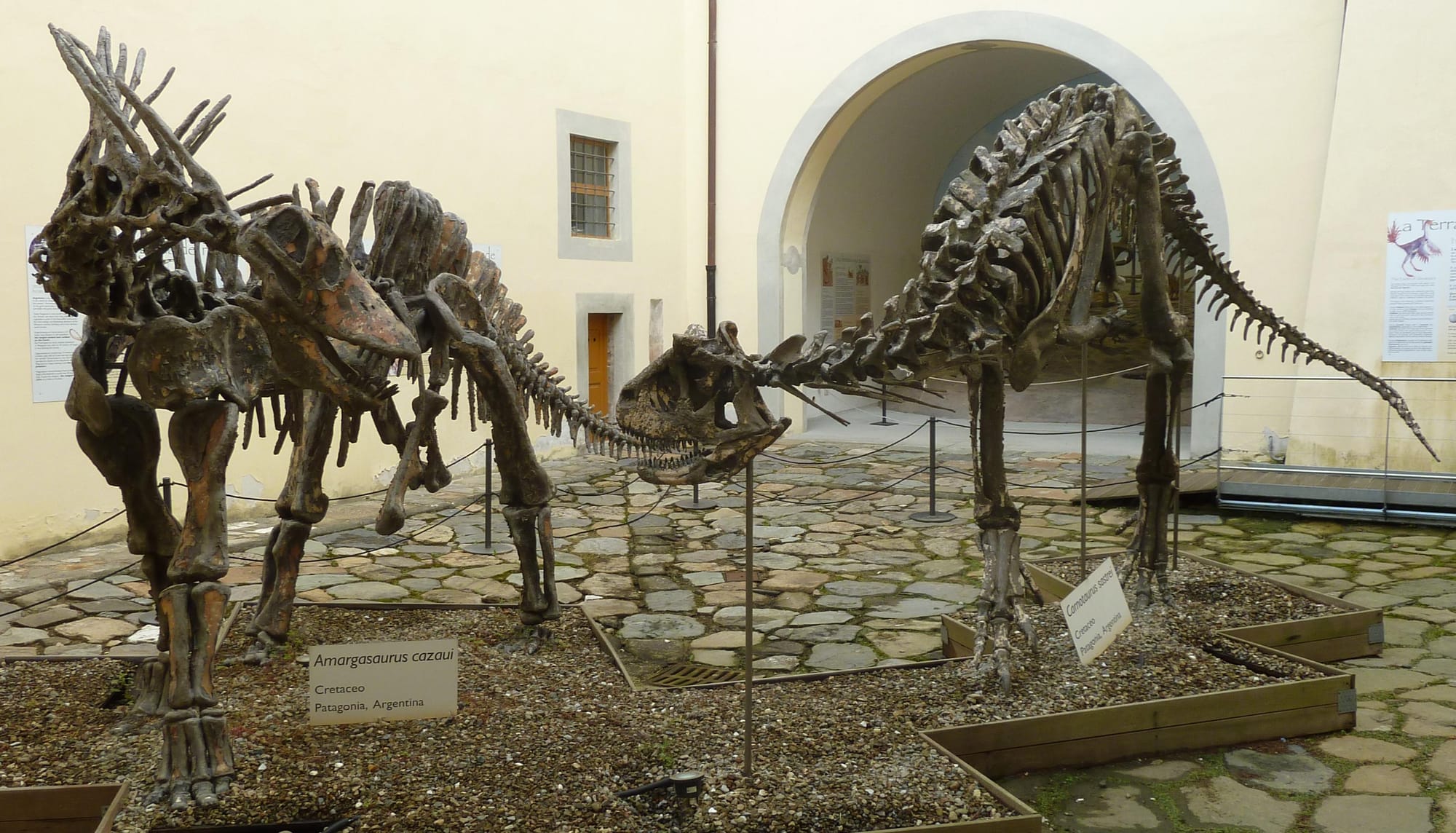
Fun fact: The team was riding high on success. Just fifteen days before landing in Chubut, they had been in Neuquén excavating another giant: the Amargasaurus, the well-known sauropod that has two rows of spines on its neck. It’s clear that dedication and that scientific "drive" for discovery allow for incredible feats in record time.
An exceptional fossil
What makes the Carnotaurus a unique specimen in the world is not just its look, but also the location and state of preservation in which it was found. The discovery site, in the La Colonia Formation (Chubut), is not what a paleontologist would call a "fertile" place. There are very few sedimentary exposures visible, making the finding of an almost complete animal more than exceptional. Almost 80% of the skeleton was recovered (missing the back third of the tail and the feet), and it was also articulated. In paleontology, this is rarer than one might imagine: most fossil remains of vertebrate animals tend to be fragmentary and scattered. In fact, it’s so exceptional that skin impressions were even found on various parts of the body (sides, neck, and tail).
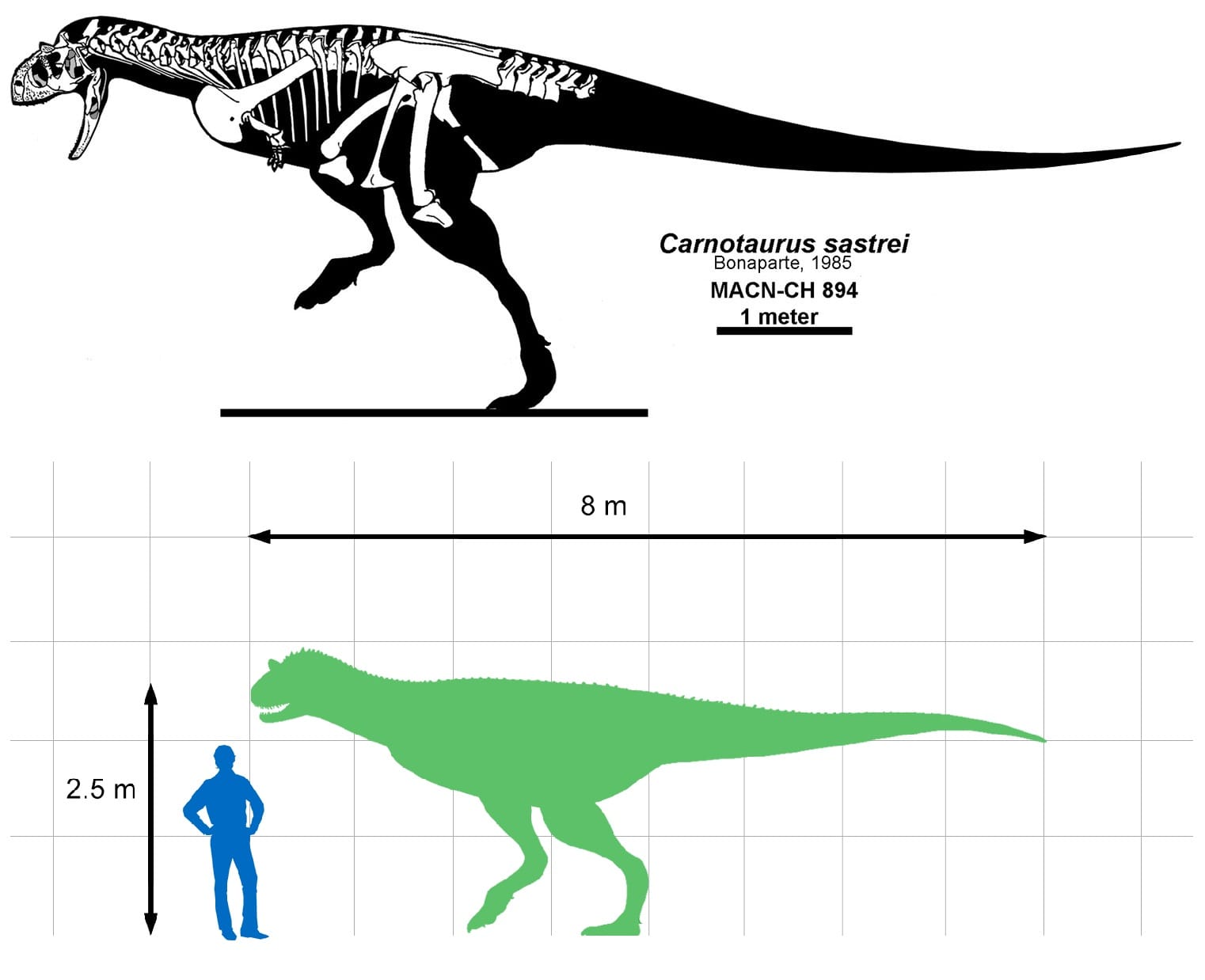
Unlike other snouted carnivorous dinosaurs, the skull of the Carnotaurus was short and high, giving it a profile similar to that of a bulldog. This structure, about 60 cm long, was extremely robust yet lightweight. It also bore two remarkable low, conical, and sturdy horns above its eyes.
It was a bipedal dinosaur, with long hind legs but extremely short arms. Its skin was not smooth: it was covered in small mosaic-like scales, interspersed with rows of thicker, larger rectangular scales that gave it a rough, armored appearance. In total, it measured between 7.5 and 9 meters long and reached about 3 meters in height. It was found in what is now the La Colonia formation, so we know it lived 70 million years ago (at the end of the Cretaceous period).
 Juan Pablo Miyano
What makes the Carnotaurus truly exceptional is not just its appearance. To this day, there is only one known specimen on the entire planet. Since that discovery in the eighties until the date I’m writing this note, no other fossil remains have been found that can be assigned to the species Carnotaurus sastrei. Every study conducted, from its anatomy to the most modern CT scans and 3D models, pertains exclusively to this individual. It is, literally, the only representative of its species that we have the luxury of seeing.
So, how much do we really know about how this carnivorous dinosaur lived? You’re probably thinking, “But I’ve seen dozens of documentaries; I think I have a pretty good idea.” The truth is, while they provide us with spectacular images, the screen often takes quite a few creative liberties that don’t always align with fossil evidence.
No matter how complete a dinosaur you find, the hardest thing to determine is how an animal behaved in its environment based solely on bones. What prey did it hunt? How did it use those short arms? What were its horns really for?
Fortunately for us, there are increasingly sophisticated methods to study fossils and accurately establish the functional anatomy of these beings. This discipline is known as Paleobiology. In this field, one does not just look at the bone as a static piece, but as a structure that was once alive and part of a context. So, I will use Carnotaurus sastrei to dissect what one can truly decipher about an extinct animal from its skeletal remains.
Why such short little arms?
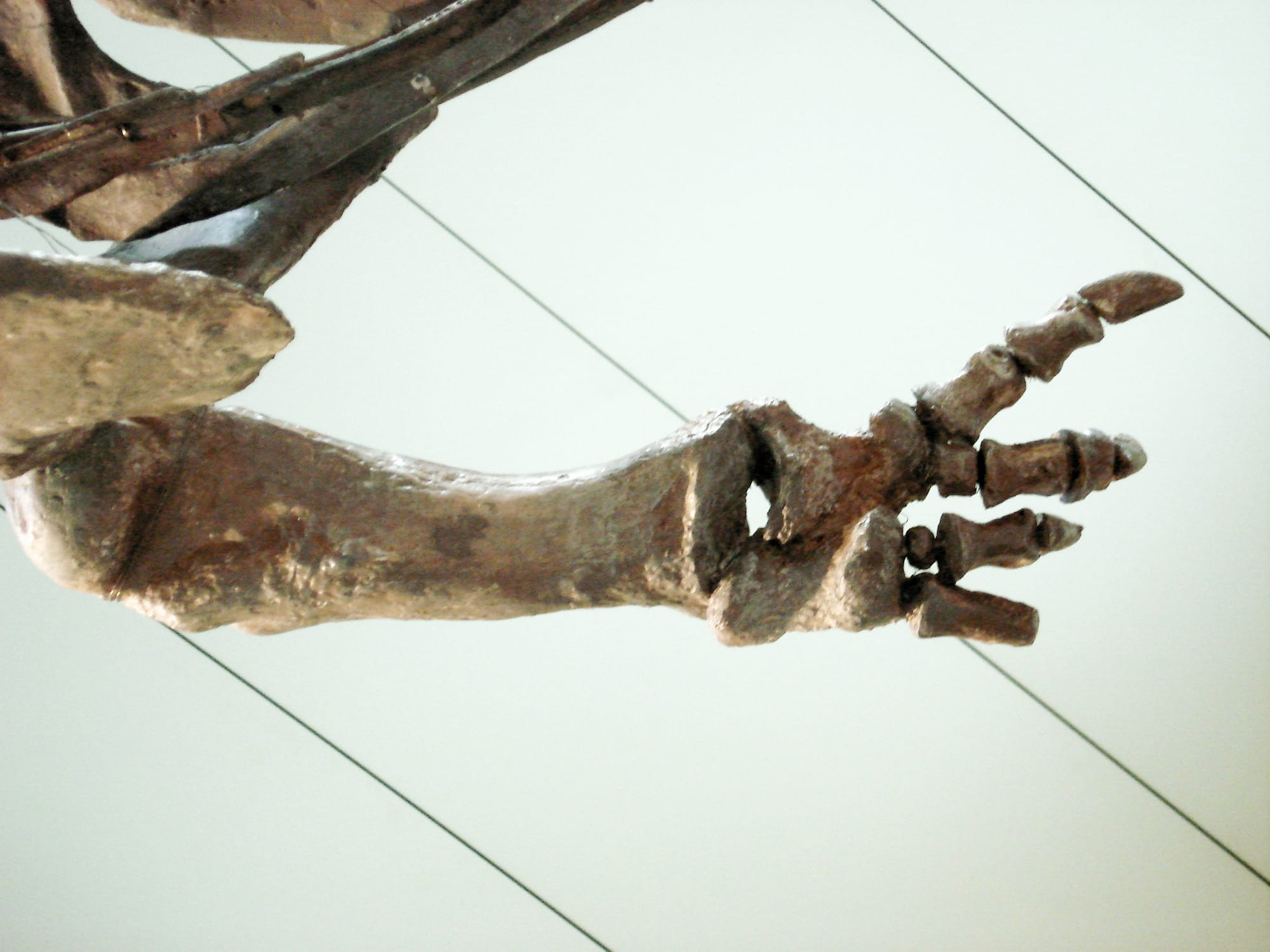
If you thought the arms of Tyrannosaurus rex were small, the Carnotaurus arms are almost a joke of evolution. They were extremely short, with four fingers, and in fact represent the most extreme case of arm reduction in theropod dinosaurs. This reduction of the forelimbs is not an isolated case: it occurred independently in various lineages of large carnivorous dinosaurs, such as tyrannosaurids and abelisaurids (the family to which our protagonist belongs).
Evolution doesn’t always work with a goal in mind, so the question “for what purpose?” wouldn’t be the right one. Instead of seeking utility, one must understand that the arms simply ceased to be necessary. Without offering a survival advantage, natural selection stopped "maintaining" them, causing them to atrophy generation after generation. It’s a process similar to what we see today in flightless birds like the kiwi or the emu. Moreover, a 2009 study suggested that they were purely vestigial. Researchers found that the nerve fibers responsible for transmitting stimuli to the arms had been reduced to levels similar to those of modern birds that have lost their wings. In summary: the Carnotaurus not only had short arms, but probably couldn’t even move them voluntarily or in a coordinated manner.
Speed Engineering: The Key Lies in the Tail
Bones are not smooth surfaces; they are filled with grooves, marks, and bumps that indicate where muscles were attached. By studying these marks, we can reconstruct the muscular anatomy of the animal. In bipedal dinosaurs, the main "engine" was not just in the legs, but at the base of the tail. The most important locomotor muscle is the caudofemoralis. This muscle anchors in the tail and connects to the femur through a bony ridge called the "fourth trochanter."
In 2011, researchers Persons and Currie discovered something unique in the tail vertebrae of the Carnotaurus. While in other dinosaurs the tail ribs (transverse processes) protrude horizontally (like a "T"), in our "carnivorous bull" they are oriented upwards, forming a "V". This would have provided extra space for a larger caudofemoralis muscle than in any other theropod. This likely made it one of the fastest large theropods to ever exist, capable of reaching speeds that would leave any human behind.
However, to accommodate this giant muscle, other tail muscles (responsible for flexibility) had to be reduced. Additionally, the vertebrae were "locked" together by interlocking bony processes, making its tail extremely rigid. The result was an animal with incredible linear acceleration but very limited turning ability. In other words, the best maneuver to escape a Carnotaurus (in case of unexpected time travel) is to suddenly change direction in a tight turn when it’s close.
How the "Bulldog" of Patagonia Hunted
We know this dinosaur was clearly carnivorous, as evidenced by its teeth: thin, curved, and serrated, designed not for crushing bones, but for slicing through flesh like knives. In the natural world, every predator has adaptations for capturing prey; some are generalists, eating anything that crosses their path, while others are specialists in hunting a specific type of prey.
For years, the study by François Therrien (2005) was used, calculating the bite force of this dinosaur to be approximately double that of a modern American alligator, but it was not the most powerful among dinosaurs. They also discovered that the jaw had a bending resistance that decreased linearly towards the tip. What does this mean in layman's terms? It means that the jaw of the Carnotaurus had a resistance that diminished towards the tip, indicating it did not accurately hunt small prey but made deep slicing wounds on large animals. In fact, it has been compared to the Komodo dragon, suggesting it executed a "hatchet" attack: bite, retreat, and wait for the prey to weaken.
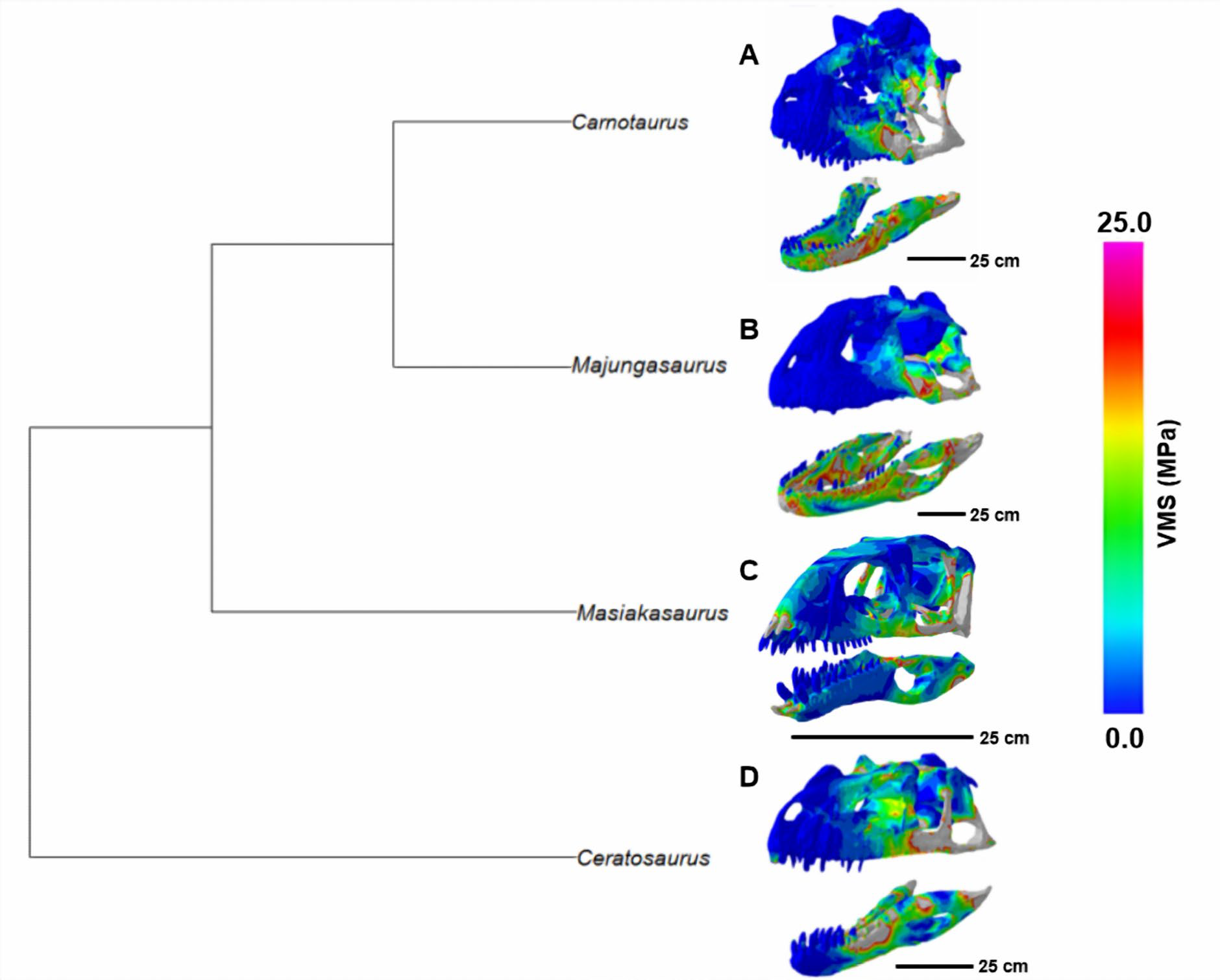
A study this year by Rowe, Cerroni, and Rayfield, which used 3D models to study the mechanical resistances of skulls in abelisaurids, has turned this issue on its head. The researchers found that the short, deep skull of abelisaurids was designed to withstand extremely high mechanical stresses. This suggests that the Carnotaurus not only executed "hatchet cuts" but was also capable of biting and holding onto its prey while it struggled, a behavior much more akin to that of northern hemisphere tyrannosaurids. Thus, the Carnotaurus positions itself not only as a fast ambush hunter but also as a predator capable of dominating the giants of Patagonia and enduring the violent struggles of its victim without its skull suffering damage. This makes a lot of sense, as it had no other way to secure its prey since it lacked claws to assist, so it had to be as efficient as possible with its jaws.
Senses and Brain
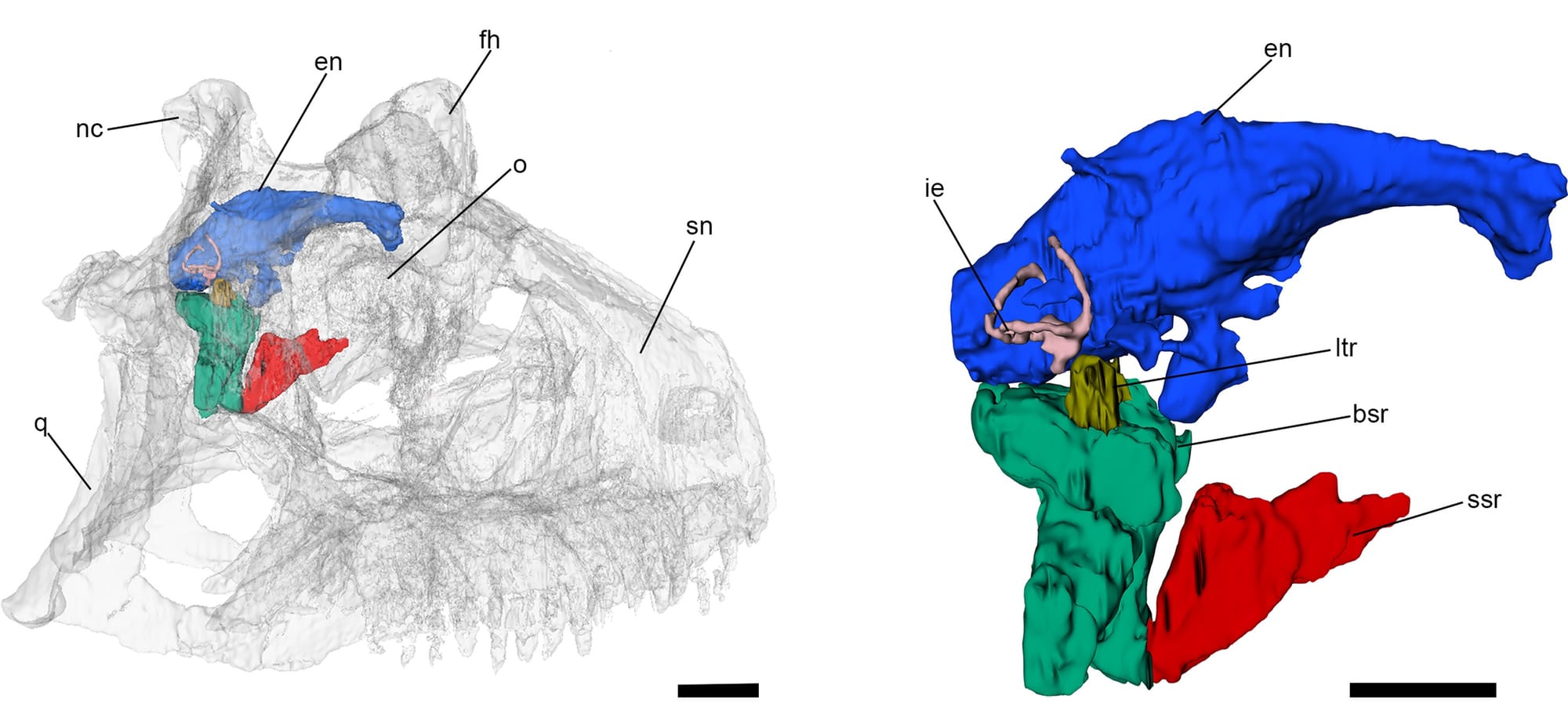
In 2019, researchers Cerroni and Paulina-Carabajal used computed tomography to reconstruct the interior of the Carnotaurus skull. The reconstruction shows that its olfactory bulbs were remarkably large, while its optic lobes were small. This tells us that, unlike modern birds, which rely almost entirely on their eyes, our protagonist primarily navigated by its nose.
A curious detail is the size of the flocculus, a part of the brain responsible for coordinating head movements with eye stability. In the Carnotaurus, this area was quite large. This fits with what I explained about speed above: it needed a very sophisticated internal stabilization system to keep its gaze fixed on its target while running at high speeds or launching quick attacks with its head.
The anatomy of its inner ear (a short lagena) indicates that its hearing range was limited, probably below 3 kHz. To give you an idea, the Carnotaurus lived in a world of low sounds and deep vibrations; perhaps high-frequency noises simply went unnoticed by it.
In terms of "brain capacity" (the encephalization quotient), the Carnotaurus was at a midpoint. It was more "intelligent" than other relatives (like the Majungasaurus), but it did not reach the level of tyrannosaurids, which had proportionally larger brains. It was not the most outstanding strategist of the Cretaceous, but it was an efficient predator in what it did.
The Horns: Combat Weapons or Style?
And we come to the million-dollar question: What were those horns for in a predator? Let's say that, in the animal world, horned animals are mostly herbivores (for example: goats, bulls, giraffes, antelopes, deer). Particularly in the case of the Carnotaurus, being a carnivorous animal, other hypotheses have been proposed about its horns. For a long time, one of the most accepted theories was that the horns helped absorb impact and mechanical stress when the dinosaur bit its prey, functioning as structural support beams for the skull. However, the biomechanical study from 2026 that I mentioned earlier tested this idea through stress simulations. The results were conclusive: the horns have no mechanical function during feeding. They do not help distribute bite force nor protect the skull when the animal subdues its prey. So if they weren’t for eating, what were they there for?
It’s worth mentioning that the horns are not isolated structures of the skull, but the nasal and frontal bones are characterized by a rough texture filled with grooves, which is a clear sign that the bone was not simply covered by thin skin. Most likely, the face of the Carnotaurus was covered by thick layers of keratin (the same material as our nails and the horns of rhinos) or by large hardened scales. Additionally, its horns were probably coated with a keratin sheath that made them appear larger and sharper. So imagine a heavily armored and ornamented face, quite stylish.
All these animals that currently have horns use these structures for display and combat for territorial defense. And in this case, it would be no different: the evidence points to a purely social function. Scientists suggest that the Carnotaurus hypothetically used its horns for intraspecific combat; that is, fights between members of its own species. It’s important to remember that there is only one specimen assigned to the species Carnotaurus sastrei, so we cannot be sure it was a variation that identified males from females (as happens in mammals), since it is impossible to determine the sex of the specimen. Nonetheless, the horns had a very important purpose, which was to confer visual identity, whether it was used to attract mates or intimidate rivals. Its skull was not only a tool for feeding but also a structure designed to “look good” in the ecosystems of ancient Patagonia.
 Juan Pablo Miyano
The Carnotaurus shows us that the dinosaur fauna of the Southern Hemisphere was nothing to envy from the North. With a look that seems straight out of mythology, the Carnotaurus remains the undisputed star of Argentine paleontology. The Patagonian "carnivorous bull" continues to be the ambassador of Argentina's lost world and one of the most fascinating.