From neighborhood cybercafés to the top of the world: the history of Counter-Strike in Argentina
19 de mar. de 2026 — Eugenio Tomás Mongi
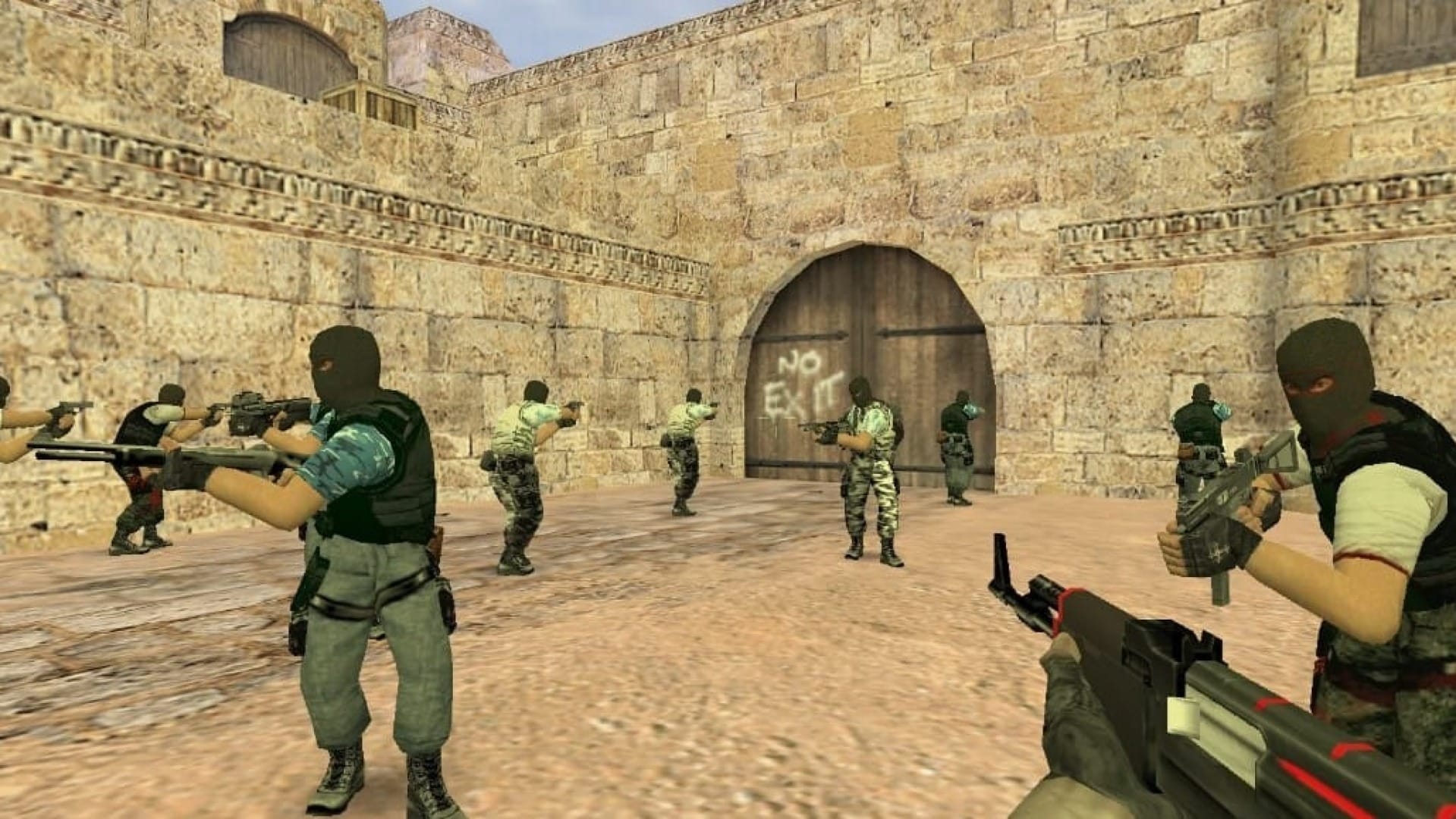
It was an ordinary summer day in the year 2000, and I was running along the sidewalks of Belgrano (city of Buenos Aires) from my house in the Barrio Chino to Olazábal and Cabildo, wearing a smile that lit up my entire face. I was headed towards my second home for the next few years, ready to indulge in my great vice, what would later be called "esports." Although I had already become hooked on Quake 3 and StarCraft at a cyber café run by a Korean (who became my mentor, berating me for how I managed my resources in StarCraft), it wasn't until I stumbled upon the cyber café "Confederación" that my life truly took a turn.
Round 1: Wake up NEO, follow the white rabbit
That day, a neighborhood acquaintance told me about a cyber café dedicated solely to gaming (a rarity at the time), decked out in a style reminiscent of a spaceship mixed with Alien and Starship Troopers. The allowed cigarette smoke, the metal floors styled like Warhammer 40,000, the intense smell of teenage body odor, and the complete absence of women created the perfect cocktail before entering the battlefield. I vividly remember the first day because it started with a hiccup: that day the café was only open for the second Counter-Strike tournament in Argentine history.
Counter created a new genre: the Tactical FPS. It was like hearing The Ramones for the first time at "CBGB"; it wasn't rock, it wasn't new wave, Counter-Strike was like punk for a teenager eager to discover who he was.
That was my revelation. I wasn't just an avid gamer; I had also competed on consoles (Golden Eye for N64), but never on PC. Nowadays, it's common knowledge that one MUST play FPS games with a mouse and keyboard, but back then it felt like putting on a new pair of socks: pure bliss. I remember approaching the tournament players like I used to in the parks, asking if they needed one more to play. I sat next to a guy who exuded an aura of complete control, a pixel Buddha: it was "Berserker," the first great Argentine in Counter, and I didn't even know it. Cigarette in his right hand, pointing to the sky like the angel on the cover of Van Halen, while in the game, he was aiming at his rivals' heads. Then, I saw a sum of money rising in the lower right corner of his screen... There’s an economy, I thought, wow. This was Counter-Strike, not some dull SWAT or a frantic Quake. This was something different, something new. Counter created a new genre: the Tactical FPS. It was like hearing The Ramones for the first time at "CBGB"; it wasn't rock, it wasn't new wave, Counter-Strike was like punk for a teenager eager to discover who he was.
Round 2: Identity
Berserker, Pointless, Betony, Optimus, Azrael... No one is named Juan, Roberto, or Luis. There, we are all who we wish to show ourselves as; one chooses the name they want to be called and competes under it. Mine was "Kam1kaze"; not very original, if you ask me today, but at the time it felt bold and conveyed a clear message to myself and others: I will do this until the end. I think for all of us who entered that world during our formative years, it was also important to know that there, no one judged you by how you looked, how you spoke, or what you listened to, but by how you performed in the game. Nowadays, playing video games is normalized, and while competing in video games is still quite niche, back then you weren't even a freak; you were outright a pariah of society. We were mutants parading our pale greenish skins molded by the dim light of the cyber café, cigarette butts, and hot dogs 24/7. From one enclosed space to another. Let's remember that in the dawn of the new millennium, having a powerful PC + Fiber at home was quite rare, so the norm was to go to the cyber café to compete in LAN.
Round 3: GL & HF
It's impossible to talk about the birth of Counter-Strike without mentioning the boom of cyber cafés in Argentina, as well as the rest of the world. In third-world countries like ours, these places gathered those looking for work during the Menem years, those skipping school, those venturing into chats and forums to meet people, and the losers in those pseudo-private booths called "Boxes." This social confluence unknowingly turned cyber cafés into the social clubs of the 21st century. And what is the nature of a club? Sports. That's where Counter-Strike comes in, along with other PC games that would lay the groundwork for what we would later call esports, electronic sports. Within the cyber-clubs, just like in traditional ones, there were various options for competition: RTS games like Age of Empires or StarCraft, arena FPS games like Quake or Unreal Tournament, because MOBAs like DOTA or LoL, and Battle Royale games like Fortnite or Apex didn't exist yet. I want to highlight that the fighting game community was a pioneer in competition, but they found their space in arcades, not in cyber cafés. Still, today they are esports.
To put things in context, in 1999, the legendary Minh Le (a.k.a. "Gooseman") and Jess Cliffe created Counter as a mod for Half-Life. But by 2000, we had the CPL (the Majors of the time, the most important tournaments in the world) distributing thousands of dollars in prizes, indicating that video games were the predominant industry. Competition had been present since the eighties and nineties (Super Mario Bros., Tetris, Street Fighter), with companies throwing crazy figures in news reports to sell consoles, but not on the same scale. The leap in thirty years was brutal: from "game creator for users" to an ecosystem with pro tournaments, players, coaches, psychologists, lawyers, agents, and academies. Today, esports are the parallel industry to video gaming, like playing cornhole on the beach versus the ATP circuit.
 Juan Ruocco 🧙♂️
Round 4: Show me the money
The website esportsearnings.com has tracked spending in esports from 1998 to the present. In 1998, a total of $153,000 was spent across all games. In 2003, I was part of the first Argentine team to compete in a Major Counter-Strike tournament in Dallas (CPL Summer 2003), and the total prize pool for that single tournament was $100,000. By 2008, the total had climbed to $7,800,000; but if we look at 2018 (with two decades of industry already), the figure skyrockets: $171,000,000. The latest record is from 2025: $237,000,000. Valve, the legendary company behind Counter-Strike, had revenues of approximately $17,000,000,000 in 2025. In China, one of the leading countries in esports, tickets to attend the finals of a mobile MOBA game called "Honor of Kings" sold out in twelve seconds. The attendance was 62,000 people.
In 1998, a total of $153,000 was spent across all games. In 2003, I was part of the first Argentine team to compete in a Major Counter-Strike tournament in Dallas (CPL Summer 2003), and the total prize pool for that single tournament was $100,000. (...) The latest record is from 2025: $237,000,000.
In 2017, when the first fully professional Latin American esports team was created, I was part of it as a coach for the Miami Flamingos. I was going to be based in the U.S., so I had to apply for a special visa that was being introduced that year: the P1 for artists and athletes. We were a peculiar case, so when I had to go to the U.S. embassy in Buenos Aires, I had the natural fear of being rejected and the terror that a lifetime dedicated to this could end because of a foreign bureaucrat.
To my surprise, the outcome was favorable: as soon as I entered the Embassy and it was my turn, the guy at the window asked me the reason for the visa. I replied, "We are a Counter-Strike team, and we are going to make a living from this in the U.S." I expected the typical response of "What is Counter-Strike?" but, on the contrary, I received, "My favorite map is Train, what about yours?" It was the closest I felt to being in a scene from Fight Club: "We know who you are, Mr. Durden." After that response, I knew the visa was mine.
Round 5: The Cumbia of the Counter
In Argentina, it was understood that the game was ours, part of our identity: "It doesn’t matter where you come from, if you feel like one of us, you are one of us." Plus, back then, the cyber hour cost just one peso (equivalent to 1000 pesos in 2026), making it practically like tossing two hoodies down to play a quick match in the plaza. This social aspect created bonds where it would have been impossible before: delivery drivers, lawyers, students, architects, etc., all coming together to plant a C4 or deny their opponent's strategy.
 Juan Ruocco 🧙♂️
This melting pot didn’t stay anchored in the golden age of cybers; rather, the following decade maintained its essence with Counter 1.6 on every computer distributed by the K government. And since the Counter-Strike of that era didn’t require much hardware, it led to an influx of new players. Anyone who didn’t experience the cyber age surely played LAN games in a classroom.
Round 6: Ez
One thing that Counter has always had is that the entry level and understanding are among the simplest out there. Just like a soccer match can be explained as "it’s 11 against 11 and you have to score in one of the goals, the one who scores the most in 90 minutes wins," the same goes for Counter: "it’s 5 against 5, you’re a cop and you’re a terrorist, first you play half the match as one and then as the other on the same map." Simple. Its mechanical aspect also makes it accessible: anyone can aim and get a frag (kill someone in the game), unlike the learning curve of games like Quake, where you needed hundreds of hours to master seven weapons, or StarCraft, where you had to learn to maintain a stable economy to keep your army constantly supplied (the famous micro and macro).
No, in Counter-Strike that comes much later. At first, you buy a gun and go out shooting.
Round 7: Current State
Counter is social because it can’t be played solo; it’s a game that requires your own team and a rival team, and in this, we Argentinians stand out from the rest of the world—we’re specialists in team sports.
The social status we have today as part of the esports industry is completely different from what it was in its early days. Nowadays, society understands that to excel in this kind of activity, you need dedication and commitment. Our realm is digital, and the world moves through digital means, but Counter-Strike has broken barriers within the industry with figures like Neymar Jr., who is a declared fan and plays with the best from his native Brazil. Countless Argentine athletes, like Emiliano Rigoni, Fabricio Oberto, or influencers like Frankkkaster, Spreen, or even people outside the sports-digital framework like Freestyler Pappo or Duki, have also competed in semi-amateur tournaments. Every Argentine under forty has a past in Counter, but not necessarily in LoL, DOTA, or Quake.
Counter is the game that has allowed me to keep growing in esports. I was fortunate to be the coach of the Argentine National Team in 2016 in Serbia, where we became world runners-up, and it was one of the most beautiful experiences of my life. We went into that championship hoping not to finish last, without a coach. I had traveled from Barcelona, asking for vacation from my job at a hotel to cover the event as a freelance journalist, and our team was the only one without a coach. I stepped up, and everyone agreed. On the first and second days of the tournament, we lost almost all our matches and ended up with the second-worst seeding for the playoffs. But some good reviews and the Argentine fighting spirit meant that when we faced Sweden, a historical powerhouse in Counter-Strike, the grit of Straka, NBL, Tomi, Tutehen & JonY BoY overcame the Viking sights. Not content with that milestone, the guys also won the semifinals against one of the four major nationalities in Counter, Denmark, where one of their players earned five times the total salary of the Argentine team at that time.
I was fortunate to be the coach of the Argentine National Team in 2016 in Serbia, where we became world runners-up, and it was one of the most beautiful experiences of my life. We went into that championship hoping not to finish last.
Unfortunately, we lost the final against Turkey's golden generation. But the echo of the epic journey of those five Argentine kids continues to resonate a decade later and is directly responsible for the fact that today the national Counter is experiencing one of its best moments.
As I write this article, it is already known that in 2027, the first Tier 1 tournament in Counter and esports history will take place. The Counter-Strike Major will be held where the Fire Esports producer and Crónica TV are currently hosting the Crónica Gaming Series. Throughout 2026, points will be awarded for access to the Counter world championships, with a total prize of u$s 50,000, and the final three days will be at the Movistar Arena, a true national milestone.
At the same time, it’s worth mentioning that even Argentine universities like UADE have had an esports degree for two years now, following in the footsteps of the U.S., Spain, China, or South Korea, where electronic athletes have a cultural prominence on par with K-Pop stars.
Round 8: GGWP
In 2023, the International Olympic Committee declared that esports are indeed a sport, something that had been denied for decades. The IOC recognized that esports and video games are not just a trend, and that humans are inherently made for recreation and competition. As Schiller said: "Man is only free when he plays." In a world where individualism thrives, we create a space where everyone is welcomed and foster a community. That's why Counter is synonymous with Argentina; because above all, Argentinians are synonymous with being social.