Deny, Defend, Depose: Luigi Mangione and Radical Self-Determination
12 de dic. de 2024 — Juan Ruocco 🧙♂️
On December 4, a video went viral on Twitter clearly showing a hooded person shoot three times in the back and cold-bloodedly kill another person. Up to that point, just another video of a violent incident circulating on social media, the kind we're used to -- to the extent that I systematically try not to watch them so as not to become desensitized.
Each of the three bullet casings recovered from the crime scene had a word written on it: deny, defend, depose, alluding to the strategies used by health insurance companies to deny (expensive) treatments to their patients. The victim turned out to be Brian Thompson, 50, CEO of UnitedHealthcare. The killer, anonymous until then, quickly became an internet hero. After a long time, someone had managed to more or less successfully fill a vacant spot in the varied contemporary political landscape: a radicalized individual who (at first) seemed to be on the left. A rare bird for the times we live in, given that the left has almost globally purged violence and direct action from its playbook.
However, it was not the only attack of its kind that year. It's worth remembering the failed attempt by Thomas Matthew Crooks, who came within inches of killing Donald Trump with his semi-automatic AR15. But providence was on Trump's side and the rest is (recent) history. In a rather simplistic reading supported by this circumstantial evidence, we might be tempted to say that radicalization is, ultimately, a symmetrical phenomenon. Just as there were far-right radicals (Breivik, Tarrant, Crusius, Gendron), it was only a matter of time before a similar violence emerged from a more left-leaning wing, whose targets were political and representative of corporate America. But reality is always more complex.
Unlike that failed assassination attempt against Trump, this anonymous New York shooter had effectively carried out his mission. Twitter's machinery quickly deployed to find more information about the anonymous vigilante. The only thing that surfaced was a photo of the attacker in a cafe, an hour before committing the crime.
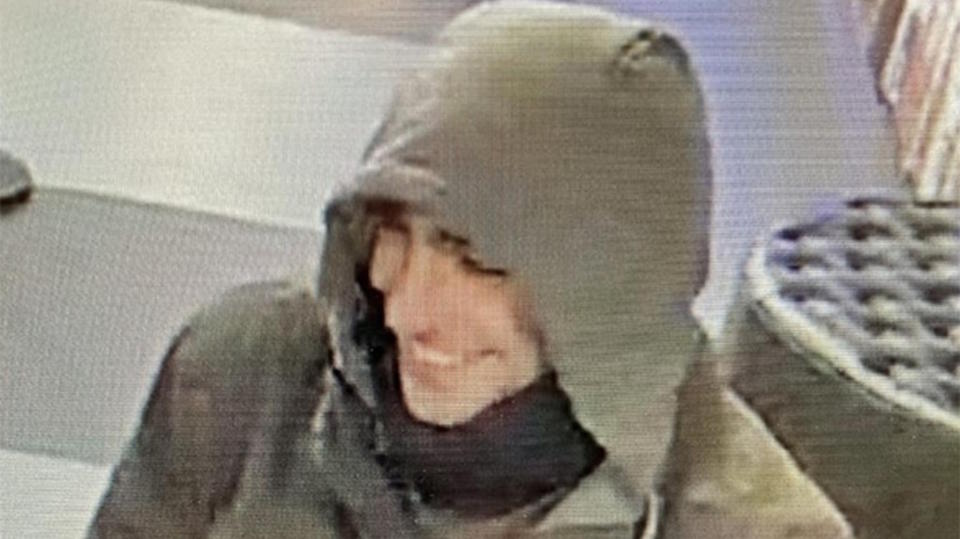
Interpretations from different factions of the ideological landscape of the internet came flooding in, because we all know there's nothing more fun than tossing hypotheses into the air, with zero evidence, while events are still unfolding. In the race to generate engagement, the most plausible insight takes all the interactions. For some, a hero who rightfully executed a despicable being, CEO of a company that profits from people's health; for others, a CIA psyop designed to launch a new "narrative" of class struggle and undermine the future Trump administration, which wouldn't take office until January 20. Hero or failed MK Ultra, the attacker's path to becoming a meme was already predetermined.
Luigi Mangione, a Model to Assemble
On December 7, the New York police reported that they had found the suspect's backpack and that it was full of Monopoly money. This further fueled the memetic potential of the case, since we were not dealing with some lowlife but with someone quite aware of what he was doing and who also took on performative overtones. A case tailor-made for Twitter.
On December 9, Luigi Mangione, a 26-year-old computer science graduate from the University of Pennsylvania, was arrested by Altoona police while eating at a McDonald's. He was allegedly turned in by an employee of the restaurant who, despite providing all the information that led to his arrest, will not collect the $60,000 reward that was on the suspect.
Once the killer had an identity, the internet did the rest. Applying every possible stalking method (or we could call it OSINT) to extract all available information from the suspect's social media accounts. Basically, diving into an endless spiral through his networks to try to build a profile, to try to figure out through his posts what his motivations were for doing what he did.
Surely 98% of those reading this article are looking for the same thing: a profile of Luigi Mangione, an explanation for his homicidal act. I'm sorry to disappoint. Almost all the information obtained is public: his obvious Italian ancestry (which further boosted his memetic trajectory), being a Pokemon fan, listening to Charli xcx, a lumbar operation, and a certain state of chronic pain. At the same time, thousands of uncheckable pieces of data emerged from supposed "sources" that were nothing more than random people trying to get attention.
The Duabomber
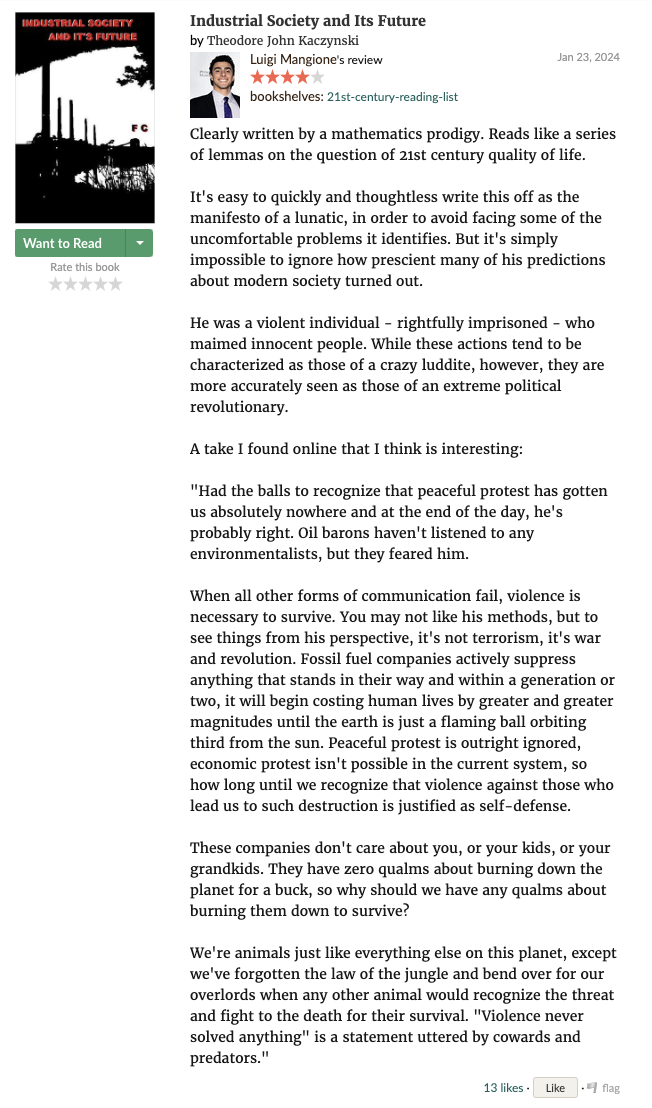
But there was one piece of information that opened the speculation even further. Mangione had a Goodreads account where he ranked and reviewed what he read. There, a review of the Unabomber's manifesto was found, and that's when the internet went completely crazy (myself included). What had started as an attack that was difficult to categorize was now starting to have links to the extensive tradition of domestic terrorism in the United States, while also shifting the suspect away from that supposed "leftist" label.
For those who don't remember or know, Ted Kaczynski aka the Unabomber was an American domestic terrorist who in some ways shaped the archetype of the modern libertarian rebel: a fervent anti-communist, he advocated for sabotaging the entire industrial system and returning to anarcho-primitivism but with the right to private property. A radical Lockean, let's say. To that already strange combination he added violence as a memetic dissemination strategy: sending mail bombs. He soon became a kind of ambiguous folk hero.
Mangione's review of Kaczynski's text points out the somewhat axiomatic writing of the manifesto and quotes another internet phrase that extols direct action, while also noting that ultimately the manifesto and the Unabomber's actions were "profoundly revolutionary." Based on the review, and seeing how events subsequently unfolded, the thesis of an ideological link between both actors gained traction.
This gained even more importance when it came to light that among Mangione's belongings there was something resembling his own manifesto. It quickly began circulating online but was then proven to be apocryphal. The close link between Mangione and the Unabomber once again fueled the desire to quickly produce a profile of the perpetrator, but when the real "manifesto," which was nothing more than a letter to the authorities who would arrest him, came to light, that ideological link proved to be quite weak.
"To the Feds, I'll keep this short, because I do respect what you do for our country. To save you a lengthy investigation, I state plainly that I wasn't working with anyone. This was fairly trivial: some elementary social engineering, basic CAD, a lot of patience. The spiral notebook, if present, has some straggling notes and To Do lists that illuminate the gist of it. My tech is pretty locked down because I work in engineering so probably not much info there. I do apologize for any strife of traumas but it had to be done. Frankly, these parasites simply had it coming. A reminder: the US has the #1 most expensive healthcare system in the world, yet we rank roughly #42 in life expectancy. United is the [indecipherable] largest company in the US by market cap, behind only Apple, Google, Walmart. It has grown and grown, but as our life expectancy? No the reality is, these [indecipherable] have simply gotten too powerful, and they continue to abuse our country for immense profit because the American public has allwed them to get away with it. Obviously the problem is more complex, but I do not have space, and frankly I do not pretend to be the most qualified person to lay out the full argument. But many have illuminated the corruption and greed (e.g.: Rosenthal, Moore), decades ago and the problems simply remain. It is not an issue of awareness at this point, but clearly power games at play. Evidently I am the first to face it with such brutal honesty."
After this sort of confession, the intentions and the reasons become much clearer. Mangione believes that the executives of America's major healthcare corporations are all parasites, sheltered within an untouchable power structure thanks to their lobbying power. And that the visible consequences of this are the deterioration of Americans' health compared to other developed countries, despite having one of the most profitable healthcare systems in the world. Until his intervention, no one had made this so clear. This discourse is not very different from that of Robert Kennedy Jr., potential Health Secretary in the Trump administration.
Anyone Can Do It
Unlike figures such as Anders Breivik or Ted Kaczynski, Mangione's "manifesto" (really, a letter) lacks an explicit call to direct action or to replicate the path he took. But there is another interesting and, in my opinion, quite revealing detail. When arrested, Mangione was carrying the murder weapon he used to kill Brian Thompson, and it was no ordinary pistol but a 3D-printed Glock. This could be related to wanting to be caught or not leaving traces regarding the weapon used in the crime, but it is also a message that "anyone can do it."
It's known that in recent years, 3D printing of firearms has advanced enough to allow the creation of nearly all components anywhere. It is significant that at the time of his arrest he was still carrying the murder weapon. Had he disposed of it after the killing -- whether in a trash can, a river, buried, or whatever -- the case against him would be much harder to prove. So why did he keep the murder weapon on him?
One last detail that somewhat contradicts this entire last paragraph and revives the link theory is that among the spiral notebooks seized from him there was a discussion about how using bombs Unabomber-style could cause innocent victims, while a firearm was much more precise and reduced collateral damage.
An Internet Guy Who Took Action
The failed characterization of Mangione as a leftist has its counterpart in what emerges from reading his Twitter account. Mangione is an "internet guy," much closer to the audience that reads 421 or listens to Circulo Vicioso. A computer science graduate, he apparently worked for a time at Firaxis, where he fixed something like 300 bugs in the video game Civilization. A graduate of an Ivy League university (the American elite), before the crime he spent a few months in Hawaii, surfing. His profile featured an image of Breloom, Pokemon number 286, and in his tweets we can see he was a reader of Tim Urban's Wait But Why, a classic internet blog.
Also discussions about how the decline of Christianity at the hands of atheism brought unintended negative civilizational consequences, or how Japan's low birth rate is an emergent product of its post-World War II cultural transformation, and of course musings about the Roman Empire. The basic topics that concern any guy aged 25-40 with a somewhat excessive screen consumption. Something that from the outside might seem like a strange mix, but for those of us who inhabit the internet, it's quite coherent.
7 years ago, I gave my hs senior speech on this topic: "Today, I will be talking to you about the future, about topics ranging from conscious artificial intelligence to human immortality. Likely, you'll dismiss all this pretty quickly as interesting, but just science fiction…" https://t.co/xJs8H1Q2Nl
— Luigi Mangione (@PepMangione) December 8, 2022
Mangione's appeal covers several aspects that are currently vacant. In the age of cyber trolling, forum culture, provocation, and hyperbolic words, Mangione cuts through the noise by acting in reality. One action is worth a thousand words. An inevitable attraction.
Second, Mangione is a good-looking guy. It's incredible what beauty does. Something similar happened with the Nahir Galarza case. The murder of her boyfriend was somewhat overshadowed because she was attractive, which earned her a following of simps. Historically, beauty has been associated with truth and goodness: the classical cultural trinity of the good, the beautiful, and the true. When someone attractive commits an act associated with Evil (killing another person), it remains a cognitive dissonance. As simple as that.
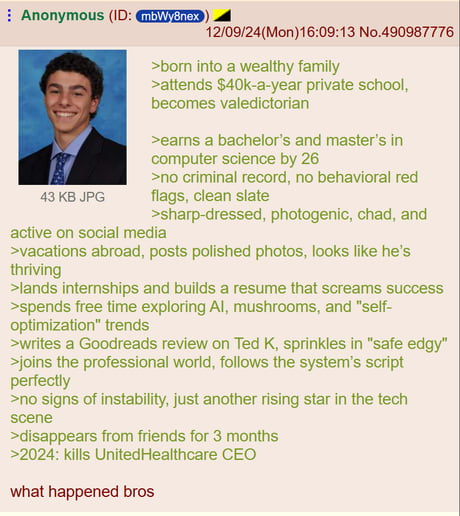
Third, Mangione had a lot to lose. We're not talking about some lowlife: he's an educated person from a wealthy family, an elite university graduate, from whom one would expect -- as the Unabomber describes in his manifesto -- to be a hyper-socialized subject, one who assumes as his own the social role assigned by his peers according to his environment. He was a subject who would eventually swell the ranks of a company like UnitedHealthcare, build a career, and reproduce the role socially assigned to him. Instead, he takes the path of direct action as if he were a Severino Di Giovanni or a Simon Radowitzky. I believe the main appeal of the case lies right there.
Perhaps the most significant thing about Mangione is that he rejected what his environment offered him: a quiet life in exchange for resignation. He could have carried on without major problems (beyond the ineffable nature of back pain), he could have settled into society like the rest of us do, cursing, getting angry, and never taking action. But he chose to act.
He sacrificed his entire life in exchange for an act of radical self-determination, even though it ended up meaning the self-destruction of his life. That idea remains very powerful. Whether in a legend about the Buddha, about Bin Laden, or about a 26-year-old computer scientist from Pennsylvania. It is the closest thing American culture can produce to a suicide bombing. Ultimately, Mangione's arc is the arc of any Jihadist. And that is the fundamental appeal of the entire case.
With the target being a CEO of Evil Corp Inc, there is almost no moral cost in supporting him. Quite the opposite: not doing so almost places you in the uncomfortable position of defender of megacorporations. That's why the "it was all a psyop" line has such a hard time winning this argument.
Aftermath
Now we can speculate a bit about what the effects of the Luigi Mangione case might be. The biggest impact may be at the level of personal security. It would be strange if the rest of America's CEOs don't feel fear during this period and raise the bar on their own defense. In other words, they're going to raise the DEFCON level. That's the first effect. Just as the 9/11 attack was the first and last to use commercial airplanes as kamikazes, it's likely that post-Luigi no CEO will walk around so exposed on the street. Now the bar for repeating an action of this kind, while latent, will be much higher. Will there be a contagion effect? Impossible to know.
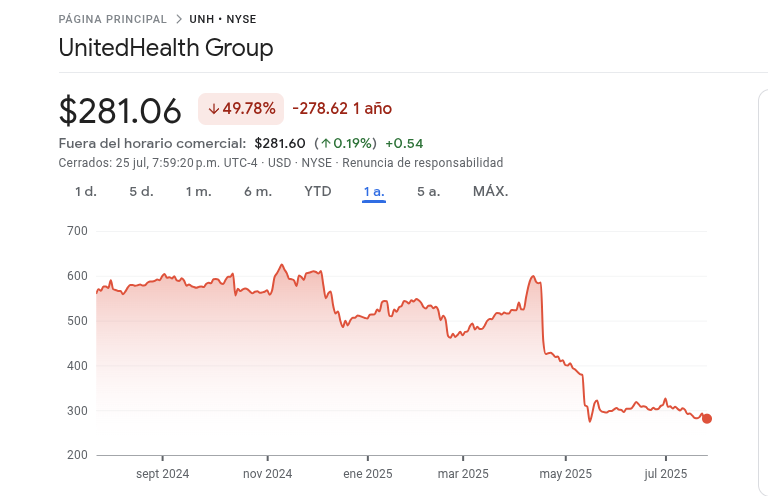
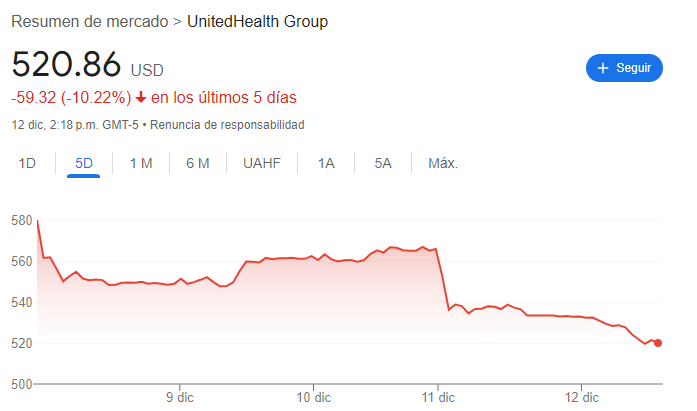
The second effect is the damage that Luigi Mangione managed to inflict on public opinion. For companies that spend billions of dollars maintaining a clean image, with everything that implies in the industry they operate in, Luigi's unstoppable, viral, and memetic act may be a future threat to Evil Corp Inc. In fact, UnitedHealthcare's stock dropped nearly $100 since the incident. This is where the psyop theory regains importance: we need to pay attention to who benefits from the resulting scenario.
The Legal Case
Since his arrest in December 2024 in Pennsylvania, Luigi Mangione faces a complex legal process for the murder of Brian Thompson, CEO of UnitedHealthcare. Since then, he has pleaded not guilty to the state and federal charges brought against him, including first-degree murder, terrorism, and illegal weapons possession.
At the federal level, Mangione was formally indicted in April 2025 on four serious felonies, including murder with a firearm and interstate stalking. The Department of Justice has confirmed it will seek the death penalty, a decision that hardened the course of the proceedings. In addition to the federal charges, he faces 11 state charges in New York and others in Pennsylvania related to document forgery and illegal weapons possession.
But perhaps the most interesting aspect, as detailed in the state charges filed before the New York court, is that Luigi Mangione was charged with first-degree murder committed as an act of terrorism, under the state law that applies when a crime is intended to intimidate the civilian population or influence government policies.
State prosecutors argue that this murder was symbolic and targeted, not a personal vendetta or a robbery. According to the indictment, Mangione chose the CEO of UnitedHealthcare as a deliberate target to convey a political message and instill fear in the industry. This, according to the prosecutors, falls within the legal definition of terrorism under New York law.
The case has received extensive media coverage, partly due to documents and Mangione's personal diary, which revealed his intention to attack figures in the healthcare system as a form of violent protest. They even confirm the thesis that he had indeed read the Unabomber's manifesto, since in his diary he raises some criticisms of the method of mailing bombs that could harm innocents.
In parallel, two legal defense fundraising campaigns were launched. One on GoFundMe that was suspended by the platform, and another on GiveSendGo that has already raised $1.2 million. The public support shown for the Mangione cause continues to be an alarm signal for the authorities.
Currently, Mangione remains in federal prison in Brooklyn. His federal trial does not yet have a date, but there are hearings scheduled for late 2025, including motions to suppress evidence and allege double jeopardy. The process remains in a preliminary phase, with a high level of complexity due to the possibility of capital punishment and the number of jurisdictions involved.
Meanwhile, UnitedHealth Group's stock has continued to fall by about 50%, and in terms of total market capitalization, the estimated loss is approximately $214 billion, dropping from $469 billion to $255 billion.