Devil May Cry and Frieren: A Debate on the Origin of Evil

5 de mar. de 2026 — Mauricio Vera
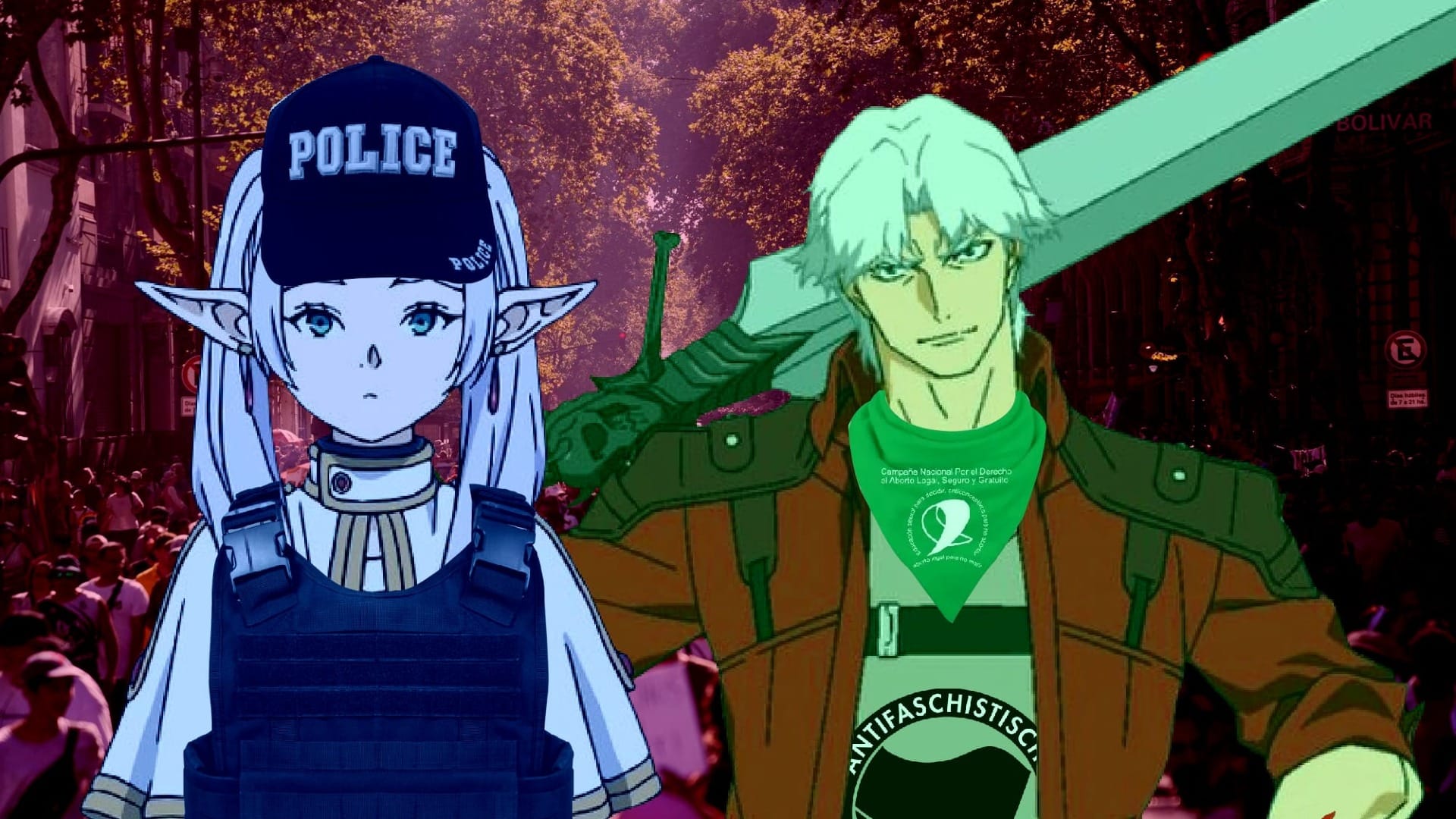
In April 2025 and January 2026, respectively, the first and second seasons of two animes that can be read in parallel premiered: Devil May Cry and Sōsō no Frieren. We already have the incredibly entertaining review from my personal friend Belucore, which pits its protagonist against Satoru Gojō from Jujutsu Kaisen. Today, we’ll compare it with the somewhat controversial Netflix adaptation of Devil May Cry. Surely, there are other animes (like Demon Slayer or Chainsaw Man) that we could include in the debate, but that will have to wait for another occasion.
Plot
Frieren
Sōsō no Frieren (2023) is an anime adaptation of the manga of the same name by Kanehito Yamada and Tsukasa Abe. The story follows the adventures of the elf Frieren in a classic medieval fantasy setting. Immortal, she was part of a group of four heroes who saved humanity from the attack of the Demon King about a century ago. At the beginning of the series, the protagonist makes new friends and embarks on another adventure.
In the second half of the seventh episode, Frieren and her new group arrive in a city that has been at war for twenty-eight years with remnants of the Demon King's forces, and that has just received a diplomatic mission proposing to end the conflict.
To illustrate that any kind of negotiation with these creatures is futile, the series uses a flashback: Frieren's old group passes through a village, and a demon-girl is about to be lynched for eating an infant. Just as they are about to execute her, she speaks: she calls for her 'mommy' and explicitly says she 'feels pain.' Upon hearing her, the village leader proposes giving her a chance for redemption and adopts her. A sort of socialization process begins, integrating her into his family life and trying to teach her human values.
Some time later, the girl kills the village leader and burns down his house. Just before her execution, they ask her about her use of the word 'mommy.' She explains that she doesn’t understand its meaning and uses words solely for the effects they have on people. Back in the present, we discover that the true goal of the ambassadors is to lower the city's guard in order to invade it.
We know that when Frieren was a child, her village was attacked by demons. That's how she learned they are irredeemable.
Devil May Cry
Devil May Cry is an animated series produced by Netflix in 2025. It follows the adventures of Dante, the son of the demon Sparda and a human. Two thousand years ago, amidst a war between Hell and Earth, Sparda betrayed his kind, sealing the crossing between both realms to protect humanity. The seal, while blocking the passage of the most powerful beings, has cracks that allow the weaker ones to slip through.
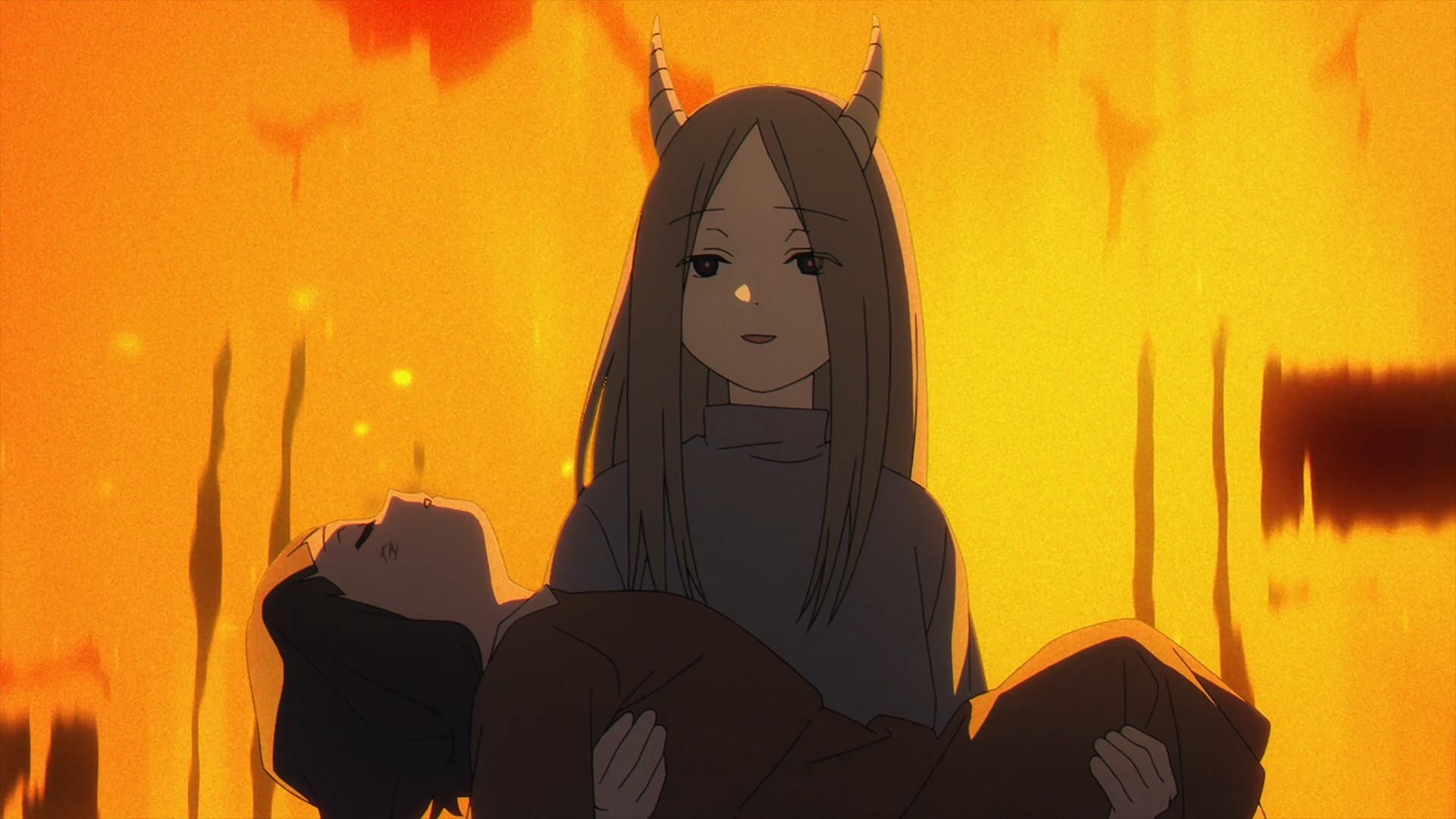
Mary Arkham AKA 'Lady' is an agent of the private contractor group Darkcom, which works for the United States government in eliminating infernal entities. Her father, after a series of experiments, became one of these beings himself, killed his wife, and then died in a self-inflicted fire at their home. This deeply affected Lady, who thereafter had a vision very similar to Frieren's.
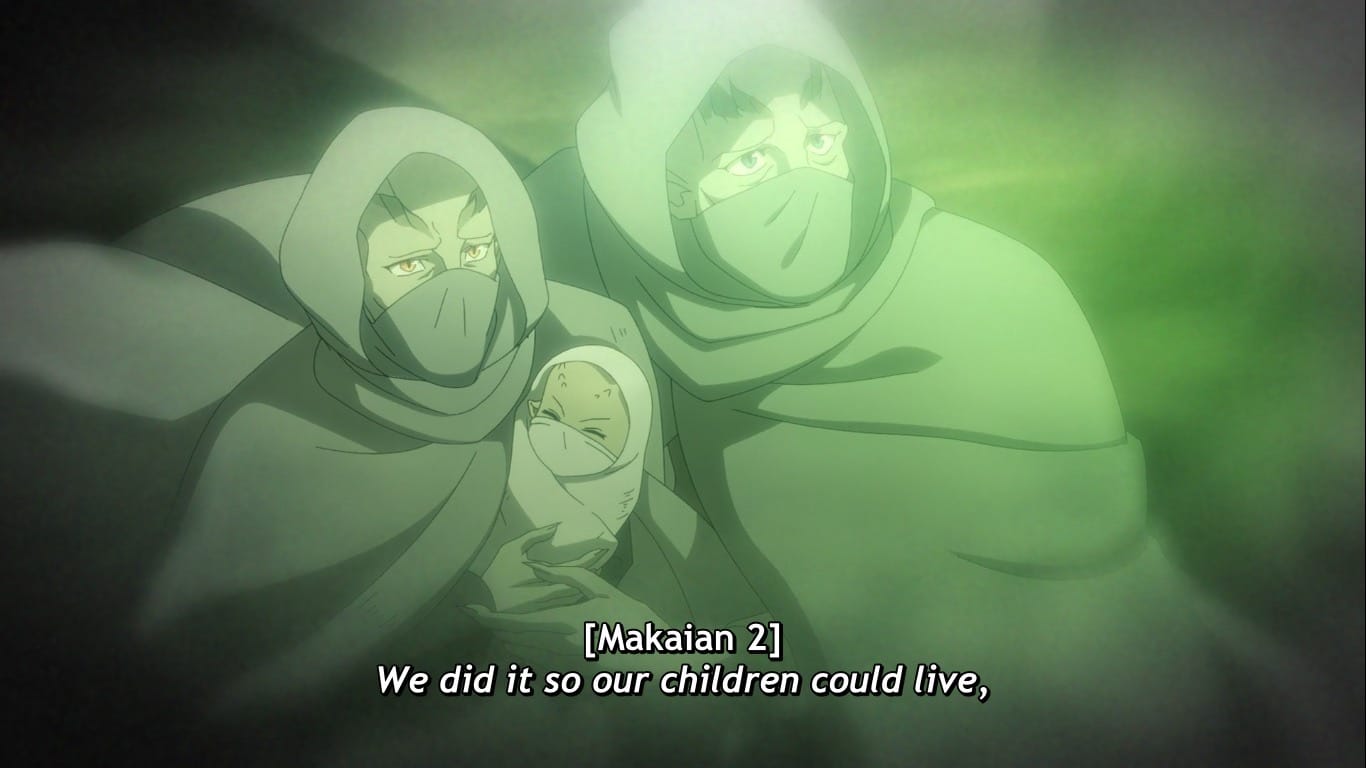
As the season progresses, we discover that Hell is a polluted world where only the strongest survive. Its weaker inhabitants escape to Earth when they can, seeking refuge. Moreover, those who live there don’t call it Hell but Makai, considering the terms 'demon' and 'hell' to be derogatory. Once this is revealed, Lady changes her view of the makaian people and decides to help them.
Themes
Evil and Free Will
Both series present the figure of the demon, and in both cases, they are dangerous because they harm humans. But what drives them to do evil? Let’s first look at how each work describes them.
In the universe of Frieren, these beings, while anthropomorphic, descend from monsters. According to the protagonist, they developed speech and their appearance merely as an adaptation to hunt better. They eat humans, but it’s unclear in the canon whether they need to do so to survive. Despite being integrated into language, they function like automatons.
In Devil May Cry, the makaian beings refer to humans as 'sapiens' (Homo sapiens). There are indications that taxonomically they are not very far from us. A basic and outdated definition of species could be: 'a group of living beings capable of reproducing and producing fertile offspring.' It’s unclear whether Dante is fertile, but in the video game saga, there is Nero, Dante's nephew and son of Virgil, who is also a hybrid of demon and human.
As with humans, it is also clear that makaian behavior is not determined by their biology. They have free will and understand the words they use. In moral and biological terms, they are very close to us.
Regarding the question of evil, both series provide mirrored answers. In Frieren, morality adheres to essentialist principles: there exists pure, unblemished evil that leaves no room for negotiation. However, if these beings can only do evil, if they are practically programmed that way, can they be held accountable? If they cannot err or act with ulterior motives, then technically they cannot do evil. Getting angry at a demon for 'sinning' is like getting angry at an animal or a natural phenomenon.
In Frieren, rehabilitation is not possible, and that seems to be the point of the demon-girl's character: to argue that even childhood is no guarantee of innocence. And if evil exists, it must be destroyed as soon as possible, because it only generates more evil. Translating this conclusion to the real world, in cases where a person acts this way, capital punishment would be justified.
The operation that Devil May Cry performs is different. The makaianos can do wrong, but not due to biological predisposition. The violence of Makai is cultural, but another organization from that world seems possible. It is personal decisions (and especially external conditions) that shape their worldview and attitudes. If a makaiano commits a crime, it’s because their choices and experiences led them there. And for that same reason, they can be reformed. Coexistence between both species is feasible.
To put it in Argentine terms, Devil May Cry is protective and Frieren is punitive.
Credulity-Mercy/ Cruelty-Severity
Frieren and Lady learn, through their personal histories, that there is no possible negotiation with demons. Their hatred stems from a traumatic situation that marks them for life and shapes a specific viewpoint: there are threats against which the only alternative left is physical elimination.
Frieren remains at that conclusion, and history and biology validate her. But Lady, upon discovering that many demons are simply seeking a better life, changes her perspective. We can establish two pairs to explain their positions: What in Frieren is credulity (the village chief), in Devil May Cry appears as mercy (Lady with the makaiano family). On the other hand, what in Frieren is severity (it’s just to eliminate demons), appears in Lady as cruelty.
What in Frieren is pest control, in Devil May Cry is genocide.
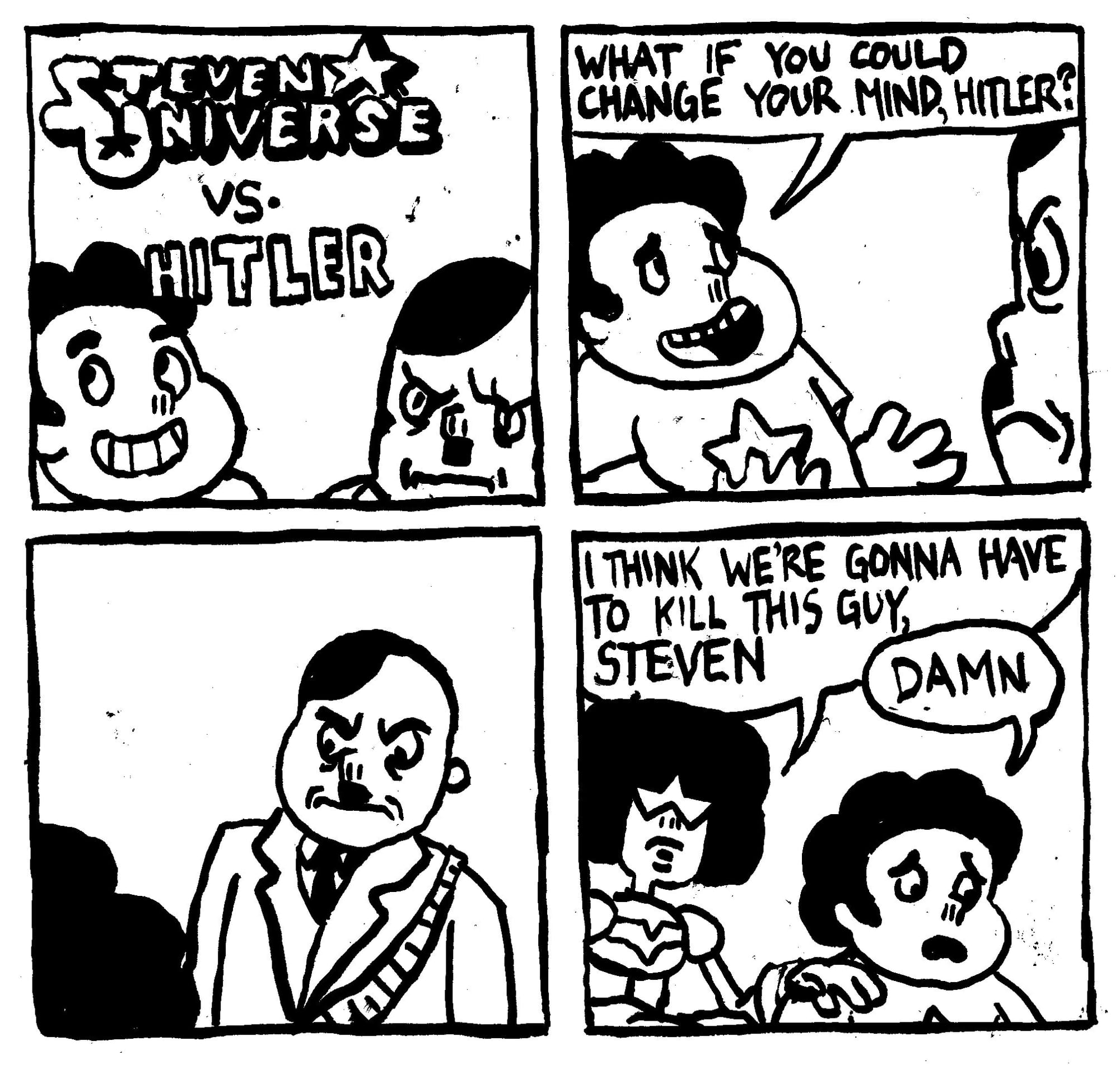
But let’s not dismiss Frieren’s stance so easily. What are the limits of the protectionism in Devil May Cry? I tend to agree with Lady in the vast majority of cases. But what happens when Steven Universe faces Hitler? Can all criminals be reformed? Doesn’t liberalism find a limit in those cases? Are there not instances where Frieren might actually be right? That will be material for another article. Now, let’s return to what concerns us.
Who are the demons?
Is it possible to separate the messages of fiction from their real-world counterparts? The author of this note believes not. Fiction shapes our understanding of the world. We learn how people befriend, argue, fall in love, and live based on the representations we see of that in movies, series, and, of course, anime. It may sound obvious, but there are articles in mainstream media arguing that since the demons in Frieren are not real, they should not be taken as a metaphor for anything.
Frieren and Devil May Cry discuss the very existence of evil. Lady starts off believing it exists, even that malice might have a biological origin, only to learn that humans and makaianos share the capacity to err. Devil May Cry begins with the Socratic premise that there are no rational beings who choose evil for the sake of evil. It is not relativistic; there is a correct way to act, but most do not act wrongly on purpose. Those who do wrong make mistakes, but often they do not know or cannot choose otherwise.
As we said, in Frieren, the demonic condition is morally fatal. To such an extent that it excludes free will.
Now the question would be: what parallel do both works share?
Devil May Cry, not so subtly, answers for us: the makaianos are illegal immigrants, coming from a planet entirely comparable to the third world. Darkcom is ICE, Lady is a remorseful soldier, and religion is the opiate of the masses, a theme that is addressed in the figure of the Vice President of the U.S. The series is so unsubtle that it ends with a blatant reference to the invasions of Afghanistan and Iraq in 2001 and 2003, respectively.
Frieren, fortunately, is more sophisticated. I’m quite sure that the authors did not actively seek for the demons to represent any minority or any real-world dynamic. In fact, the canonical reading links them to another theme of the series: the importance of forming interpersonal bonds. The demons are immortal just like elves, a species that struggles to relate to humans due to their longevity. But while the former use language solely for hunting, the elves, with all their difficulties, try to connect with others. The demons in Frieren exhibit psychopathic traits: they are manipulative, egocentric, and do not feel guilt.
I insist: it does not seem to be a conscious pursuit; the authors have clarified at some point that the demons are merely a narrative tool. However, the elements provided by the anime allow for other readings. Setting aside the racial issue, the premise that evil exists in essence implies that those who commit certain crimes must be eliminated because there is no redemption. And it’s not far-fetched to think that the authors might agree with this idea. After all, in Japan, the death penalty is legal.
Fiction exists to engage in dialogue and explain the human life experience. If the authors meant to convey something else, what does it matter? Or do people always say what they think they’re saying? Fortunately, fiction does not have closed meanings. And, above all, it does not exist in a vacuum. Or in other words: fiction is not neutral. Without undermining the figure of the author entirely, it doesn’t matter so much if in Dragon Ball Toriyama only wanted to see monkeys fighting each other. What’s most interesting are the effects that this produces; and that’s why Gordo Dan and Rebord can sit at a table and make two directly opposing interpretations of the same work.