PC Fútbol: Rise and Fall of the Great Sports Management Game of the ’90s

26 de nov. de 2025 — Luis Paz
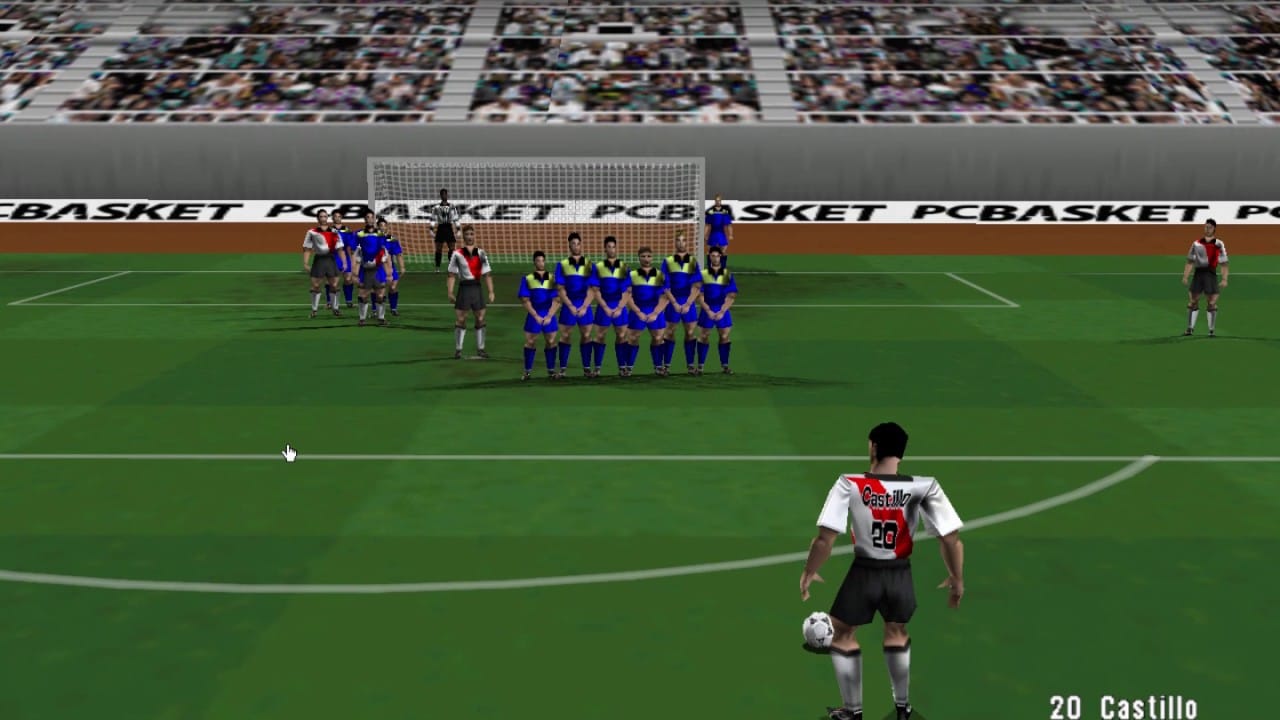
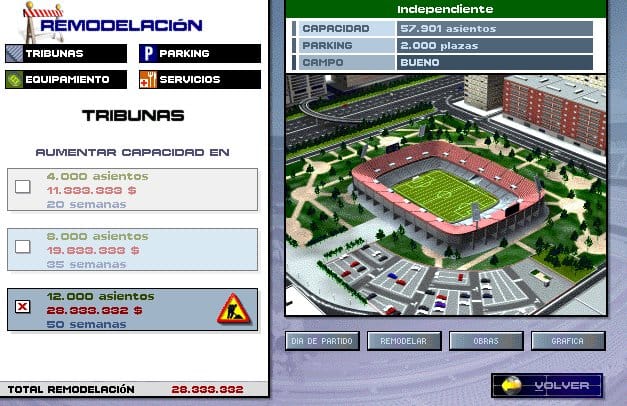
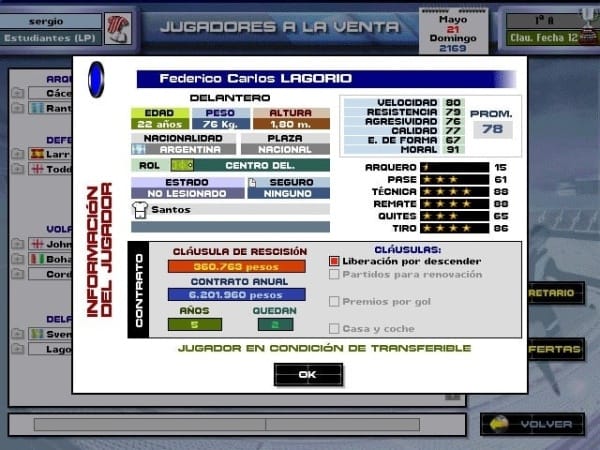
Loops were easy to learn. In PC Fútbol 5.0, the loop was starting a Manager League with Gimnasia y Tiro de Salta and using its 167 million dollars –the wildly bugged petty cash of the Albo from Salta– to max out every stadium upgrade and buy any players you wanted. In PC Fútbol 6 Apertura 98, the loop was starting a Manager League with Atlético Rafaela, dominating local football with the goals of Juan Manuel Suligoy –whose absurd overall rating of 91 points was only beaten by Ronaldo Nazário– or selling him to buy a full squad of quality Argentine players.
In between, you'd assign captaincies, hire goalkeeping coaches, negotiate TV broadcast rights and pitchside ad boards, or go hunting for stars in the last year of their contract so you wouldn't have to pay their release clause. All of this was happening thirty years ago, at a time when Argentina basically didn't show up in video games, and all thanks to PC Fútbol –a saga whose rise, fall, and emotional comeback arc mirrors that of Commandos, shoulder to shoulder the two most iconic video game IPs ever made in Spain.
PC Fútbol Taught Us How To Use a PC
PC Fútbol was a football management series that spent a full decade under the direction of Madrid-based Dinamic Multimedia, from 1992 to 2001. It later made a comeback handled by Gaelco for three more editions (2005, 2006, and 2007), but those were irrelevant both to the legend of the saga and to its players. Every single one came out on PC, of course, because in the '90s we learned that the name of the game is the game. And as the title says, PC Fútbol was football as competitive sport and as a business, captured in polygons and databases –from the price of the hot dogs to who wore the number 10– but all inside your PC.
The genesis was Simulador Profesional de Fútbol, which Dinamic released at newsstands in partnership with Editorial Jackson in 1992. Before the two canonical installments came versions 2.0, 3.0, and 4.0 –and it was on 4.0 that a playable Argentine league appeared for the first time, exactly thirty years ago, in November 1995. For reference: the Argentine league wouldn't show up in FIFA or PES until 2013.
By the time PC Fútbol 5.0 came out, it was easy to find each new edition in supermarkets, appliance chains, and big kiosks around Buenos Aires. Like other games of the era, they came in boxes almost the size of a school binder, with a CD, a manual, and often a poster. The standard price was 15 pesos in the convertibility era –15 U.S. dollars. My parents bought mine at the same Carrefour in Lomas where they later picked up Fallout for me and, a bit after that, the first Commandos.
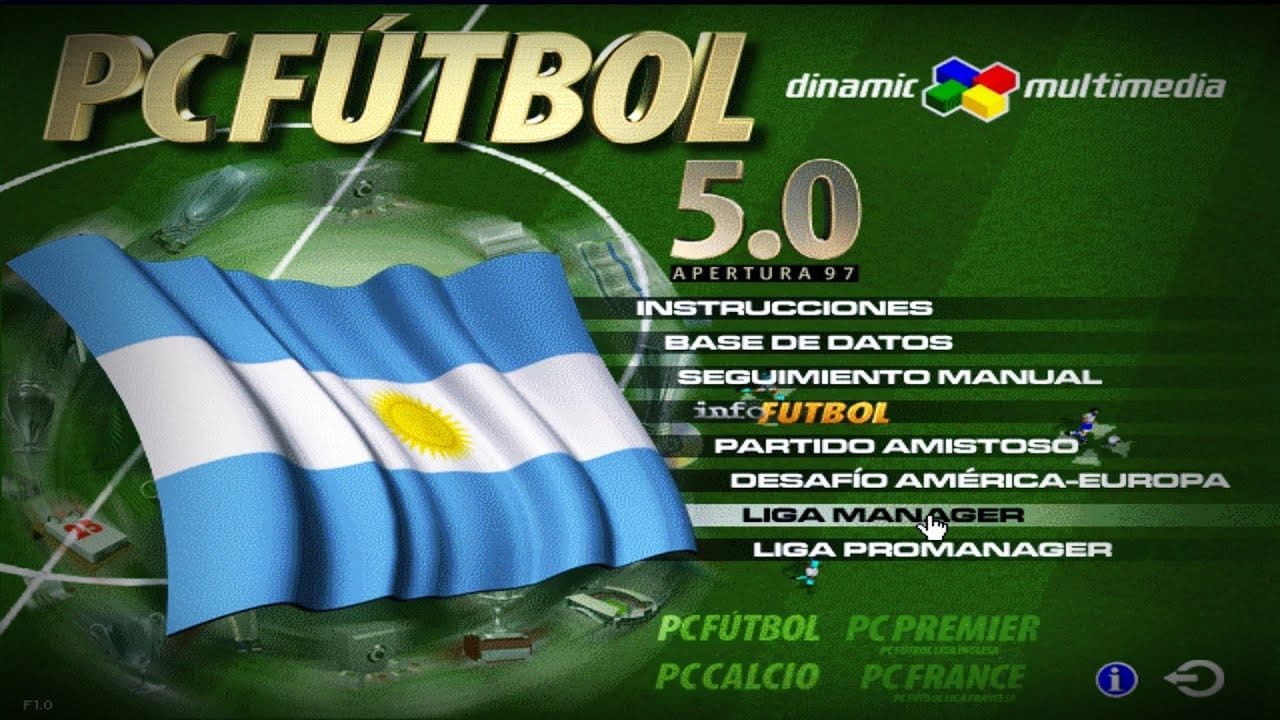
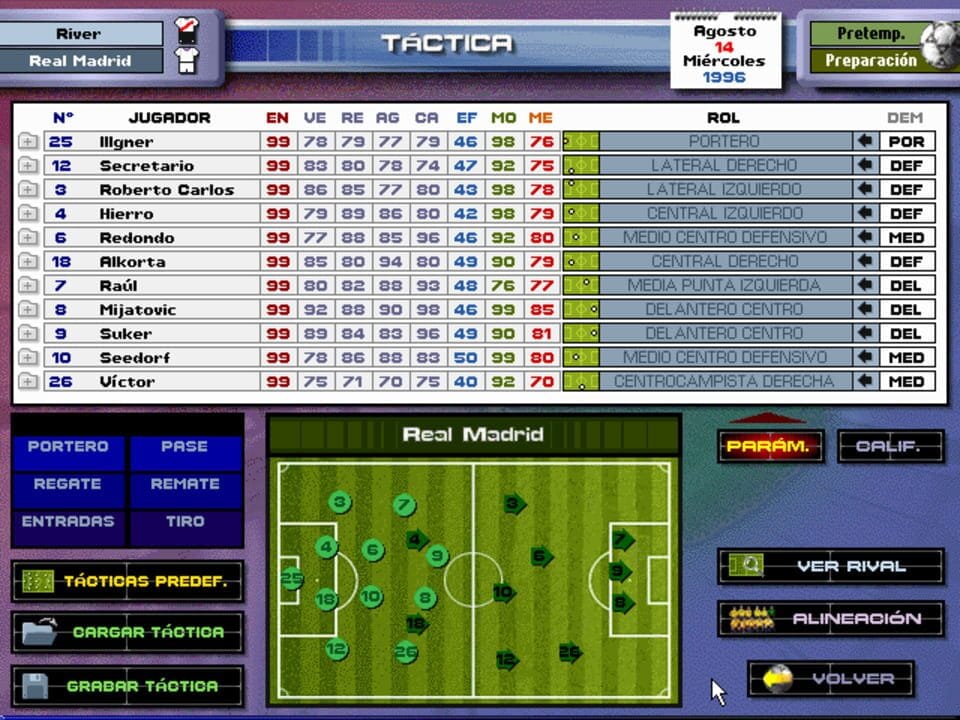
PC Fútbol 5.0 was released in December 1996, but it only arrived at my house months later, together with my first desktop PC. It had (and still has) Maradona at Boca, and commentary by Marcelo Araujo with incredible lines. It had (and still has) a simple interface built around menus and databases, very much in tune with the computing of the time, and in Spanish. I learned to use a computer better thanks to PC Fútbol.
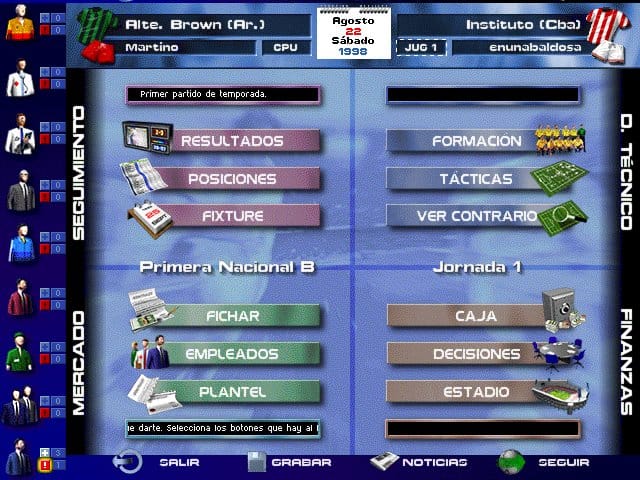
The canonical menu, cemented in PC Fútbol 6 Apertura 98 as the point of perfect balance for the saga, is laid out as a quadrant. Top left: data on results, standings, and the fixture list. Top right: formation and tactics screens, plus the option to scout your opponent –see who's playing, how they line up, and what kind of shape they're in. Bottom right: finances, commercial deals, the boardroom, and infrastructure upgrades for the club. And to the left of that, the contractual zone: transfers, squad, and staff.
On the left edge of the screen, little guys represent those same staff members, popping up with notifications, alerts, and call-to-actions about their area: an injured player, an expiring contract, a depleted stock of jerseys. And tucked away at the bottom is a button that takes you to more lore: the News section, with results, transfers, and awards. PC Fútbol isn't just a game where you manage footballers: like any good strategy game, it's a game where the real core is managing and arbitrating information –and the timing of when to use it.
Fantasy Football in Argentina
PC Fútbol caught on because it barely asked anything of your hardware, because it had Argentine clubs, and because it was simply there, on the shelf. But it also hit thanks to a particular cultural moment: the cultura del aguante on the terraces and clubs as narrative through-lines in rock and cumbia; the first big wave of bootleg jerseys; the prime years of Clarín's Gran DT, played with paper sheets and landline calls to make transfers; the golden age of Olé and Fútbol de Primera, and the foundational programming years of TyC Sports.
Those were the calendars in which the fantasy football gene was implanted: the idea EA Sports would eventually blow up with Ultimate Team in its FIFA / EA FC titles –using players as interchangeable cards in a TCG, managing teams beyond the regulations of any league, more like handling decks in Magic: The Gathering. Transfer windows are, ultimately, just a way of sideboarding.
Across all its eras, the saga was defined by its very low technical requirements. That held even in later editions like PC Fútbol 7 – the least successful in Argentina, because we were all still playing 5.0 or Apertura 98– and in its two big quality leaps: PC Fútbol 2000 and PC Fútbol 2001. My thesis is that this mattered far more for its massive reach in Argentina than its supposedly "360-degree" approach to sports management, as people would say now.
For a lot of people, their first experience was buying "a football game" without really knowing what they were getting into –and quickly realizing it wasn't as explosive as other PC titles of the time, like Actua Soccer, FIFA 97, or the legendary FIFA: Road to World Cup 98. But it was also obvious that these Dinamic Multimedia games were much more than match simulators, unlike a Virtua Striker cabinet in the arcade or International Superstar Soccer Deluxe on the SEGA Genesis.
In that main menu quadrant, in the line of staff alerts, in the news, and in the player and club database on the CD, it becomes clear that one of PC Fútbol's big themes is access to information for decision-making. That's central to most video games, sure, but it's literally life-or-death scale in any strategy or management game – which is what PC Fútbol really is, much more than just "a football game".
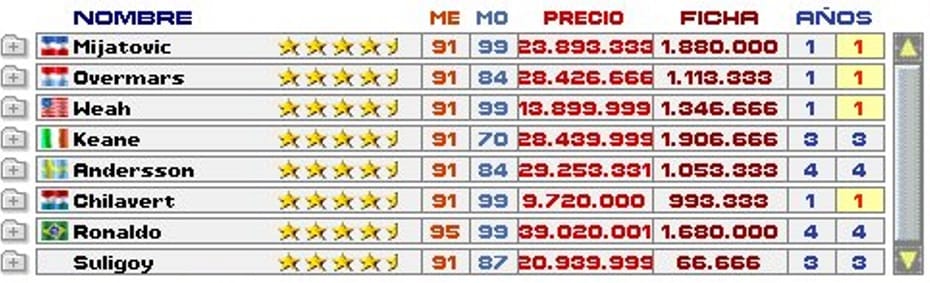
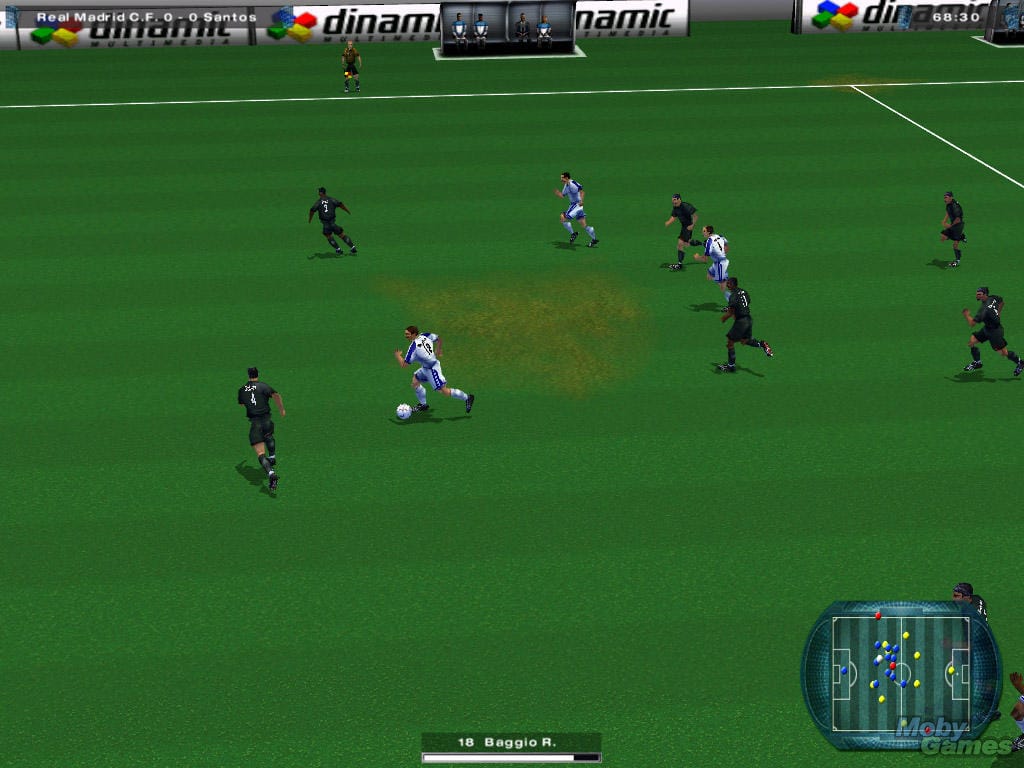
The matches themselves were bad: alien physics and graphics from the underworld. Clumsy, ugly, and somehow still fun. But the core of the PC Fútbol experience was always everything tied to inhabiting three roles at once: coach, sporting director, and club president. Football video games are turbo-normie, no doubt, but they carry a fantastic component because they offer another way of living out the hero's journey –if you accept that the path of the hero can be taking El Porvenir to a Copa Libertadores title, with an 80,000-seat stadium and Ronaldo Luís Nazário de Lima up front wearing the number 9.
The Dinamic Multimedia Bubble and the Legacy of FX Interactive
There's another layer to how the saga fades out in the early 2000s. The original core team was made up of Carlos Abril on overall design and programming, Nacho Ruiz on visual identity –except for the match engine, which changed several times– and Gaby Ruiz on AI design, database, and related systems. Former footballer and commentator Michael Robinson completed the picture by putting his face and voice on the game, front and center in all the branding and eventually taking over commentary duties.
But in 1999, the Ruiz brothers and Abril –the original creators– walked away, after Dinamic Multimedia's majority shareholder, José Ignacio Gómez-Centurión, decided to scale the company from 50 to 120 employees to jump into the dot-com gold rush.
Gómez-Centurión, Dinamic, and several dozen workers were wiped out when the bubble burst. Meanwhile, Carlos Abril and Nacho and Gaby Ruiz went on to found FX Interactive, and spent years iterating on the core idea of PC Fútbol. Today –or rather, as of 2021– they're the ones offering the most dignified and well-executed heir to those classics: Football Club Simulator, available on Steam for under 10 USD. And the original PC Fútbol games? Today they're practically abandonware, and you can still find them on Clásicos Básicos, my favorite foolproof retrogaming site.