Disco Elysium: Marxism and Detectives

24 de feb. de 2026 — Rocco Fregoti
The RPG about reading
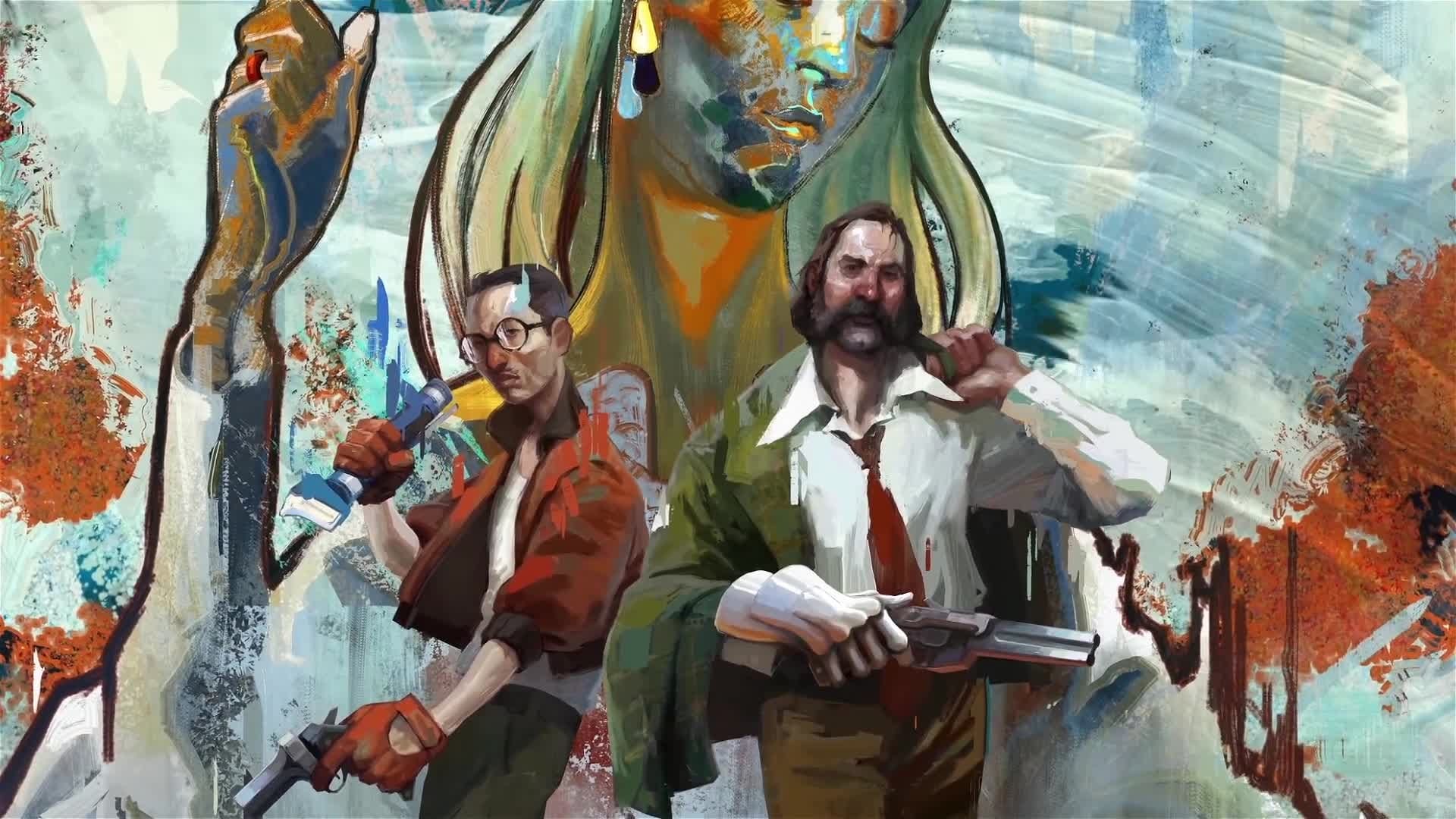
Disco Elysium, developed by ZA/UM in 2019, is not a game with great gameplay in the classic sense of the term "gameplay." I think I might get some backlash for this, but please let me continue, I beg you. It's part of the game's memetic identity that it’s a game where you do a lot of reading, with 55 hours of dialogue, descriptions, etc. It can be a bit tedious, and I don’t say that as a gamer, but as a reader: I read all day, so sitting down to read for another hour doesn’t excite me much. The other part of the game consists of dice rolls and percentages that unlock (guess what) more dialogue and more text as the plot progresses. It’s always relatively useful because it gives you experience, allowing you to allocate points to skills that are useful for (you won’t believe this) unlocking more dialogue.
In Disco Elysium, the protagonist is a sketch that you finish composing as you progress. Harrier DuBois is a noir-style detective who has amnesia, and you can start by choosing skill distributions that shape his profile (whether he ignores human rights or is more of a reflective hound, you know) and as you play, other skills are defined (which materialize not only as possibilities for rolls but also talk to you). Additionally, Harrier is an alcoholic who hasn’t moved on from his previous relationship, and he was a good detective until the combination of the factors mentioned made him stop being one.
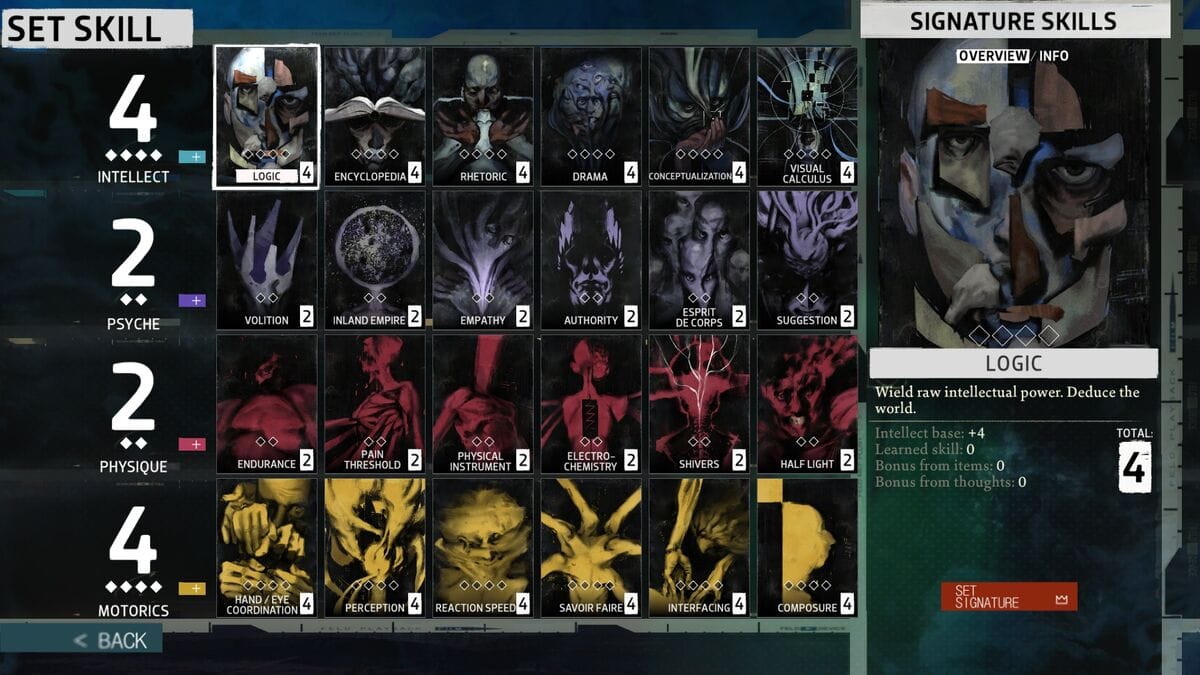
The "skills" in Disco Elysium are subjective aspects of DuBois. Four intellectual categories (like "visual calculus," which refers to how details of an environment are perceived; or "encyclopedia," which consists of knowing things), psychic (like "will," which refers to the detective's ability to cope with circumstances; or "authority," which allows him to compel others to do what he wants), physical ("pain resistance" is obvious; "physical instrument" refers to his physical strength), and motor skills (like "hand-eye coordination," which refers to complex operations like shooting a sniper rifle; or "interface," which indicates how well one understands technology). You allocate points, and with those points, certain dice rolls become more feasible and provide more information about the world and grant more experience. Want to diplomatically ask the smoker if he’s gay? Points to "composure." Want to open a heavy door? "Physical instrument." And so on.
I, wanting to play the detective, put everything into "logic," "visual calculus," "perception," "empathy," and whatever the plot required to progress because I’m the most boring person the 21st century has ever known. But if, for example, you want a poetic and melancholic Harrier DuBois, throw everything into "drama," "savoir faire," like Jacob Geller did. And if you want to role-play as Vic Mackey from The Shield, focus on "authority," "physical instrument," "reaction speed;" or if you want to be McNulty from The Wire, you can go half and half on "electrochemistry" for alcoholism and "logic" for detective talent... Because the game lets you interpret, act as someone; not in an infinitely free way, but with contrasting options. And then there are the political plots. Because the other joke of Disco Elysium is that it’s a Marxist game. The question of this article is, paraphrasing Civil War by Alex Garland, what kind of Marxist?
Marxism within Disco Elysium: Kraz Mazov and the failed revolution of Martinäis
The game takes place in Martinäis, a district of the city of Revachol. Within the fictional (but similar to ours) world of Disco Elysium, Revachol was an important nation that fell into decline and eventually had a communist revolution that overthrew its traditional monarchy, but was later suppressed by the international order, the Moralintern. Martinäis is a cross between a war zone, filled with bullet holes and ruins, and the Baltimore of The Wire, a nest of poverty and corruption where characters have zero autonomy due to belonging to corporations (international companies, police stations, unions, etc.). The remnants of the revolution (some are waiting for their moment) and members of the Moralintern make up an official government that, for practical purposes, is like NATO or Western liberal Atlantism.
The Revolution was based on the writings of Kraz Mazov, who is, of course, Karl Marx. Let’s review the classics of ideology, shall we? History is a consequence of the transformations of the means of production, and the relationships between the social classes that own them (lords, feudal masters, bourgeois) and the subordinates (slaves, serfs, proletarians). The state, law, religion, art, even family ties, are superstructures conditioned by the productive order. But for Marxism, history is essentially progressive: productive changes make previous superstructures unnecessary and they are violently overthrown by revolutions. The bourgeoisie overthrew the feudal order, now it’s their turn. Ideally. Let’s hope. There’s a problem: the world revolution (ours, from Disco Elysium) failed, or at least its first attempt did.
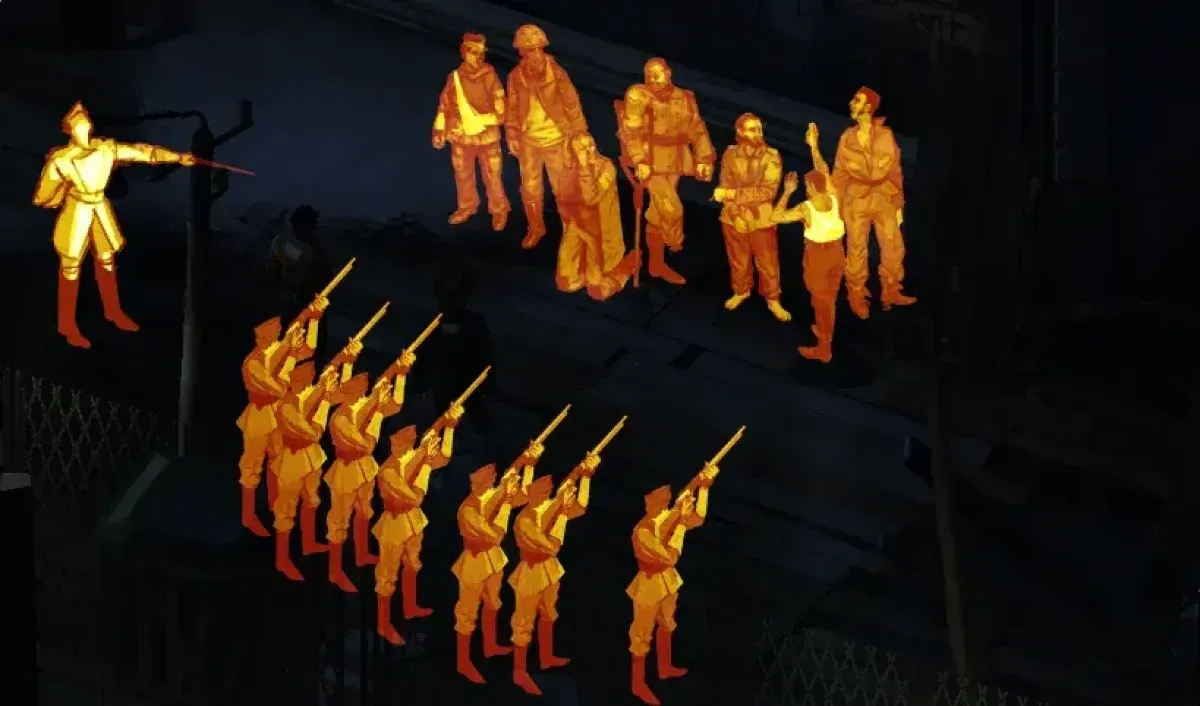
In Disco Elysium, besides a Karl Marx, there is a successful revolutionary: Nilsen. Ignus Nilsen is a mix of several historical figures: a friend of Mazov (Engels), a believer in somewhat absurd theories in metaphysical terms (Posadas, Lysenko, but we’ll get back to this later), a globe-trotting revolutionary with varied success (Che) and a reputation for being bloodthirsty (Lenin, Stalin). The sniper, a key figure at the end of the game (no spoilers), is, in turn, a political commissar like the members of the early Soviet Cheka, the German Stasi, the Stalinist secret police, etc. People who, more than being the New Revolutionary Man, are the new bureaucrat of the new boss (and we go from the Okhrana to the Cheka, from the Tsar to the Prime Minister, wink-wink). One can embrace communism as the ideology of Harrier DuBois, just as one can be libertarian, classical liberal, or fascist. All those paths are parodied to a greater or lesser extent, but it’s clear that the game’s authors lean left. Now, this isn’t Novecento or a propaganda film from the USSR, but a JRPG made by the only post-Soviet Estonians who aren’t anti-communist, so we need to be more nuanced.
The Marxism of Disco Elysium: Marxism, postmodernity, and the crisis
I mentioned earlier the classic pillars of Marxism. A utilitarian and economic logic of society inherited from English liberalism, and ideals of social justice from French revolutionary utopianism. Also, the progressive logic, which is part of Hegelianism, so now we must listen to the "grotesque stony melody," as a young Marx would write to his possibly frustrated father ("I sent him to be a lawyer and now he talks to me about Hegel"). Hegel never speaks per se of the end of history, although he does speak of the progress of history: a gnoseological progress of humanity (understand humanity as the West), of its art, of its civil institutions, etc. But his conclusions are generally quite ambiguous: Marxists have trouble reconciling Marx into a single system of thought, counting both his published and unpublished works. You can imagine that with Hegel, who mixes Enlightenment thought, German romanticism, and Jewish cabala, among other things... well, I’m sorry.
What does this have to do with Disco Elysium? Everything, because if I had to define the specific Marxism of Disco Elysium, it’s more aligned with European academia and its multiple blends (greater emphasis on Hegel and German idealism, Nietzsche, psychoanalysis, semiology, etc.) than with Soviet, Chinese, Third World, or even the Trotskyism of your nearest college. Partly due to the resonance of its thematic conclusions, partly due to the not-so-veiled references. Not because they are all equally heterodox regarding Marx, but because there’s a key difference between "the revolution is possible and we must face it, even if it’s violent" and talking about the tragic break of the human condition. Let’s clarify.
In the Lessons of Aesthetics, and an item that reappears in Lukács, the Frankfurt School, Jameson, Fisher, Derrida, etc., the idea stands out that the contemporary individual is in a situation of substantial irreparable openness. There exists a closed society where the religious, the artistic, and the civil are one and the same, and then this breaks, whether with Greek individuality, the interpretive break of the biblical canon, or the emergence of the market. The subject sees the world shattered and feels his identity crumbling. Such is the protagonist of the modern epic. For practical purposes, it doesn’t matter: Harrier DuBois has a terrible hangover and emerges from it broken, his personality is a chorus of fragmented voices. They are the specters of his life, just like the dreams and linguistic failures that refer to his ex-partner, Dora. Fragments of his previous life, a past that haunts him like the ruins of the revolution remind him of the failure in Martinäis.
In theory, Marxism and its revolutions offered the possibility for the substantial social humanity to return to its spiritual unity. But, in practice, between the violent counterattack of the bourgeoisie ("the mask of humanity falling from capital") and the repressive touch of any revolutionary regime (Lenin, Stalin, Mao, Castro, the "grandchildren of Robespierre"), Western Marxist intellectuality seemed to capitulate, with the last nail in its coffin being the fall of the Wall. And so we move to the "end of history," to the idea that all that remains is capitalism and the nation-state, to the notion that the end of the world (Jameson) is much more imaginable than the end of capital. The revelations that DuBois has in his drunken state show him that there will be a second revolution in Revachol, but this time it will be suppressed with atomic bombs and that will unleash the apocalypse.
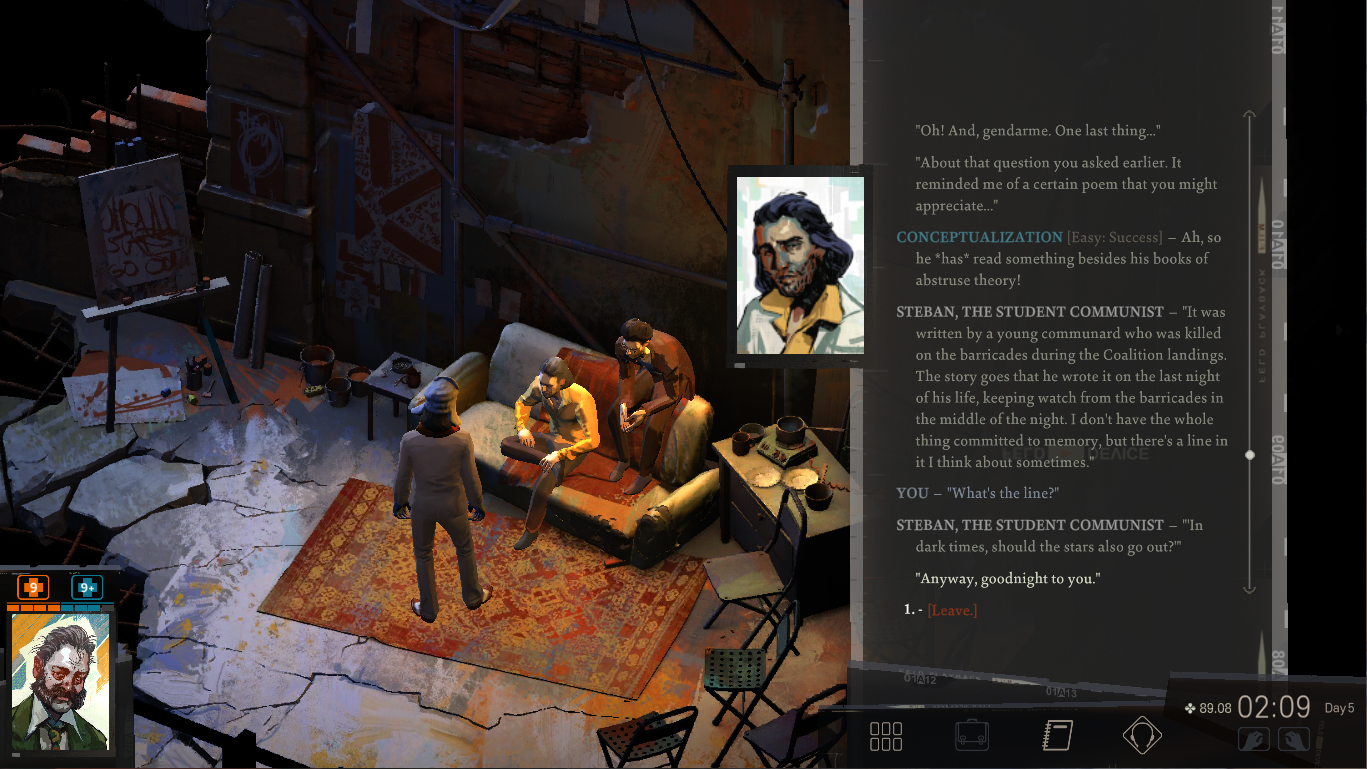
And it’s not that I’m pulling an analysis out of thin air, because the game itself parodies the Marxist intellectuals that Harry encounters in the communist mission: Steban and Ulixes, who not only explain the theoretical framework of Mazovianism but also speak ill of the other schools, like the members of the Gottwalder school, who are depressed liberals (a clear jab at the Frankfurt School). They also reference Benjamin’s historical thesis, which speaks of Marxism as a secularization of redemptive Christian thought, because within Kraz Mazov’s ideas (Marx) would be present Dolores Dei (Christ). Of course, these critiques of the theoretical drifts of Central European Marxism, devoid of praxis and hopes for the future, are ironic, because the sarcastic admission that something is out of place comes with the package of (post)Hegelian thought. Disco Elysium is a hilarious game that laughs at itself, its ideological opponents, and the current world, because the inevitable complicity with capital is in the equation: producing video games is impossible without a degree of integration into the capitalist system. At ZA/UM, the studio produced video games, and the collapse of the studio due to a rights war confirms this.
Conclusions: armchair Marxism (with wheels)
“Armchair Marxism” is an internet insult that refers to Marxists who spend more time reading and discussing like scholastics than doing, well, anything else. I don’t know, pick one. Militancy in a union or political organization, whether civil or part of the party framework, training in labor law, engaging in outreach, I don’t know, whatever you want, but something that isn’t just arguing about Marx and his correct and incorrect heirs. Does Disco Elysium do that? Yes and no. It ends up a bit in that because the substance of its text ultimately doesn’t differ much from the theoretical drifts of Western Marxist thought. Is the end of the world more imaginable than the end of capitalism as Zizek, Fisher, and Jameson point out? Yes. Is the specter of the past (and the future that could have been) besieging our present with melancholy as in Derrida and Fisher, the ghostly thesis? Yes. Can Harry have a happy ending that gives closure to his personal story, but not to the world, as Lukács' literary theory suggests? Yes. Add in the nod to Benjamin’s thesis and you’ve got the whole family gathered for Christmas.
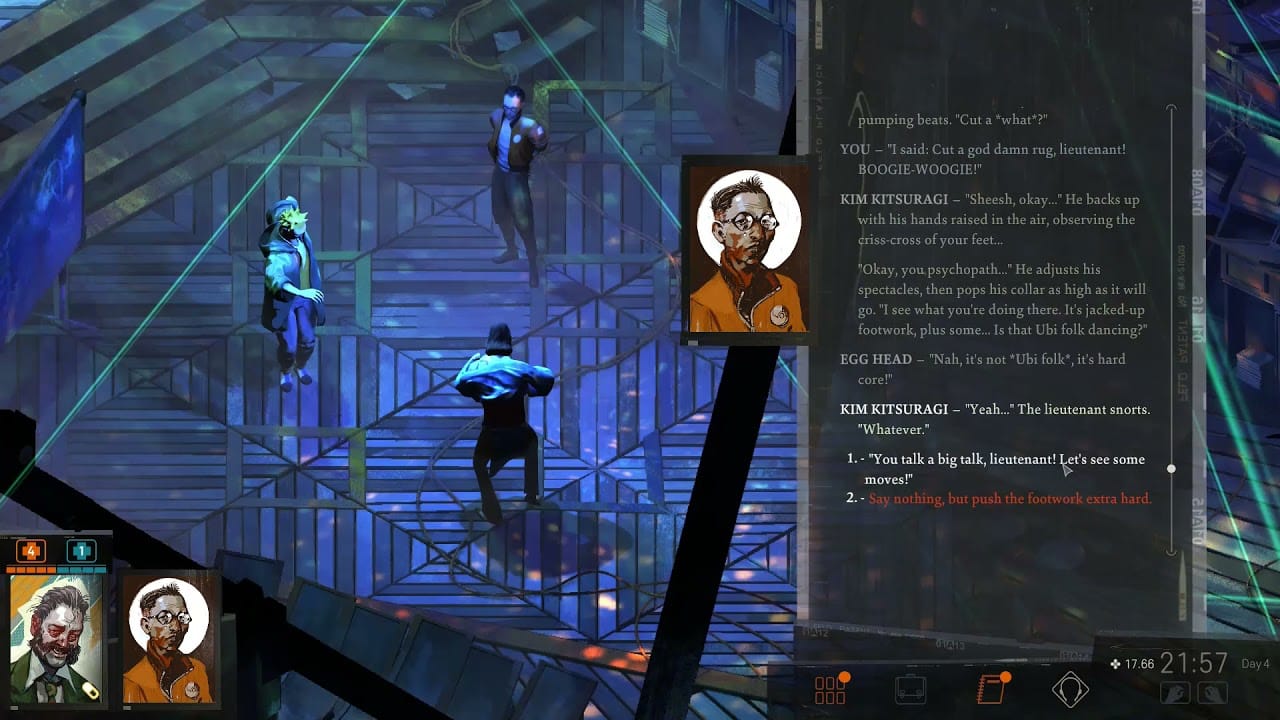
Now, in the game, there’s a reason why the mission of the Marxist intellectuals ends with the leader deciding to expand the network, so it’s more than just a duo of critics. There’s a reason why the Evrart brothers, the port turbine unionists, want to provoke a revolt in Martinäis, come rain or shine, regardless of how many mercenaries Wild Pines sends, how many must die, or how many moral norms must be broken: Revachol will become independent from the Moralintern. Very likely, Harrier will be part of the rebellion. By that point, Harry has already developed as a person and his cause is the right one even if it ends badly (or perhaps because it ends badly, it’s the just one).
Disco Elysium is, above all, a self-aware work. It knows it’s a text and not a manifesto, a video game and not a call to action. It’s very much in tune with European trends, which shows a bit of its blindness to what’s happening in other latitudes. At the same time, the geopolitical shift of the last two to four years makes it feel somewhat dated: the world’s norms have changed since 2019. Nonetheless, it’s a work with humor, that knows how to laugh at itself, that understands it’s closer to a pop culture introduction to Marxism than to a manifesto by Vladimir Lenin. Probably, Marxism is finished as a global change project, perhaps it never existed in pure form, perhaps things can’t exist in a hermetic way except in text and when applied, they become corrupted. The world is complex, to say the least. Still, that doesn’t mean we should stop playing or, for what matters to us, dancing disco.