Being a Magic: The Gathering Judge, the Path of the Shepherd of Nerds

25 de jul. de 2025 — Nico De Bonis
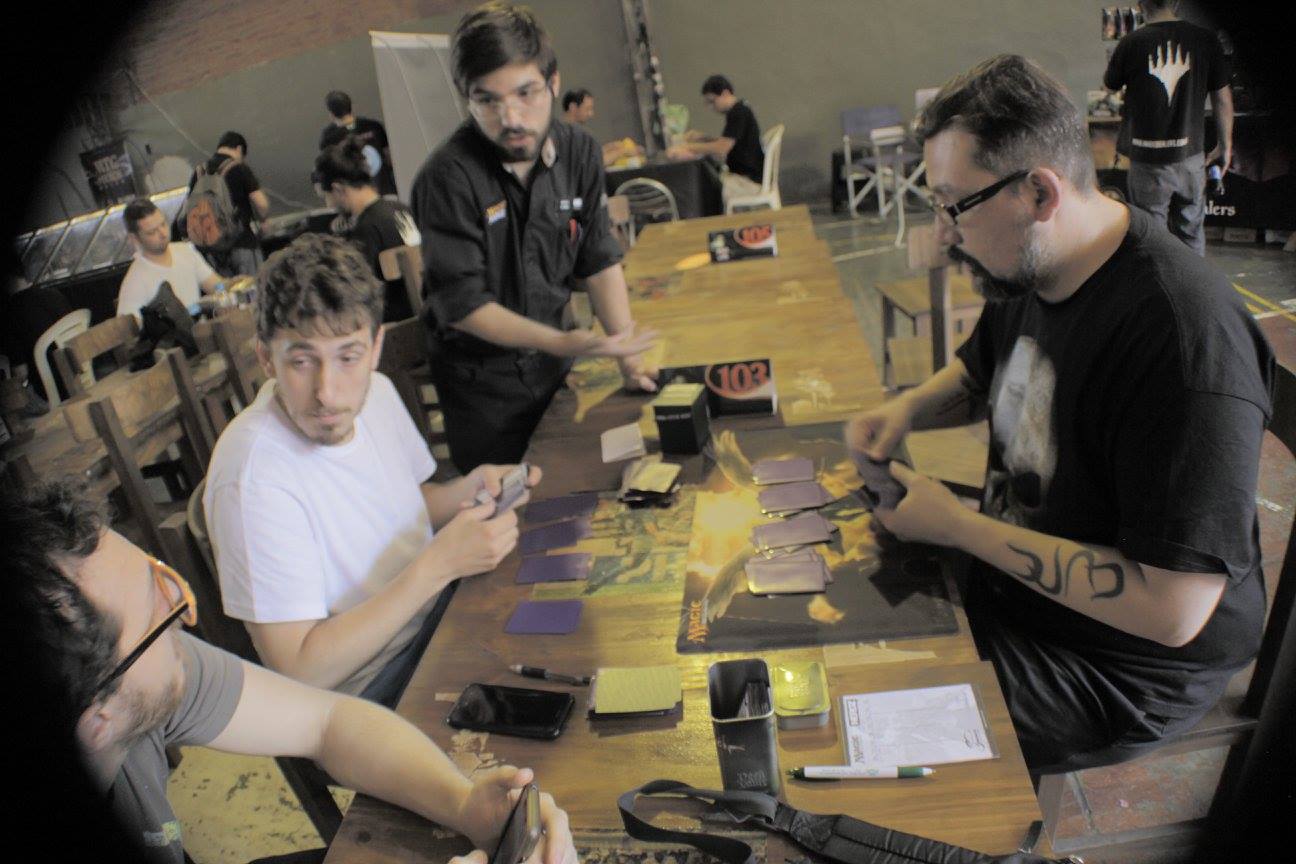
"What's the deal with that card game nonsense?", my old man told me, full Tony Soprano, one morning while driving me to high school. I was 15 and didn't have much in the way of argumentative tools to respond. Years later, those little cards took me around the world working as a Magic: The Gathering Judge. And on top of that, they funded my studies, got me my first motorcycle, and today are an integral part of my professional life. Such is the Path of the Nerd.
I started playing Magic inconsistently around the age of 10, thanks to my brother and his friends, but I kept drifting in and out. The definitive reunion with the addiction came at 14, when I walked into the old El Senor de los Anillos (a comic book shop in the Colegiales neighborhood of Buenos Aires, now called Muy Lejano) for the first time and bought my first deck, a Black-Green Infect precon. It was love at first sight.

The more I got into moving from casual to competitive play, the more I realized an irrefutable truth: Magic is an expensive hobby. Competitive events were everywhere thanks to new formats and the presence of MTG Mulligan, an Argentine tournament organizer, but I was increasingly short on cash. That's when, at a tournament held on the Maipu bridge next to the Tren de la Costa, I first encountered the figure of the Magic judge: a person who studies the game's rules to serve as a referee and also run tournaments, round by round. I went home, downloaded the rule PDFs, and with the help of a local judge, I took and passed the Level 1 judge certification exam (back then there were five levels; the higher the number, the bigger the Nerd you were). My relationship with the cards would never be the same again.
I got certified at 16, and the first two years were more of a hobby thing, a way to stay in touch with the game I loved more than anything. Until I was selected for my first major event in Brazil, one of the beloved old Grand Prix, large-scale open competitive tournaments.
That's when the entrepreneurial bug bit, and once you taste that honey there's no going back. And so, the hobby started behaving like a side income. Little by little, the destinations became wilder and more exciting: the year after Brazil, I was called up for a similar event in Amsterdam, and I closed that year with the Grand Prix Vancouver in Canada. Everything was starting to blur, and the little hobby that made me fail math in junior year and was so hard to justify to my old man began turning into something serious. I had set out on the Path of the Nerd.

What It Takes to Be a Magic Judge
First and foremost, you have to be a massive nerd, at least in spirit; because if you're not ready to geek out, the ecosystem will eat you alive. Obviously, one of the most important things is knowing all or the vast majority of the game rules. This isn't just knowing how to play; it's being able to fully understand how the game works, the hows and the whys. That means the complete rules of the game, as well as tournament policy and, in part, the philosophy behind the whole package.
When I talk about tournament policy, I'm talking about the procedures and the meta-ruleset that govern a tournament beyond the game itself: communication during matches, competitive tournament structure, that sort of thing. And when I talk about philosophy, I'm talking about the reasoning behind those two things. What's the idea behind, for example, giving someone a Game Loss for showing up 5 minutes late to their seat once the round has started? Or why do we allow certain actions to be reversed and not others? Because a referee's main job is usually, well, to referee: to mediate in a situation or conflict and resolve it with an understanding of what happened and an expected outcome.
And at the same time, it also means being, in a mystical yet precise way, a sort of Shepherd of Nerds: a guide through a swamp of cards. Their friend group asks them about rules, players who know them share interactions from their games, and store owners consult them on how to do this or that.
What It's Like to Work as a Judge at Magic Tournaments
You usually come in thinking that if you have a decent understanding of how the rules of Magic: The Gathering work and you're up to date on the cards seeing play, you can handle running a tournament: that's when the multidisciplinary nature of the Nerd life smacks you right in the face.
The first and most fundamental thing a judge does is answer rules questions: they've read the documents, they know the rulebook well, and they can usually answer almost any common question at a Magic tournament. Along the same lines, their role also involves ensuring that tournament integrity is maintained: making sure nobody pulls any shady tricks, for example. But here's where the mix starts getting complicated, because tournament integrity also means preventing one player from getting into a fistfight with another. Or, in the event that the invitation to throw hands over fetchlands has already been extended, de-escalating the situation before things get worse.
Suddenly, the judge needs a certain social finesse. The ability to speak calmly so everything doesn't spiral out of control. They have to be able to explain to a player that their opponent just made a mistake and wasn't trying to gain an advantage by mispaying a spell, or teach them that a rule doesn't work the way they thought it did. They might even have to catch a player cheating (like drawing extra cards), disqualify them, explain the reasons, and effectively remove them from the tournament -- a tournament the player paid for and prepared for. I've disqualified the same person three times, at three different events across three different years; an Argentine player I'm actually quite fond of.
On top of all this, the judge is in charge of the logistical procedures of the event: starting each round, making sure players report their match results as they finish, and keeping the energy up so the tournament ends on time.
As for the technical-logistical-contractual side, no, a Magic Judge is not an employee of Wizards of the Coast or Hasbro, nor of the event organizing companies (like Pastimes, StarCityGames, or others). They're a contractor, an independent contractor who provides a specific service for that event and then goes back home, sometimes with booster packs, sometimes with promo cards that have good value on the secondary market.
For certain events they send you the flight directly; for others they give you a stipend to cover travel expenses. Generally, it works better for subsidizing a trip and offsetting a vacation than for living off of it for a couple of months. Plus, event frequency isn't that high: MagicCons, the large-scale events that attract the most people and need the most staff nowadays, only happen three times a year. So it's a gig that floats in the gray area between hobby and side hustle. Not many people can make a living from this, since it requires being known worldwide and getting called for every possible event.

The Competitive Circuit of Magic: The Gathering
Rules, social skills, logistics. The judge trifecta on the Path of the Nerd. And so emerges a factor rarely considered in the profile of judges/referees for card or board games: the perspective of an organizer, a producer, and a logistics coordinator. At every Tinder and OkCupid date, I always told them I was an "event organizer"; an answer that, being half honest and half stretching the truth, is actually pretty accurate. Being a judge for a card game, mainly Magic, inevitably ends up involving heavy logistics management, venue organization, event planning, and especially people management.
Now, what happens when a tournament, instead of having 12 people at tables in the back of a local game store, has over 100 players and takes place in a convention hall or event center, with serious prize money on the line? Then you need more than one judge, and like everything in human social life, that requires organization and hierarchy to function. That's where the roles come in: Head Judge, Team Lead, and Floor Judge. And so, the Path keeps getting more and more complex.
After the hard reset that COVID was for the world, purely competitive Magic tournaments started disappearing and were replaced with more of a convention model, like today's flagship MagicCon events. Now, Magic is a product that combines different IPs and brands, like Final Fantasy, The Lord of the Rings, or even SpongeBob, so holding events purely as competitions is no longer profitable or viable under the logic of selling as much product as possible within a single event. Fun fact: this article was started from a hotel room in Las Vegas during MagicCon Vegas 2025 ft Final Fantasy weekend.
Today I work closely with the MagicCon organization, and while I've judged several Pro Tours (the highest-level competitive events, which award tens of thousands of dollars in prizes), lately my role at events has shifted more toward coordination, planning, and logistics across convention areas, so I no longer answer rules questions but I do resolve operational issues across entire sections of the event.

Judging or Playing
Working at Magic events this way creates an inevitable effect: it desensitizes you to the game. I played less and less, and increasingly wanted nothing to do with spending five hours playing five rounds of Modern, or if I got together with friends to sling some cards, I'd be bored after the first game. Same with the excitement of cracking a booster pack: completely annihilated. At large events, the volume of product is so massive that, after opening several pallets of hundreds of boxes of boosters to set up all the drafts and prizes for the weekend, you completely lose that semi-erotic thrill that, as a kid, I used to get from ripping open a pack and seeing what was inside. A self-inflicted numbness.
Obviously, it's a role that opens a pretty wide door of possibilities that, while distancing you from the game at a recreational level, brings you much closer to one of the factors sometimes overlooked but vitally important to it: the social factor. Magic is, in all its versions and stages, a social game. A game that depends entirely on communication between participants and that, because of this, inevitably builds community.
Every store where cards are sold and events are held, every group of nerds who commune on Friday nights ordering pizza and getting together to play Commander or Cube, and even every large-scale event where a person seems to be just one among thousands -- they all generate their own community, of people who share a code, a comfort zone, and a way of playing the game. The Magic Judge, at least in their most atomic and original conception, is also meant to be someone who fosters and encourages community.
To give an example, I don't think there's a single Magic store in all of Buenos Aires and the surrounding area where I don't say hi to at least three people when I walk in on a Friday. Similarly, there isn't a single store owner or event organizer I haven't worked with. I've taught people how to play Magic at booths in conventions that had nothing to do with the card game, organized conferences to train other judges, and even advised players on how to approach a competitive tournament. That's how I got to see how all the groups work, all the different communities and the spaces they share.
In that sense, the role of the Magic Judge is also the role of the Keeper of the Flame, the one who promotes and keeps the Path of the Nerd walkable for others. I'm still walking it. But if you're not someone who cares about other people having a good time, then this path isn't for you: just keep playing UW Taxes.

How to Become a Magic Judge
Well, here the answer kind of sucks: it's complicated nowadays, simply because Wizards dropped official support for everything judge-related. In a classic corporate American move to dodge lawsuits, Wizards of the Coast decided to distance themselves from any parallel organization that doesn't involve producing the game; in fact, they don't organize any Magic events anymore: it's all done by companies they have various arrangements with. In this state of affairs, there's no longer an "official" structure that establishes how and when someone can become certified as a Magic Judge, and those of us who still hold this role do so through experience and knowing how to stay up to date with everything that's happening.
Now, this doesn't mean the Path of the Nerd has been closed, because if there's one thing we know, it's that nerddom lives in the spirit, not in a title. There will always be a need for people who are there, whether in their friend group or at a local Magic store, learning the rules well enough to answer the questions of those around them, to teach new generations how to play, and even to help ensure that the game we love so much continues to be a source of fun, stories, and above all, connection. Because there's a reason it's Magic: The Gathering.