The Political Compass of Fallout: New Vegas Factions

6 de oct. de 2025 — Sole Zeta
Recently, Amazon officially announced what fans already knew: the next season of Fallout, the series based on the video game saga, will be set around New Vegas, the central location of the eponymous game. Beyond being one of the most acclaimed in the saga, the choice is interesting for another reason: despite being created during the early Obama years, Fallout: New Vegas seems to speak to our present.
Yes, it's a political reading of a game from 15 years ago -- something you can do even with games that are 40 years old and completely abstract, like Tetris -- but one that's about to take on new relevance with the December 17th premiere of the second season of the TV adaptation of Fallout. And the best way to do it is by reviewing its main factions, just as 421 once analyzed the economic structure of the post-apocalyptic societies presented in the Fallout saga
NCR, the New California Republic
The New California Republic (NCR) is the closest thing Fallout has to the American political order of its time. This has been made explicit by its creators, but you really didn't need much more than to read the text.
Like practically every mass entertainment product of its time (between 2001 and the rise of Trumpism as a political movement), New Vegas is about 9/11 and its geopolitical consequences. Yes, Call of Duty, The Dark Knight, Mass Effect, Game of Thrones and Iron Man are about this too. American pop culture of the 2000s and early 2010s necessarily exists in the shadow of the Bush Doctrine.
"Americans are asking, why do they hate us? They hate what we see right here in this chamber — a democratically elected government. Their leaders are self-appointed. They hate our freedoms — our freedom of religion, our freedom of speech, our freedom to vote and assemble and disagree with each other." [George W. Bush, 9/22/2001, address to Congress]
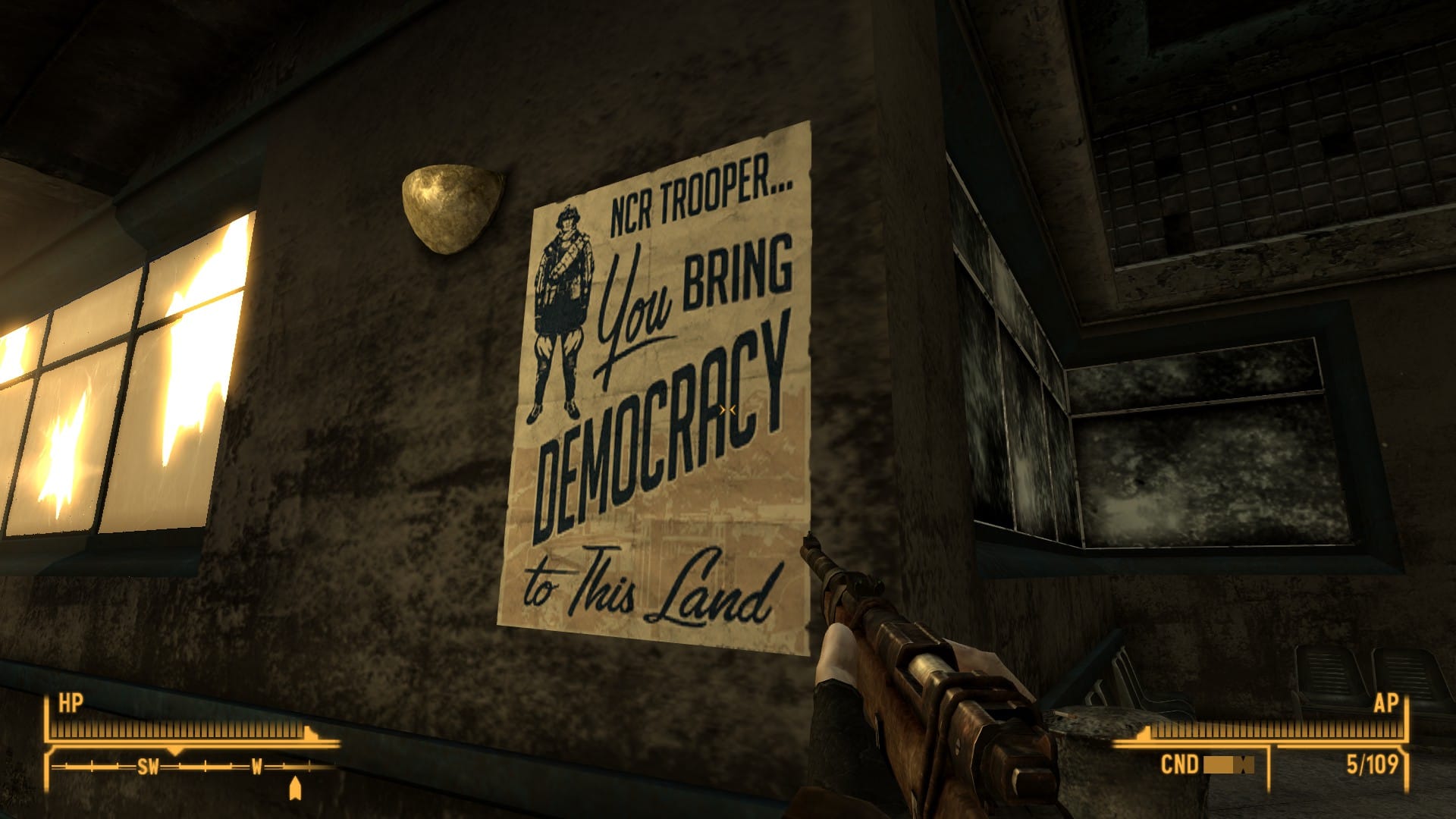
In the case of New Vegas, it's hard to be more explicit: a liberal democracy, with serious problems but functional, deploys its forces eastward to fight a coalition of barbarians who seek to destroy its way of life and seize a strategic energy source. In a way, the post-apocalyptic genre is the ideal genre for this conflict: it works perfectly as a western by other means.
Is the NCR the "good" faction? The stated goal of the game's creators was that there wouldn't be such a strong moral contrast, but it's hard not to see them as, at least, the lesser evil. Most characters with negative opinions about the Californians in general complain about regulations, bureaucracy or corruption. Personally, those seem like minor sins next to some war crimes and even a small genocide. All in all, they're still by far the least psychotic faction. They are the normal guy.
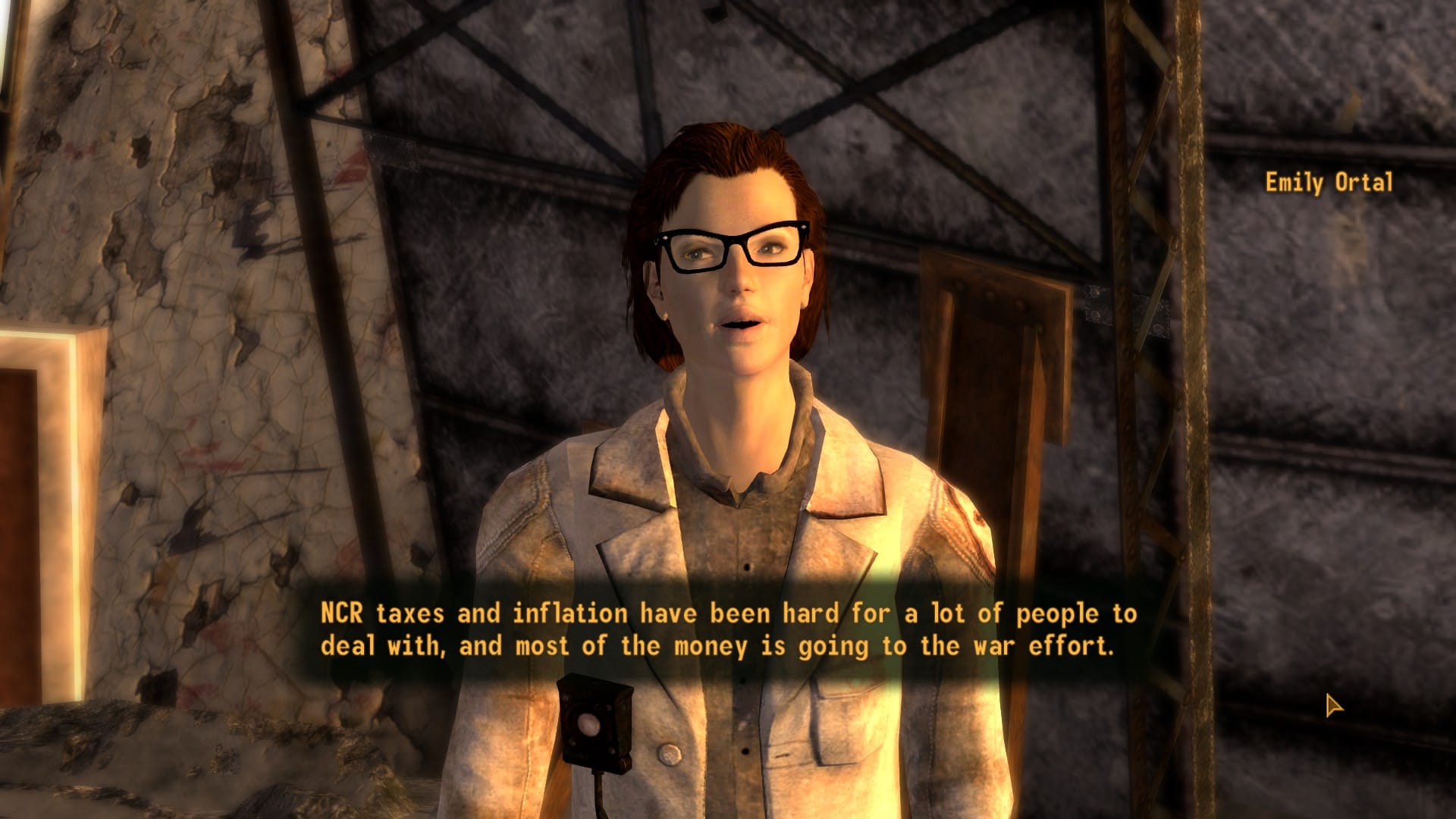
The problem is that, just like the normal guy, the NCR isn't sexy. They're a boring faction, one that hardly inspires enthusiasm. They're gray. They're vanilla. And in that they're also a bit ahead of their time: in 2010, the United States was living the effervescence of early Obamism while much of Latin America was going through the last stage of the pink tide of progressive governments. Those were perhaps the best years for liberal democracies in this hemisphere and yet, in New Vegas the disillusionment was already visible.
Caesar's Legion, the Empire of Edgelords
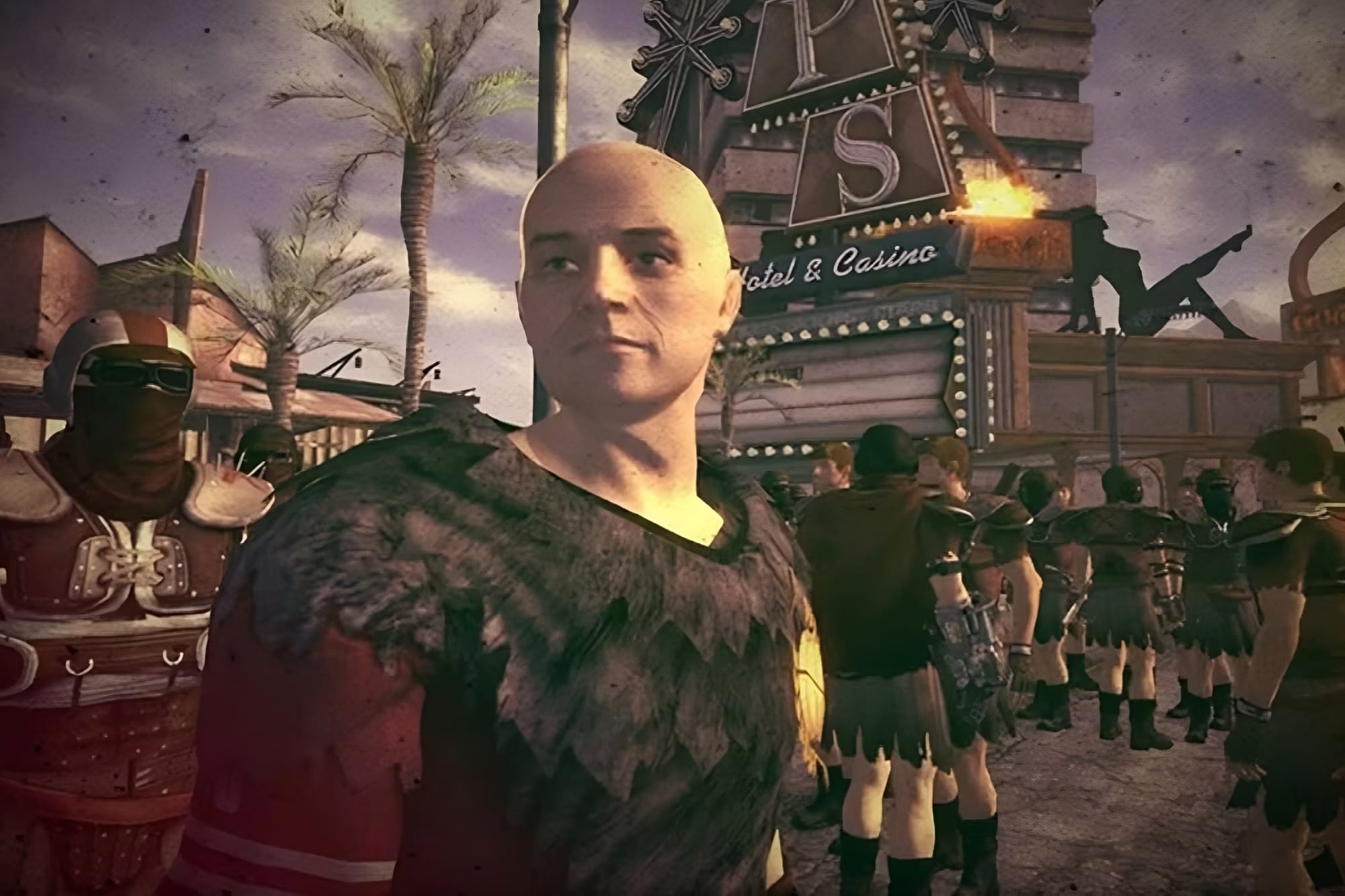
A couple of years ago we woke up to the news that apparently all men in the world have an unhealthy obsession with Imperial Rome. In this too, New Vegas was ahead of its time: in 2010 we could imagine a post-apocalyptic future in which a young man's Roman obsession would become the seed of an empire.
The Caesar's Legion was founded by Edward Sallow, a young member of the Followers of the Apocalypse -- the embodiment of "we'll come out of this better" in the post-nuclear wasteland. Sallow was sent from California to study the languages of Arizona's tribes. Along the way, he was captured by one of them, which to make matters worse was the weakest and was at war with all its neighbors. Seeing his imminent death, he decided to use his "civilized" knowledge to teach his captors military tactics and strategy.
After an unexpectedly successful campaign, the dirt-poor Blackfoot managed to impose themselves on the other peoples of the Grand Canyon. Sallow, elevated to military leader, integrated all the vanquished into his new army, and like a proper edgelord, turned them into ancient Roman cosplayers. He himself adopted the name (and title) of Caesar.
It's very tempting to draw a parallel between the Legion's Roman paraphernalia and the party favors used by some radicalized right-wing forces, like the beleaguered Fuerzas del Cielo. But the thing is, both draw from the reclamation of imperial iconography by 21st-century fascisms: the "Roman salute" appropriated by Mussolini and Hitler (and, more recently, by ideologues like Steve Bannon), the eagle as an imperial symbol, and even the word fascism itself, which traces back to the fasces, a symbol of judicial authority in Rome.
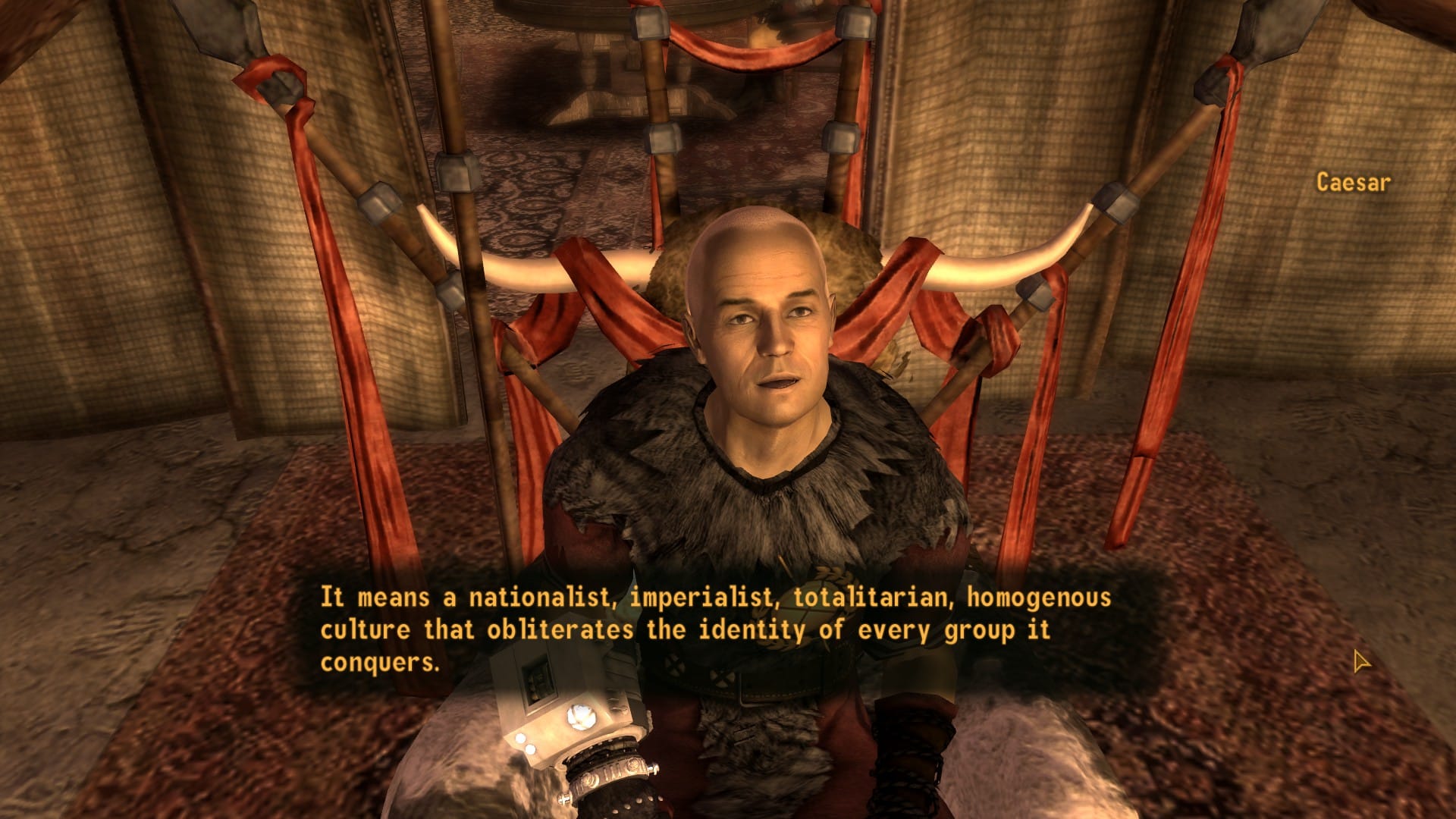
Caesar is quite explicit about his ideology: his vision of a new Pax Romana is "a nationalist, imperialist, totalitarian and homogeneous culture that destroys the identity of every group it conquers." And in that he's peculiar, because he maps much better onto current political movements than onto those from 15 years ago, when the pro-fascist far right was only a relatively marginal (though growing) alternative in Europe. In the United States, the mainstream currents of conservatism could adopt some of the characteristics Caesar defends, but they rarely appeared together.
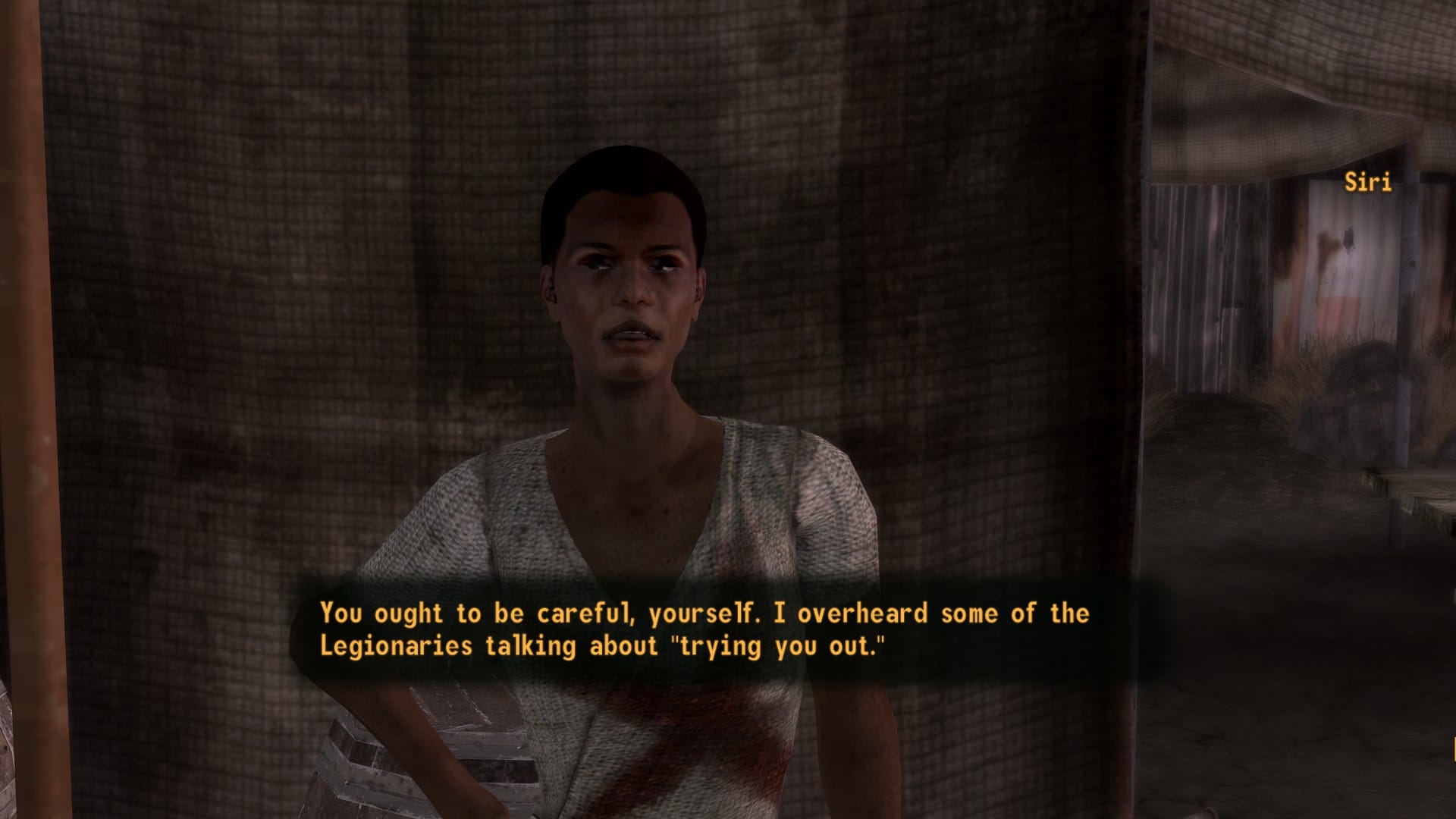
However, there's another element Caesar doesn't mention but that explains the transformation of the right: structural machismo, which the Legion takes to cartoonish levels. As a slave explains in the legionary camp, in Caesar's empire women are private property in the best of cases. If we play with a female character, there will be no shortage of insults and even threats from the soldiers.
In the real world, the entry of radicalized right-wing movements into "the online street" was Gamergate. And it didn't end with that witch hunt, but rather it was a sustained movement over time. Each campaign gave new strength and new blood to the movement, and it was one of the main drivers of Donald Trump's candidacy in 2016. The connecting thread was Steve Bannon, editor of Breitbart (the outlet that sheltered Milo Yiannopoulos, one of the Gamergate ringleaders) and later presidential strategist.
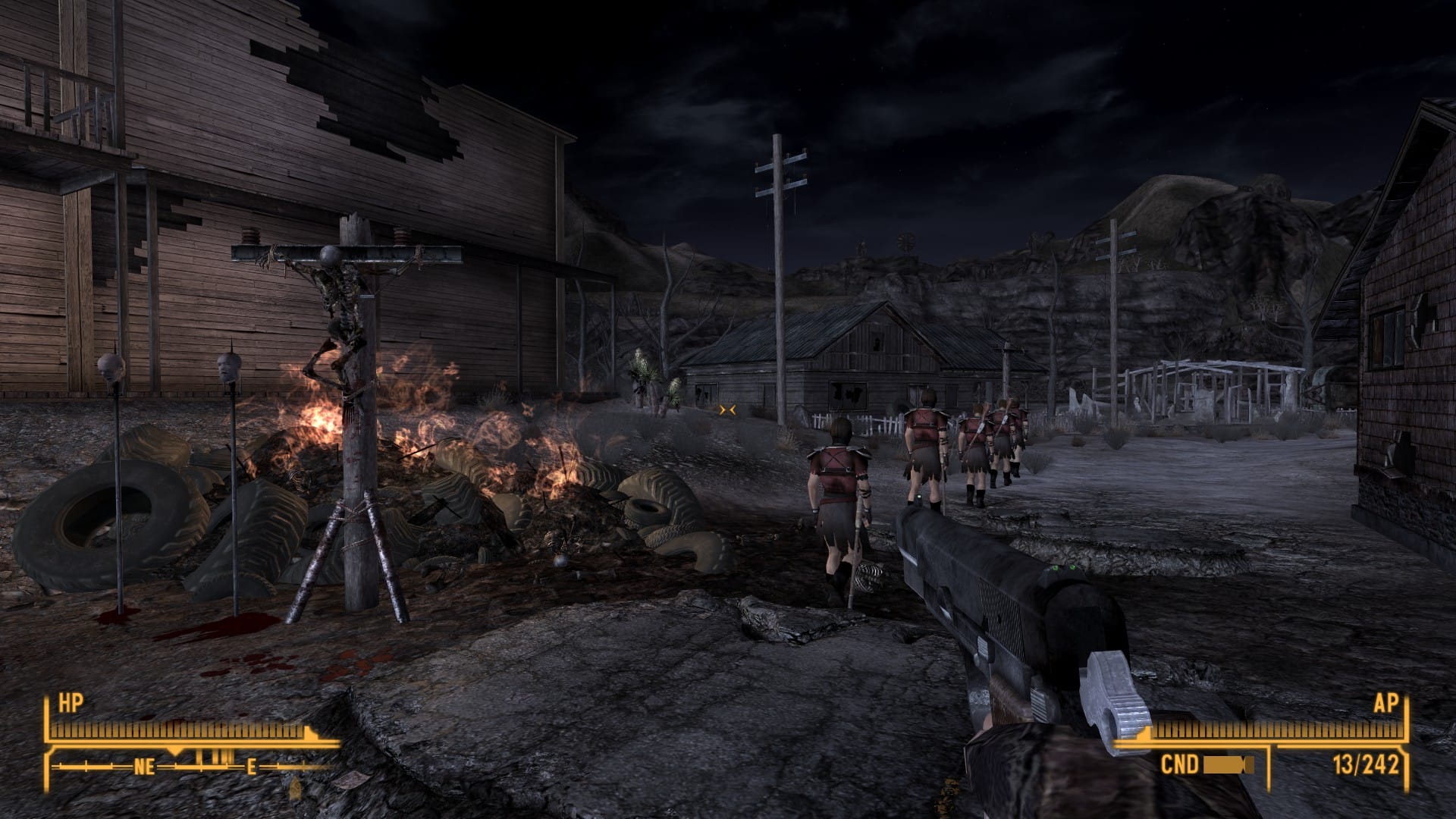
But misogyny is only the most salient example of a characteristic that also links the Legion to some manifestations of the contemporary right: cruelty. Our first encounter with Caesar's forces is in Nipton, a Mojave town where Vulpes Inculta, a Legion agent, has carried out a purge of degenerates (meaning, the entire town). The burned buildings, the streets flanked by rows of crucified bodies, Vulpes's chilling account urging us to tell others what we saw. And they're even cruel toward their own ranks, with practices like decimatio, an exemplary punishment for cowardice.
The obsession with bravery has its counterpart in Caesar's anti-technological obsession. Most Legion soldiers carry primitive weapons. The idea is that this reinforces their discipline and courage. Even beyond weapons, Caesar opposes the incorporation of medical technology, to avoid becoming dependent on it. Unless, of course, the one who needs it is him. The Simpsons may have predicted many things, but New Vegas prefigured some anti-vaxxer leaders who didn't hesitate to use the most advanced treatments when their own lives were at stake.
Although perhaps this is also a manifestation of something else they share with extremist leaders: they're WEIRD. They're an army that amalgamates different tribes in the post-apocalyptic wasteland of Arizona, using football pads to cosplay as ancient Romans. Their leader thinks the city that should be his Rome is Las Vegas, which even before the apocalypse would have been an unusual choice. It's not that different from the eccentricities of contemporary right-wing leaders or even from the mystical ramblings of the Thule Society, the esoteric group that founded the German Workers' Party that would eventually become the Nazi party.
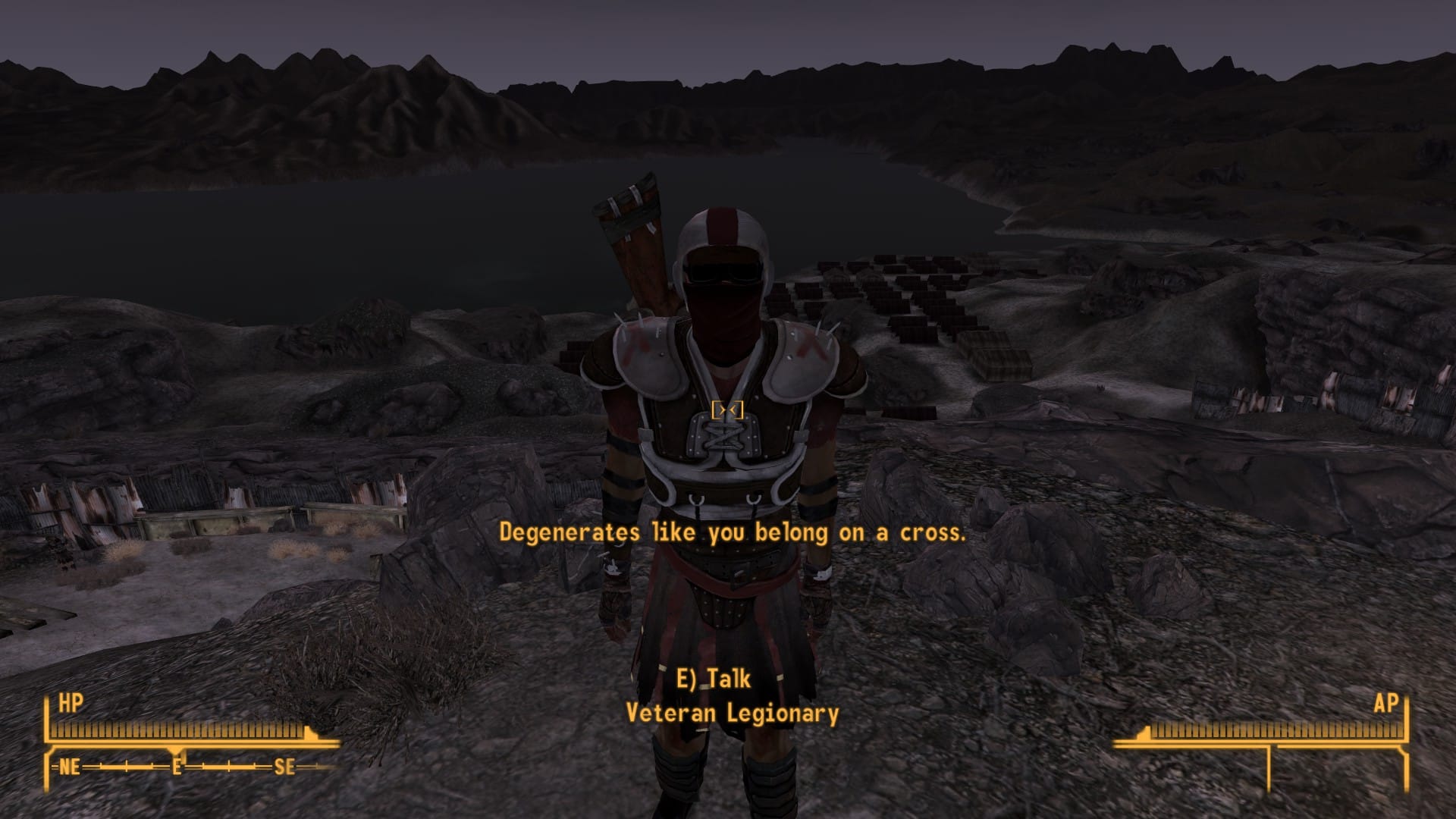
And yet, with all that... there are people who in the post-nuclear Mojave support Caesar. In some cases, the explanation is obvious (merchants asking for safer routes), but it seems like a small price in exchange for being ruled by a retrograde, misogynistic, delusional dictator.
Then I look around in the real world and it clicks. Why would a player choose this particular legion of psychopaths as their faction? Maybe because Rome may not pay traitors, but there are always traitors who trust they'll be the exception to that rule. All the same, it's still astonishing that unlike what happens to the original Julius Caesar, it seems that today for Caesar, crossing the Rubicon (or the Colorado) doesn't have enormous consequences.
Mr. House - Technofeudalism avant la lettre
It wasn't only Obama -- or the euphoric late Kirchnerism in our neck of the woods -- that organically mobilized multitudes in those years. In the United States, the other great social emergent was the Tea Party, closely associated with libertarian Ron Paul's presidential candidacy. Partly from there draws Mr. House, a character who is a faction unto himself. The embodiment of the Ayn Randian ideal, Robert House managed to survive the great war that destroyed the world in his anti-nuclear bunker in Las Vegas. Using his technology, he managed to shoot down several of the missiles aimed at the city, succeeding in preserving it. Or at least its buildings, because the people of Las Vegas were never part of the equation.
Centuries later, House is still alive, locked in a life-support sarcophagus. He only communicates with the outside world through the screens of his Securitron army, combat robots that maintain order in New Vegas. His greatest recent achievement is the reconstruction of the city, a project for which he enlisted the support of three local tribes, turned into gangs that control the different casinos of the city. As a contemporary statesman said, for that worldview, the Mafia is preferable to the State.
The idea of a "free city," without state regulation, with a tech entrepreneur as "benevolent dictator," is not something foreign to our contemporary political reality. In Trump's United States, various powerful groups are pushing for the establishment of "freedom cities", cities free from state regulations. Most of these initiatives are in various ways linked to Peter Thiel, tech entrepreneur, former mentor of Elon Musk and political godfather of Vice President JD Vance.
The idea of an entrepreneur as absolute ruler of a physical territory is perhaps the most literal and unbridled expression of the concept of Technofeudalism outlined by Yanis Varoufakis, except that his book Technofeudalism was published 13 years after New Vegas and 3 after Tecnofeudalismo by Cedric Durand.
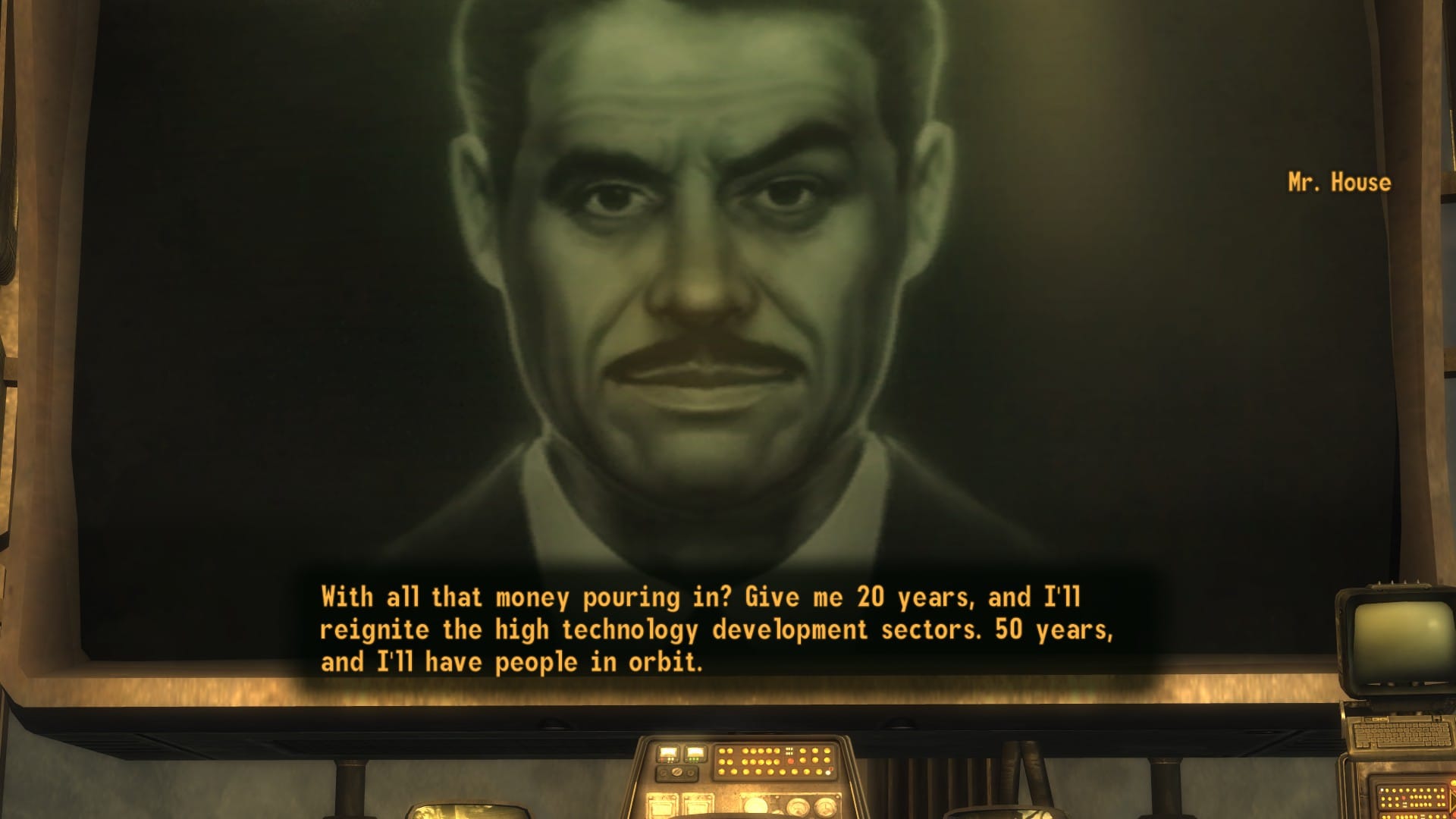
And what would House do with that power? His vision is to recreate a thriving tech sector that gives rise to a space program. According to his estimates, in 50 years he could be ready to launch rockets into Earth orbit, and in a century for interstellar colonization. But... what for? We already established that when he had the chance, House focused on shooting down missiles during the War, but he never considered the possibility of using his resources to save the inhabitants of Las Vegas.
On the other hand, his disdain for democracy is tied to his pre-war experience: destruction would be the inevitable conclusion of misgovernment. However, if the world of Fallout makes anything clear, it's that the decay of democracy in its universe had a lot to do with its co-optation by corporate interests, including RobCo, Mr. House's company. Companies like that one or Vault-Tec bear more responsibility for the nuclear holocaust than the governments that launched the bombs.
The Divergence
At this point, I think the parallels between the factions of New Vegas and some movements of our present are in plain sight. However, there's a crucial difference: in Fallout, Mr. House and the Legion are never allies, unlike what has happened in our world, with Trumpism containing opposite poles like Thiel/Bannon (or even Trump/Musk). Or, closer to home, the Milei/Villarruel alliance.
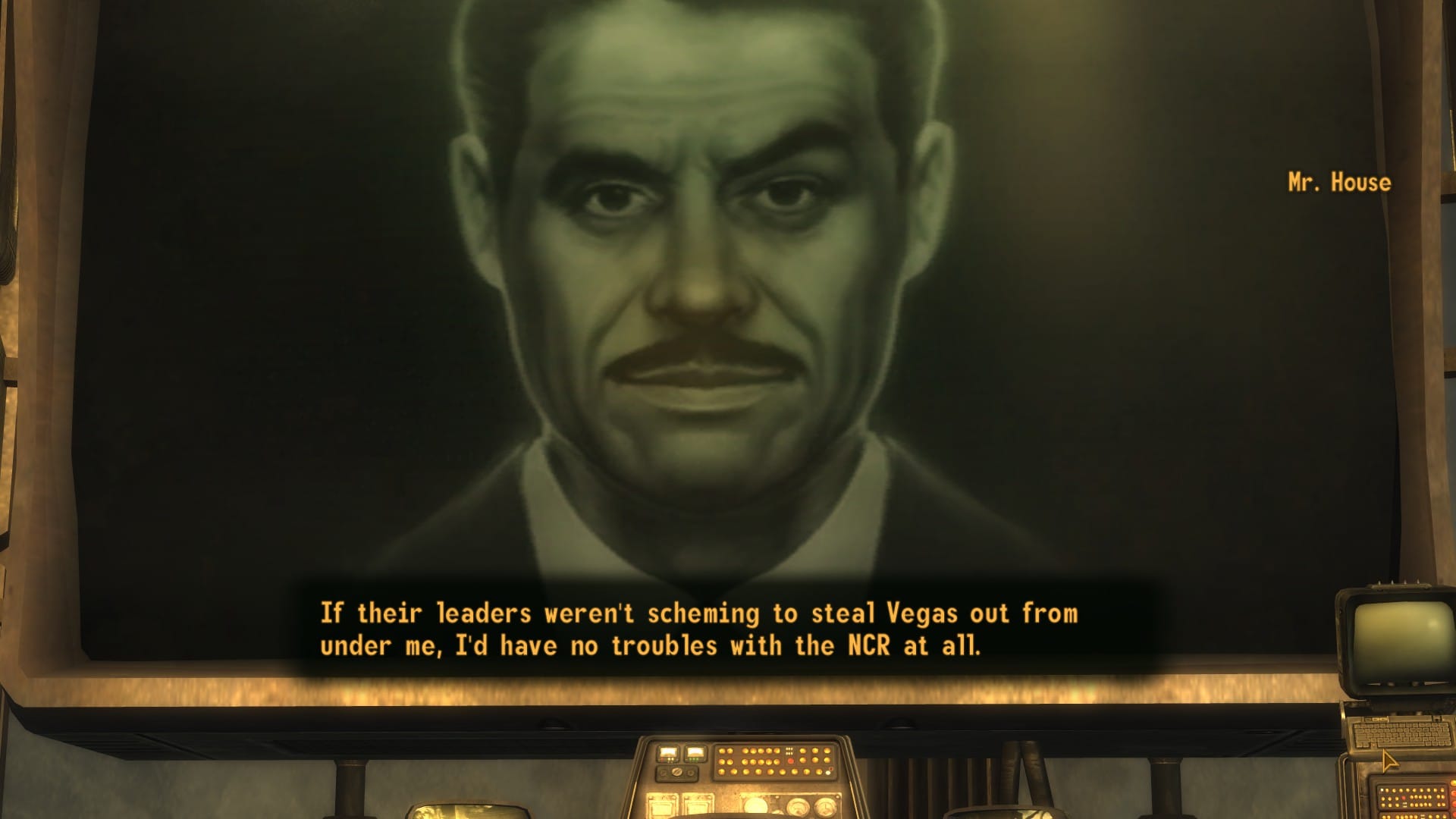
Robert House is quite clear about this: while he believes the NCR is a threat due to its imperial tendencies, he also understands he needs their tourists to survive. And, ultimately, at least the NCR is a reasonable interlocutor. That said, he can in no way allow them a military victory on their own terms. The Legion, for its part, never considers House as a potential ally: Vegas will be the New Rome that Caesar aspires to. So why, in the real world, were the different forces of reaction so quick to ally with each other?
My first intuition would be that they simply hate us more. They prioritize defeating their common enemies over coherence. However, Cory Doctorow offers a somewhat more sophisticated explanation. Every sudden political change is a covert coalition, says Doctorow (yes, the same one who talks about the enshittification of the internet). And if the history of fascism confirms anything, it's that as soon as there are no easy enemies left, they start creating them within their own ranks.
Perhaps Josh Sawyer was naive in 2010 and simply trusted in the ideological coherence of different factions. The real world prioritizes interested coexistence. The give and take of politics, as the pundits of the world would say. Perhaps it's a good reminder for well-meaning centrists, both-sidesists and other beautiful souls: political coalitions, always and everywhere, are built on sectoral interests. Maybe it would be good not to forget that the next time a legislative list seems like "a bag of cats" or "a haunted house."