Faustino Oro, Argentina's Child Star of World Chess
20 de dic. de 2025 — Pablo Gowezniansky
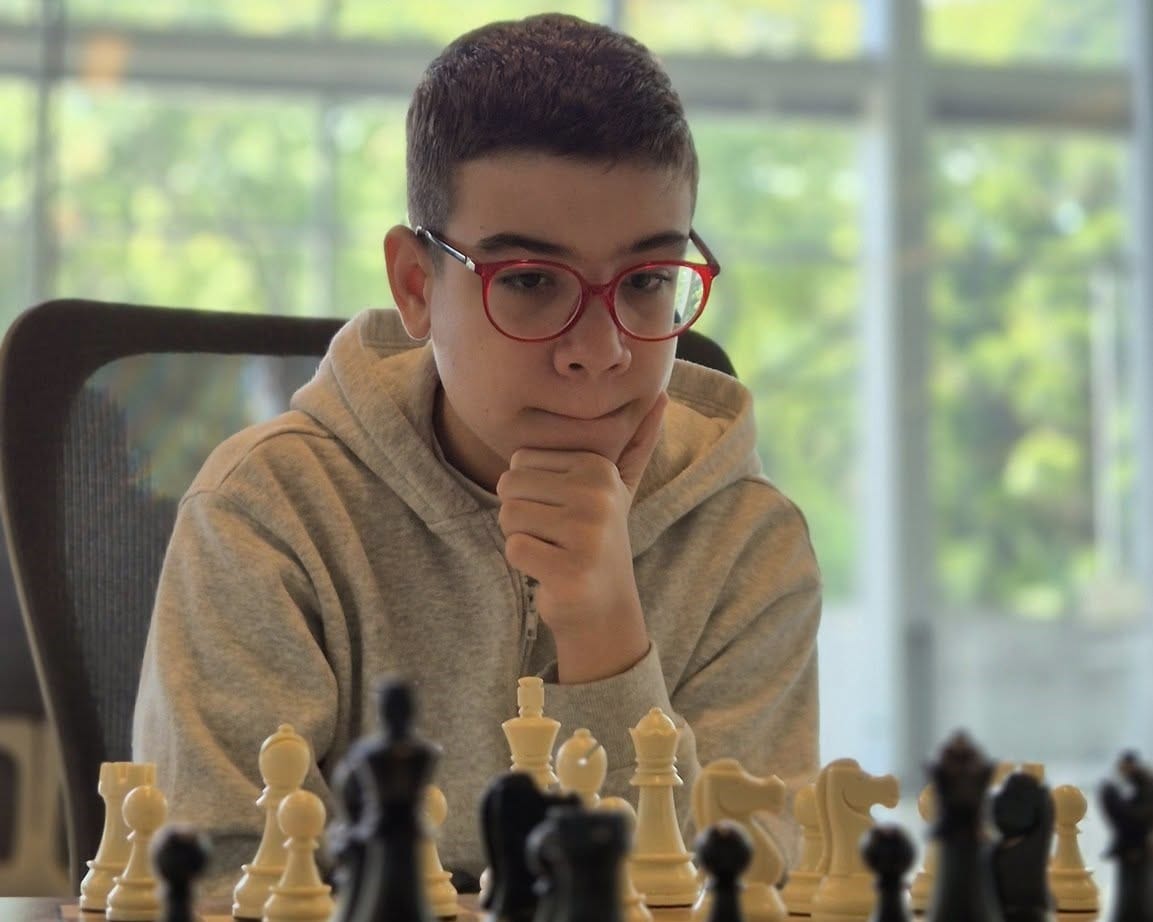
Faustino Oro is a generational talent –one of those players who show up only once in a great while. Someone with his upside is rare in Argentina, and would be rare almost anywhere. At 12, he had already shattered records in an ancient game, and a few days ago he set out to leave his mark on the Argentine Championship.
This Argentine Championship was special. First, for symbolic reasons: it was the 100th edition –round, beautiful, and striking. But there was another twist: the defending champion, Grandmaster Sandro Mareco, wasn't going to play. There was no formal announcement and no public explanation, so I started asking questions. It's not normal for a champion not to defend his title. Chess is a special sport: imagine Boca Juniors or River Plate pulling out of a tournament –impossible, right? But in individual sports it can happen. In tennis, for example, Alcaraz could decide not to defend Roland Garros –but it would take some kind of force majeure. Was that the case with Sandro Mareco, the Argentine champion?
I was lucky enough to be asked to commentate Mareco's most recent event, the Valle Medio International Open (Río Negro), from November 21 to 24. There I could ask him, face to face, why he wouldn't defend his title at the Argentine Championship, which would start on November 25 and run into early December –back to back. Mareco had chosen to play Valle Medio instead of the national championship. Why?
But before that, a different question: why was I there in the first place? Why was I asked to commentate the Valle Medio Open? Because I'm a chess commentator. It's probably the first time someone has introduced themselves to you like that. Yes –I had the nerve to invent my own job. One day I opened a YouTube channel; at some point I started streaming Faustino Oro's tournaments. And life found a way.
Sandro Mareco's Reason
But back to Valle Medio. Mareco sat down next to me. He's a big guy, and his mind runs at its own speed: he fires off variations like a machine gun. Lines race through his head like projectiles, and he spits them out for the analyst to decode (that would be me). Sitting in front of the computer, I tried to share with the audience the vertigo of a brilliant mind.
Sandro had just won round 6 with the White pieces against Eugenio Crespo. He came to the broadcast desk and shared his thoughts with me and the audience. And that's when I asked why he wouldn't defend his Argentine title. His answer surprised me. I was expecting political explanations –internal disputes, a clash with the federation, something along those lines. Not because I'm cynical, but because chess has seen plenty of fights between players and officials. A few years ago, Argentina's top player, Alan Pichot, switched federations to Spain after conflicts with the leadership. Chess isn't immune to that kind of tension.
But that wasn't it. Sandro's story went back to Brazil: a relationship that never fully ended cleanly, a five-year-old son, and a brave decision –to set aside a full month for his child. The cost? Not defending his Argentine title. I'm a father too –I have a six-year-old– and his answer hit me hard. I felt the perfect ambivalence: on one hand, wanting to see him defend his crown against the country's best; on the other, understanding the reality of a traveling competitor who lives by unusual schedules. And in the middle: fatherhood. Oh, it's a real challenge. Sandro is 38 now, and his priorities aren't the same as they were at 20.
But Faustino Oro isn't even 20 –he's a 12-year-old kid. And this was his second Argentine Championship. He had played his first in 2024, and he was incredible: 4th out of 12, with a performance rating of 2524. In chess terms, that's grandmaster-level strength –the highest title a player can aspire to. And Faustino was only 11. Still, thinking about him isn't really thinking about a child. He shows an almost unnatural maturity over the board. He's a competitive animal –the way Michael Jordan was, the way Djokovic is, the way our local phenomenon is: Lionel Messi.
Faustino arrived at the 100th Argentine Championship fully reloaded. He had spent the entire year training. He played tough events, and it wasn't easy –he had to adjust to high-level competition. If this were a TV series, we'd see the relentless training of a kid trying to become something singular. We'd see the hard moments –because there were plenty this year. We'd see effort, setbacks, frustration, and that inner noise that shows up when you realize raw talent alone no longer carries you. And then, yes: the feats.
Oro and Flores in the Argentine Championship
Oro earned his first GM norm at a record-setting age –one of the youngest players ever to do it. And he did it with style: a stunning 2759 performance rating, the kind of level that puts you in world-title territory. If you could sustain that level regularly, you'd be hovering around the top 10 in the world.
So Faustino was coming off a major success –and he wanted another. To become a Grandmaster, you need to cross 2500 Elo and score three GM norms. He had already gotten the first, and he went hunting for the second. On the horizon were two records: becoming the youngest Argentine champion in history, and –eventually– becoming the youngest Grandmaster in world history.
A quick clarification, because this thought obsesses me. For us –I'm 38– "history" carries a different weight. I've read history books, drifted back through millennia, gotten lost in eras, civilizations, slow changes. For an adult, history is vast and heavy. But for a kid who's been breaking records since childhood, the word "history" lands differently –more immediate. For us, Faustino is rewriting history. For Faustino, he is his own history; it's his normal. He knows what he's doing, of course. But he also normalizes it. And that, strangely, helps him: it shrinks the pressure, turns down the drama. For chess fans, it's unbelievable. For him, it's another month of competition.
So Faustino came to the Argentine Championship chasing two records –but standing in his way was the man who could crush both dreams: Grandmaster Diego Flores. He's 43, with seven Argentine titles already. If he won this one, he would tie the all-time record held by Argentina's greatest legend: Miguel Najdorf, with eight national titles. Oro and Flores –both fighting their way into the country's biggest chess history. What a tournament we had ahead of us.
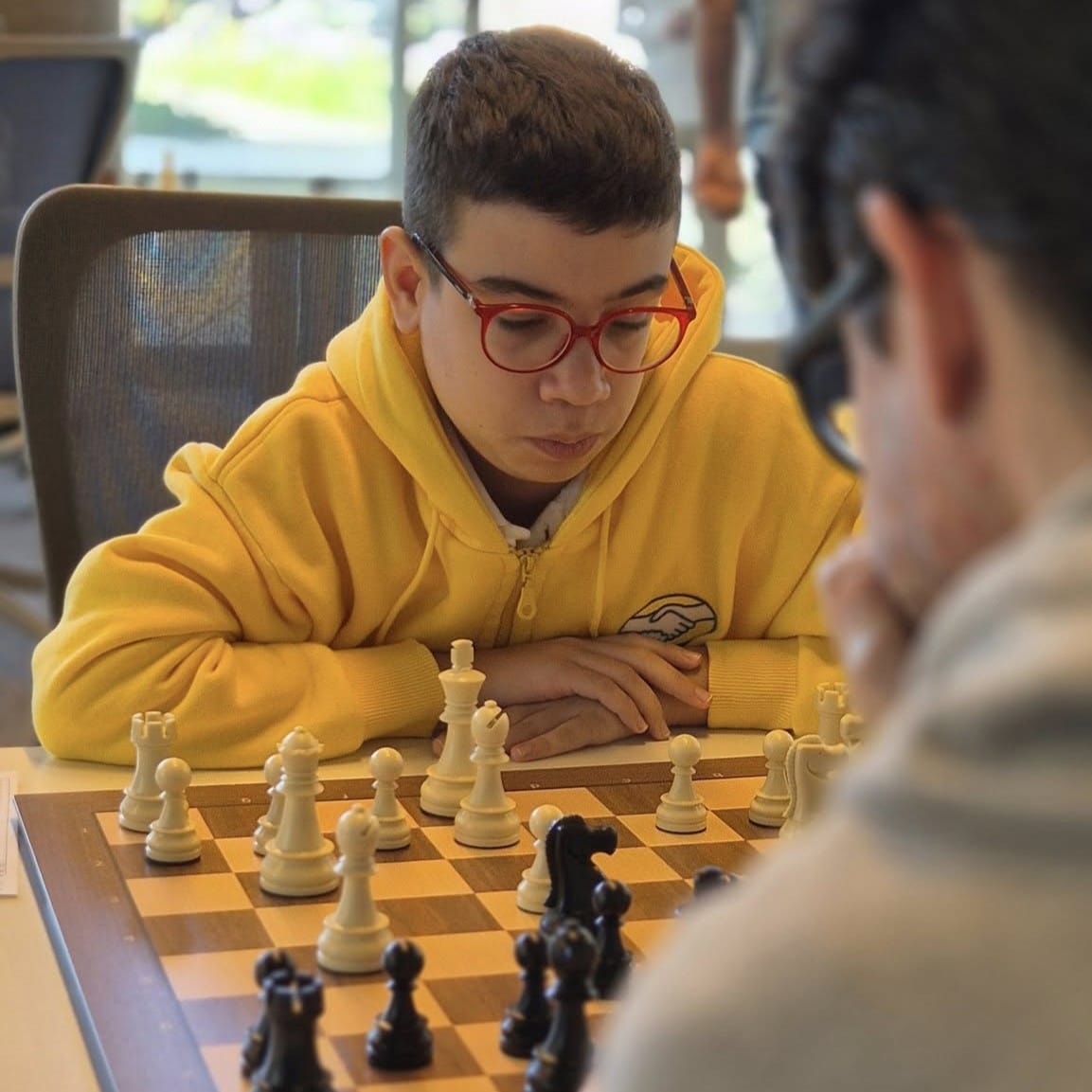
The "Pibe de Oro" Takes Off
Last year, Mareco won the title with 8.5 points out of 11 rounds –roughly what it takes to take the championship, and also the exact score that often lines up with a GM norm in this kind of closed event. So if Faustino wanted his second norm, he would very likely need to win the whole thing –becoming the youngest champion in history. And his start was phenomenal: in the first four games he scored three wins and a draw, taking sole first place. The spotlight was locked onto him; newspapers ran stories about his blazing start. Everything was going perfectly –until round 5, when Grandmaster Leonardo Tristán showed up.
Faustino surprised everyone with an unusual line in the Scotch Game and –true to his all-or-nothing style– sacrificed a pawn in search of glory. But Tristán's defense was clever and solid, and Faustino's advantage evaporated fast. In time trouble, Tristán found the best moves and won. It was a punch to the Golden Kid's dream.
Even so, he bounced back and won the next two games, with a competitive spirit that's hard to believe at his age. After seven rounds, Faustino Oro and Diego Flores were tied for first on 5.5 points. With four rounds left, Faustino essentially needed two wins and two draws to secure his second GM norm. But then came International Master Julián Villca, one of two players from Salta in the field (the other was Pablo Acosta, another top local player, who had also played Valle Medio). And that's a lot for anyone: two very strong tournaments in a row, without even a single day of rest.
In round 8, Faustino faced Villca, who had White. Villca's opening looked unambitious –but it was perfect: it gave Faustino too many options, no simple lines, and that isn't his strongest territory. Mareco recently said Faustino struggles in "irrational" positions. Another grandmaster told me privately that he has "a noticeable weakness in certain messy, unclear positions". This isn't a criticism –it's normal. Every chess player has strengths and weaknesses. Except one: Magnus Carlsen. Magnus is Nietzsche's Übermensch.
Round 8: The Test
The position turned messy. The right plan wasn't obvious. Faustino has a habit of playing for a win in every game, and this one was no exception: in an equal position, he tried to unbalance things. But the cracks showed, time slipped away, and the critical mistake came with only 11 seconds left on the clock. Faustino lost, and Diego Flores won –putting the seven-time champion half a point ahead. In round 9, Faustino drew. Flores, meanwhile, beat Villca and extended the lead. He was now a full point ahead with two rounds to go.
And then we got what everyone wanted –the scene the tournament seemed to be saving for the final act. In round 10, Oro and Flores finally faced each other: Faustino with White, Diego with Black. Everything could be decided right there. Faustino opened with 1.e4; Diego answered with the Sicilian Defense. The game entered complex waters almost immediately. Faustino built a promising edge, and Diego's king looked delicate in the center –one slip and the position could collapse. But then the winner's instinct kicked in. Diego took risks, pushed his pawns, harassed Faustino's queen, and played a move that left everyone stunned: an exchange sacrifice that froze Faustino's blood. If he took it, he'd be close to lost. If he declined, his position would still be worse –and hard to play.
He chose not to take it, sensibly. But when you get hit with a surprise that sharp, it's hard to get back on track. Faustino missed a key attacking idea, and the game ended with a spectacular queen sacrifice to seal it. Diego Flores, with Black, had beaten the future of world chess.
In the final round, a draw was enough for Flores to claim his eighth Argentine title, finishing a full point ahead of second place on 8.5/11. Argentine chess history had shifted again: Diego Flores tied the record of the legendary Miguel Najdorf, the Polish-born grandmaster who fled war-torn Europe in 1939 and rebuilt his life in Argentina. Faustino Oro finished fifth on 6.5 points.
It was an adventure that had everything –and it proved, once again, that no matter how hard the challenge is, this child genius always goes for the biggest prize. In sports, sometimes you win and sometimes you lose, but the best carry something extra –something hard to replicate: a mind of steel. It's what makes you sit back down after the hit; what forces you to keep staring at the board when the result is turning against you; what refuses to bargain with discomfort and won't hide behind excuses. It looks forward –far out on the horizon– and upward, toward the sky. Faustino has that in abundance.