Antonio Mamerto Gil, the Gauchito Who Lived by His Own Code

26 de ene. de 2026 — Cocó Polinari Sabattini
In Argentina, the gaucho has long shaped a way of seeing the world —rooted in rebellion and emancipation. A way of pushing through an established order with a system of one’s own. Even if it now feels distant, almost mythical, that figure leaves behind a legacy: the option of not surrendering. Living by one’s own law. Turning rebellion into a harvest whose fruits are later shared with others who carry the same sorrow.
“Sin saber qué hacer de mí / y entregado a mi aflicción / estando allí una ocasión / del lado que venía el viento / oí unos tristes lamentos / que llamaron mi atención.”
(José Hernández, La vuelta de Martín Fierro, original in Spanish)
The Bandit
There is one kind of gaucho that concentrates that tension: the bandit. Eric Hobsbawm did not treat banditry as a homogeneous phenomenon. In rural societies, he distinguished several figures: the social bandit, sustained by his community and pursued by the state; the avenger, marked by personal and excessive violence; and the haiduks —organized bands of horsemen who saw themselves as free men and who, in some territories —like ours—faced foreign conquest.
All of these figures appeared in Argentina, before and during the country’s formation; at times they were described as gauchos alzados —gauchos in revolt. In Facundo, Sarmiento portrays the gaucho malo as a man both hunted and admired.
“Justice has pursued him for many years. His name is feared —spoken in a low voice, without hatred, almost with respect.”
(Domingo Faustino Sarmiento, Facundo)
The context Sarmiento writes about —conscription, displacement, and the expansion of the state— became a seedbed for stories of gauchos who, after tasting the misfortunes of someone else’s gunpowder, chose to live outside an order that demanded obedience and kept them on hand to kill men like themselves.
Antonio Mamerto Gil is part of that lineage.
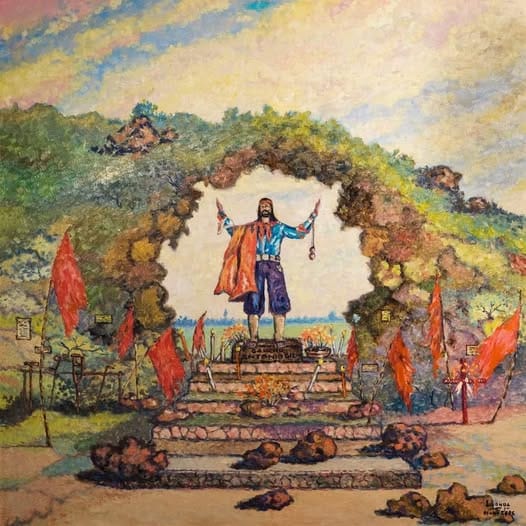
Gaucho Antonio Gil
Antonio Plutarco Cruz Mamerto Gil Núñez was born in Paiubre, Corrientes, sometime between 1840 and 1847. Like so many gauchos, he was forced to fight in the War of the Triple Alliance; when he returned, he was conscripted again —this time by a colonel aligned with the Liberals— to fight in the civil wars.
In those days, oral tradition says, Antonio dreams of the Guaraní god Ñande Yara, who brings him a revelation: do not spill the blood of your own. Gil —identified with the Colorados, a federal partisan like many 19th-century gauchos— recognized the command as a foreign war, not his own. Like Martín Fierro fleeing the fort so he won’t keep killing on other men’s orders, he saw there was nothing to decide: he bent destiny to his will and deserted.
“Why should I fight and spill blood?”
With that decision, he accepted that his life would unfold on the margins of the law. Fleeing and surviving through sheer daring, he came to see that violence was never just one thing —and he turned it into a tool. His myth was forged in life: on the run, he moved from town to town, joined the festivities, stole and distributed among the poor, seduced policemen’s women, and found shelter with families who chose to hide him.
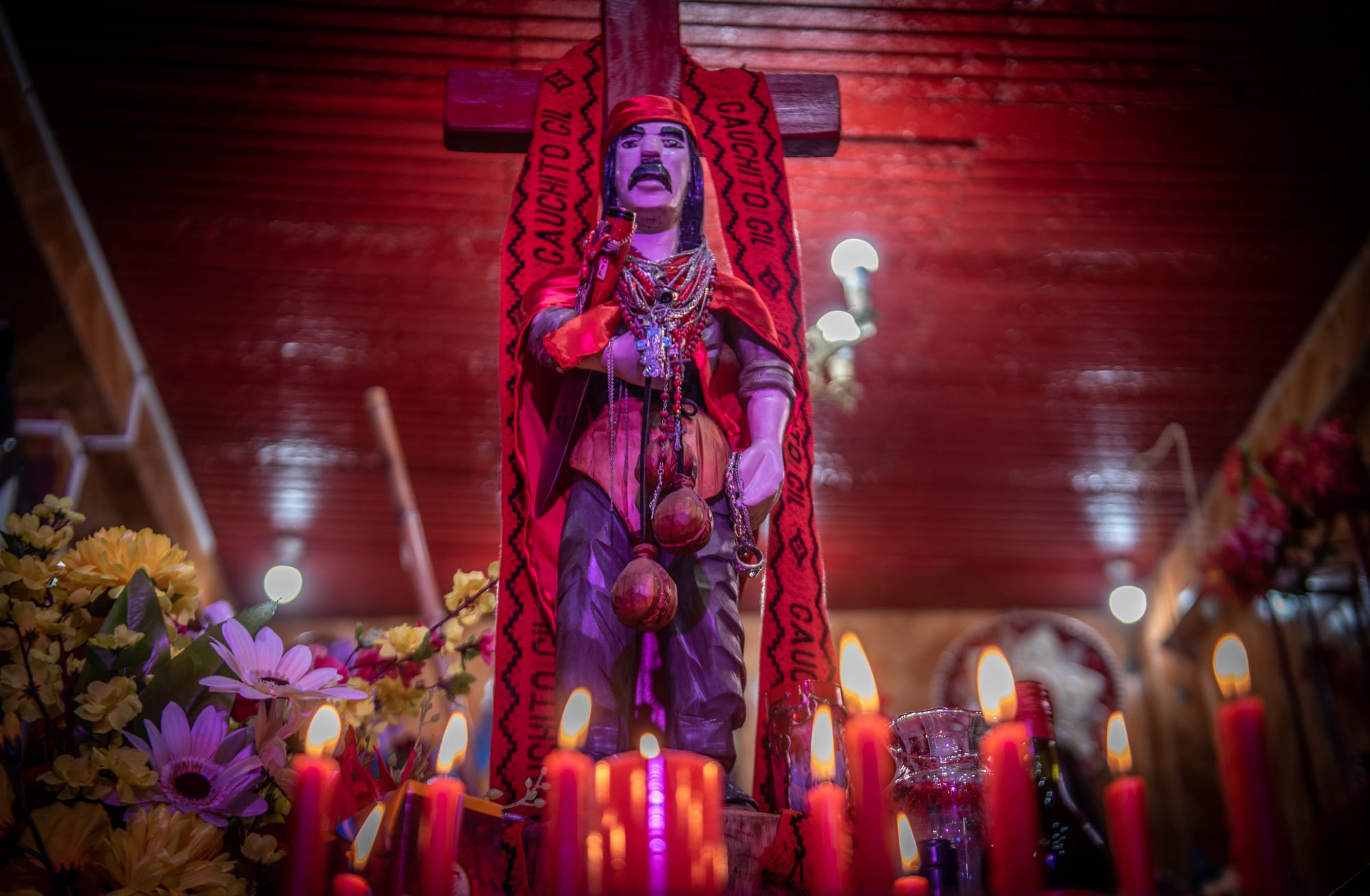
Antonio existed because he created his own system. His entire life was syncretic: in his beliefs coexisted God, San Baltasar, and San La Muerte —whose image he wore on his chest as an amulet. God, because some versions describe Mamerto as a gaucho with a rare skill for his time: he could read, and would read the Bible to himself and to his companions. San Baltasar, meanwhile, is the Black Saint venerated in Corrientes and honored by devotees and promeseros (people fulfilling vows) through dances and drum-driven celebrations with an African imprint; he is treated as a popular saint while also being tolerated by the Church as part of the Three Kings tradition. San La Muerte is different: legend says he was a Jesuit monk in Guaraní lands who abandoned his mission to heal the poor. Accused of witchcraft, he was unjustly imprisoned and isolated; he died behind bars and became an object of devotion among the humble. Antonio Gil was devoted to them all —a man of faith who built it without commandments, in his own image and likeness.
Crime, Desire, and Violence
In the same way, crime, desire, and the management of violence coexisted in how he inhabited the world. He would rather be read as a criminal than surrender —docile— to an order that refused to recognize his reasons. From there, he crossed a threshold into possibilities that seemed endless. Storytellers —skeptics and believers alike— embroidered the account: Cruz Gil could be anything. The myth was contradictory, and that contradiction made room for as many versions as there were ways of remembering him.
Chronology —and the way events supposedly unfolded— stopped mattering, because the myth adapted to the desire of whoever told it. But one fact remained a common starting point: Antonio stepped outside the order and became a problem for the state. He refused —and made that refusal his reason. It was that trait that condemned him and offered a justification to the man who ended his life on January 8.
His final days were told in multiple versions, all of them insisting on the same thing: the stubborn presence of the world he built for himself. Some said his sin was falling for a police chief’s wife.
Another version —the most charged— said that on January 6 the gauchito joined the celebrations of San Baltasar. There was drinking and dancing; Santo Cambá was honored for two days straight. When the feast ended, exhausted, Gil and his men lay down for a siesta beneath a tree. They did not expect a sergeant to catch them, seize them, and take them toward Goya. Everyone knew that on that road prisoners often failed to reach their destination: they were executed at the roadside.
About eight kilometers north of Mercedes, the troop stopped to rest the horses. Gil’s companions were shot on the spot, but the bullets did not touch him. Two shots ricocheted off the amulet hanging at his neck. The soldiers —aware of the gaucho’s reputation— were shaken: the myths surrounding the matrero seemed to confirm themselves. They refused to kill him, but the sergeant ordered him hung upside down to avoid being paralyzed by his gaze, and there —beneath the tree’s shade— he slit his throat.
Antonio’s last words to his executioner unfolded almost like a promise:
“With the blood of an innocent man, another innocent man will be cured.”
All the men present carried the discomfort of what they had done. But the sergeant returned home to two misfortunes: a note informing him that Mamerto was innocent, and his own child —racked with cough and fever— struck down by an inexplicable illness. The memory hit him: Antonio’s words.
He picked up his child and returned to the tree. He laid him on the ground, still damp with blood, smeared his hands with it, and began to pray —asking the gauchito to intercede with God. Thus the first devotee was born: his own executioner. Later he returned again, this time on foot and carrying a wooden cross on his shoulder. He took the body down, buried it, and as he planted the cross in the earth, he gave thanks.
He had killed an innocent man —and drove into the soil a sign meant to outlast him.
Antonio Mamerto Gil, correntino and miraculous
gaucho of God, as broad as the Paraná
friend of heaven, lamp for the abandoned
how many have come to kneel at his cross,
as if seeking the light that gold has always denied […]
From the miracle he granted the executioner
he left no one behind on foot, the most faithful little saint,
for he is and was without quarter, amid red ribbons
one of those gifted souls who, even after death,
keep serving, by good fortune, all their people.
(Saúl Huenchul, Historia del Gauchito Gil, adapted in English)
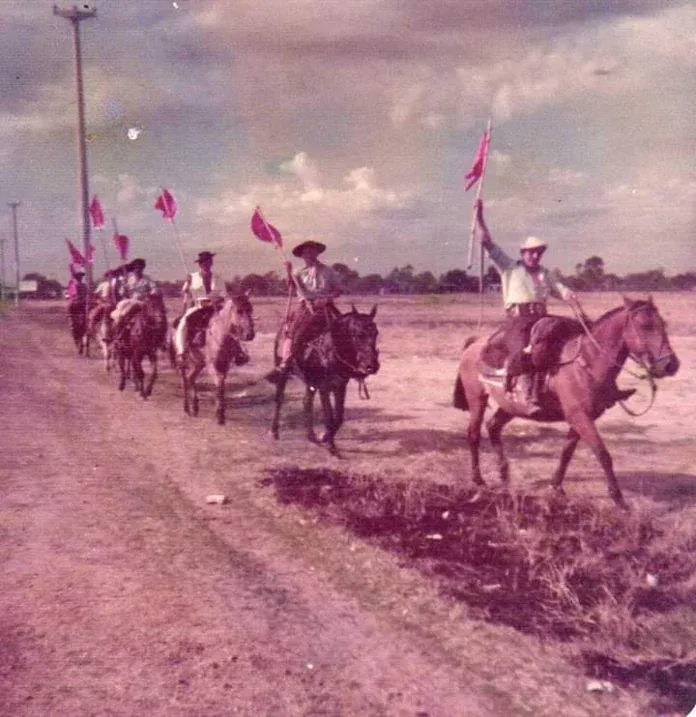
It is almost comical how that insistence on being a nuisance to those who would impose order is something Antonio kept expressing even after death.
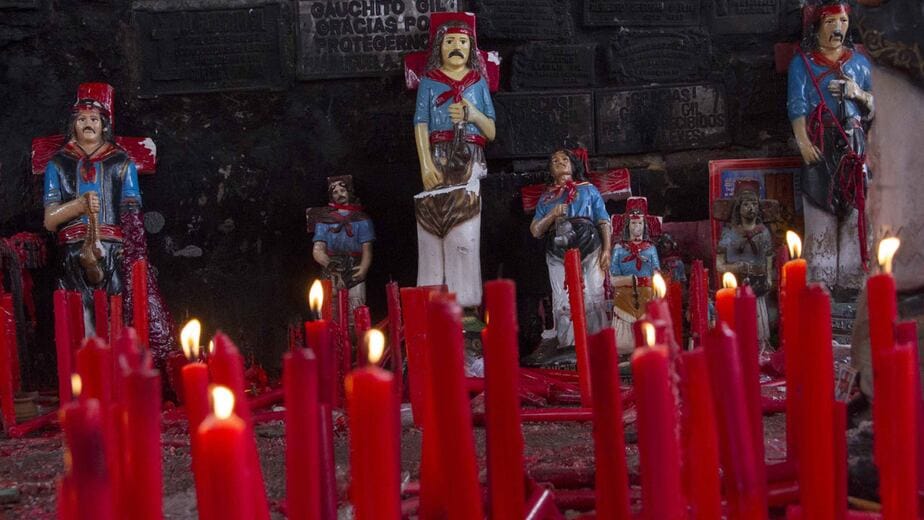
One story, told in El culto al milagroso Antonio Gil “El Gauchito” (1996), goes like this: a highway was to be paved, and the planned route ran straight into the roadside shrine. To the engineers, the solution was obvious —move the sanctuary a few meters into the field, pave the road, done. The workers warned them it was a bad idea, but no one listened. They were ordered to obey. Many quit on the spot. Those who stayed witnessed the gaucho’s refusal: cranes broke down; machines stalled for no reason. Supervisors lost their crews, who fled spooked by the omen. Then those who gave the order began to fall ill. It became clear that the altar could not be moved. The gaucho would not allow it.
Something similar happened to the landowner where Antonio was killed, buried, and later venerated. Fed up with his property becoming a gathering point for devotees, he requested that the body be moved to a cemetery in Corrientes. Soon after, his life turned upside down and he became the target of persistent bad luck. He realized it was no coincidence and decided to leave the body where it was. In the end —though for other reasons— the remains were moved to the cemetery anyway.
His relationship with Catholicism followed the same logic of friction. The institution did not recognize him, yet he existed. He bore a cross, and people prayed to him as an intermediary before God. Though often labeled a “pagan saint”. priests in the areas surrounding the sanctuary still opened their doors to devotees and miracle-seekers: they blessed the images, kissed the small statues, and even celebrated Mass alongside his cult.
The Will to Defy Order
Myth outlasts time. The mysteries surrounding his life provide reasons to feel close to him. In that order of his own —chaotic, syncretic, unpredictable— anything can happen. Iorio once described him as “a spiritual entity that mediates between the deity and the incarnate man”.
There is an ultimate meaning here: to understand and share the pain and courage of a man who grew out of spontaneous opposition to what confronted him. In that sense, we might do as he did —becoming, ourselves, a tribute to daring.
“Fill me with your courage and grit, so I can face the harsh days I must endure.”
(Prayer, Day 6 of the novena to Gauchito Gil)