A Guide to Getting Lost in the City: From the Flâneur to Psychogeography
We explore psychogeography and the art of drifting: from the French flâneur to Grant Morrison’s “magical drift.” We’ll see how to break out of tunnel vision, wander aimlessly through the streets, and turn aimless wandering into a rediscovery of the city’s hidden soul.

26 de mar. de 2026 — Marcelo Acevedo
The city can be navigated automatically, trapped in our tunnel vision that barely allows us to see just enough to avoid colliding with another pedestrian or getting run over, or it can be read like a mystical (and even magical) earthly map, traversed through improvised yet conscious practices like flâneurism or drifting, methods that go beyond mere aimless strolling and can be used as a system to alter our awareness of the artificial environment. The discipline that studies the impact of these urban geographical settings on our emotions and behavior is known as psychogeography.
Flâneur
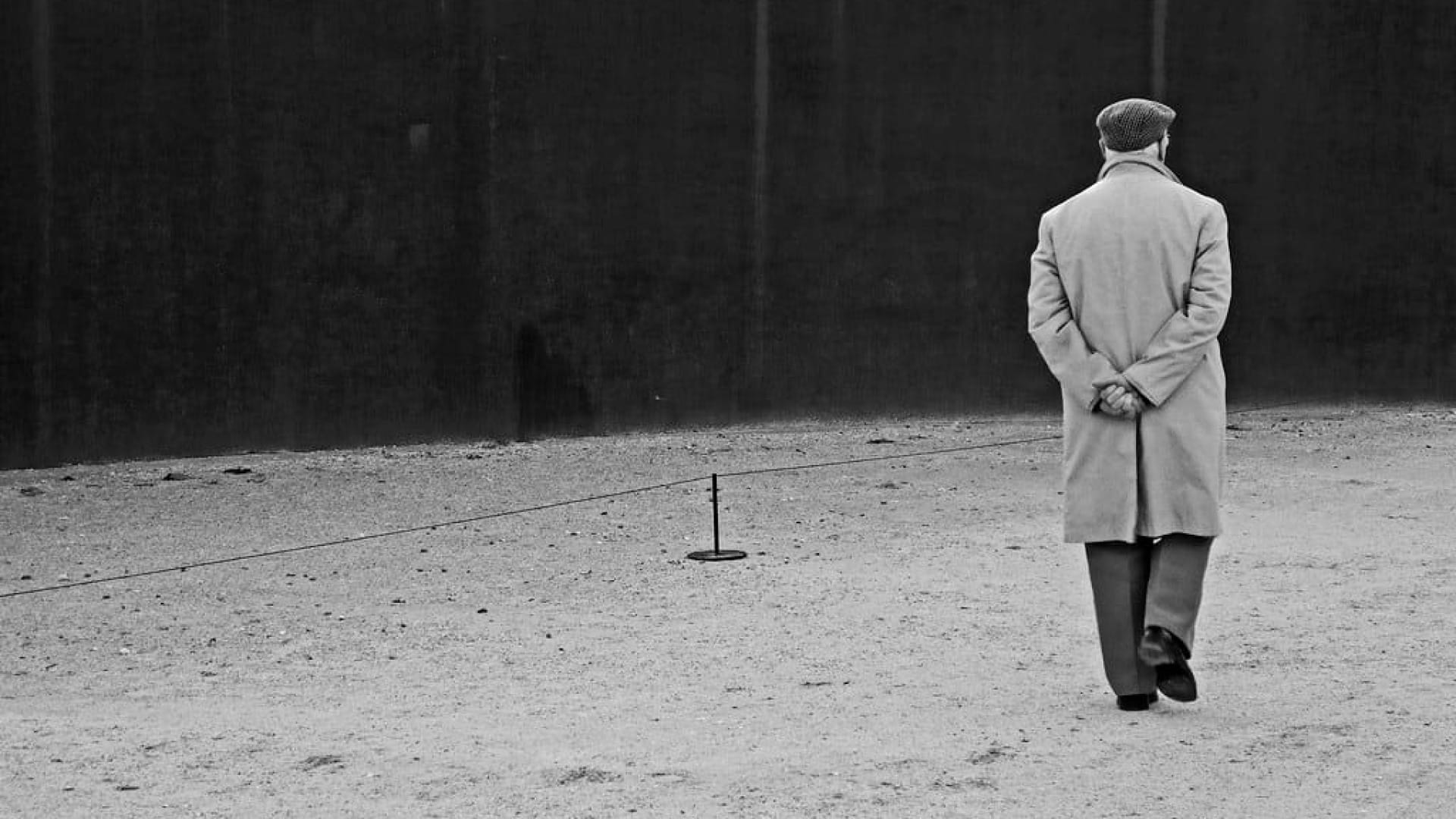
The concept of psychogeography has its roots in the figure of the flâneur and the act of urban drifting. The flâneur was a character that flourished in France between the early and mid-19th century, an interpreter of city life who wandered its streets on foot without any specific plan, allowing himself to be guided by intuition; a walker who analyzed and absorbed the urban landscape through mindful attention to details, interpreting the symbolism, messages, and information (indiscernible to the average passerby and the inattentive eye) that the cities offered him: strange architecture, abandoned objects, anomalous artifacts, marks and graffiti, passages.
Through the less-traveled streets, dimly lit corners, forbidden doors, and dark alleys, the flâneur walked with his particular poetic-spiritual quest, allowing himself to be amazed by the oddities of a city brimming with life.
The Paris of that era was a city abundant in bridges: above them traveled the bourgeoisie in their modern cars, while below, through the less-traveled streets, dimly lit corners, forbidden doors, and dark alleys, the flâneur walked with his particular poetic-spiritual quest, letting himself be astonished by the oddities of a city full of life. In this way, the daytime dandy mingled with the bourgeoisie, and the nocturnal flâneur met with the hidden losers, the defeated of history: drug addicts, dealers, criminals, pimps, prostitutes, vagrants, street mystics.
In the opening lines of his book Childhood in Berlin around 1900, German philosopher Walter Benjamin writes: “It matters little not to know how to orient oneself in a city. To get lost, however, in a city as one gets lost in a forest, requires learning.” The figure of the flâneur (embodied in the poet Charles Baudelaire) was revived by Benjamin in texts like The Arcades Project, A Poet in the Age of Capitalism, or On Some Themes in Baudelaire. For Benjamin, the flâneur is a free spirit who moves following his own dreamlike cadence, paying no heed to the frantic rhythm of the city and its always hurried pedestrians; an alienated detective of the urban landscape, who vanished with the advent of consumer society.
The Psychogeographer
It was the members of the Situationist International (the political and artistic avant-garde of the 20th century that became a cornerstone of the theoretical and practical framework of the cultural revolts during May 1968, whose main figure was philosopher Guy Debord) who first used the term drifting to refer to a technique of uninterrupted steps through diverse urban environments, where one or more drifters renounce their routine motivations for an indeterminate period to surrender to walking and exploring the cities for hours, getting lost in random passages, wandering without a specific goal, and observing the possibilities that the city offers with its urban landscapes. The drifts proposed by the situationists could last an entire day (the interval between two sleep periods, unrelated to sunrise or sunset), and the most extreme could extend for four or five days.
The concept of psychogeography has its roots in the figure of the flâneur and the act of urban drifting. According to Guy Debord, psychogeography proposes the study of the precise effects of the geographical environment, whether consciously planned or not, acting directly on individuals' emotional behavior. Psychogeographers assimilate these effects through the exploration of streets, analysis of architecture, and interpretation of sculptures and graffiti, using drifting as a means of assimilating urban space. The concept of drifting, Debord states, being directly linked to the recognition of effects of a psychogeographical nature and a playful-constructive behavior, is opposed in all aspects to the classic notions of travel and stroll. The situationists did not find the formula to overturn the world in books, but rather by wandering. It was these wanderings that perhaps later translated into writing. “By reading the streets, and documenting it on paper, the flâneur functions almost like a journalist whose task includes both inquiry and information gathering, as well as reflection on contemporary impressions,” writes Fiona Songel in The Art of Reading the Streets.
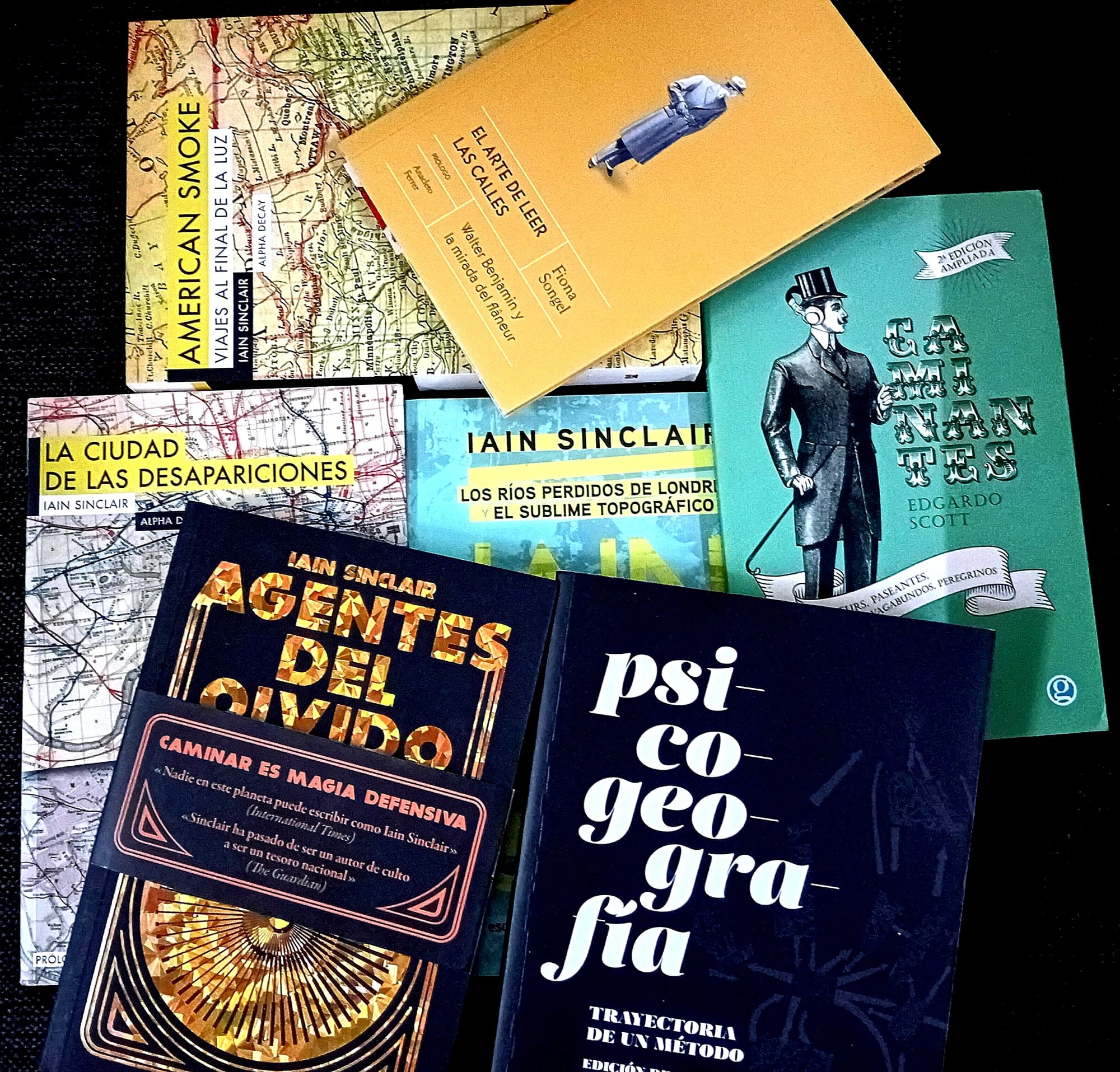
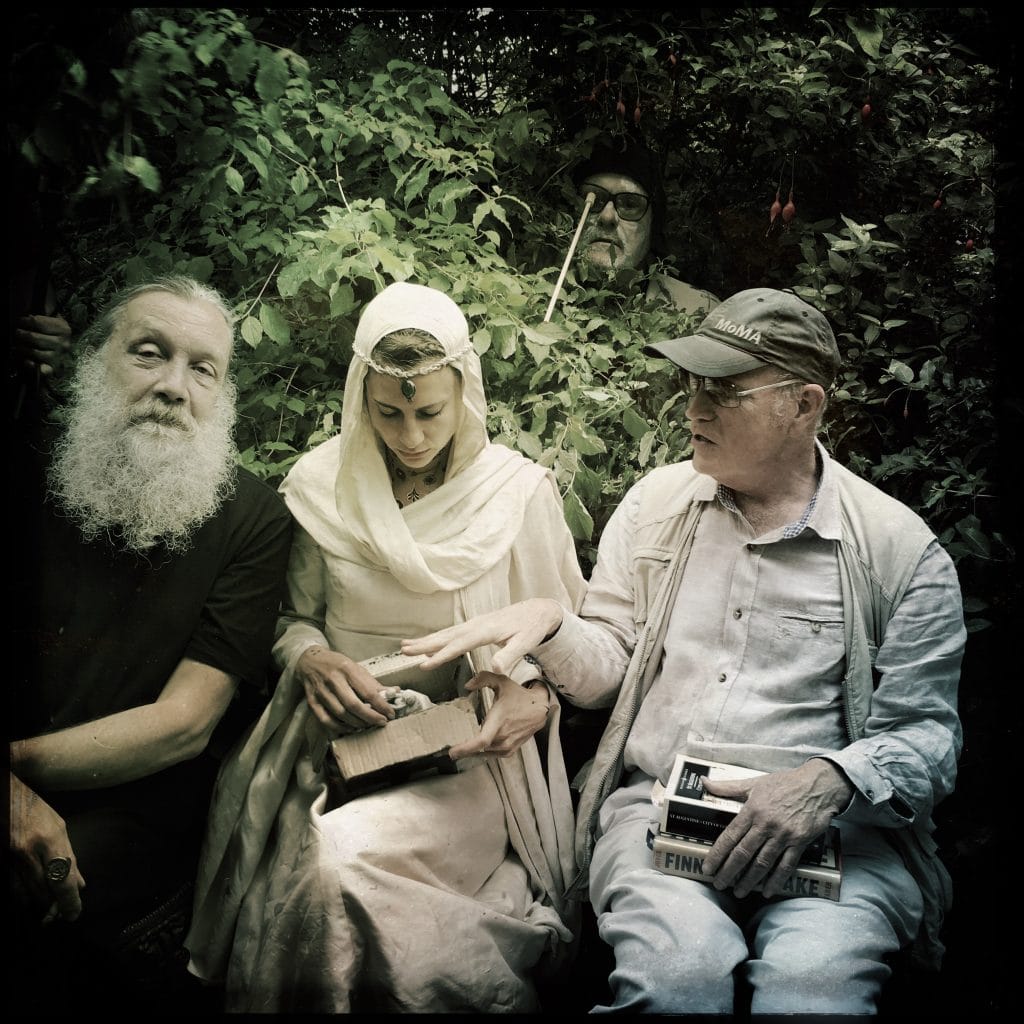
Perhaps the quintessential modern psychogeographer is writer Iain Sinclair, a living legend of English literature, author of foundational books of the revival of psychogeography such as Lud Heat, London Orbital, The City of Disappearances, and The Lost Rivers of London / The Sublime Topographical.
Sinclair believes that walking can become a magical act, a ritual that connects us with the invisible layers and vibrations of places, providing us with information that can be linked to reconstruct the history of the city. He employs the practice of drifting and psychogeography (terms he admits to having cannibalized from French situationism) to connect with the psychosis of the place where he lives and to write about it.
One of his most important works arose from the unhealthy obsession Sinclair developed with the orbital motorway M25 (at that time the largest ring road in the world) built by Margaret Thatcher in 1986. The English psychogeographer viewed Thatcher as a witch who introduced occultism into British politics, a dark sorceress who absorbed the grim vibrations of London and generated a cursed aura that was gradually destroying the city, and he believed that the inauguration of the M25 on October 29 (two days before Halloween) had tremendous occult significance. For Sinclair, that motorway was a conceptual parapet, a safety collar to strangle the metropolis, the witch's circle that Thatcher had placed around London to protect her domains. Thus, to counteract the black magic imbued in the M25 and exorcise it of Thatcherian demons, he employed psychogeography through a kind of “controlled drift,” seeking to assimilate the concrete and asphalt beast by walking it counterclockwise for months. This psychogeographic act was later captured in a transmedia project (book and documentary) called London Orbital.
Sinclair believes that walking can become a magical act, a ritual that connects us with the invisible layers and vibrations of places, providing us with information that can be linked to reconstruct the history of the city.
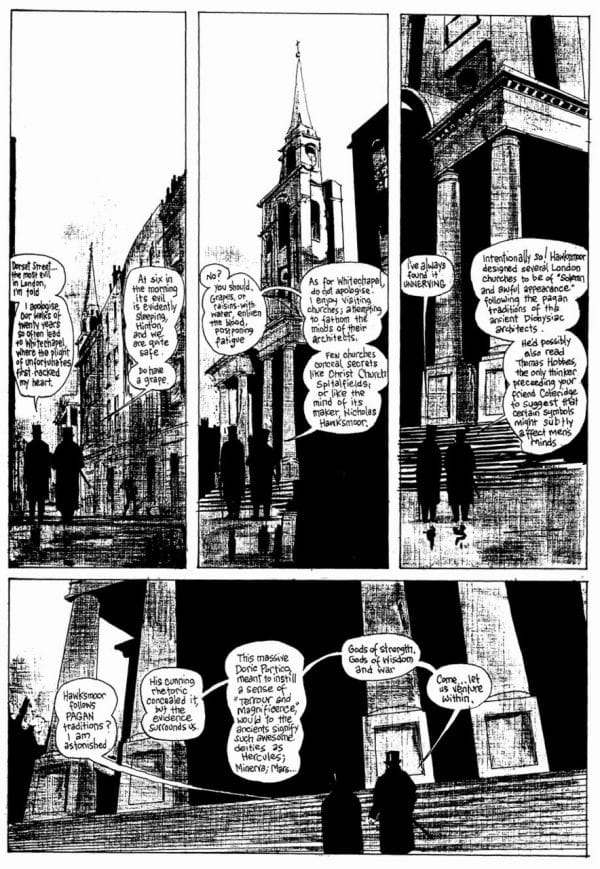
Sinclair is also the author of White Chappel, Red Traces, a novel with a clear psychogeographic spirit that takes the reader on a walk through the hidden areas of London's darkest corners where (following the clues of British journalist and researcher Stephen Knight) he risks a hypothesis about the true identity of Jack the Ripper. This novel and other texts by Sinclair, such as Lud Heat, inspired writer and magician Alan Moore to create From Hell, a cult graphic novel that deals with the identity of Jack the Ripper and paints a portrait of Victorian London through drifts, occultism, magic, epiphanies, and murders. The fourth chapter is a clear example of the psychogeography understood by Alan Moore: the royal physician William Gull and his coachman embark on a cart ride that takes them through the East End of London, an excuse to reveal to the reader the hidden history of the city through its architecture: rites, symbolism, and mythology imbued in sculptures, buildings, graves like that of mystical poet William Blake, and above all, cathedrals and obelisks built by baroque architect and freemason Nicholas Hawksmoor, to whom Sinclair dedicated one of his most famous texts: Hawksmoor, His Churches. Regarding this writing, Javier Calvo (the Spanish translator of Sinclair's work) wrote in the prologue of The City of Disappearances that, thanks to urban drifting, the mysteries and their hidden archaeology, it is the most influential text in English literature of recent decades, and that it alone generated phenomena such as the occult revival linked to post-punk, the renaissance of psychogeography, or the entire careers of Alan Moore and Grant Morrison.
The Magician
Grant Morrison, pop magician, psychonaut, and screenwriter by profession like Alan Moore, practices what urban magicians call “magical drift.” Some occult traditions (such as Chaos MagicK), being derived from non-dogmatic magic, incorporate performances and rituals like drifting or psychogeography into their practices, but with esoteric variations. Magical drift consists of getting lost while wandering the streets, but with a purely ritualistic intention, of divination or invocation. In an esoteric outreach article, Morrison wrote about drifting from the perspective of Pop Magic: “Relax, go for a walk and interpret everything you see as a message that infinity wants to give you. Look for patterns in the flight of birds. Make oracular prayers from the letters and numbers on license plates. Listen to the sounds of the streets, voices that transform into rapid, almost subliminal requests and pleas. Walk as far and for as long as you wish. The more senseless the walk, the more you wander for the sake of pure experience, the deeper you will immerse yourself in magical consciousness.”
Going out to walk aimlessly, getting lost in the city, dedicating our time to an unproductive activity, claiming the space we inhabit, can be an act of resistance, a subversive movement.
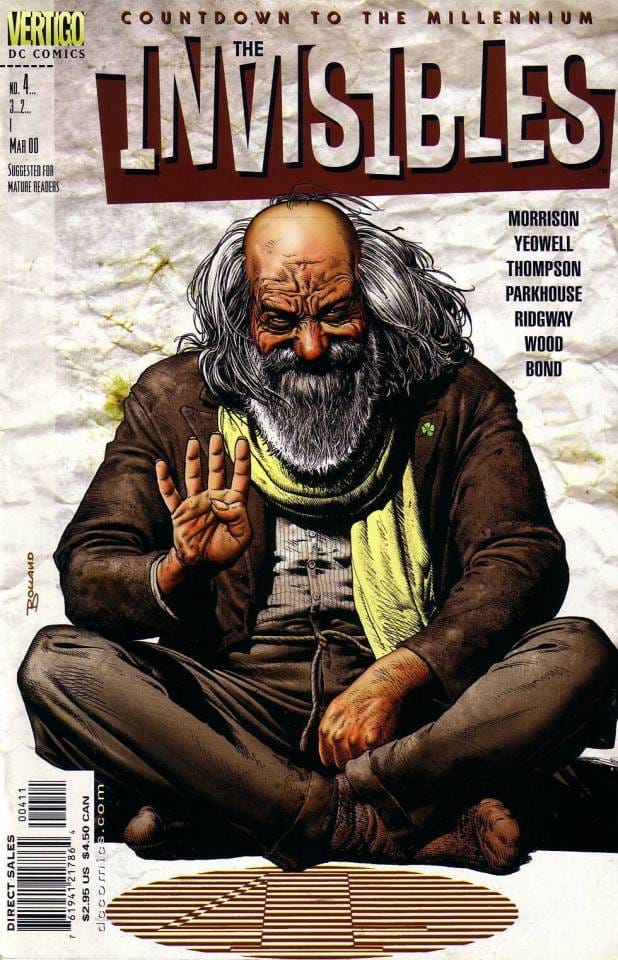
Between 1994 and 2000, Grant Morrison wrote The Invisibles, his magnum opus. Among the secondary characters is a homeless man from the streets of London named Tom O’Bedlam, who is also a powerful magician and a member of the secret and subversive organization known as The Invisibles. Tom O'Bedlam is the mentor of Dane (a.k.a Jack Frost, the chosen one), whom he must teach about magic, occultism, disobedience, the true nature of reality, and the secret that cities hide. In a revealing monologue, Tom tells Dane: “Cities have their own way of speaking to you, observe the reflection of a neon sign and you will see it spell out a magical word that evokes strange dreams. Have you never seen the word ‘ixat’ shining in the night? That is one of the sacred names.”
Magical drift is an effective method of direct communication with the genius loci (the protective spirit of a place), the guide of urban magicians who seek to get lost to connect with the cities.
The Guide
We live immersed in late capitalism. Hyper-commodification transforms every aspect of our existence into a commodity; hyperconnectivity forces our digital selves to be available 24/7; hyperproductivity pushes us towards constant efficiency; the idea of “wasting” our time on activities deemed “useless” by this capitalist society fills us with guilt. Produce, consume, produce, consume. Physical and mental exhaustion is inevitable. In this context, going for a purposeless walk, getting lost in the city, dedicating our time to an unproductive activity, reclaiming the space we inhabit, can be an act of resistance, a subversive movement. Psychogeography is a practice that shapes reality.
Next, here’s a brief practical guide for anyone who wants to cultivate the liberating art of psychogeographic drifting:
- Probably the best way to approach the cosmos of psychogeography for the first time is through a controlled drift. You can carry out this practice without even straying from your routine: the simplest way is to take that same path you walk every day (to work, to school, to the club, to the bakery, etc.) but this time committing to break your tunnel vision. How? By paying attention to everything around you, focusing on what you usually overlook, being aware that you are stepping on a living organism called the city. You will soon notice that the same path you take every day (which you think you know by heart) changes completely. Accepting that tunnel vision limits your sensory universe is the first step towards understanding psychogeography. Observe your neighborhood with the eyes of a stranger, as if it were your first time there. Through this new perspective, you will be able to glimpse all that architecture that previously escaped your notice: graffiti and murals that now seem to speak to you, objects that have always been there but that you never saw simply because you never paid attention to them. Let yourself be carried away by all these novelties without straying from the route that leads you to your destination, whatever it may be. Feel with your body what the place has to communicate to you. Let your instinct guide you on where to focus your gaze, where to stop and analyze the space. Reclaim your neighborhood.
- For a more advanced exercise, choose a place where you want to get lost to explore it thoroughly. It can be your neighborhood or somewhere unfamiliar. If you’re traveling by train, you can get off at a random station; if you’re on a bus, get off at a randomly chosen stop and start walking wherever your instinct leads you. When you feel it’s enough, stop and look closely at everything around you. From that neural center, choose a path to follow, or rather, let your intuition choose it for you. Start walking, aware of everything, but without thinking about where you’re headed. That’s the least important thing; what truly matters now is to walk guided by the sensory experience. Your legs moving on autopilot are the best compass.
- Let yourself be influenced by what the architecture evokes in you. Sometimes drifts stimulate bright impressions, but other times they leave us with dull sensations. Accept it as part of the journey. Learn from it. Look for objects that no one claims, artifacts discarded due to planned obsolescence. The fragments that cross your path can be pieces of a larger puzzle. Take them as gifts that the city has to offer you. Reflect on their meaning.
- Walk around a square, then enter it and walk in a cross pattern. Stop in the center and observe what surrounds you: they are anomalies in a concrete bubble. Feel the residual energy of the thousands of people who have passed through that space. Connect with that part of the city.
- Get away from the crowds. Choose, whenever possible, the neighborhoods. Buildings have a story to tell; houses, a very different one.
- Be patient, relax. Don’t try to force sensations or situations that don’t exist. When things happen, your body will feel it.
Because what’s important is to find the genius loci, to connect with it through drifting. Move always alert because it can be in the least expected place: under a bench in a square, in the cooing murmur of a pigeon walking around you, in the mouth of a sewer, in the message of a neon sign, in the eyes of a hungry dog. When you communicate with it, what it has to say will be just for you and no one else.