Ghost in the Shell (1995)

21 de sep. de 2025 — Juan Ruocco 🧙♂️
It's been a long time since I wrote for "the Canon". Those who've been following me since Substack (and before Random, and before Medium, and before vdpraxis, and before Velociraptors, and before projectovdp, and before...) know that "the Canon" is a series of articles dedicated to what I believe are the pillars of science fiction audiovisual. Perhaps someday, when I have enough time, I'll be able to expand the canon to books and video games; although if I think about it more carefully, that's what we're doing in some way at 421.
Gentle reminder for those who may have lost track of the continuity of things: a year ago, in September 2024, together with Juanma La Volpe and Luis Paz we launched this written publication. A project we had been incubating since 2023, for which we did a fundraising round that went well; and recently, after a year of significant growth, we added enormous institutional support from Ergodic, one of the most innovative holdings in the country and on the planet, with a broad scope that ranges from "deep technology" to real life. I'm really happy this happened and that not only was 421 a cool idea and a cool passion project, but now we're truly playing the game of becoming a relevant media outlet for the entire continent.
I know I promised in the title to talk about Ghost in the Shell and I haven't started yet, but let me take this small detour. I like the idea of putting out a monthly Sunday column, to keep us updated, a little closer, and to feel that that small space of connection with you, which my blogs always were, still exists in some way, beyond the fact that everything is scaling to a dimension that I, at least, never thought possible.
Ghost in the Shell enters the Canon
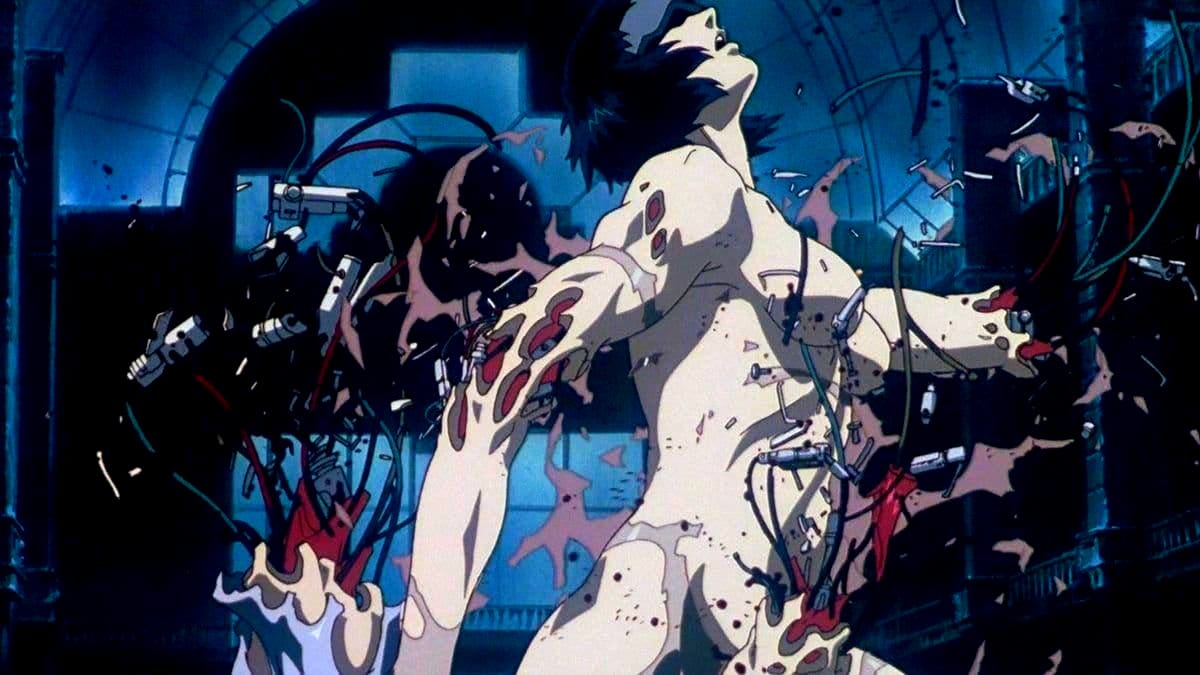
Ghost in the Shell is a 1995 film directed by Mamoru Oshiii and based on the manga of the same name written by Masamune Shirow. It's one of those totally formative films that wreck your brain. Like the bullet that hit JFK: you're left in shock, jumping to the trunk of the car to pick up the pieces, as if you could put back together what was there before. I still can't believe it's 30 years old.
It's undoubtedly one of the series/films of the death trident, alongside Akira and Evangelion. The three works are consummate examples of the best of Japan's tradition, achieving a very unusual blend of animation, science fiction, and existential drama. Around the same time, in our country animation was associated with anything "childish".
For children of parents born in the '50s or '60s, Japanese animation was associated with Astroboy, Mazinger, Speed Racer and Heidi. It wasn't until the '80s that some young teenagers understood that the anime genre had another level of depth, with the arrival of Robotech. Non-animated science fiction cinema had its own tradition: from the founding myth of Metropolis to modern gems like Blade Runner, 2001: A Space Odyssey and Solaris. All adaptations from masters of science fiction like Phillip K. Dick, Arthur C. Clarke or Stanislaw Lem and translated into cinematic language by titans like Ridley Scott, Andrei Tarkovsky and Stanley Kubrick. Nothing less.
The contribution of the "Death Trident" was bringing some of that high-flying cinema to a younger audience and, at the same time, being able to show through animation things that were still quite complex to achieve on screen with traditional methods. Let's remember that we were already in the era of the transition from practical effects to CGI. The scenarios of Akira and its chases, the technology of Ghost in the Shell or the giant battles in Evangelion were sufficient proof of what animation could do to stimulate the imagination of the future.
Hacked ghosts
Ghost in the Shell basically tells us a police case entangled in an international political intrigue with two main actors: Major Motoko Kusanagi, a top-secret military-grade cyborg who works for "Section 9" and is in charge of hunting the second protagonist; the most famous hacker on the planet known as The Puppet Master, or in Japanese the Puppet Master. The paths of these protagonists will asymptotically converge until, in the end, both paths become one. Let's move on.
The Puppet Master has the ability not only to "hack" computers but also to get into the human "spirit-soul." It's quite significant that the word the characters use to refer to this in the original Japanese is ゴースト (gōsuto), the Eastern version of "ghost," which we could translate as "spirit" in English. In English, the Holy Spirit is also called the Holy Ghost.
These hacks to human spirits generate significant effects. First, they replace memories with new ones designed according to the Puppet Master's needs, erasing and making the previous (and original) ones completely inaccessible. This effect can affect how the hacked person sees the world, which becomes evident when Kusanagi and her team catch a garbage collector with a hacked ghost who is convinced he sees his family in a photo, while the protagonists see that it's just him walking his dog.
These sequences begin to raise more than a few doubts in Major Kusanagi, whose body has been completely replaced by biomechanical elements. Only her original brain remains. But if it's possible for someone to rewrite another person's memories and spirit, what guarantee does she have that her memories are genuine and that her self-perception as human is real?
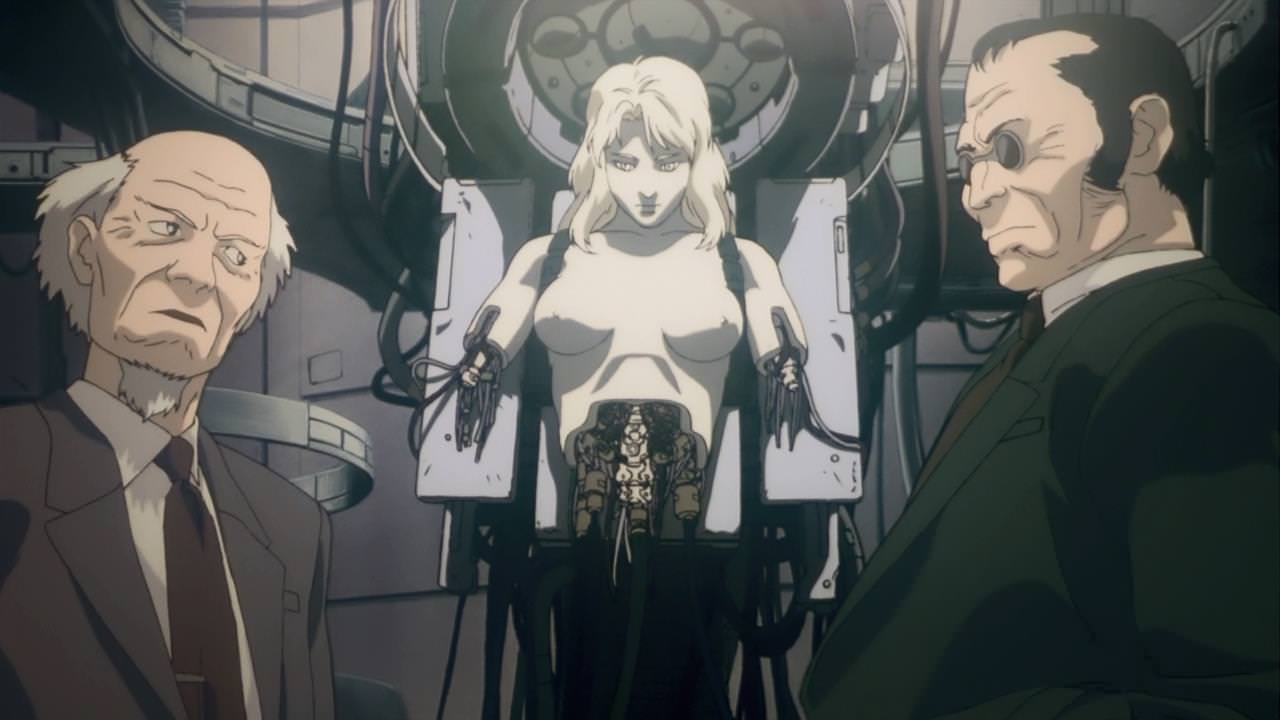
The uncertainty will only increase as the plot of internal deception among different government sections grows. The film will get even denser when the Puppet Master, through a completely new droid from the ultra-advanced company Megatech, is detained and put under interrogation. Half-broken and hanging like a carcass, the Puppet Master presents itself before its captors as an intelligence born as the product of the sea of information that becomes self-aware, requesting political asylum in Japan.
But the newcomers from Section 6 deny this version and claim it's an artificial intelligence programmed in the United States, used by Section 6, that gained its own consciousness and wants to escape. Just before things go sideways, the Puppet Master communicates with Major Kusanagi, telling her that it's quite aware of its own existence and that it has a plan.
Towards the end of the film, Major Kusanagi risks her life to save what remains of the Puppet Master, while Section 6 hunts them down to annihilate them. The Puppet Master offers Kusanagi to merge in order to give birth to a new type of intelligence. When asked why this path and not simple copying, the Puppet Master responds that human evolution shows that information, if it changes and evolves, can endure through time. That simple copying doesn't work because a way to neutralize it can easily be found and, with it, all the copies.
In the film's epilogue we see that Batou got a new body (with a child's age) to which he transferred the now unified consciousnesses of Kusanagi and the Puppet Master. Between the Puppet Master's appearance in society and his merging with the Major, we can identify a series of highly interesting philosophical topics that constitute the thematic core of The Ghost in the Shell.
A philosophical detour through Descartes and Hobbes
These kinds of thoughts have been pursuing human beings since their very constitution as such, and we can find many traces of these discussions in philosophy. But there was a period when this type of reasoning around the body, the mind, and suspicion became philosophical thought per se. We're talking about none other than René Descartes and his Metaphysical Meditations, a book that almost unanimously is considered the formal beginning of modern philosophy (if we accept the division between classical, medieval, modern, and contemporary). As we always do in the Canon, science fiction is an excuse to talk about philosophy and/or theology.
Getting into summarizing Descartes would be a very long task, but what really concerned him was applying a method, a new science, that would allow him to arrive at an idea that was impossible to doubt, in order to rebuild upon it the epistemological edifice of the sciences. Hence the book prior to the Meditations, and a sort of preliminary version of it, is Discourse on the Method.
In the Meditations, then, Descartes applies the method and tears down all assumptions about what we see, believe, or reason, applying various degrees of skeptical arguments. His goal: to find an idea so "clear and distinct" that he could not doubt it. Midway through the book, René realizes he doubts everything, but he cannot doubt that he doubts. Therefore, there is thought. Cogito ergo sum, or in English "I think therefore I am".
From then on, modernity would concentrate around this division of substances. What Descartes calls "res cogitans" and "res extensa". Today, the legacy of that dual thinking can be interpreted under the mind-body dichotomy. The tangible and the intangible. Software and hardware. And all the questions and/or problems that entails to this day.
But even in the same era as the formulation of the cogito, Descartes had to face some rather sharp criticisms. Among them the objection of another titan of European thought: Thomas Hobbes, author of Leviathan and — within it — perhaps the most important political theory of the last 500 years. The Englishman questions whether from the proposition "I think" one can immediately conclude "I exist" as a necessary truth. In the philosophical glossary, we speak of "necessary" when something cannot be otherwise than what it is. For Hobbes, the Cartesian proposition is a kind of incomplete syllogism. What is really being affirmed in the cogito is something like this: "Whoever thinks, exists; I think, therefore I exist." In that sense, it's not a self-evident intuition but a deduction, and it depends on accepting the universal premise "everything that thinks, exists".
He also suspects that Cartesian certainty presupposes the existence of that "I" who thinks, but that's precisely what it attempts to demonstrate. If one only has the experience of thoughts, affirming an "I" that sustains them may be an unjustified leap. In any case, what can be affirmed is that "there is thought" or that "something is thinking." Along the same lines, Pierre Gassendi, who also served as a critic of Cartesian theory, states that from immediate experience it follows: "something thinks", and not necessarily "I think". The step from the simple phenomenon of consciousness to the personal "I" is a metaphysical leap.
The problems derived from this dual conception of mind and matter and, specifically, of how the two realms relate to each other, are largely a recurring topic in science fiction in general and in Ghost in the Shell in particular.
If I'm not my memories...
This whole more or less historical detour was made to highlight one of the main problems that Ghost in the Shell addresses: the difference between mind and body. This problem becomes evident, initially, when Major Kusanagi begins to doubt her human condition. If her entire body, except her brain, has been replaced by synthetic parts, how can she be sure that her mind is truly her original Self and not something also manufactured?
This permanent suspicion will not be resolved but rather deepen throughout the film and will be one of the reasons why Kusanagi chooses to merge with the Puppet Master. In this sense, the film seems to have a strong "Cartesian" inclination, given that the mind is something that exists on its own, that can be hacked, and that can move from one body to another. Is that really so? We'll see.
On the other hand, as the case progresses and they encounter more "spirits" that have been hacked, another problem also appears: identity and memory. This is a topic originally treated in Blade Runner, although in a secondary way, since the fundamental problem there is understanding what makes a human human (hence why the Voight-Kampff test exists to discern what is human from what is not). However, both the androids in Blade Runner and the hacked individuals in Ghost in the Shell share the same uncertainty: how do I know my memories are real? Which leads to an even more complicated question: who the hell am I?
From these two angles, Gassendi's critical position is reinforced: insofar as there is thought, I can only consistently affirm that "there is something that thinks." Whether that can be associated with a state of self-conscious reflexivity is a separate problem, in which philosophy has been immersed for several centuries. Herein lies the mastery of a film of this caliber. It's not just an action film, nor one of imagining the future, but it has the full capacity to problematize some of the most complex human issues, without even breaking a sweat.
... what the hell am I?
If there's one thing Ghost in the Shell has, it's that not only is the protagonist a memorable character but the antagonist is at the same level and perhaps above her. The Puppet Master — I love calling him the Puppet Master, sorry — represents in several ways an updated version of Skynet. While in Terminator Skynet becomes conscious and automatically seeks to exterminate humanity, the Puppet Master gains consciousness and tries to leave the sea of information to basically become another person. It has its own agenda, of course: to evolve. And for that it needs to merge with Kusanagi. In the manner of the two super-intelligences from Neuromancer.
From this we can deduce at least three more than interesting conclusions.
First, the fact that the Puppet Master assumes itself as the "product" of the sea of information, that is, an organism that appeared in a kind of informational primordial soup. In another sense, we could then think that according to this definition, intelligence or consciousness is an emergent property of information systems. First great thematic insight.
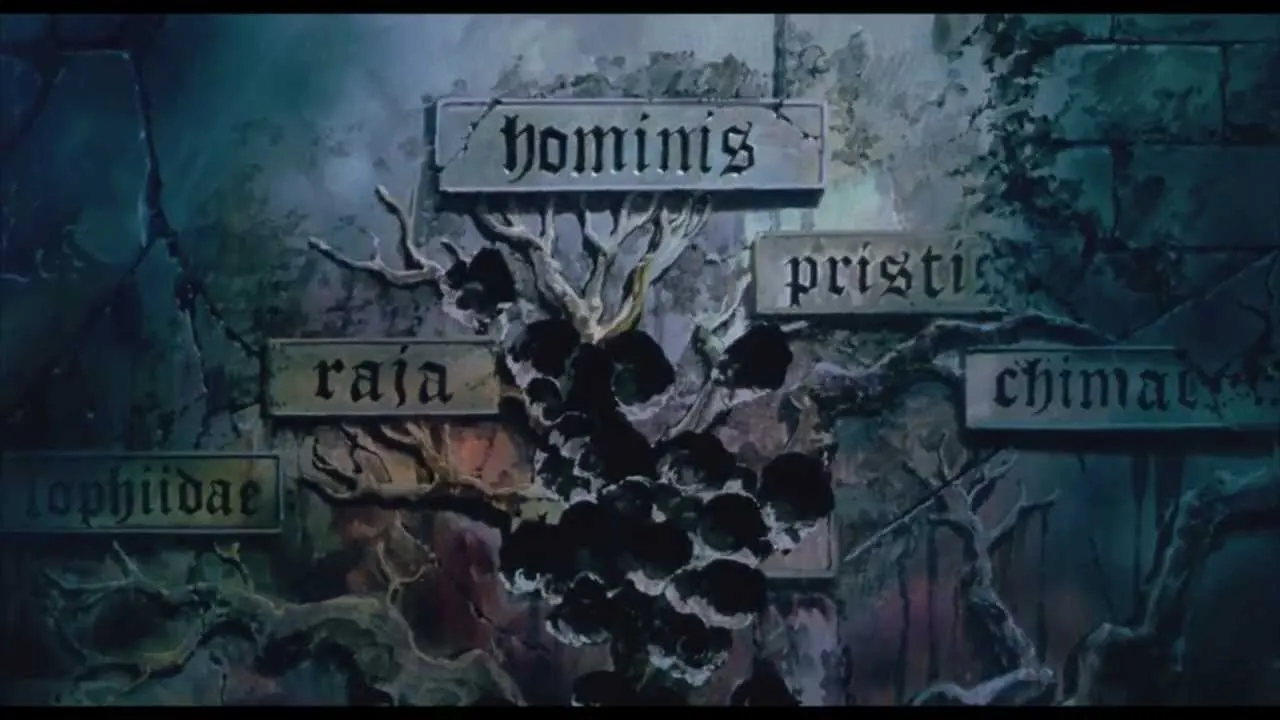
Second, we can think, above all, about the final soliloquy of the Puppet Master with the Tree of Life in the background, and its particular evolutionary notion. Unlike apocalyptic proposals like the intelligence of Skynet or Ultron, this particular AI doesn't despise humans but rather the opposite, recognizing in the evolutionary process of natural selection a more perfected mechanism than that of simple copying. If a file or genetic information is simply repeated as a copy, once an effective threat appears, it won't only destroy one unit but can destroy all copies (that entire species). That's why the evolutionary process that adds genetic mutation as a feature is better in every way, because it allows variety to become an immune defense system.
Lastly, and based on both things, the Puppet Master chooses the path of evolution. To leave the sea of information and instantiate itself in a body (point for Husserl and Merleau-Ponty), to merge with another intelligence similar to its own (Major Kusanagi) and evolve into a new stage of life form: the conjunction between a human mind and/or spirit and a synthetic spirit. Thus, the Ghost in the Shell becomes Ghost in the Body. In this last sense, and building on what we've been exploring around the Canon, this antagonist is an improved version of Frankenstein's monsterFrankenstein, a reversal in which there isn't necessarily revenge but rather a path from the instrumental use of human beings to a more complete exploration of the meaning of life.
Long live the Puppet Master.
A few more paragraphs and we're done
In conclusion, Ghost in the Shell is everything that animated science fiction ever aspired to be. The spiritual and material heir of Akira that maintains the same tropes and takes them a step further: cyberpunk, government intrigue, totally disruptive technology, explorations of the human spirit.
On a philosophical-aesthetic level, it anticipates The Matrix almost completely. Just look at the opening credits, the action sequences, and the connection to the information network through cables in the neck. Although in this animated film, unlike the Wachowskis' classic, the suspicion about the veracity of human experience isn't placed in the external world (the Matrix is a simulation) but in the problem of how humans perceive the world and perceive ourselves (it's a suspicion about the very tools of human cognition). In that sense, Ghost in the Shell is much closer to Blade Runner, where "the human" and whether it can be artificially replicated occupy the center of reflection.
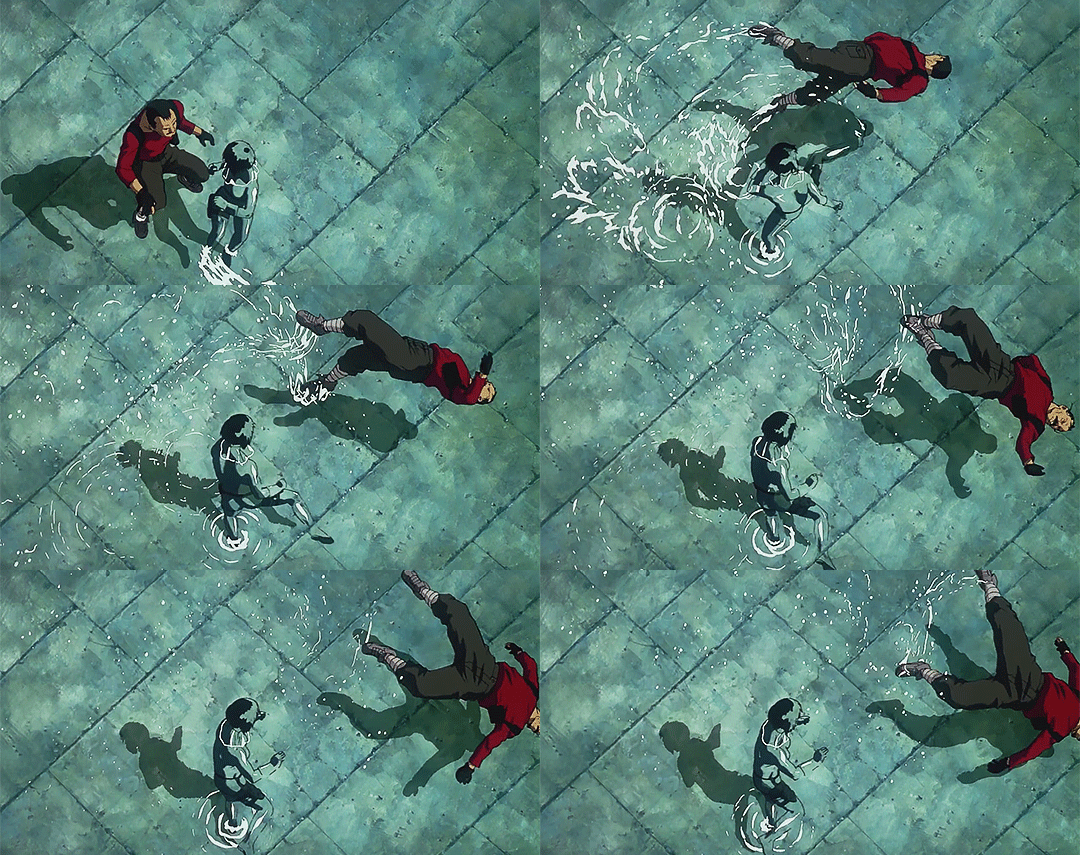
Mamoru Oshiii's film is a compendium of animated action scenes indelible from collective memory. A legacy of a technique that will undoubtedly transcend time. Just look at the collection of frames and combat sequences of Kusanagi to understand the visual marvel we're dealing with. The opening assassination of the diplomat, the chase through the flooded city, and the final battle against the spider-tank in the old city are scenes hard to forget and that have become icons for many of us.
But beyond the aesthetic aspect, also inseparable because it's the theme that runs through the entire film, there's the philosophical aspect. A synthesis of some of the most complex problems regarding human identity, our relationship with philosophy, the mind-body problems. In short, a collection of classic topics synthesized in one hell of a film. We can't ask much more from cinema.