Tyrannosaurus rex or Giganotosaurus? In this article, science enriches (and complicates) fiction. Discover the titan of Neuquén: a 13-meter-long predator with “shark-like teeth” that ruled Patagonia, a land of giants.
Among the largest carnivorous dinosaurs that ever existed, the most globally recognized figure is the Tyrannosaurus rex, for obvious Hollywood reasons. Although we have fossils of dinosaurs in our land that we can be proud of, as we have seen in previous articles: the most iconic predator of Argentina and the largest dinosaur of all time. And Patagonia also gave us the "king lizard of the south," the Giganotosaurus carolinii.
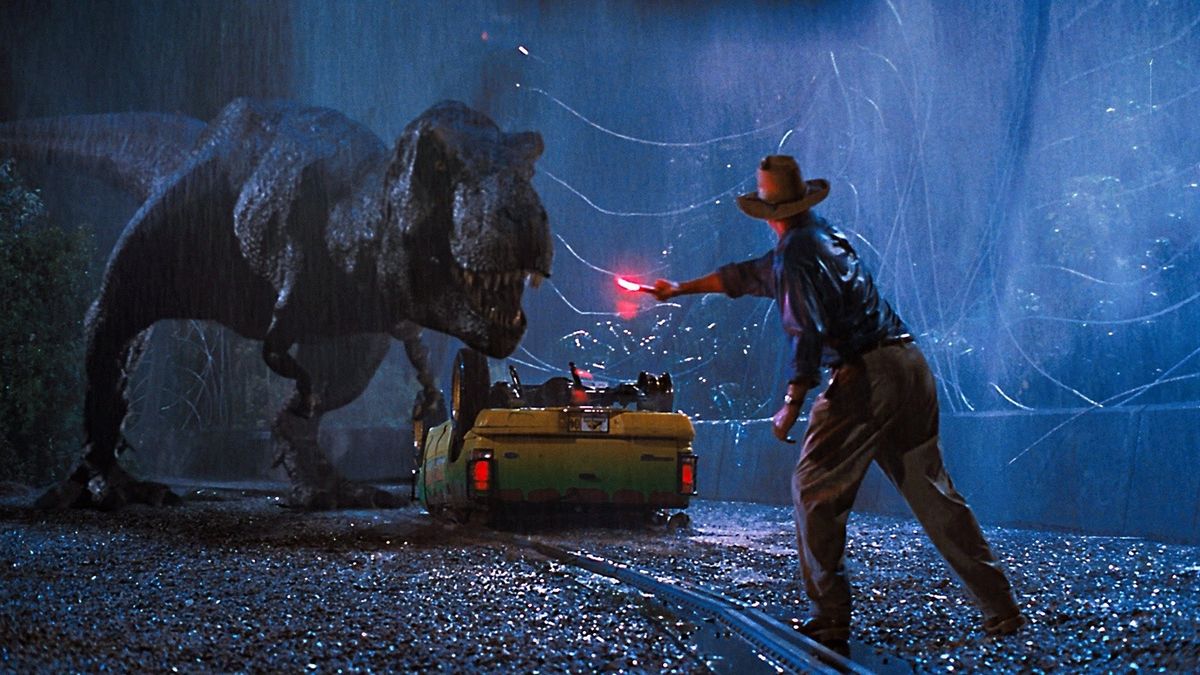
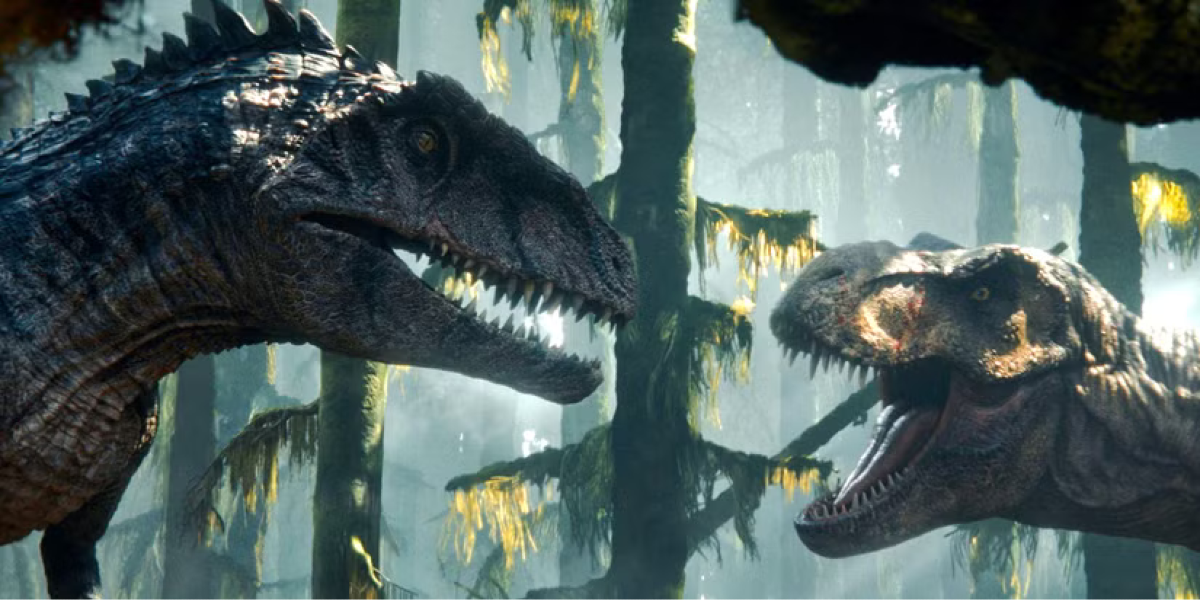
It's worth mentioning that this dinosaur had its moment of global fame as the main antagonist in the closing of the Jurassic World saga, where it was depicted in a millennia-long rivalry with the iconic T. rex, and there's a lot to say about that. But before diving into cinematic debates, let's focus on what truly matters, the science behind our compatriot.
The story of this dinosaur began in 1993, when Argentinian amateur fossil hunter Rubén Darío Carolini was driving through the canyons near Villa El Chocón (Neuquén, Argentina) in his buggy. Suddenly, he spotted something emerging from the sediment: part of a dinosaur's tibia. He reported the find, and specialists from the National University of Comahue proceeded to excavate the fossil. The specimen was completely disarticulated, with both cranial and post-cranial bones scattered over an area of 10 m². Despite the disarticulation, almost 70% of the skeleton was preserved, including most of the vertebral column, the girdles, and part of the skull.
The skull of the largest specimen would have measured 1.95 meters long, the longest skull recorded for a theropod.
The discovery was announced in 1994 at a congress of the Society of Vertebrate Paleontology by paleontologists Rodolfo Coria and Leonardo Salgado. The dinosaur was named Giganotosaurus carolinii, which means “the giant lizard of the south of Carolini”. The holotype skeleton is currently housed at the Ernesto Bachmann Paleontological Museum (cataloged as specimen MUCPv-Ch1) in Villa El Chocón, inaugurated in 1995 at Carolini's request.
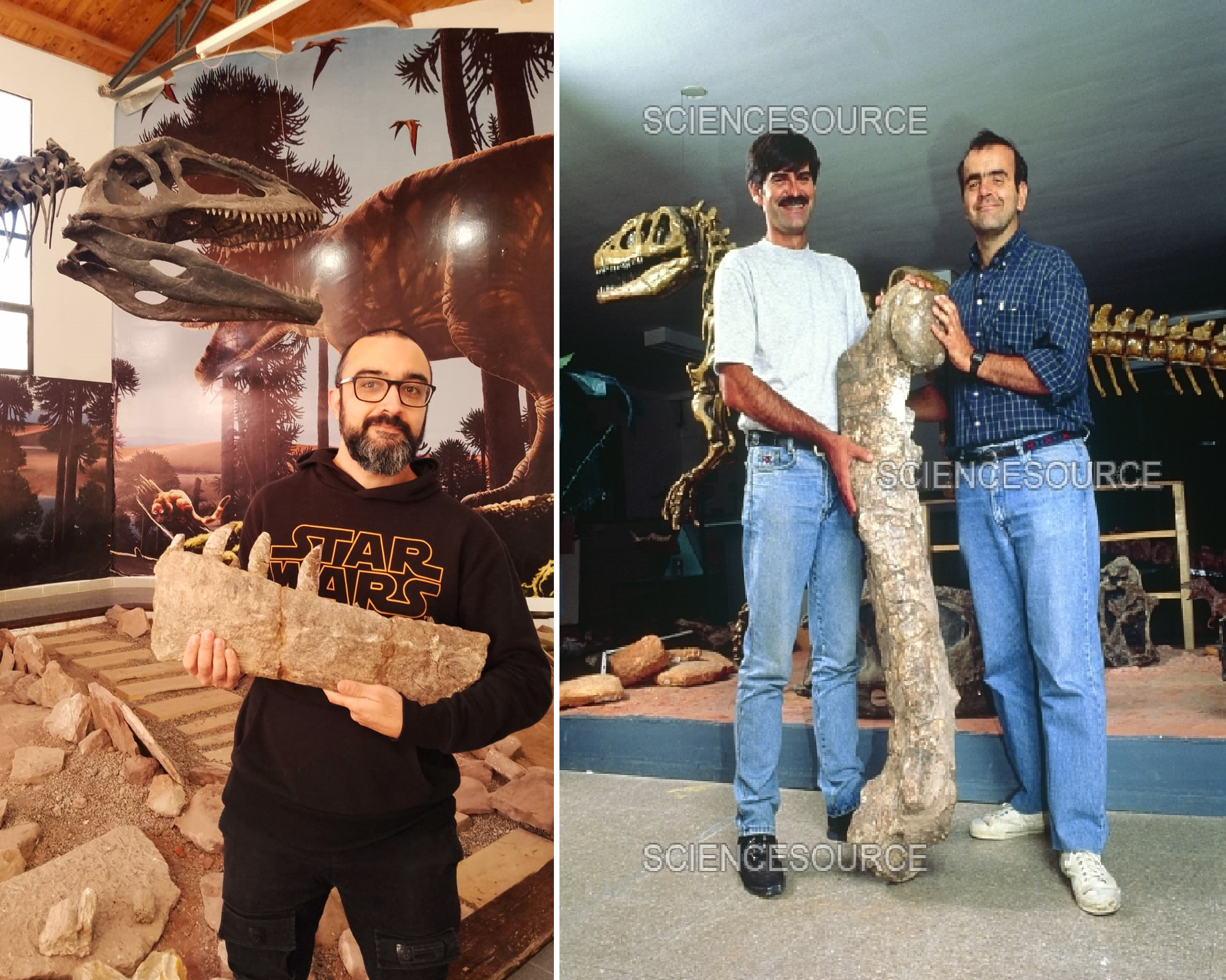
And that's not the only specimen. In 1998, paleontologists Jorge Calvo and Rodolfo Coria assigned a bone to Giganotosaurus that belonged to part of the left dentary (part of the lower jaw) containing some teeth (MUCPv-95). It had been collected by Calvo near Los Candeleros in 1988 and described as belonging to a theropod, but not assigned to any species. Calvo and Coria considered that the dentary was identical to that of the holotype, although 8% larger, measuring 62 cm. Although the back part was incomplete, they proposed that the skull of the holotype specimen would have measured 1.80 m long, and estimated that the skull of the largest specimen would have measured 1.95 m long, the longest skull recorded for a theropod.
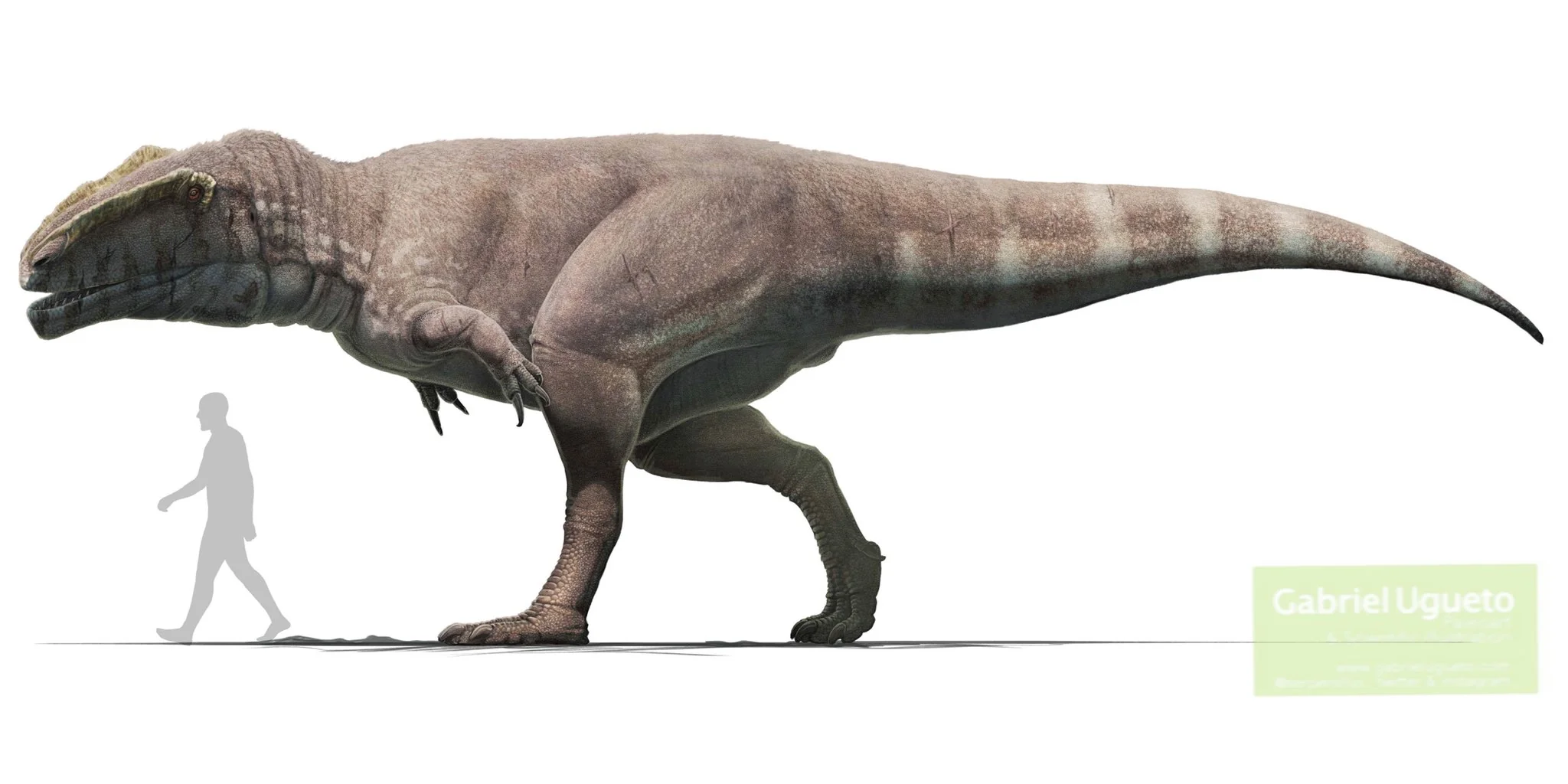
Reconstruction of Giganotosaurus carolinii, illustrated by Gabriel Ugueto. Source: Deviantart.
The face of this giant featured a low profile, dominated by rough and coarse nasal bones, and a prominent crest on the lacrimal bone that rose just in front of its eyes. Its teeth, laterally compressed and with serrated edges, were optimized for cutting flesh and inflicting deep wounds. The lower jaw ended in a very distinctive bony protrusion, a flattened "chin", and had a jaw joint located much further back than in other carnivores, giving it a wide mouth opening.
The rest of its body was no less impressive compared to such a head. A short and robust neck acted as the necessary support to stabilize the skull, while the back was supported by vertebrae with high neural arches and elongated spines. Unlike the rest of the body, its pectoral girdle was proportionally small and short. The femurs, on the other hand, were robust and had a characteristic sigmoidal shape. This animal was a giant among giants, basically the “house specialty” in the ecosystems of the southern hemisphere at that time.
Photographs of paleontologists posing with Giganotosaurus fossils. On the left is Dr. Mauricio Cerroni, holding part of the dentary; on the right are Dr. Rodolfo Coria and Dr. Leonardo Salgado holding the femur. Source: Courtesy of the Ernesto Bachman Museum and ScienceSource.
Color note: Under his management as director of the Chocón Museum in 2006, Rubén Carolini chained himself to the remains of the Giganotosaurus in protest. The act was to demand the return of fossil replicas that had been rented without the prior consent of the museum's management.
Lizards with Shark Teeth
The Giganotosaurus belonged to one of the most imposing families of predators to have ever walked the Earth, the carcharodontosaurids. The name of this group comes from the discovery of Carcharodontosaurus saharicusin Africa by Ernst Stromer in 1931. The species name comes from its teeth, which are compressed and finely serrated, resembling those of the great white shark (Carcharodon carcharias, read: “carcarodon carcarias”). So its name means "lizards with shark teeth".
This family of theropods were the dominant predators of the Gondwana ecosystems (the supercontinent that included South America, Africa, Antarctica, Australia, and India), although they also made incursions into the Northern Hemisphere. They emerged in the Late Jurassic and reached their peak during the Early Cretaceous, dominating the top of the food chain between approximately 127 and 90 million years ago. After the Turonian (94 - 90 ma), these giants in the north were replaced by tyrannosaurids, while in our lands, abelisaurids took over.
Our region was the preferred setting for the evolution of gigantism in these carnivores. Considering that these species coexisted with titanosaur dinosaurs, it's evident that they couldn't fall behind in terms of size.
Carcharodontosaurids are close relatives of allosaurids and, like them, had a robust yet relatively lightweight build. While their length rivaled that of tyrannosaurids, their body design was more streamlined, allowing for remarkable agility given their size.
One of the places where several species of this dinosaur family can be found (yes, you guessed it) is Patagonia. Our region was the favored setting for the evolution of gigantism in these carnivores, and considering that these species coexisted with titanosaur dinosaurs, it's clear they couldn't fall behind in terms of size.
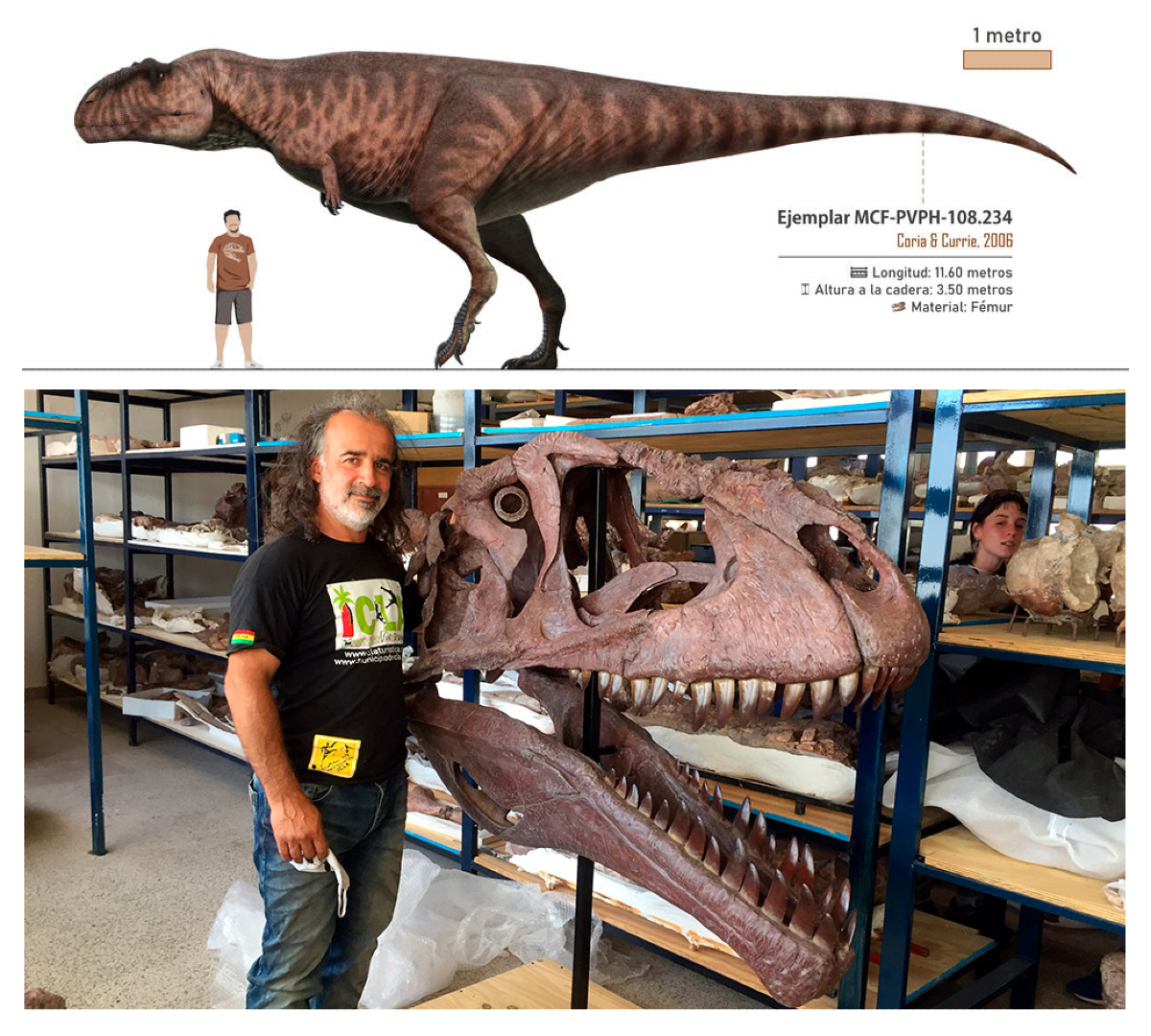
Among these giants stands out the Mapusaurus roseae, also found in Neuquén, whose remains were discovered in a "bone bed" that included several specimens piled together in one spot. We also have the Tyrannotitan chubutensis, from the province of Chubut, which is considered one of the earliest representatives of this lineage in the region. Finally, there's Meraxes gigas, discovered in 2022, whose name pays homage to one of the dragons from the A Song of Ice and Fire saga, featuring a very complete skull and arms, making it a crucial piece for understanding the anatomy and evolution of this family.
Top: Reconstruction of Mapusaururs roseae (Source: Devianart). Bottom: Life-size reconstruction of the skull of Meraxes gigas with one of the researchers who described it, Dr. Sebastián Apesteguía. (Source: CONICET).
As you can see, we know quite a bit about this family of dinosaurs to understand the Giganotosaurus. But, of course, being "the largest in the south" inevitably leads to comparisons with the monarch of the north, the Tyrannosaurusrex. So, without further ado, let's break down this titanic duel and see what's true about what the screen tells us.
Was the Giganotosaurus the largest predator that ever existed?
We arrive at the question that seems to be of utmost public interest: Which was the largest predator? The Tyrannosaurus rex or our Giganotosaurus?
From a scientific perspective (and, above all, a personal one), this is perhaps one of the least interesting discussions. After all, we're talking about animals that played ecological roles in the past, not about Pokémon designed for battle. Moreover, we must remember that the fossil record is just a tiny and exceptional fraction of the biodiversity that truly existed nearly 100 million years ago; what we know is merely a snapshot of a long and complex movie. However, this rivalry does help me explain things and capture the reader's attention, because here we teach and have fun. So, if you want to win an argument online and sound like an intellectual who really knows about science, the short answer is: the T. rex is bigger. (Sorry, guys, this time we take second place, at least until the fossil record proves otherwise).
Now, let's go with the long explanation: What do we really mean when we say that the T. rex is "bigger"? In paleobiology, size is not measured solely by how long or tall an animal is, but by its body mass. An organism occupies space in three dimensions, meaning it has volume. To understand this better, let's compare a giraffe with a white rhinoceros. Which one is bigger? The giraffe is undoubtedly taller, weighing around 800 to 1000 kg (for adults). On the other hand, an adult white rhinoceros can weigh between 1,800 and 2,500 kg (easily surpassing a ton). The rhinoceros has a much greater body mass and, therefore, is biologically "bigger" than the giraffe.
Scene from *Jurassic World: Dominion*: the age-old rivalry between the Giganotosaurus and the T. rex.
It's worth noting that our dino-compatriot starts with a certain statistical disadvantage: we only have two specimens, of which the largest is merely a fragment of a jaw. In contrast, there are dozens of skeletons of the T. rex (more than 30), including more complete and larger specimens like "Sue." Thanks to this abundance of data, we know that the tyrannosaur had an adult weight range of between 8 and 10 tons, reaching lengths of 12.3 meters. Meanwhile, the Giganotosaurus has an estimated length of between 12 and 13 meters, but with a calculated body mass of a range of 7 to 8 tons.
The difference, although both have similar linear dimensions, lies purely in their build. Tyrannosaurids had much more robust and compact shapes, while carcharodontosaurids were more streamlined. This doesn't make one animal "better" than the other; both were the top predators of their ecosystems, efficiently adapted to their respective environments, and rank among the largest carnivores to ever walk the Earth.
Tyrannosaurids had much more robust and compact shapes, while carcharodontosaurids were more streamlined. This doesn't make one animal "better" than the other; both were the top predators of their ecosystems.
Cinematic note: in the prologue of Jurassic World: Dominion, this rivalry is literally represented, with both animals sharing habitat and competing for territory. Well, that scene is fiction all around. Beyond the design of the Giganotosaurus, which in the movie looks more like a hunchbacked monster than a real dinosaur, the biggest issue is the situation presented. First, they belonged to different continents, the T. rex to North America and the Giganotosaurus to South America, which at that time were not connected. But the bigger problem is not the distance but the time. The Giganotosaurus lived about 97 million years ago, while the T. rex only appeared at the end of the Cretaceous, between 68 and 66 million years ago. In other words, they were separated by almost 30 million years. Our Patagonian giant would have needed a time machine to cross paths with the tyrant king.
Two distinct predator models
Let's not just focus on size; we can compare these two giant predators from a scientific perspective and analyze how different or similar these two dinosaurs were, coming from different lineages yet seemingly converging on the same ecological role.
A 2017 biomechanical study analyzed the running capabilities of the T. rex and concluded that the skeletal loads on an animal of such tonnage would have been too high to allow an adult to run. For a long time, it was thought that their long limbs were synonymous with speed, but this model suggests that these legs mechanically limited their locomotion to a fast walk. According to the researchers, this finding extends to other giant theropods of similar proportions, such as our Giganotosaurus, Mapusaurus, or Acrocanthosaurus. They were not high-speed pursuit predators; they likely hunted through ambush or constant pursuit until they exhausted their prey.
A 2005 study analyzed the bite force of theropods and found distinct strategies. The Giganotosaurus and its relatives had specific adaptations for making deep, repetitive cuts, while the tyrannosaurs were "designed" to withstand lateral torsion and physical stress, allowing them to hold onto large prey and prevent it from escaping their jaws. The bite force of the Giganotosaurus was less than that of the Tyrannosaurus, and this force decreased towards the back along the row of teeth. This suggests that it likely captured and manipulated its prey with the front of its jaws, and probably hunted smaller prey... at least, if we consider it a solitary hunter. However, the fossil record gives us a couple of additional clues.
As I mentioned earlier, the Giganotosaurus has a statistical disadvantage due to the scarcity of its specimens, but what we know about its close relatives allows us to understand that the carcharodontosaurs were unique predators. The key to understanding their biology lies in their closest relatives: Mapusaurus roseae and Meraxes gigas.
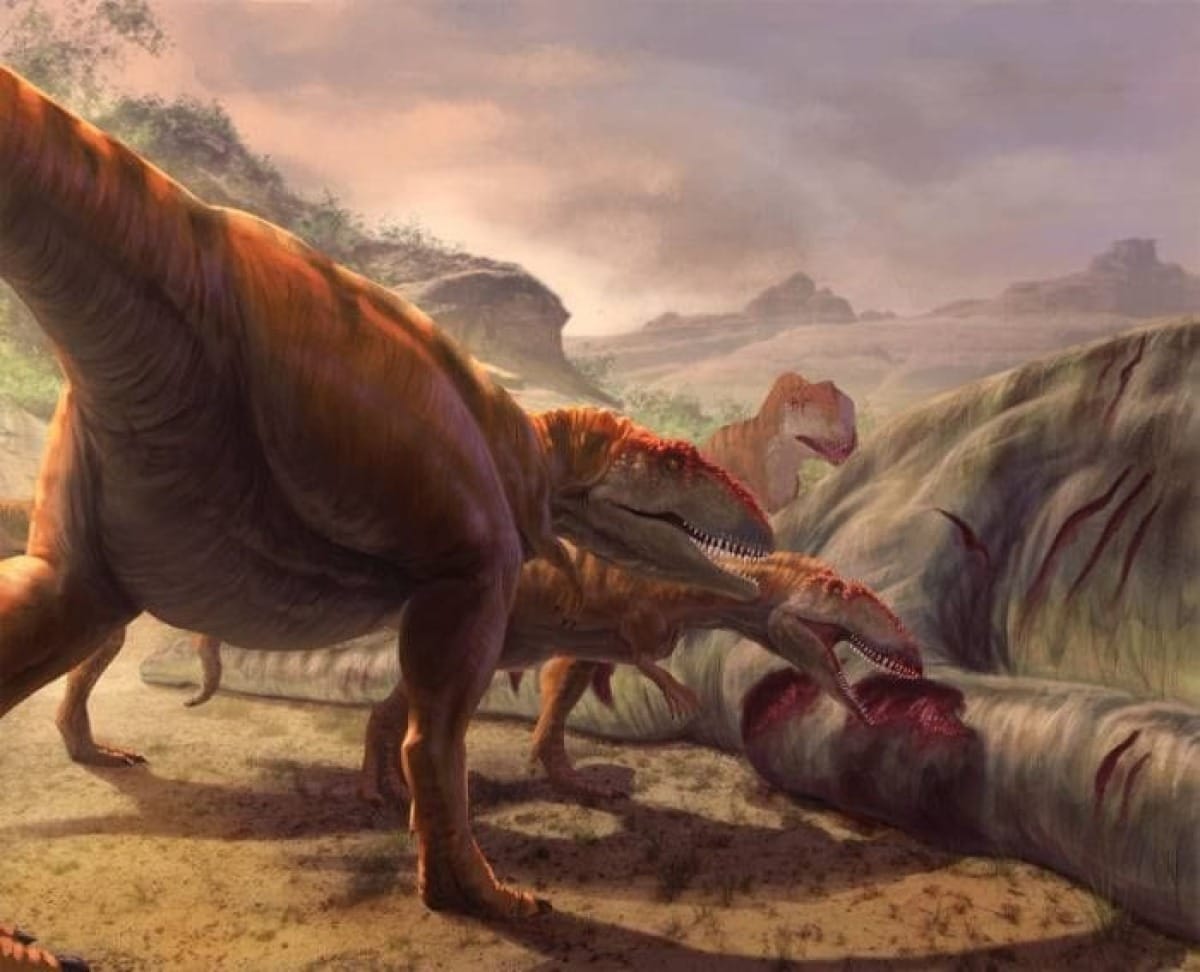
In the case of Mapusaurus, it was found in the Cañadón del Gato site in Neuquén, in a "bone bed" that contained between 7 and 9 individuals of different ages. The presence of multiple specimens of the same species at different growth stages suggests that it was not a casual accumulation or a sediment trap, but rather evidence of gregarious behavior. While we don't know if they formed organized packs like wolves, or if they simply grouped opportunistically like Komodo dragons or crocodiles, the possibility that a coordinated group of carcharodontosaurs collaborated to take down a titanosaur is certainly there. Meraxes, despite being a recent find, also shows specimens from the same area and sediment layer, reinforcing that this behavior was not unusual for the family.
Reconstruction of the social behavior of Mapusaurus roseae. Source: Deviantart.
Meraxes gigas also reveals important histological information. The osteohistological analysis of the holotype of Meraxesshowed that the individual died when it was between 39 and 53 years old, having reached its skeletal maturity only around 40. This makes it one of the longest-lived non-avian theropods known to date.
The most interesting aspect of this study is that it reveals that Meraxes had a prolonged growth stage, meaning that it took a long time, decades, to reach giant proportions. Interestingly, a study from 2026 indicates that the Tyrannosaurus rex also likely experienced a more gradual and prolonged growth than previously thought, reaching its maximum size around 40 years old. This convergence suggests that large theropods shared the same growth strategy; the key to being the largest predators on the planet was longevity and patience.
The analysis of the fossils allows us to reconstruct Giganotosaurus carolinias a formidable predator, an 8-ton animal, long-lived and social, adapted for a wear-down hunting strategy and capable of taking down herbivore titans with ease. As the fossil record reveals more information about the past, it becomes clear that the significance of carcharodontosaurs goes far beyond competition for size. Science once again shows us that millions of years ago, Patagonia was the epicenter of the greatest giants that ever roamed the earth.
✦ Suscribite
Las notas de 421 no tienen paywall
Y a cada colaborador se le paga por su trabajo. Las dos cosas dependen de los suscriptores.
Paleontologa y doctora en Ciencias Aplicadas. Trabajo en investigación de cinodontes del Triásico. Hago divulgación en insta y tiktok sobre paleontología y evolución.