Neither Woodstock nor Monterey: The True Origin of Rock Festivals
9 de ene. de 2026 — Luis Paz
No music festival has ever reached Woodstock’s level of historical hype. Not even today’s, with all their marketing pomp and end-of-night fireworks. And it makes sense it’s still that way: Woodstock, framed as the grand finale of the Summer of Love, is a hard narrative to beat—propped up by the Vietnam War, political discord, voluntaristic leftism, and the boom in visionary psychedelia. It’s a story that matters to fewer and fewer people, and it lacks the urgency of queuing up for a 12-installment promo to snag tickets to this year’s Buenos Aires festival circuit. Still—even in the scene (a.k.a. the rock-and-drugs trench)—the belief that Woodstock was the first rock festival remains widespread. But there was a story before that.
Love Pageant Rally (San Francisco, October 6, 1966)
This year marks six decades since the Love Pageant Rally: the first event to bring together all the traits we’ve come to associate with a rock festival for at least half a century—long before today’s catalog of musical juvenilia, product placement, and cash-burning sinkholes run by the big festival stables. The rock festival, in other words, as political action, social expression, and a mind-bending experience.
By the mid-’60s, Haight-Ashbury in San Francisco had become a gentrified hub of counterculture: beat poetry, alternative medicine, free love, and expanded consciousness via psychedelics. Vegan food spots next to kinky clothing stores; next to the newsroom of a countercultural outlet like The San Francisco Oracle; next to a tiny shack where underage hippies were completely spun out; next to Ron and Jay Thelin’s Psychedelic Shop, the first store dedicated to psychedelic paraphernalia.
As a response to that Eden—and because they never let you be at peace, in any time or place—California’s ban on LSD took effect on October 6, 1966. Drug arrests were already rising, and police had intensified their crackdown on hippie communes and their cultural figureheads. In response, street protests kept popping up. Some got heated, and everything ended in a “curfew.”
The Oracle had started circulating in September ’66, a couple of weeks before the LSD ban. The poet Allen Cohen, its founder, and the artist Michael Bowen, its illustrator, believed the counterculture should express its discontent artistically. With posters and a logo featuring a marijuana sprout, they called for a music-and-poetry event on that same October 6, at Golden Gate Park.
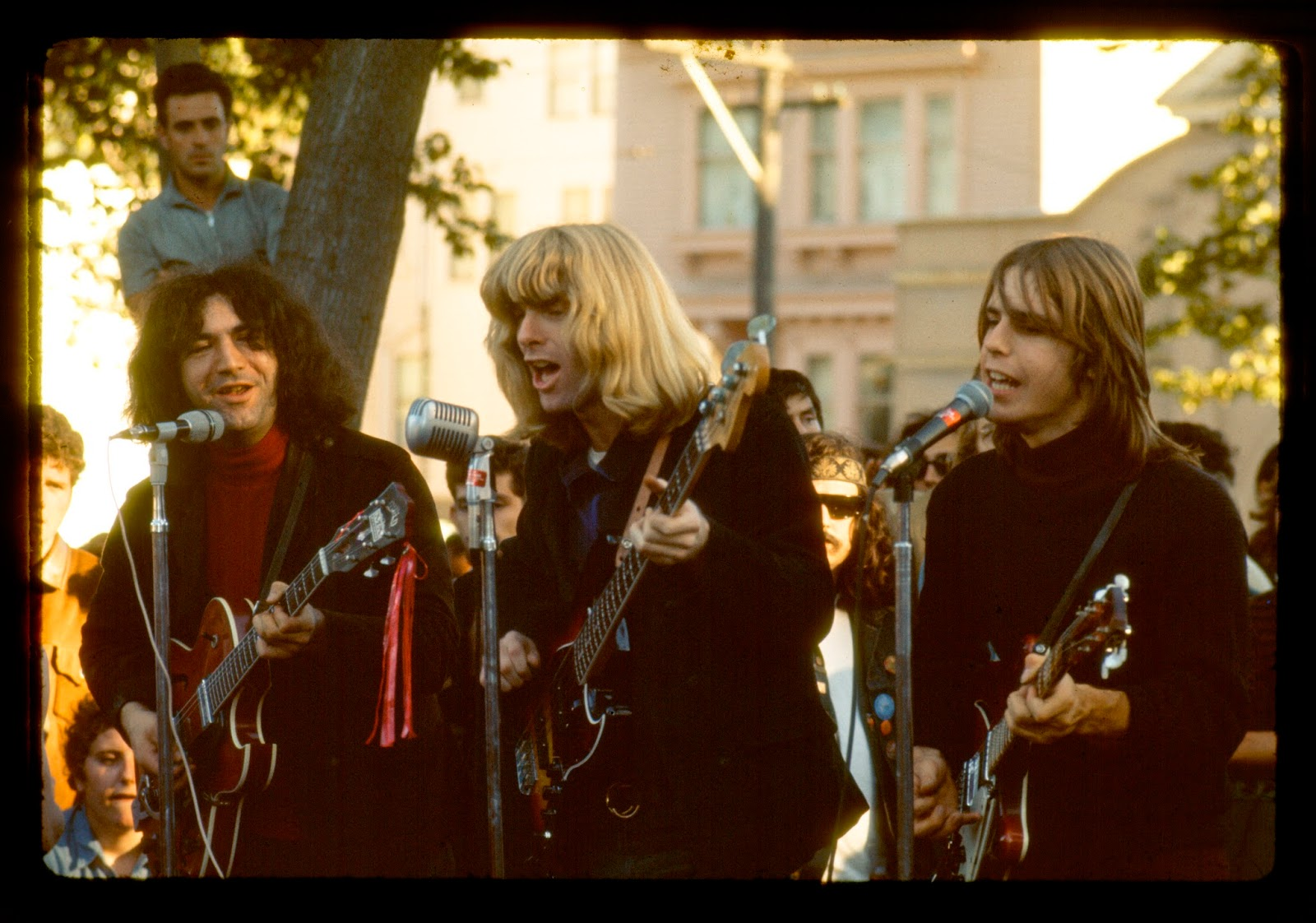
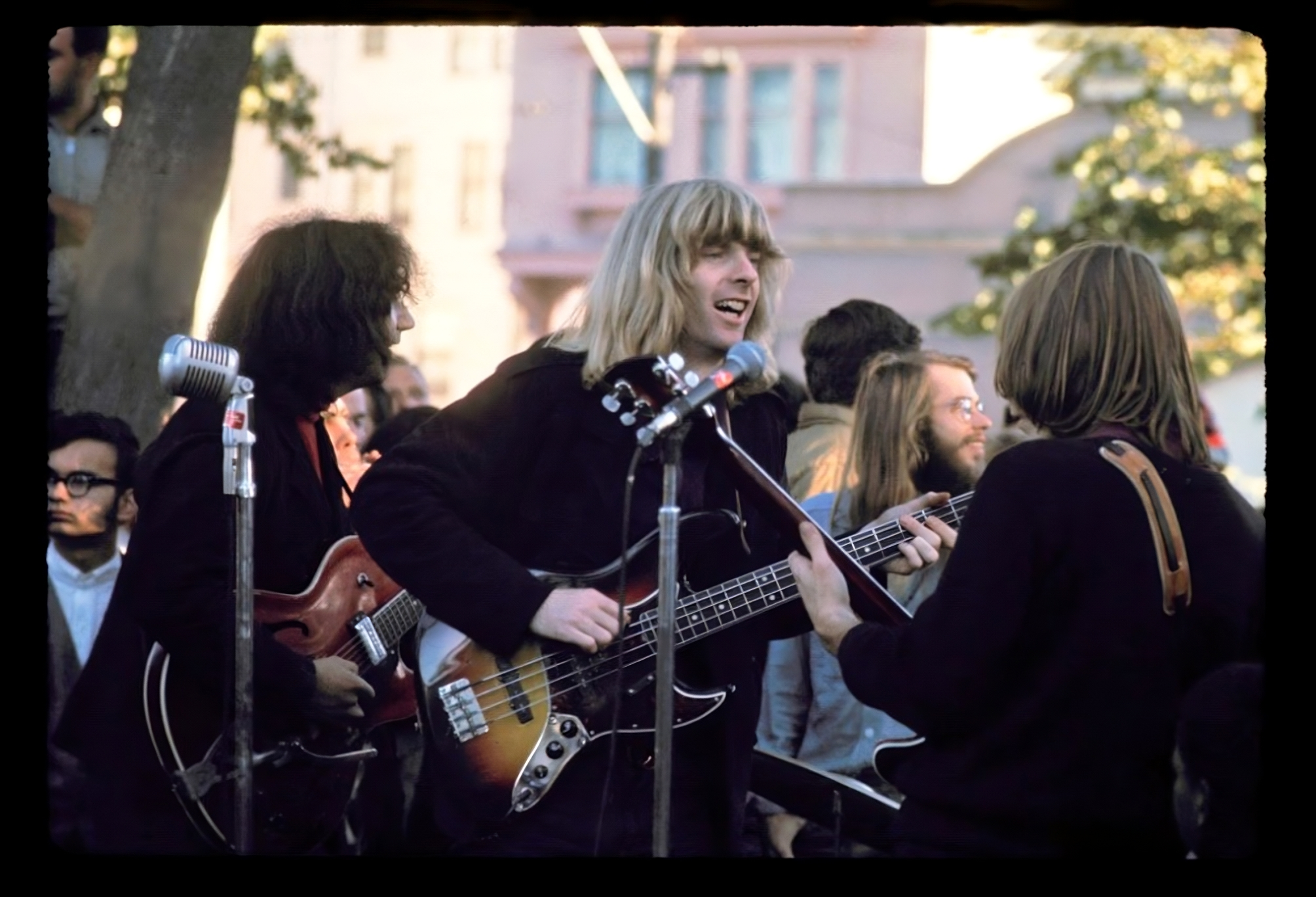
The gathering drew 3,000 people and featured readings, performances, and sets by Big Brother and the Holding Company—fronted by a still-unknown Janis Joplin—and by Grateful Dead, the central band of San Francisco’s lysergic scene. “We wanted to create a celebration of innocence, transcendental consciousness, the beauty of the universe, of being,” Cohen explained. The idea took root. The community mobilized. And, in a very precarious way, a tradition was born—one that would soon, within just a few months, find a far more definitive form.
Human Be-In (San Francisco, January 14, 1967)
After the Love Pageant Rally, Haight-Ashbury kept growing in importance, got noticeably more upscale, and the youth-oriented urban rebrand wrecked half the symbols of hippiedom—the half hippiedom itself hadn’t already wrecked. The Oracle grew, too: from 3,000 copies to 50,000 printed in just three months. Riding the success of the first event and the new scale of their outlet, Bowen and Cohen organized another gathering at Golden Gate Park: the Human Be-In.
This time, more than 20,000 people showed up. The Doors, Dizzy Gillespie, and Janis Joplin were reportedly in the crowd; there were readings by Lawrence Ferlinghetti, Timothy Leary, and Allen Ginsberg; and sets by The Mamas & the Papas, Jefferson Airplane, and The Charlatans.
John Phillips of The Mamas & the Papas was so fired up that a few months later he ended up organizing—alongside investor Alan Pariser and publicist Derek Taylor—the much more famous Monterey Pop Festival, another event many mistakenly cite as “the first rock festival.” Woodstock? Still two years away.
Background: The First Festival Templates
Of course, there were earlier templates than the Love Pageant Rally and the Human Be-In. One of the most important is the Newport Jazz Festival, now more than 70 years old. From its first edition in 1954 in Rhode Island—far from San Francisco, in the U.S. Northeast—it established the logic of the annual outdoor summer festival. In recent editions (for example, 2024), its lineup ranged from Nile Rodgers & Chic, Elvis Costello, and the Sun Ra Arkestra to Kamasi Washington, André 3000, and Laufey.
But the real watershed was Newport 1965: the legendary set where Bob Dylan walked onstage with an electric guitar. In the moment, Dylan took heat from the audience; in hindsight, that Stratocaster moment reads like a path-opening spell for electric rock and what came after.
A few years later, in 1958, the Monterey Jazz Festival launched in the California town of Monterey, halfway between Los Angeles and San Francisco—on the same fairgrounds (Monterey County Fairgrounds) where, a decade later, Monterey Pop would debut. A year after that, in 1959, the Newport Folk Festival joined the mix. Rock wasn’t yet a coherent commercial category, and music tended to be compartmentalized: pop for youth, folk for tradition, jazz for the avant-garde—a taxonomy I wouldn’t mind bringing back today, in 2026.
In any case, in the couple of years leading up to the Love Pageant Rally, California—especially urban San Francisco and Los Angeles—had become a breeding ground for parties and gatherings in mansions, properties, fields: people getting together to take LSD, with a few band sets, over-the-top performances, and poetry readings. A bridge between the happening and the festival idea—one that, in early 1966, crystallized in the Trips Festival: a three-day run in an enclosed venue (San Francisco’s Longshoremen’s Hall), featuring psychedelic rock, light shows, and a more “professional” production effort than the living-room gigs.
Beyond Haight-Ashbury: The Other ’60s Festivals
The massive scale of the Human Be-In kicked off an acceleration process that ended the way reckless acceleration often does: in a brutal head-on crash. That crash was the Altamont Speedway Free Festival in 1969—Rolling Stones as patrons, Hells Angels handling security, and no fewer than four deaths: a kid stabbed by an out-of-control biker, two people run over, and another case that contemporary accounts split between “drowning” and “overdose”—possibly both.
Fantasy Fair & Magic Mountain (June 10–11, 1967, Marin County, California)
A two-day festival at the Sidney B. Cushing Amphitheater, right in the middle of the Summer of Love, on an unusually large scale for the time: more than 20,000 tickets sold, with sets by The Doors, Jefferson Airplane, The Byrds, Canned Heat, Captain Beefheart & the Magic Band, and more.
Monterey International Pop Festival (June 16–18, 1967, Monterey, California)
Monterey is the seed of the modern festival: strong curation, serious production, and music treated as an artistic discipline—not just a vehicle for psychedelic expression. It featured career-defining performances by The Jimi Hendrix Experience, The Who, and Janis Joplin, alongside soul singer Otis Redding and Indian sitarist Ravi Shankar.
Isle of Wight Festival (August 31–September 1, 1968, Isle of Wight, United Kingdom)
A canonical early British version of the open-air festival, with artists from both sides of the Atlantic—Jefferson Airplane, Arthur Brown, The Move, Smile, Tyrannosaurus Rex, Fairport Convention—and a model that would soon spread across the rest of Europe.
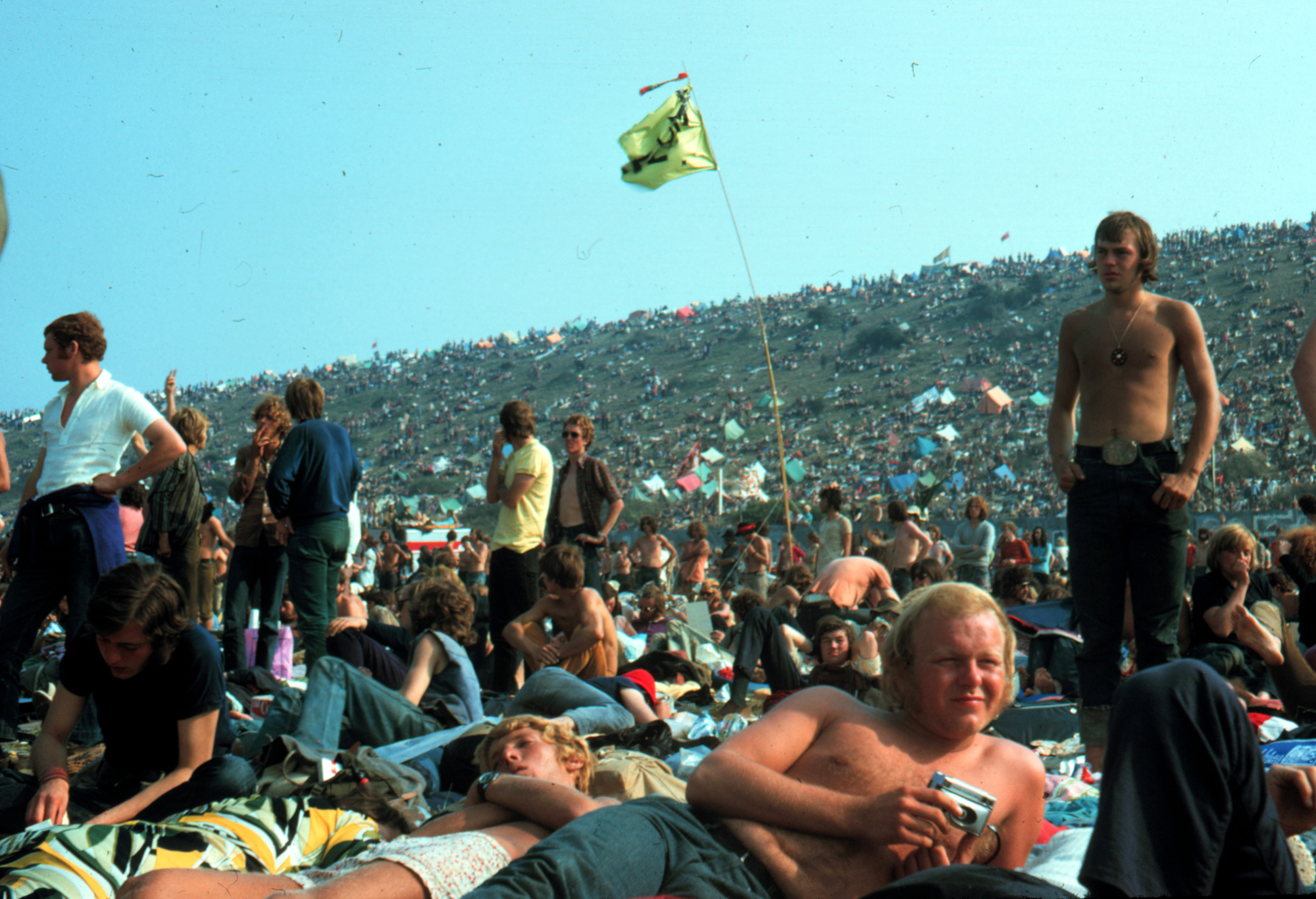
Woodstock Music & Art Fair (August 15–18, 1969, Bethel, New York)
Woodstock is the canon: the modern rock festival as myth. Gigantic scale, overflowing logistics, and a perfectly marketable “peace and music” narrative. Jimi Hendrix, The Who, Janis Joplin, Grateful Dead, Santana, Sly and the Family Stone, Jefferson Airplane, Ravi Shankar, Country Joe and the Fish—among many others.
Altamont Free Concert (December 6, 1969, Altamont, California)
If Woodstock is the myth, Altamont is the anti-myth: a free concert pushed by the Rolling Stones that ended up symbolizing the end of the ’60s. Santana, Crosby, Stills, Nash & Young, and the Rolling Stones played. The Hells Angels handled security badly on top of an already flimsy setup, and it all went to hell—four dead, and an era’s optimism collapsing in public.