Introduction to the World of FPV Drones
22 de ago. de 2025 — Pablo Wasserman
The world of FPV drones appeals to me because it has tons of niche companies making hardware, digital and analog technology, an audiovisual component, things that fly, abandoned places, you can do it while listening to music, and it has an artistic streak. Over a year ago, on episode #180 of Círculo Vicioso we saw a clip of an FPV drone in an abandoned place, moving at full speed in an ultra-technical and meticulous way, and I completely lost it. It plunged me into a new rabbit hole full of components I had been looking for elsewhere for a long time, at a level that hadn't happened to me with anything in many, many years.
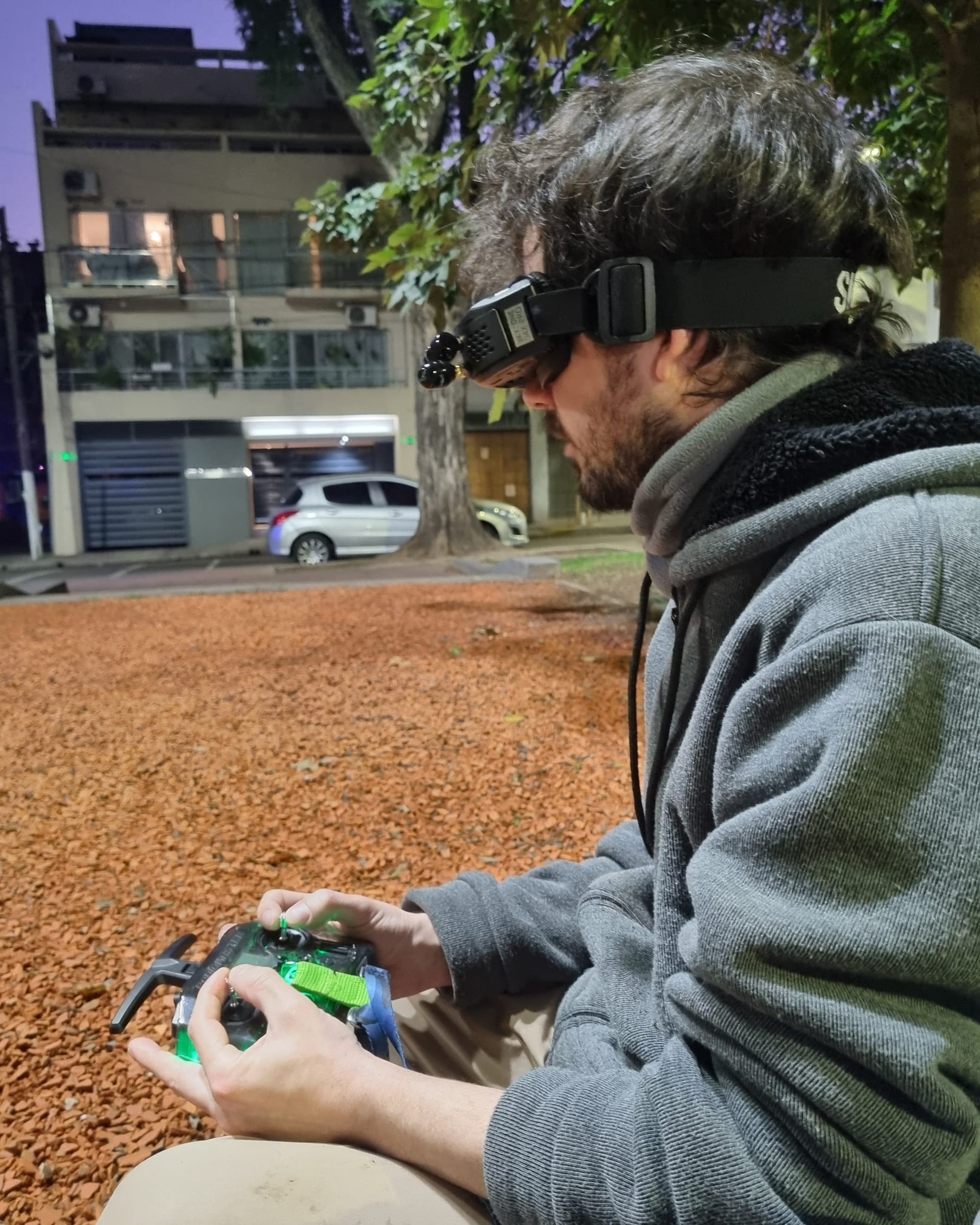
It wasn't the first time I'd seen or heard about drones, but it was the first time I started to understand them. FPV stands for First Person View. And for me, it all comes down to this: the possibility of feeling like you're flying is priceless. Feeling like you're in spectator mode in Counter-Strike 1.6 but in real life. With a tiny whoop (the smallest drones) it's the closest you can get to being a fly wandering through the air, passing through tiny spaces. But to achieve that, first you have to acquire a certain level of control and technique to internalize the movements of the radio (the "joystick") and make them second nature. When you do, it's like a kind of avatar, an extension of your body. You stay still, but you're somewhere else observing and interacting with the real world. What a trip.
I had started writing something about this a year ago, anticipating many of the things that happened in the Ukraine war with drones and how they changed the entire metagame of war. But honestly, there's not much left to say. Or rather, there's a lot to say, but right now I'm more interested in the artistic side of this world, so let's get to it.
Some basic concepts
First, let's differentiate some terms and look at the big picture. Technically, a drone is any unmanned aerial vehicle (UAV). But nowadays the quadcopter has become very popular, often abbreviated as "quads". Those are the drones we usually see in everyday situations.
Now, to use an FPV drone we need the aircraft itself (with all its parts), battery, radio (the "joystick") and goggles. The drone has antennas that transmit (TX) the radio video signals to the goggles and also receives (RX) the signals from the radio for movement. Typically, the radio control frequency operates at 2.4 GHz, and the video frequency at 5.8 GHz (yes, the same as WiFi). You don't need to know any of this to fly a drone, but data is data.
Then, within video transmission there are two important categories to differentiate: analog and digital. Analog drones are in principle cheaper, use open non-proprietary technology, have ultra-low latency, greater range, and tend to be lighter, although the image looks like that of an old TV with an antenna, with SD quality and static noise. It's ideal for having the greatest possible precision and speed (due to low latency) and also because the noise in the image gives clues about signal quality. To compensate, many people use analog drones but mount a GoPro on top to get an HD image as a result, in addition to the analog video from the flight.
Digital drones, on the other hand, are more expensive, use proprietary technology, the latency is higher than analog (although depending on which digital system is used, some have more or less), shorter range, they're a bit heavier, and the image can be HD, high definition. It's ideal for making higher visual quality videos without requiring as much precision or speed. In this category of digital systems, the most well-known are DJI, HDZero and Walksnail.
That said, digital systems are getting better and better, and the range also depends a lot on the antennas used. There has also recently emerged an open-source digital system called OpenIPC, which is very promising since it could significantly lower the prices of digital systems and expand the number of companies that can offer it.
The world of commercial drones can be broadly organized between photo/video drones and FPV drones. In the first category you find those from DJI, by far the most important and well-known drone brand in the world. These are drones with assisted flight, which move in a more controlled and slower way, and are ideal for shooting wider cinematic shots or taking photos from above. Agricultural drones also fall into this category—they're not very customizable and use closed systems, but are suitable for any end consumer.
And then there are FPV drones. These are flown completely manually, so they have a certain learning curve, which usually starts with PC simulators. They're highly customizable, super fast and agile, and can be built on a lower budget.
As for sizes, there are many, but let's say the most common are three: the tiny whoop, the 3-inch ones, and the 5-inch ones. From what I've heard, once you know how to fly a tiny whoop, the experience transfers pretty well to larger drones. For me personally, for now the ones I'm most interested in are tiny whoops for several reasons: I want to be able to fly anywhere, make it as "stealth" as possible without anyone noticing, have that flying bug vision—or feel like you're on the de_rats map in CS 1.6—, and also I don't want to hurt anyone if I eventually screw up and crash into someone. Tiny whoops are extremely lightweight, weighing around 30 grams with battery and all.
The glossary of the scene: guerrilla whoop, bandos, and tricks
There are thousands of videos of drones doing spectacular and cinematic shots of incredible landscapes, cities from above, and so on, all in beautiful ultra HD. They're excellent shots to use as B-roll in a movie or commercial. But they're boring. Nothing happens in particular there, beyond how impressive an aerial shot is. In parallel and in contrast to this world of drones, there's another scene with more AURA.
The guerrilla whoop consists of flying a drone in a generally public place without anyone's permission, in some interesting spot, trying to do tricks or just cruising around, sometimes messing with people a bit. One of the best at this is FPV Vegan, a guy who lives in New York and mainly flies analog tiny whoops in random spots around the city. He makes videos and uploads them to YouTube and Instagram. What I like about this guy is that he mixes his videos with footage of himself flying, sometimes alone or with someone else, and you can see the gear he uses and the places around the city where he hangs out. His level of control and precision when flying drones is impressive, the result of years of practice.
The guy moves around the whole city and wherever he sees a good spot, he flies the drone. He does it on the street, in malls, on bridges. In the video above he's flying a drone with a joint through the park, getting close to people to see if they catch it. He can also show up goofing around for a bit in a laundromat, messing with the owner a little. Or climbing the Empire State with a 65mm tiny whoop and throwing in a dive.
There's a whole huge scene of people doing this in different places. The easiest way to find them is by searching for those who have FPV in their name. Not everyone does, but the vast majority at least have it in their bio. For example, Baboo.fpv, who here is opening the door of a corner store with the drone and going inside.
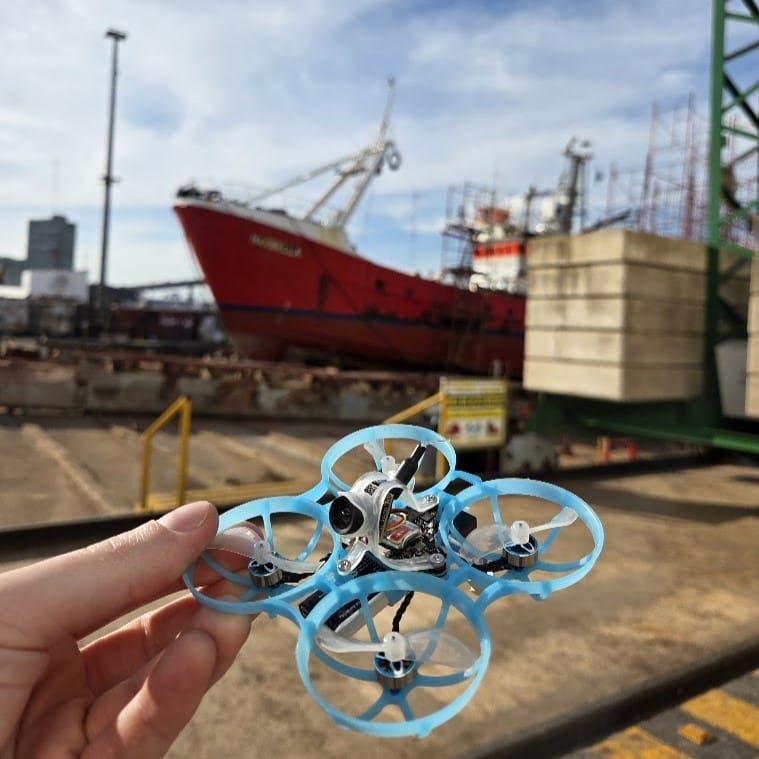
And for a bit of self-promotion, below is me flying at a shipyard in Mar del Plata. While I don't come even close to the quality of the pilots above, just being able to see my own city from the perspective of an analog drone is, for now, more than enough for my enjoyment.
On the other hand, there are FPV YouTubers who make more "content"-style videos, where they show different things. One of them is BotGrinder, a total drone addict who shows himself wandering around places and talking about FPV stuff, and who made for example this video about the unwritten rules or etiquette of guerrilla whooping.
And then there's also the scene of flying in abandoned places, better known as bandos. In this category, most people tend to focus more on freestyle, which consists of pulling off complex tricks with various drone movements in tricky spots. What's also interesting is that they usually show, alongside the flight footage, a shot of the radio so you can see how the movements are made. It's insane to see the level of precision involved. An absolute legend at this is nils.vo.
A lot of all this easily resonates with the world of skateboarding, for obvious reasons: street, technical skill, sneaking into places without permission or abandoned spots, doing tricks, making videos, meeting up at spots with others who do the same, and so on. So much so that a guy built a trick library where he shows with GIFs all the existing ones and how each one is done. He named the page Tyrantt’s Pro Whooper in a clear nod to Tony Hawk's Pro Skater, copying the logo and everything.
As new tricks emerge, the FPV community names them and some stick. There's also a magazine in the style of Thrasher, which is really cool and is called Fly Tribe Magazine. And also a competition, the IGOW (International Game of Whoop), which has been running for five years now, where each week a different challenge is presented until completing the four letters of the word IGOW. It's international because people from all over the world share videos of the challenges and then they're judged on a livestream. There are prizes with quite a bit of money involved, and on the official IGOW page they expressly state that they want to pave the way for the FPV freestyle category to be considered a legitimate sport, an interesting goal to keep an eye on.
coto whooping 🛒
— PabloW (@pablowfpv) July 27, 2025
BETAFPV Meteor65 Pro
Skyzone SKY04X PRO
RadioMaster Pocket pic.twitter.com/5RaLFq1sh5
Before all of this, years ago the FPV drone community was classically made up of a much more technical profile, classic hardware nerds focused on the radio control hobby not only for quads, but also for example small fixed-wing airplanes which are ideal for flying much farther. The technology is the same; the most widely used protocol today for radio control transmission is ExpressLRS (open source), and a few years ago it was FrSky. Many of these RC legends can be found on the IntoFPV forum, where they constantly answer questions from beginners and also discuss higher-level topics.
One of the worlds these folks are into is the Long Range subgenre, which refers to long-distance flights. A fun story is that of an Australian who wanted to break the record for the longest flight distance using this ExpressLRS protocol, which actually has a leaderboard on its website to compete for who makes the longest flight. The guy managed to fly 101.3 kilometers, which is more than double the previous maximum of 43 km. Absolutely insane. He uploaded a video showing the flight and explaining in detail how they did it. Shortly after, he was hit with a fine of 2,750 Australian dollars (about 1,800 USD) and was forced to take down the YouTube video. The FPV community raised the money in minutes and he was able to pay it without any problem. Shortly after, another channel re-uploaded the original video here. All of this was, of course, discussed on the forum: here and here.
It's hard not to also mention Joshua Bardwell, an inexhaustible source of learning resources. Any question or doubt you have about FPV drones has probably already been talked about or discussed on his YouTube channel. Another must-visit is the website of Oscar Liang, an encyclopedia of absolutely EVERYTHING related to FPV drones
Anyway, the drone scene has been around for a while, but at the same time it's just getting started. Like all technology largely driven by war, it will surely bring us great joys and also problems we can't even imagine today, which is why I think it's worth following closely.
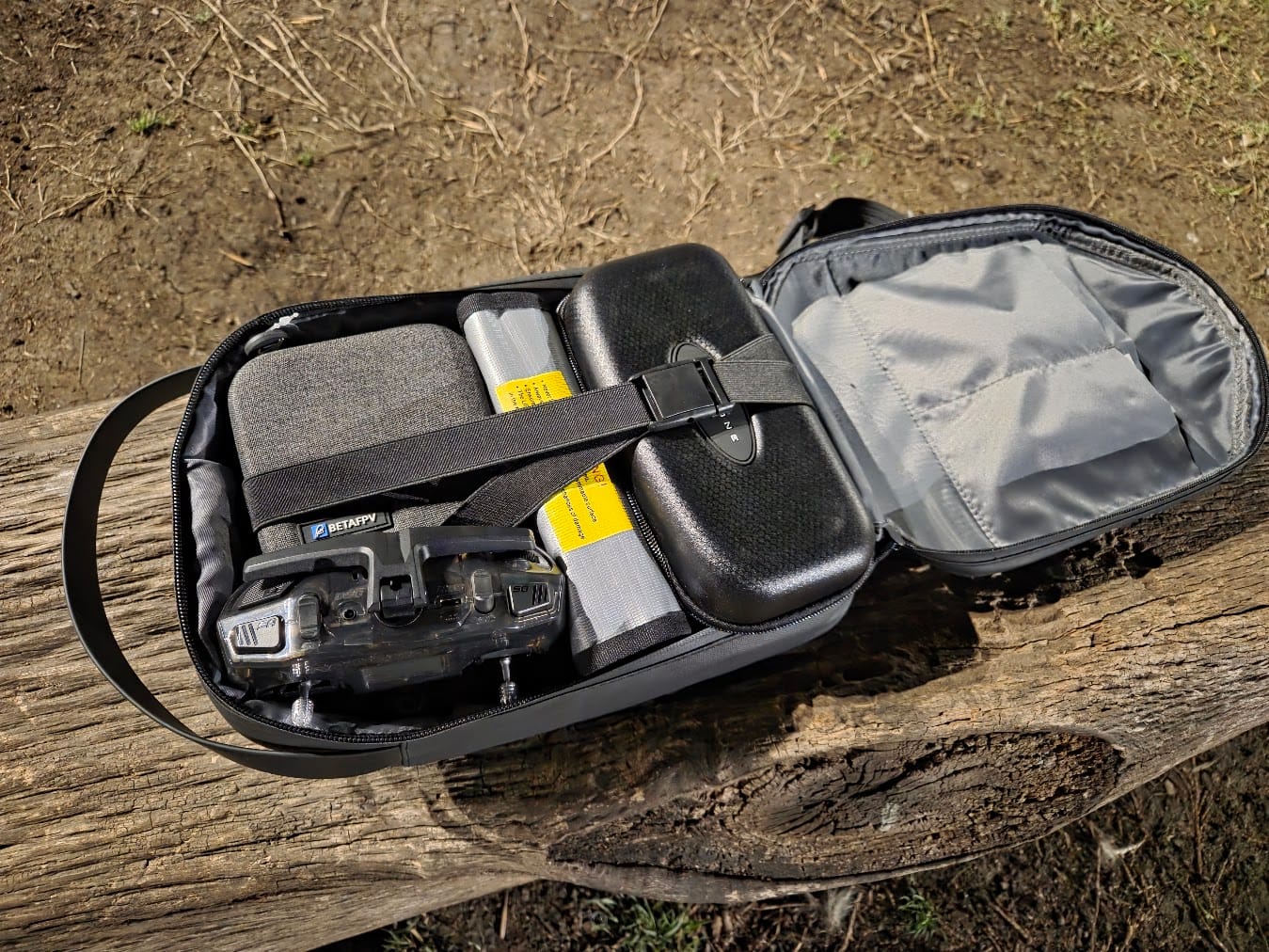
FPV drone buying guide for every budget
The best way to start is to get yourself a good, cheap radio like the RadioMaster Pocket —the one I use. You can find it on Amazon (a bit more expensive but it arrives fast) or on AliExpress (takes a bit longer, but it arrives and costs a bit less).
Once we have the radio, the best thing to do is practice on a drone simulator. The most well-known ones are Velocidrone, Liftoff, Uncrashed and a few more. The first one is bought from their website, and the other two on Steam. Of those, the one I like the most is Velocidrone, which also has a mobile version. Plus, racing people really like it, so I feel it's more "realistic" (none of them fully are, but it doesn't matter that much). If you don't want to pay for a simulator, there's a free one on Steam, FPV SkyDive. And if you don't have a computer, there's a free one for mobile on Android, FeelFPV.
With this radio + simulator combo we can practice for many hours until we feel we have a basic grasp of how to fly a drone. The most recommended thing is to follow a tutorial to learn the basics, like Joshua Bardwell's, which is very good. You don't need to complete it all, but doing the first videos of the series for beginners is extremely useful for getting a good start.
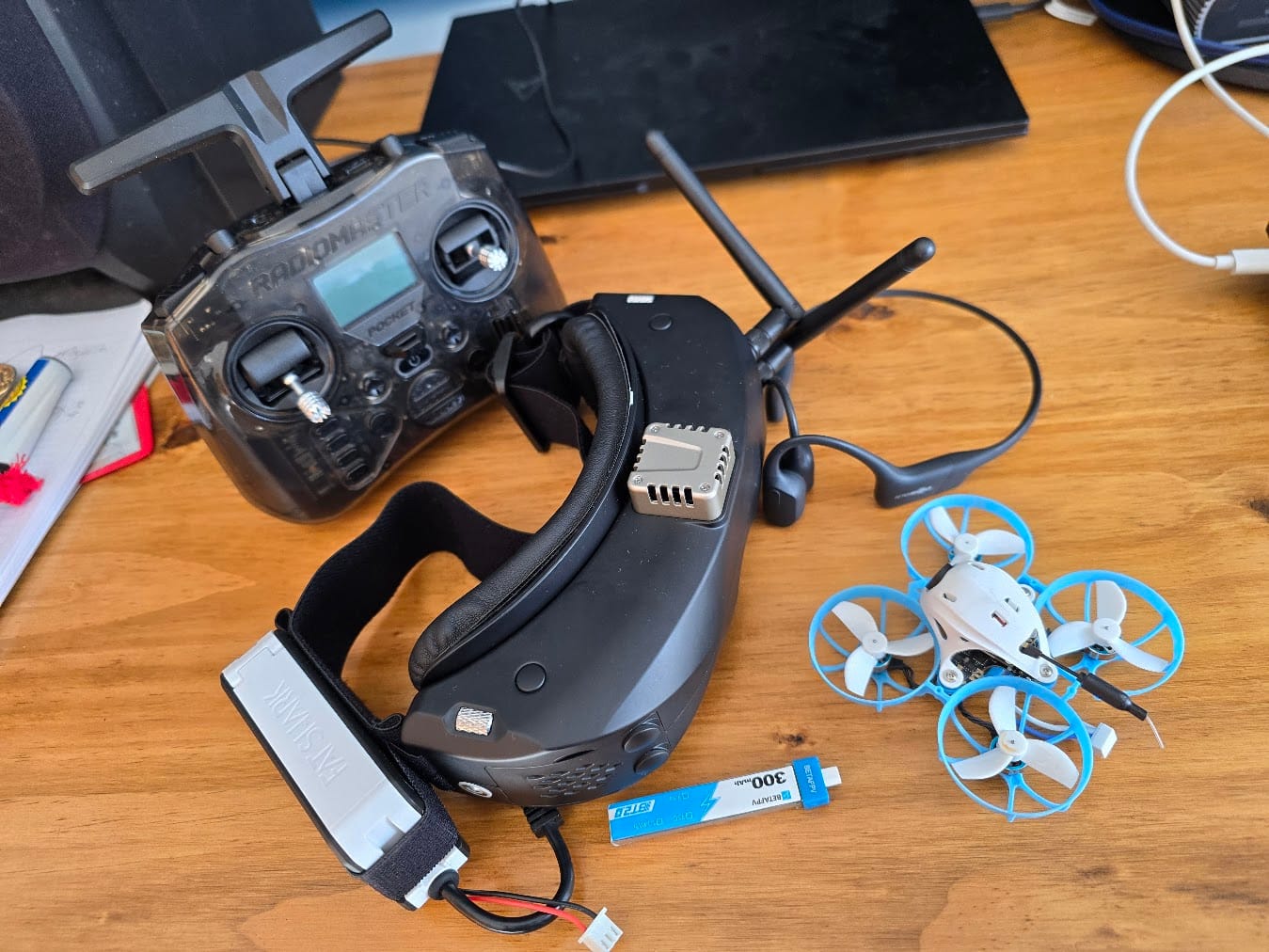
Only after mastering this stage can we start thinking about the first drone and the first goggles. The first drone could be the BETAFPV Air65 or the BETAFPV Meteor65 Pro. It's small, agile, cheap, and one of the best on the tiny drone market. The second one is a bit less agile but more durable, and comes with a couple of batteries and a charger (mediocre).
Regarding goggles, my philosophy was buy once cry once, meaning spend a ton of money upfront, cry about it once, and that's it. Goggles can last forever, so if you're interested in staying in this hobby long-term, it's worth investing in a good pair. But there are also cheap ones like the Eachine EV800D (the 2-antenna version, Diversity) which tends to be one of the most recommended low-cost options. But watch out for clones—there are a lot of counterfeit products out there. And another one that's a bit more expensive but still "affordable", the Skyzone Cobra. As you'll notice, the cheaper ones have this larger box format.
And if you feel like spending a lot for something more pro, the Skyzone Sky04x Pro or its slightly cheaper variant the Sky04O Pro. Another option in the expensive category is the HDZero Goggle 2, which although it's for a digital system, also has analog built in, making it an interesting option.
Finally, for batteries, the Tattu 300mAh 3.8V HV 75C, which come in packs of 5. And for a 1S (1 cell) battery charger, the VIFLY WhoopStor 3, which has a storage charge option, something necessary if we want our batteries to last.