"Cazador was like a soccer ball: one kid had it and everyone played"

13 de jun. de 2025 — Hernán Panessi
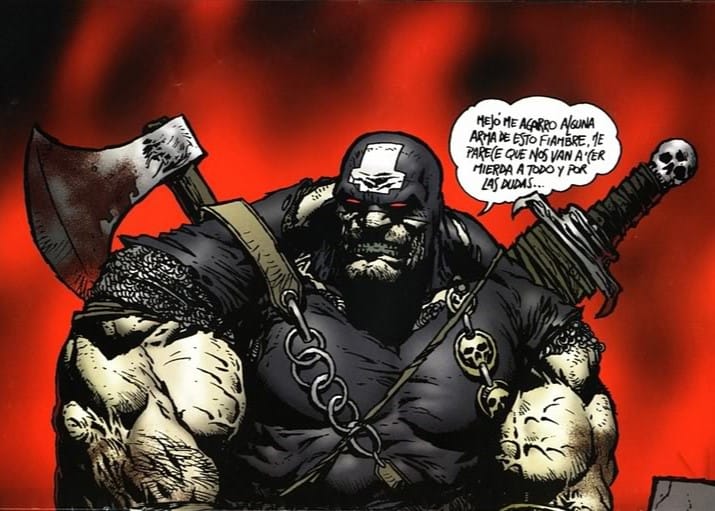
It's incredible to think that the best-selling Argentine comic of the last 40 or 50 years earned its creators the grand sum of a few McDonald's combos, a few slices of mozzarella pizza, and enough cash to hit the comic shop and bring home a title or two. That's where Jorge Lucas stands, the creator of the hit that was Cazador, the last great boom in Argentine comics; the guy who knows his work was read by more than one generation and that, by some twist of fate, it gave what it gave, but never gave him the millions you'd expect.
Something Lucas is clear about regarding Cazador, his comic: it was read a lot. A lot, a whole lot, a ton. Something he learned over time: one kid in the class would buy an issue and it ended up being read by 20 or 30 others. That is, not everyone bought Cazador, but everyone read Cazador. "It was like a soccer ball -- one kid had it so everyone could play."
The origin
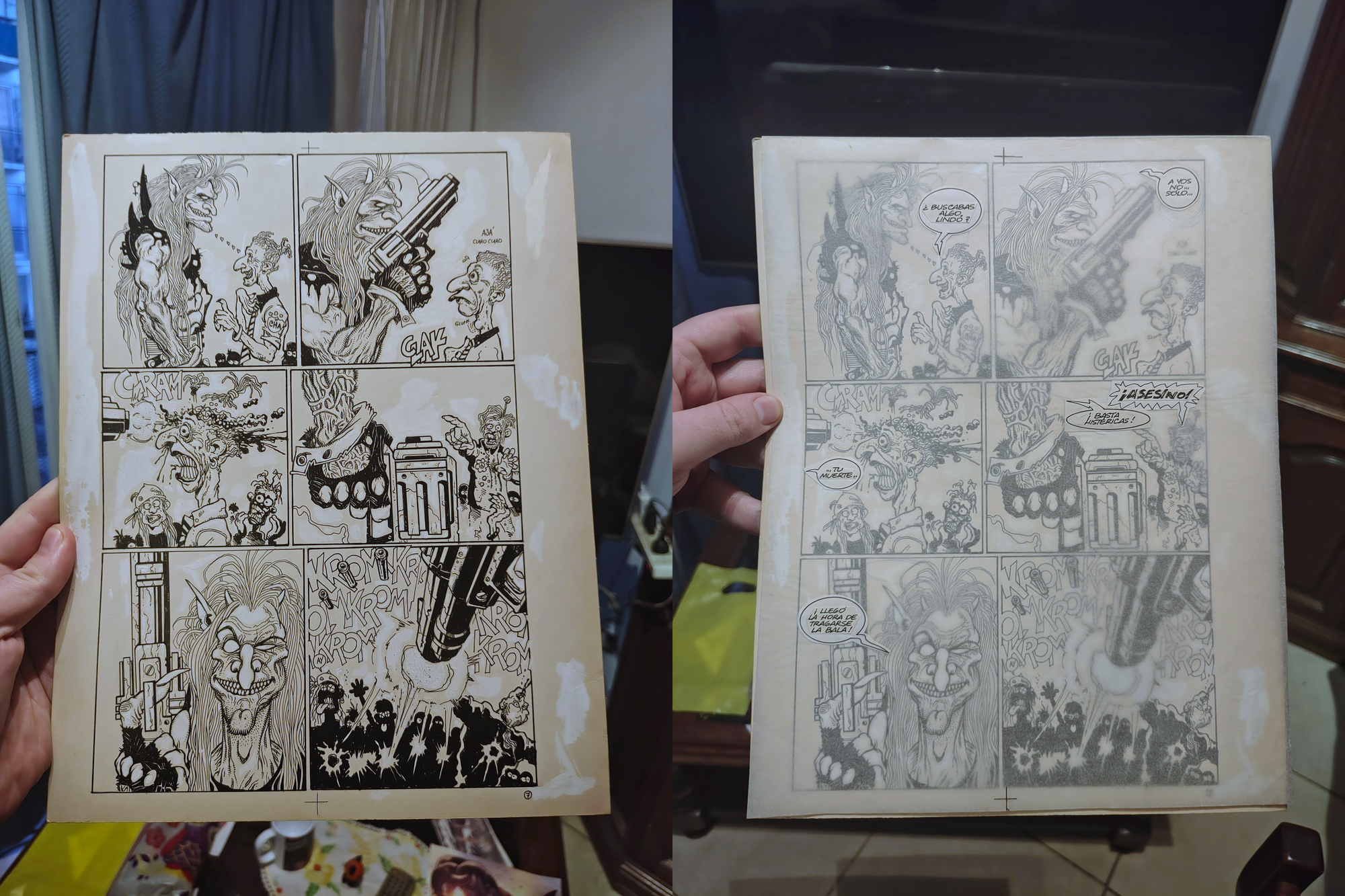
"We learned to paint with Photoshop to finish issues faster," says Jorge, sitting in the living room of his apartment in the Villa Santa Rita neighborhood, right at the dawn of El Eternauta series, that cultural product turned into homegrown soft power capital that comes genealogically from the pantheon of Argentine comics. A space occupied, obviously, by Cazita himself, among other giants.
In historical terms, Cazador was born in the twilight of the Alfonsin era, in '88, when Lucas entered a contest sponsored by Revista Skorpio. "I was really into Frank Miller's Dark Knight. Cazador has a style similar to that Batman, but, you know, worse." There, he won an honorable mention (not the contest, because "Cazador never won anything") and that became the fuel to put together his first fanzine: Arkham, a comic made with photoduplication with a print run of 100 copies, in March 1990.
"It got some traction," Lucas recalls. That buzz brought Javier Doeyo, who became the editor of his "first issues," a revamped edition of that debut. It was 1990 and, until then, Cazador presented itself as a kind of third-world Batman, a natural enemy of the CIA and the American government apparatus. The period references speak for themselves.
The canon
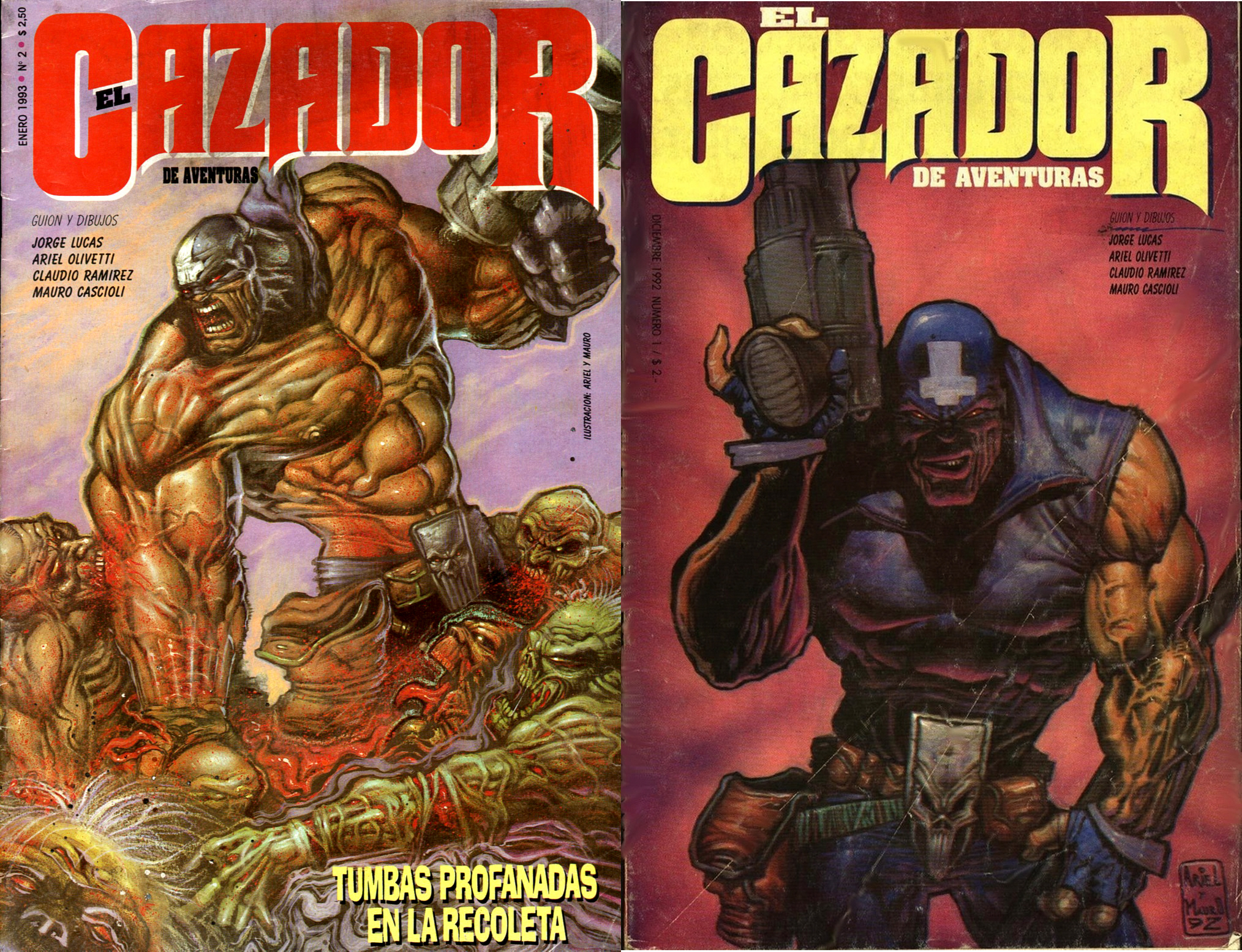
By late '92, Cazador signed with Ediciones de la Urraca under the influence of a somewhat shaky start and a trajectory that kept swelling in public conversation, in jokes, in popularity. And it was Mauro Cascioli, his editor, who ordered a guerrilla poster campaign along Av. Corrientes, which became the first great viral moment, that "coming out of the nerd closet" to reach the passerby, the office worker, the neighbors, the kids. "Cascioli wanted a character like Lobo. So we took Cazador and turned him into a kind of Lobo, but with way more swearing. Over time, the character took on a life of its own."
And so, Cazador went from being a "serious" character to a "mocking satire," from having a personality shaped almost by default to carving out the ego of a transcendent character, the kind that defines eras. From that relationship with Cascioli came 66 issues: 7 in black and white and the rest in color, the fundamental and spiritual backbone of the entire body of work. "At first it came out every four months, but when we put together the compilation book of the first seven issues, which sold a lot, Cascioli got excited and made it monthly," Lucas says.
That first staff is also the most remembered of all: Claudio Ramirez, Ariel Olivetti, and the aforementioned Cascioli and Lucas. "Mauro did the covers and the centerfold posters. Olivetti left at issue 7, but he was the one who drew and inked. And we'd put together the scripts with Ramirez, as a way of having some kind of guide," Jorge explains. With that methodology -- urgent, rushed, with merciless deadlines -- they managed to sell about 30,000 copies a month. A staggering number that, at the time, wasn't treated as such. "We didn't give it much thought," Jorge tosses off. "I only saw the full scope of that movement when I made a Facebook account, and a ton of people joined right away."
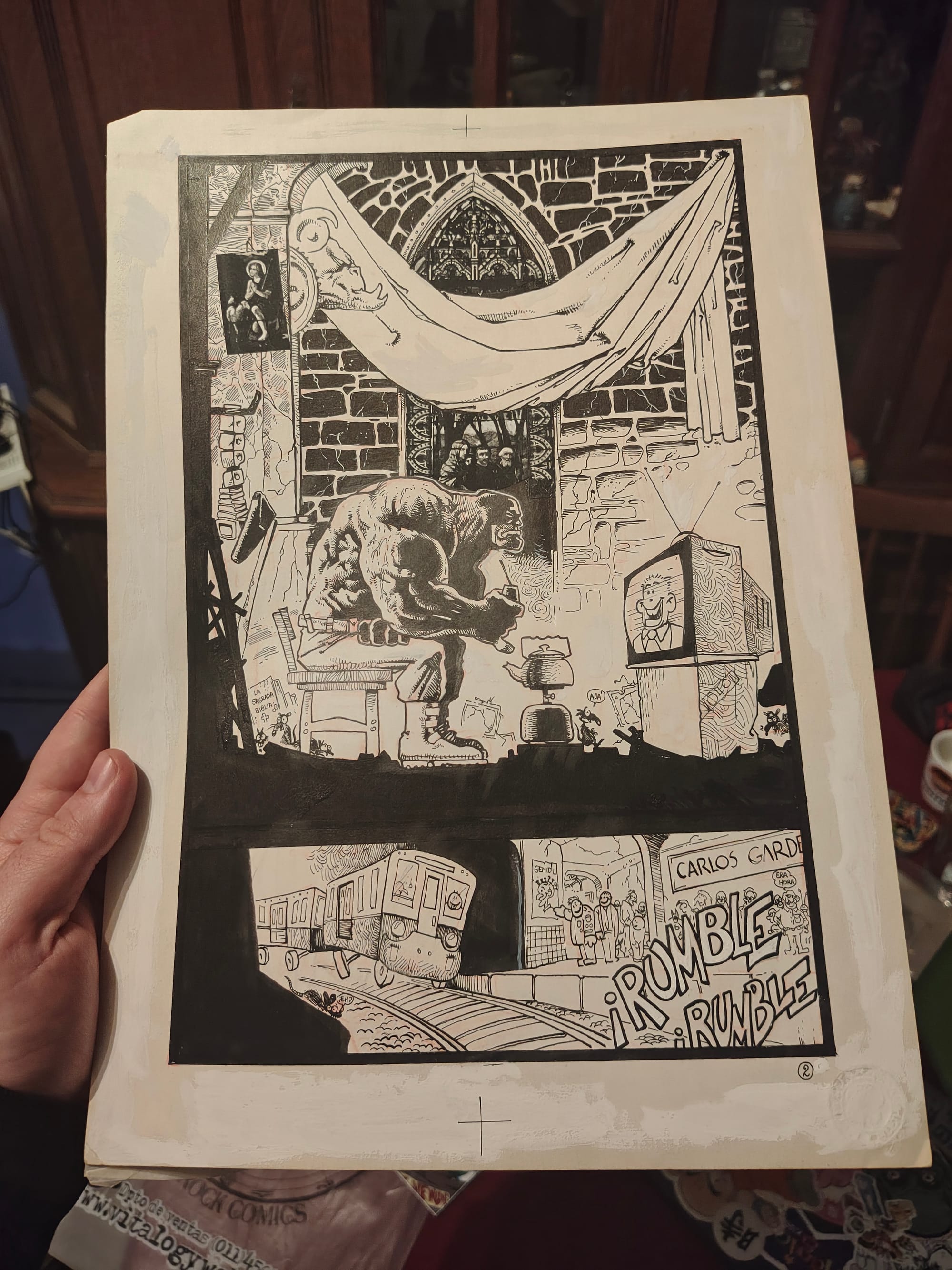
Cazador's misadventures stemmed from random stories that fell into his (dis)grace. He lived in an abandoned church and, out of nowhere, he'd pick up a woman who turned out to be an alien. Everything like that, everything like this, all very random. "Those kinds of things happened to him, maybe he'd fight an alien invasion in Buenos Aires, but he didn't want to save the world -- things just happened to him."
The return
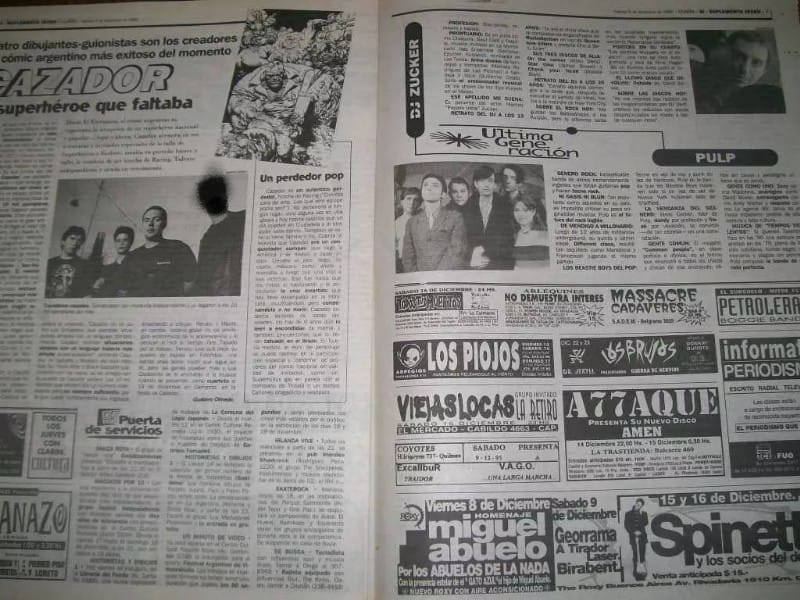
But then came the fallout from the Menem era, the death of publishers, the drop in consumption, the nominal loss of wages, the crash before the crash. But since Cazador is immortal, he found a way to come back. In 2000, there was a Cazador experience in the mainstream through Editorial Perfil, which lasted another 22 issues. There were Ramirez, Cascioli, and Lucas, but also Omar Francia, Walther Taborda, and other artists. The last issue? Very timely: scheduled for December 20, 2001. "Claudio Ramirez called me -- he had the connection with the publisher -- to tell me it was over."
In those years, Cazador was soaked in current events because, literally, they wrote the scripts "on the spot." Their urgency made them drink from the well of breaking news, from the last five minutes of the decadent and pop-infused '90s celebrity gossip. That's why the news exploding from television ended up embedded in the story, like that cover with Mauro Viale and Jacobo Winograd, or the one with the Spice Girls, or the other one with Sailor Moon.
"One day, on Radio Rivadavia they said they couldn't believe we hadn't been buried yet, given the amount of jokes we made about Menem-era businessman Jose Luis Manzano," he says. "At some point we had to clarify that it was a comic for adults because kids were buying it, and it wasn't a product for kids."
The cult
Naturally, given its inherently irreverent identity, Cazador endured the blows of censorship, and the Argentine comic world still remembers those issues wrapped in a black band that covered most of the cover, as if it were a pornographic magazine. That's how the Dragon Ball cover was distributed, along with the Comodines one and the Lady Di one. "We threw in a lot of outrageous stuff and did things just to stir the pot. A lot of people started getting annoyed when Cazador became popular. What we did was also social commentary, it wasn't just profanity. That's why some people defend it and others faint."
His work inserted itself into the heart of Argentine reality to, at some very grotesque point of an equally grotesque era, narrate it. Like a diabolical, parodic, and gritty chronicler. Like a funny clown pointing a very firm finger at everything that's wrong, everything that's hopelessly messed up, and, while he's at it, laughing his head off at all of it, with pure irreverence. With pure honesty. Because if there's one thing Cazador is, far from highbrow theoretical frameworks, it's a visceral, authentic, youthful, broken, alive artifact, even if it's dead, even if it's immortal.
As things went, the popularity Jorge Lucas gained making Cazador led him to work for Marvel and DC, the two biggest comic publishers on the planet. After some tryouts, he spent five years doing work on X-Force, Black Panther, Inhumans, Fantastic Four, Thor, Hulk, The Avengers, and others. "I worked a good amount, and thanks to those years I have this apartment that I bought in 2001. Before that, I spent all my time at my parents' house, drawing nonstop."
The rescue
After a hiatus, Cazador came back around 2010 with two issues published by Deux, the imprint of Pablo Munoz. And, out of nowhere, it always respawns with old stories in anthology-style books. "Today I could come up with a thousand stories for Cazador. In fact, Ramirez and I have been itching to write some, but I want them to be on paper because I hate the veg... I mean, the digital format. At one point, the character went to hell, and my idea is for him to come back from there."
Beyond that, due to the sheer weight of the character, Cazador always had cinematic rumblings that never quite materialized, for one reason or another, for X or for Z. Animation projects, titanic ones, flimsy ones, outlandish and not very concrete. Cazador deserved its own audiovisual version, like Las Puertitas del Sr. Lopez, like Zenitram, like Isidoro, like Don Fulgencio... like El Eternauta.
Until in 2015, filmmaker Georgina Zanardi appeared (first in collaboration with Marcelo Leguiza) and delivered Cazador, la pelicula, an independent production starring La Masa, the pro wrestler from 100% Lucha. "Georgina was a student of mine in a comics workshop. One day, I asked the students what they did, what their day jobs were, and she said she made films. So I told her, half-jokingly, why don't you make a Cazador movie? And she went and did it."
With a chaotic premiere set in 2022, barely coming out of the pandemic, the Multiplex de Belgrano gathered a first wave of viewers who saw a full version of the film. Before that, in late 2019 and just steps away from the coronavirus, a sort of unfinished version was screened at the Buenos Aires Rojo Sangre Festival, a conclave of gore fanatics, guts, and genre cinema, the natural home for a production of this kind. "We showed it to a packed house but, obviously, we didn't win any awards. As always," he laments.
The now
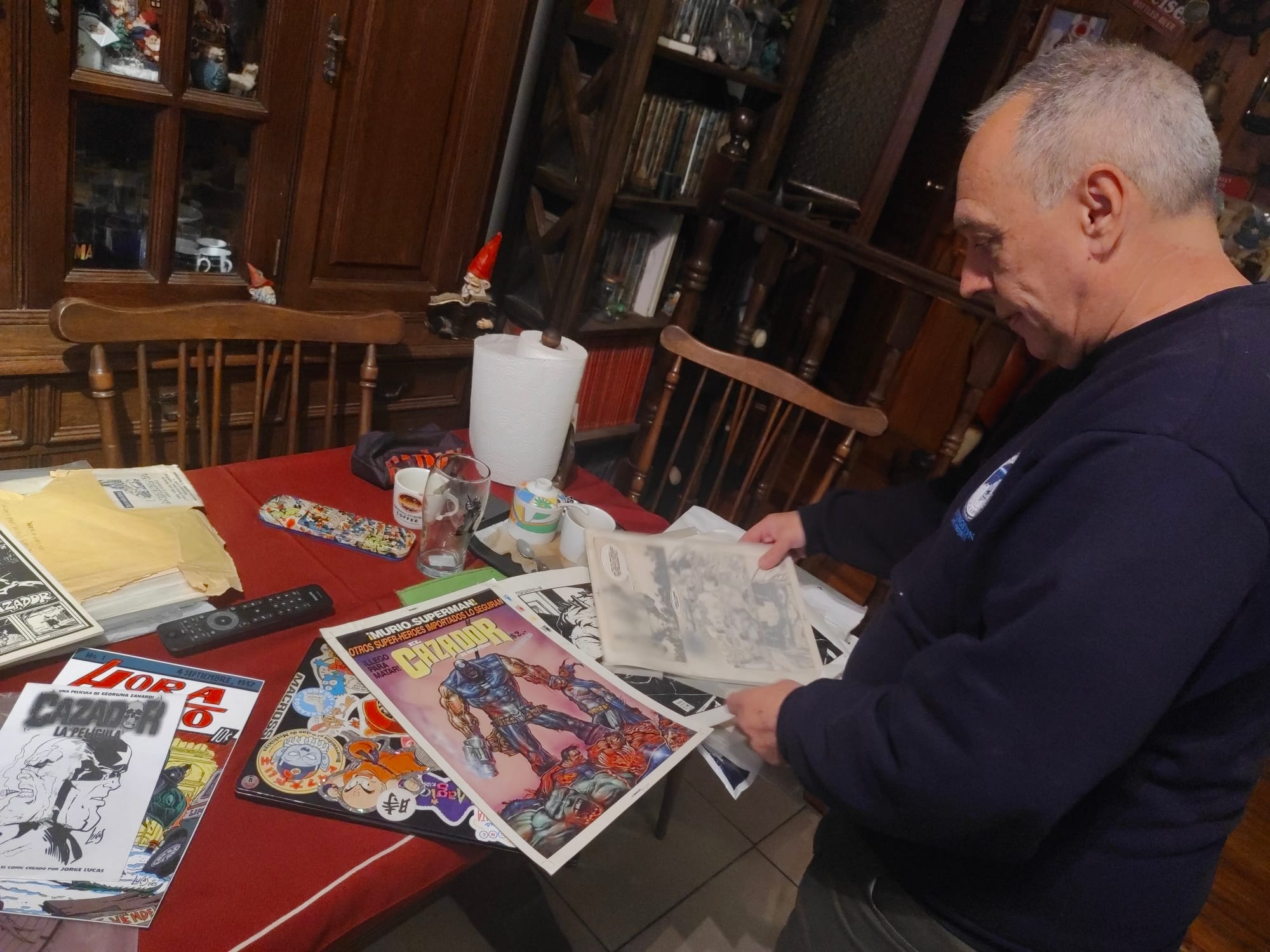
These days, at 62, Lucas still hasn't fully come to grips with it, as if he can't quite internalize aaall the milestone he sparked in Argentine comics. His dream rests on shelves, ledges, and bookcases of (ir)responsible adults. His comic survived moves, breakups, every storm, in his followers' homes. That's also why today he lives light, without rockstar fables and, like many Argentines, just scraping by, picking up gigs here and there. Like the impeccable comic he did for the shop Capitan Barato.
Riding that ego-free train, Jorge Lucas regularly shows up at conventions selling some prints and original illustrations. Presenting himself as just another working guy, still chasing the Batman comics that fascinated him as a kid, and with some of that old urge to stir things up, sometimes a lot, sometimes not as much as before, but right now, exactly right now.
And his work, which is an involuntary slash mark left by that old adolescent boldness, carved a groove that cannot be filled. Or that, at least until now, hasn't found its natural successor. Not a single worthy heir. And that even though a presidency like Javier Milei's would fit it like a glove and they'd have plenty of material to work with. That's why the unmistakable scent of a comeback rises; that's why it's necessary to underscore that -- come what may, because Argentina is Argentina -- Cazador didn't die and never will. Not even if they drag him to goddamn hell.