JRR Tolkien: Visiting an Old Friend

2 de oct. de 2025 — Juan Ruocco 🧙♂️
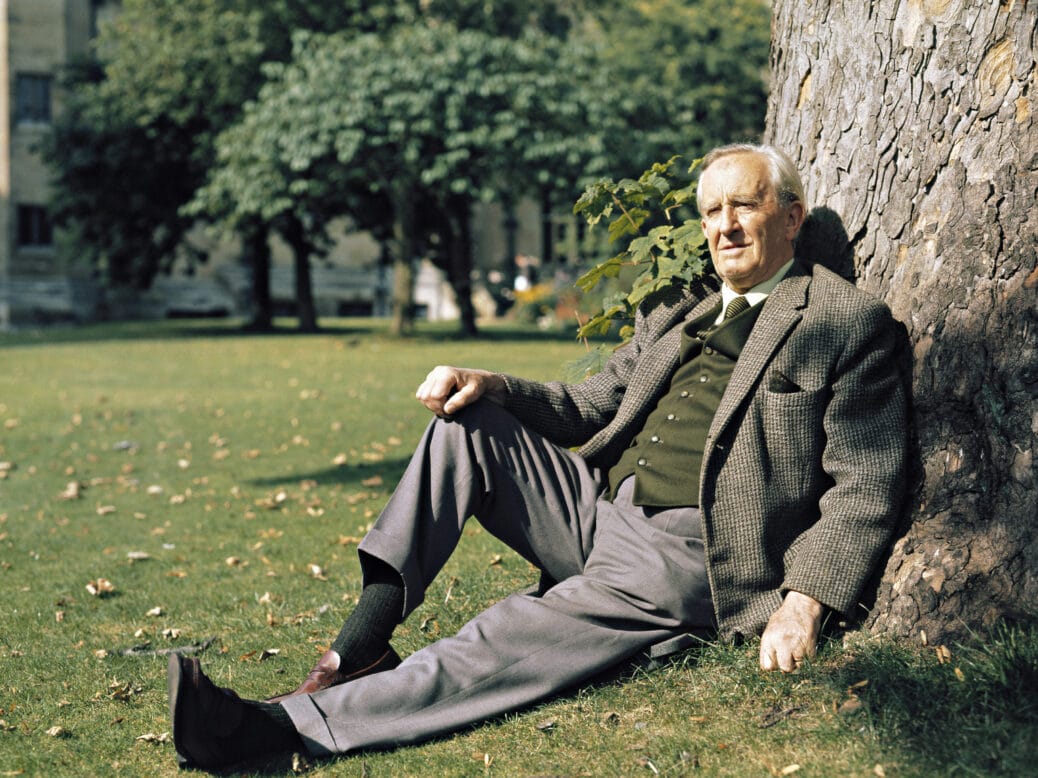
There aren't many authors I hold in such love and respect. Very few, really. I could add Cordwainer Smith and stop counting. I won't list the reasons why Tolkien became a pillar in my life; there's no need. Saying it is enough. Taking advantage of our honeymoon and the fact that we went to see Black Sabbath, Agus also suggested it would be a good time to visit JRR Tolkien's grave in Oxford.
Taking a train in England is like eating pasta in Italy. Across the entire network you can even find topological similarities with our own lines, which were also built by the titans of the 19th-century railway industry. The riveted steel bridges on the San Martin line are identical to those at some old stations on the Great Western Railway, the operator of the Oxford-London service. Or the pointed wooden trim decorating the station valances, here and there. England has miles and miles of tracks with services running all the time, at all hours.
The journey from London to Oxford is, on the surface, simple. A train from Paddington to Oxford station and not much more. A small two-platform station, and from there a street that takes you to the epicenter: the universities, spread across colleges. Oxford is a house of learning nearly 1,000 years old (930, actually). Nine hundred and thirty. We could say the city is what grew up around the university.
Wolvercote Cemetery is about 5 kilometers from the center, reached via the main avenue, or at least the city's longest thoroughfare. Several bus lines cover the full route, round trip, for about 5 pounds. We happened to visit the city on the day students come to explore study opportunities, so all of Oxford was somewhat bursting with people. Especially the area around the colleges.
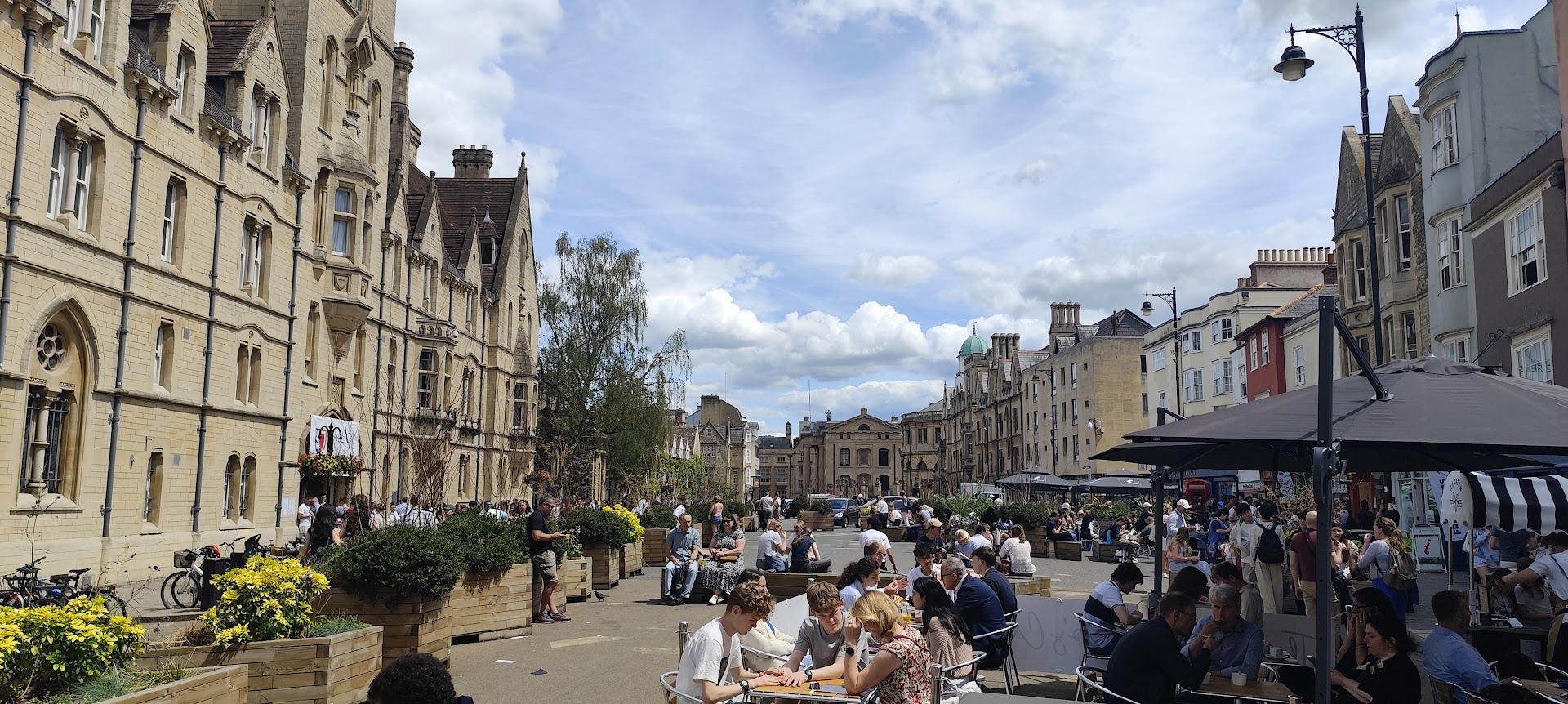
Colleges, churches, and family homes
It's at the university where most of the "tributes" or commemorative sites are concentrated. A bust here, a plaque there, a bench. But for some reason, all of that interested me very little. What I cared about most was visiting the pub where Tolkien used to meet his friends, the parish he attended every Sunday, the house where he lived with his family, and lastly, his grave. None of the places have anything particularly remarkable. Except that at the Lamb & Flag pub there's a small inscription written in Tengwar, which appears to be a (incorrect) rendering of the phrase written on the doors of the Mines of Moria: "pedo mellon a minno" (or "speak, friend, and enter").
But beyond those details, what was truly interesting was being able to have a small window into the everyday life of this colossal genius. The pub with friends, the home at the end of the road, the Inklings gatherings. We continued on and walked to the only (?) Catholic church in Oxford. In a country as Protestant as England, Catholicism has an almost anomalous character.
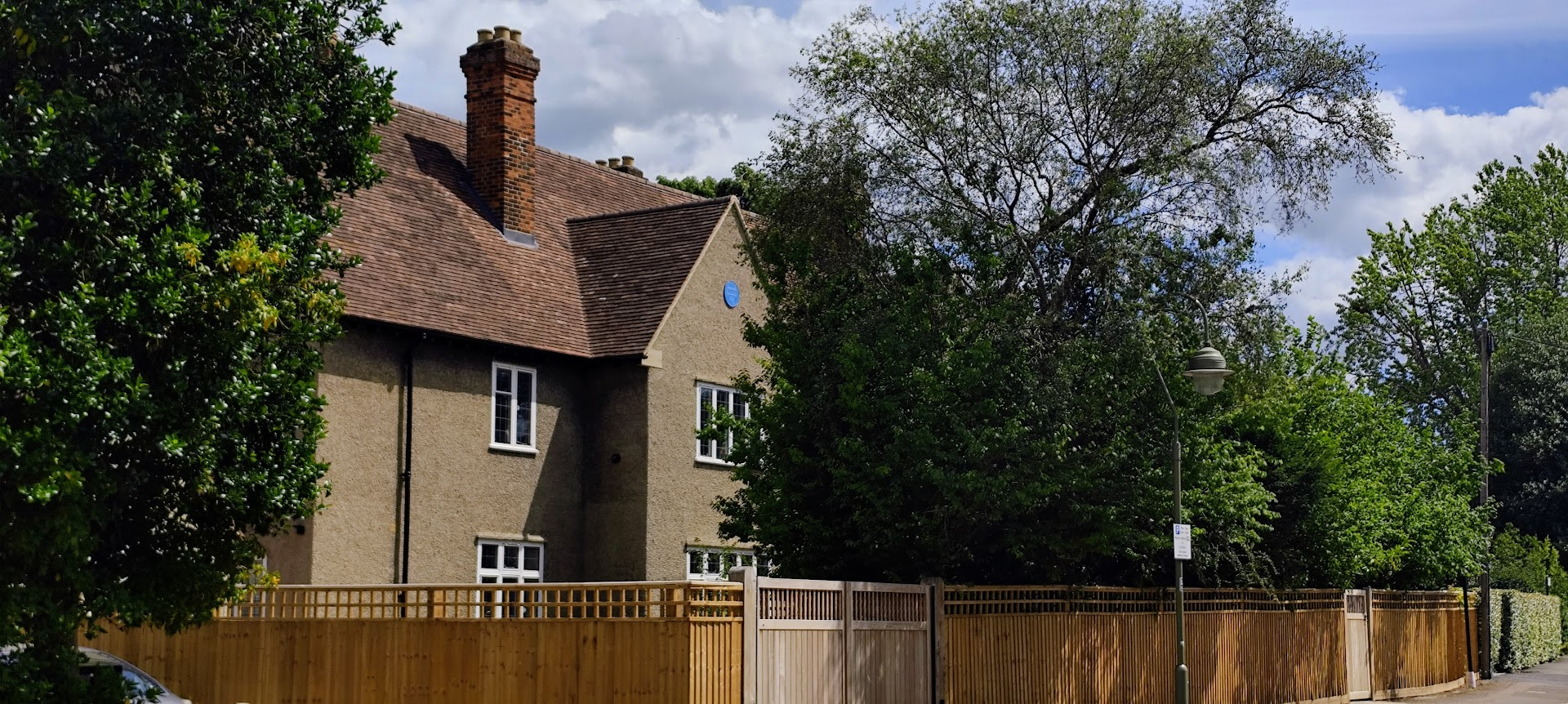
From there we walked several more long blocks past all kinds of houses, imagining with Agus who might live there. Professors, students, shop owners, professionals. Imagining someone's life and income to be able to keep living in a place that looks like something out of a Tolkien story. That's how we arrived at the family home, which has a commemorative plaque visible from outside that reads "Here lived JRR Tolkien" and not much else. He inhabited that house between 1930 and 1947, when he wrote most of The Lord of the Rings and The Hobbit. Spying on someone else's intimacy.
Tired, we took the bus to Wolvercote Cemetery on the outskirts of the city, crossing a charming little town -- well, a neighborhood -- Summertown. At the cemetery there's nothing particularly remarkable other than a sign that reads "Tolkien" with an arrow and a plaque commemorating its award for best cemetery in 2001, coinciding with the theatrical release of the first installment of Peter Jackson's trilogy.
I walked through the cemetery with a mix of nerves and excitement that was hard to contain. As if I were about to meet someone important or had to give a talk before an immense auditorium, as if I had to sit for a final exam. After a 5-minute walk, with no particularly noteworthy detail, we arrived at the grave of John Ronald Reuel Tolkien and his wife Mary Edith Tolkien. A simple grave, in a simple cemetery, in a simple town. Almost like a monument to English simplicity. It's curious that they are buried together. Below JRR's name it reads "Beren" and below Mary Edith's it reads "Luthien." Two key characters in the legendarium.
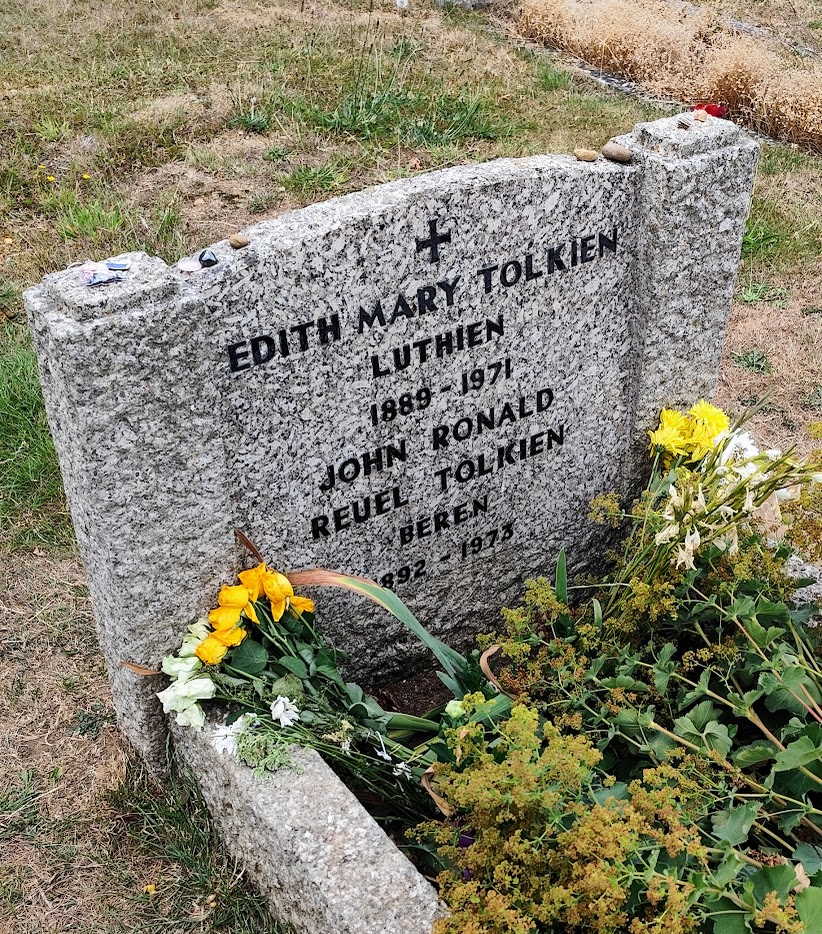
Beren, son of Barahir and Emeldir, is orphaned after his father and the Twelve Companions are slain by orcs in Dorthonion. His mother had already departed to Brethil. From then on, he lives alone as an outlaw in the forests until he meets Luthien (JRR was an orphan). For her part, Luthien Tinuviel is the daughter of Thingol, King of Doriath, and Melian, a Maia. She is the most beautiful of the Children of Iluvatar who ever lived. She loves Beren, a mortal, and for him defies the will of her father and of Morgoth. She sings and dances with magical power; with her song she puts Morgoth to sleep. Together with Beren she obtains one of the Silmarils from his crown. She then renounces immortality to share Beren's mortal fate. Both die and are brought back to life through Luthien's intercession before Mandos, becoming the first to break the separation between the fate of the Elves and that of Men.
I took advantage of this small pilgrimage to thank the old man for all the years of joy he gave me through his books. Particularly between 2001 and 2004, during that complex stage we call adolescence, when all of Tolkien's literature, his legendarium, was an inexhaustible source of happiness, friends, and imaginary worlds. In that dizzying year of 2001, my sister Clara and I joined the Tolkien Society of Argentina (the old and beloved ATA) founded by Father Jorge Ferro. There we met dear friends with whom we formed a solid group that transcended our cosplaying adventures: Laura, Xiomara, Virginia, Florencia, Nicolas, Federico, Francisco. Friends who endured and with whom we reconnected years later, like Martin or Telma.
The ATA was a spectacular space full of quirks. The group's original mission was the study and dissemination of the old man's work. There was a monthly meeting, on the first Monday of each month -- or was it the second? I can't even remember anymore. Someone would give a talk on a topic and certain administrative arrangements were made. Parish announcements, basically. And then there were other important dates that gathered the faithful. Tolkien's birthday (January 3rd) and the annual celebration of the "Fall of the Ring". Every March 25th we celebrated the completion of Frodo's mission and the fall of Sauron, in the year 3019 of the Third Age.
At the ATA we became close friends as a group, which later evolved into something else, a friendship beyond the Society but always carrying that tradition, that lore. We met all kinds of people: really cool people, awful people, normal people, and very borderline people. That year, at the convention held alongside the theater production, I had a small preview of what would later become fandom culture. In my case, a debut and farewell.
While reading up for this article, Agus's invaluable help led me to the Wikipedia entry. Very basic, but I hadn't read it in years.
In 1911, while at King Edward's School in Birmingham, Tolkien and three friends (Robert Gilson, Geoffrey Smith, and Christopher Wiseman) formed a semi-secret society known as the T.C., B.S., the initials of the Tea Club and Barrovian Society, a reference to their fondness for having tea at Barrow's Stores, near the school, as well as in the school library itself (illegally). After leaving school, the members stayed in touch. In fact, in December 1914 they held a "council" in London, at Wiseman's house. For Tolkien, the result of this meeting provided a strong impulse to write poetry.
Beyond the intimate bonds of literature, studies, and games, a greater purpose flowed. According to John Garth, writer, editor, and researcher, awarded for his work "Tolkien and the Great War: The Threshold of Middle-earth," Smith "declared that through art, the four of them had to leave the world better than they found it." Furthermore, Smith believed that he and his colleagues bore the responsibility "of re-establishing sanity, cleanliness, and the love of real and true beauty in everyone's breast." Tolkien declared his belief that "they had 'a power that shook the world.'"
A mission that, we can say, he fulfilled beyond all measure and more. Being not only a source of beauty but a permanent inspiration for hundreds of people around the planet to also devote their lives to art, imagination, and the creation of beauty.
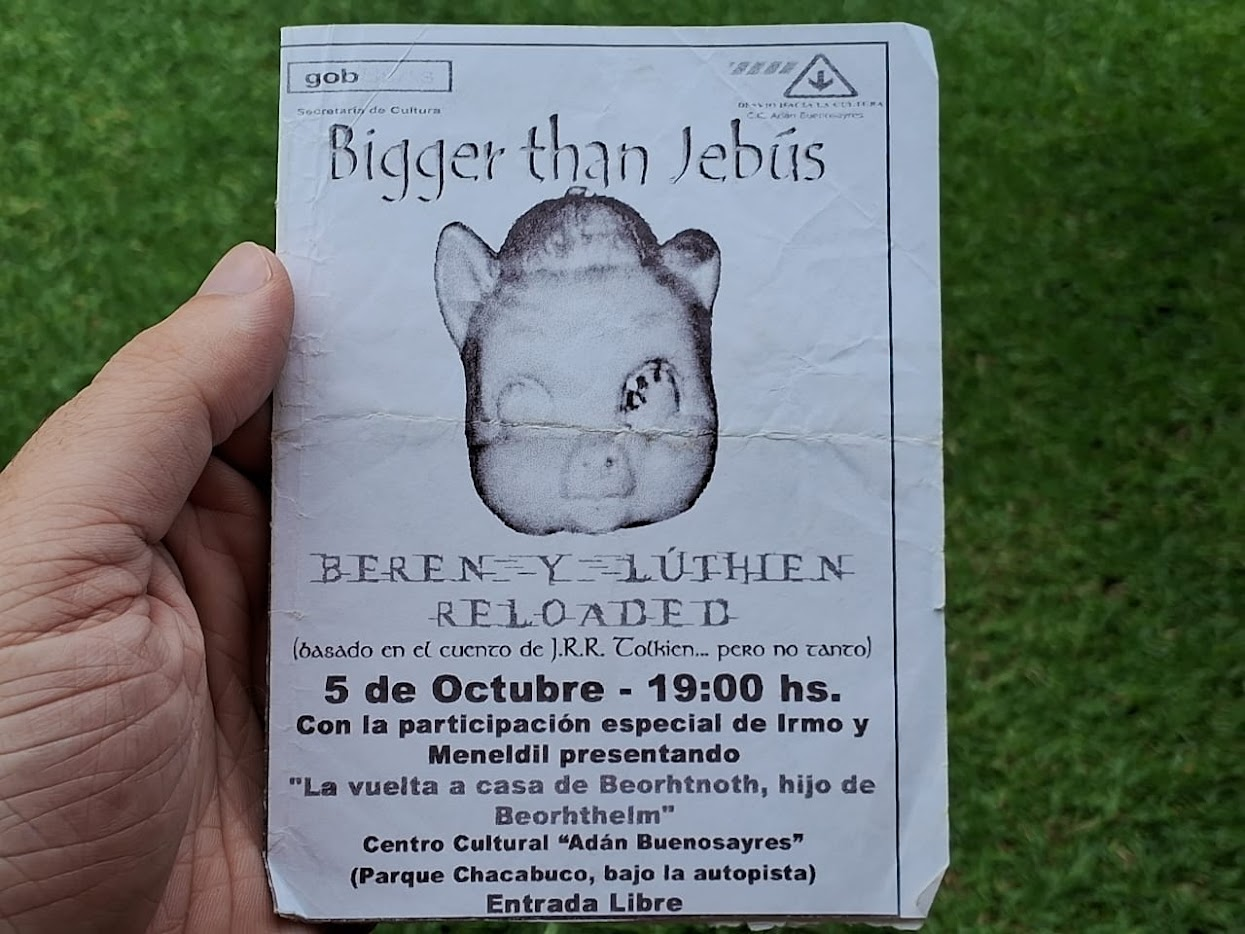
Tolkien was my gateway to many worlds: to science fiction, through readings recommended by the whole group, to tabletop RPGs (MERP), to Magic: The Gathering, miniatures, even the first backpacking trip to the mountains was with the guys from the group. In one way or another, we all remained attached to some form of artistic expression: writing, painting, radio, games. All of this during very difficult years for everyone, with a country on the brink of the abyss, a wrecked economy, and not a cent to spare. With Fede, Nico, and Fran we went as far as adapting The Lay of Beren and Luthien for the stage. We presented our play on two occasions, at the Adam Buenosayres cultural center and at the Parque Avellaneda community center. Not only are there photos, but also a film record -- which for now will not see the light of day.
Standing before the grave of our old friend, I thought of Martin, who became a renowned science fiction author, of Clara who published her thesis backed by the National Library, of Virginia who hit it big with her novel Los Sorrentinos, of Nicolas who gifted me one of his oil paintings. Of Fede, a physics PhD doing his postdoc in Sweden -- or maybe I'm dreaming that up --, of Laura and the illustrated edition of The Hobbit she gave us for Christmas, of Xiomara and her acting career. I thought of Florencia, of her passion for radio (she now runs the FM station at Unahur) and I thought of Francisco, who passed away a few years ago. Of the trip we took with him, Lala, and Xiomara down south in the summer of 2003 along the Seven Lakes Route. Foundational times.
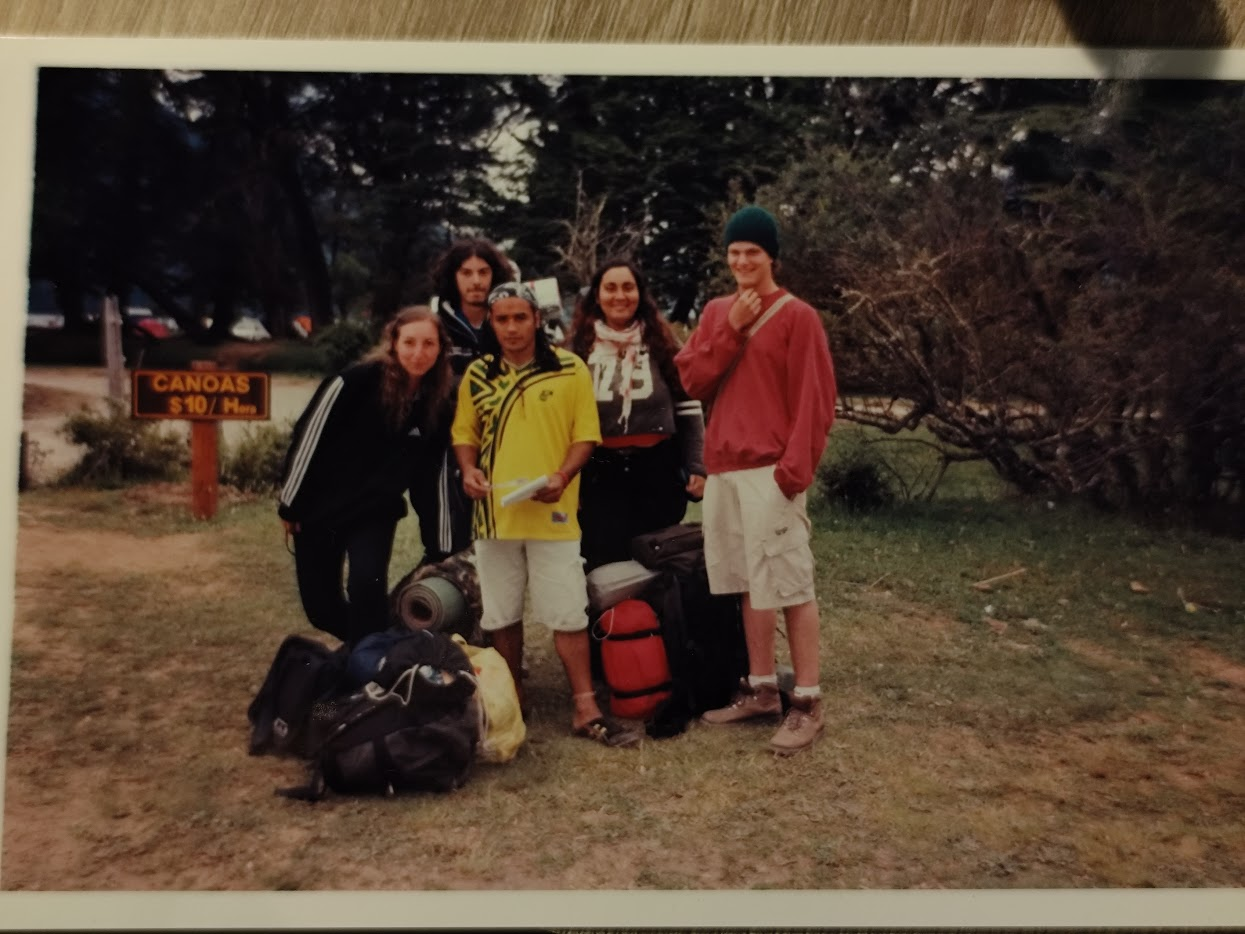
In short, I thought of all of them, of all those moments of happiness, of companionship, of community. I thanked the old man for so much, for his stories, for his characters, for Boromir, Feanor, Beren, Earendil, for Tulkas, Laurelin, Telperion, for Valinor, Gondolin, Menegroth, for Numenor, for Aragorn, for Frodo. For being an inexhaustible source of happiness. I said my thanks and my goodbye with the feeling of having closed an enormous 24-year cycle. Clouds were gathering on the horizon and we felt like strolling through Summertown for a while.