Jurassic Park (1993)

11 de ago. de 2024 — Juan Ruocco 🧙♂️
I'm writing about Jurassic Park (1993) again, twelve years later. A film I appreciate greatly for several reasons. The first article I ever published in print was about Jurassic Park (JP). That article can be read in the first issue of the magazine "Velociraptors". But this little biographical detour is not very important. Let's focus on the importance of JP to the Canon.
Jurassic Park is inspired by the techno thriller of the same name written by bestselling author Michael Crichton, who has other novel-to-film adaptations to his credit such as Sphere, Congo (canon), The 13th Warrior (canon); TV series like ER and screenplays for films/television like Twister (canon) and Westworld. Truly a powerhouse on the level of Stephen King.
JP is a reworking of the classic trope "invention turns on the inventor," that is to say, Frankenstein. Which, as you may have noticed, is the common thread of the first three canon entries. Akira, Terminator and JP. It seems that these initial chapters of the canon revolve around the role of the creator, the problem of replacement, and rebellion against authority. Or perhaps the topic of God as a metaphor for the father figure, the role of children, and the problem of freedom.
Unlike the other two, where the focus was on the relationship between creator and creation, the fundamental question in JP seems to revolve around the dilemma of power and control, around the great metaphor of Genesis that is Paradise Lost, the Garden of Eden. And how that connects with the great question of free will. At its core, JP is traversed by four problems. Engineering versus science, the use of automated control systems that leads to a dispute between order and chaos, and finally the role of entertainment as simulacrum.
Deloitte & Dinosaurs
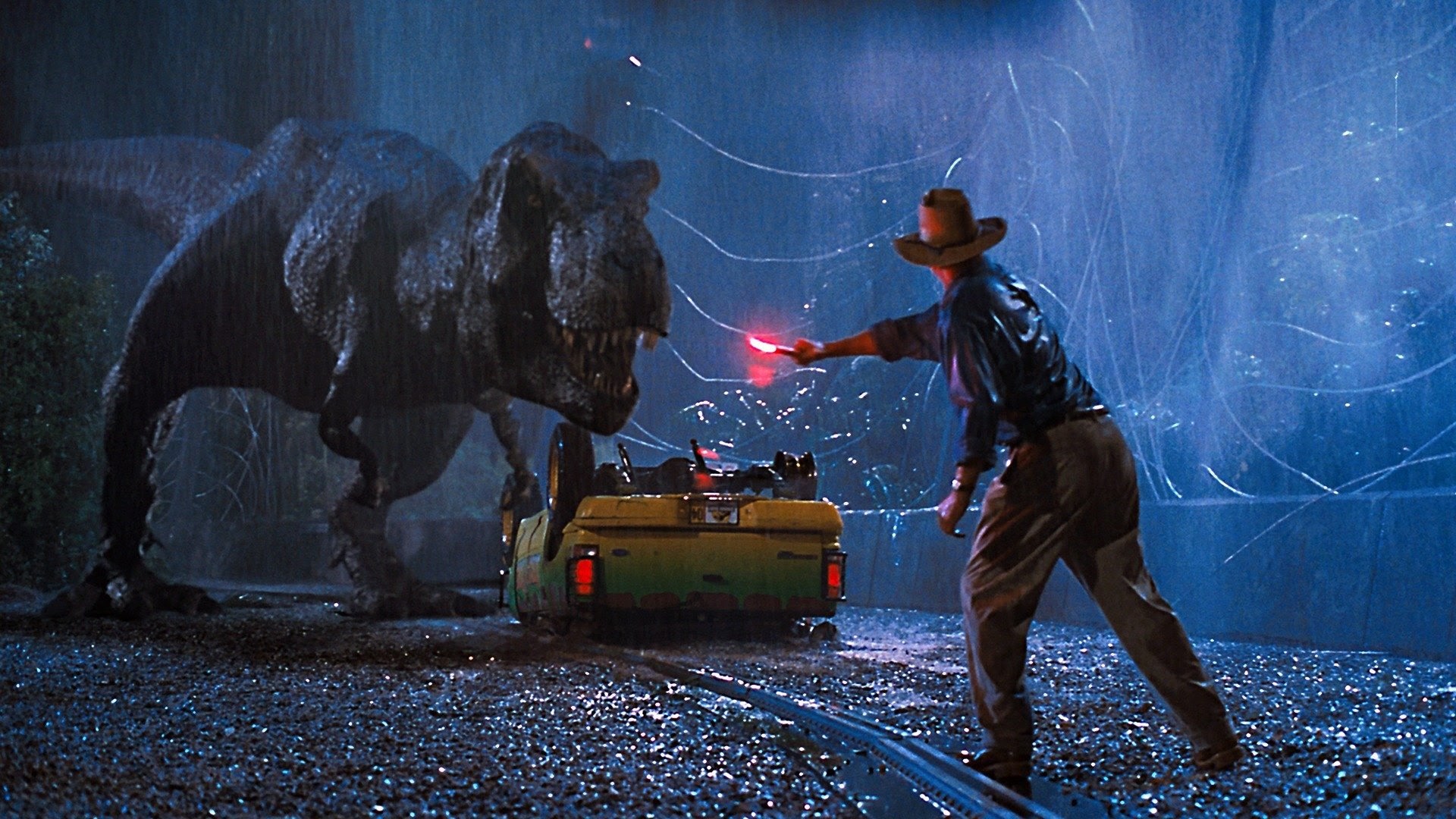
Basically, JP is a movie about an audit gone wrong. If we do a brief summary we'll realize this easily. Billionaire John Hammond manages to resurrect dinosaurs through genetic engineering. To profit from his research, he has no better idea than to create a dinosaur zoo. In the middle of the park's launch, an accident occurs. A velociraptor being transferred eats a worker. The park's investors, concerned, request an investigation into the accident. To that end, they send a lawyer and a mathematician. For his part, John Hammond gets a paleontologist and a paleobotanist. Hammond takes advantage of the weekend to organize a visit to the park and demonstrate that there are no problems. Hammond's grandchildren join the group. But, as is obvious (otherwise there would be no movie), everything goes wrong, the dinosaurs escape, and the film becomes "Jaws" on dry land. The protagonists' conclusion before leaving the island is "do not endorse the park." The protagonists fly away in a helicopter, we see a bird flying over the sea. Credits. Masterpiece.
If we remove the dinosaurs and replace them with, I don't know, tigers, and instead of placing the park on Isla Nublar we set it in some suburb, this whole affair would be an internal investigation by an insurance company to determine whether it has to pay the life insurance to the family of the dead worker. But, in reality, Jurassic Park is about something else. Its power does not reside solely in its plot but works on a second level of reading.
Let's think about how this tragedy unfolds and how each plot action implies a certain commentary on the film's theme. The first scene we see is the introduction of the great enemy. The night, the park, the workers, the cage, the velociraptor, the accident. An opening very similar to Jaws (1974) where Spielberg also opens the film with the presentation of the setting (a beach in that case) and the enemy (shark).
Opening a movie this way follows a logic very much inherent to cinema, masterfully defined by Alfred Hitchcock regarding the role of suspense in filmmaking. Quoting more or less from memory, Hitchcock proposes that the goal of good cinema is to achieve this state of permanent tension in the viewer, which he calls suspense. A word that later became popular to define a non-existent "genre" of cinema, which in reality is nothing more or less than the thriller.
Hitchcock gives a definition of suspense through an example. Suppose we have to film a scene where two guys are talking in a bar until a bomb explodes. The first way to do it is to film the two guys talking and then suddenly, without warning, the bomb explodes. This creates a very strong surprise effect but one that is lost when someone watches the movie again because they already know what's going to happen. The second way to do it is to film the guys talking and show that there is a bomb under the table. This way, all the idle chat becomes a countdown to death. This effect holds up on subsequent viewings because the suspense was created not from surprise but from the fact that the viewer knows more than the characters and there is no way to warn them about what is about to happen.
This feeling of doom covers the entire first part of JP since the viewer knows more than the characters. The viewers know that the computer engineer in charge of park security, Dennis Nedry (Wayne Knight), sold out to BioSyn, InGen's competitor. Nedry received a bribe from Lewis Dodgson to steal all possible dinosaur embryos and smuggle them off the island inside an iconic shaving cream can with a false bottom.
The Simulated Paradise
This movie has a fundamental conflict between men who believe they can somehow tame the killer instinct of an entity that almost everyone is unfamiliar with. A complete negativity. An apex predator. The question is whether one can contain a pathogenic agent, a being so dangerous that its freedom implies your destruction. In other words, a child. In this case Hammond plays the role of a Doctor Frankenstein who knows perfectly well that he is building a monster. But he believes he can domesticate it. Can you domesticate a monster?1
The entire metaphor of JP revolves around the possibility of creating a perfect closed system where monstrosity is exhibited as a spectacle but never breaks through the containment barriers. A kind of Garden of Eden, lush, overflowing, isolated from the rest of the planet; but with a constitutive tension between danger and safety. Order and control.
In this case Hammond comes to play the role of God, but instead of creating, he resurrects an extinct species by mixing dinosaur DNA with African frogs. These genetic hybrids are the closest thing one can get to a dinosaur with the available technical resources. They are the most perfect simulation available of what a dinosaur once was. Almost like a Walt Disney World for animals. Well, it exists. It's called Animal Kingdom and it opened in 1998. The dinosaurs of Jurassic Park are a simulacrum, the park itself is a simulacrum, and the movie, of course, is also a simulacrum. But each of them has effects in the realm in which it exists. The dinosaurs in the movie, the park in the movie, the movie in the real world. Consider how these dimensions overlap with something as trivial as the logo of the non-existent park being the same as the movie's logo. Or how the merchandising we see of Jurassic Park (the park) inside the movie later became real-world merchandising. Even the animatronic puppets used to create the film, once filming was completed, were used to create the amusement park at Universal Studios. In other words, the performative effect of JP (the film) was such that it created a simulation of the simulation in the real world. On this topic I recommend reading Baudrillard.
This idea of simulacrum and control appears in the iconic conversation between Dr. Sattler and Hammond while the kids are still lost. Hammond confesses that his trick has always been being an illusionist and that JP is the first "real" thing he creates. Sattler responds that the entire park, the automation of security, and the attempts to make it better are completely illusory. It was all an illusion.
On the other hand, it is impossible to avoid the overlap between JP and the Garden of Eden. A friendly old bearded man with unlimited money (power) decides to build his own paradise on a tropical island. A place far from the world where a "new world" will be created. A traitor breaks that delicate balance and unleashes a series of events that turn that Garden of Eden into a new Paradise Lost. It seems that the idea of an idyllic garden survived the biblical narrative in a literary trope known as Locus amoenus, which represents idyllic spaces surrounded by vegetation, plains, and shadows, where protagonists relax in bucolic reflections about life and existence. And even in the tale of Beowulf (I need to read it) the story takes place in a space of these characteristics until it is invaded by a Dragon.
Poor reptiles, always condemned to causing trouble.
Dinosaurs vs. Computers
There is something of the Promethean power of the Jurassic Park narrative that seeped into the production of the film, through the visual effects studio Industrial Light and Magic, which had to invent entirely new methods from scratch to represent these animals on the big screen with the degree of precision demanded by a director of Steven Spielberg's caliber, as well as the use of Silicon Graphics computers for these purposes, which represents a certain still innocent or embryonic spirit of Silicon Valley ideology that would later become what we all know to exhaustion. The Silicon Graphics equipment itself would make an appearance within the film, reinforcing this connection and the role of computers both in the creation of the film and in the world to come.
Silicon Graphics largely shaped the popular imagination about dinosaurs. It updated it. It crystallized the interpretation of the era, but constant progress, the Whig spirit of history, is always and everywhere a tragedy. Now velociraptors are feathered chickens.
However, the most important role that computers play in the film relates to the control of the park, its automated systems, its low number of human staff, and the possibility of managing everything from a "control panel." In fact, throughout the entire film Hammond stays locked inside the control center while continuing to give orders to the nearly nonexistent staff remaining in the park. This has always drawn attention given the small number of humans who seem to be in Jurassic Park and how that led to its inevitable collapse. What must be remembered is that the audit group's visit takes place during a weekend and all personnel had left the island. Still, it's quite wild to think that in a park of that scale, everyone goes home on weekends.
In any case, the dichotomy laid out throughout the film consists of whether it is possible to automate the security systems of a park like this to such an extent that human intervention becomes unnecessary. As I argued in my previous article, security is an illusion (a simulacrum) of electrical societies. That is, the illusion of control arises from various electrical principles, such as the lights that turn on in a city at night, surveillance cameras, radio communication systems. Don't we feel a sense of helplessness every time the power goes out? Don't we feel endangered every time we are in a field, at night, with no phone signal, isolated from the rest of the world?
If there was one thing John Hammond could not afford, it was losing power or having the computerized control systems fail. And that is precisely what failed -- in the film's narrative due to a human betrayal, but something that could have eventually happened as an accident. The dinosaurs resist computational domestication (today we would say algorithmic). We can think that something similar happened in the last major Hamas attack on Israel. The IDF seemed lulled by the comfort of having suppressed every attempted attack by the terrorists from the Gaza Strip, while the latter had managed to assemble a large-scale operation without it showing up on any of the Israeli army's "control panels." The attack that triggered the current war was off the map of the control systems and advanced the way the Velociraptors and Tyrannosaurs did, jumping over every kind of wall.
In a system like Jurassic Park's, where automation seems to have managed to handle all the potentially dangerous aspects of carnivorous species, the chaos unleashed by human action seems like a guarantee of free will. That is, chaos in the face of a perfect control system (for the dinosaurs JP is a totalitarian system) is what allows for a margin against the devices of domestication and for carnivorous dinosaurs to exercise their nature as hunters and apex predators. This stance of anti-domestication irredemptism is what Ian Malcolm seems to uphold throughout his stay in the park, arguing that it is impossible to compute the behavior of complex systems (though chaos theory doesn't actually say this) and that, eventually, life finds a way.
It remains to be explored (actually no, Slavoj Zizek wrote a good book about it) why within paradise the conditions for its destruction are always found. In the case of the biblical Garden of Eden, the trees of knowledge and the free roaming of the serpent (oh coincidence, a reptile). In the case of Jurassic Park, two of the most dangerous species of dinosaurs resurrected: the Velociraptor (which was actually a Deinonychus) and the Tyrannosaurus Rex.
Wouldn't a park composed solely of herbivorous dinosaurs have been equally impressive? What lies behind the intentions of the creators (Hammond or God) to populate Eden with dangerous beings?
It is truly hard not to side with the dinosaurs in this film.
Some Conclusions
Jurassic Park contributes a series of themes to the canon. It closes in a way the monster trilogy, opens discussions about domestication as a human task, about chaos and rebellion as (deformed?) forms of freedom, and establishes the unsettling question of eugenics, genetic engineering (or perhaps social engineering?), power and its most modern tool: marketing. It configures the modern fear of blackouts, the constant dread of the invasion of safe space (a metaphor for gated communities?) and the constant problem between security and chaos. Perhaps a prefiguration of the terrorism to come.
For a positive take on the same question I recommend "How to Train Your Dragon (2010)." ↩