Lazer, community, and architecture: the legacy of Lina Bo Bardi in São Paulo
22 de abr. de 2025 — Agustina Sojit
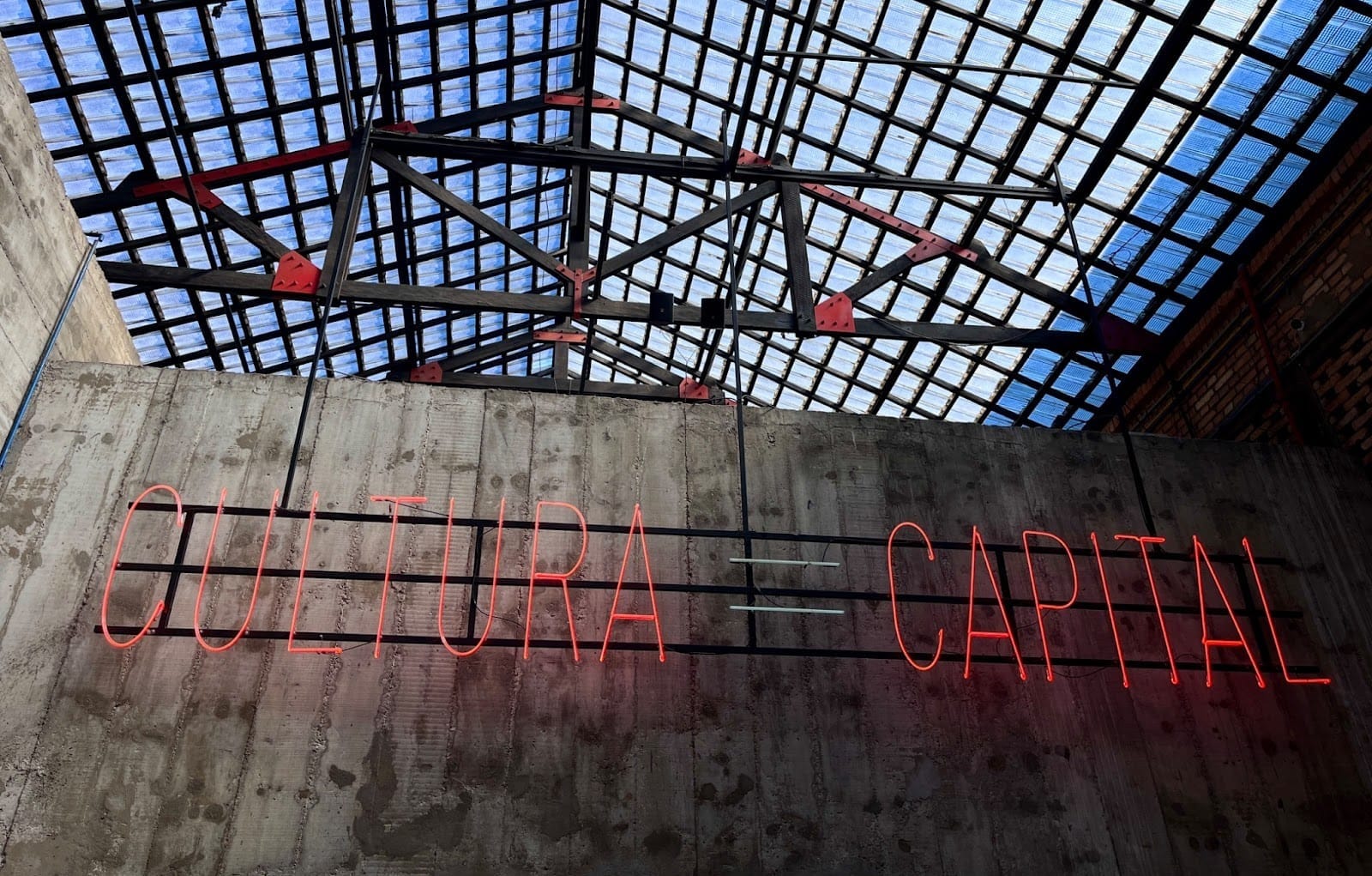
"Architecture is not a utopia, but a means of achieving certain collective goals."
Lina Bo Bardi, 1990
Traveling to São Paulo was like going to outer space and seeing ourselves as the tiny ants we are: an overhead perspective I had never had so close at hand. A memento mori par excellence that reset my axis. It was a lesson in humility, yes, but also one in finitude. A cold plunge in summer, after which I did not want to die without first saying certain words, making some decisions, and doing a whole lot of things.
________________________
It is 2024, January, and a notification pops up on my phone. A message from Ale (aka Bauhasaurus) that reads: "Exclusive incoming." I open it. It is a PDF: MODERN Brazil. I scream. I did not know São Paulo beyond the eyes of Rogerio Sganzerla in his film O bandido da luz vermelha (red). I had never taken a tour. I had always wanted to do a guided architecture tour because when I travel I feel like I miss information and lack the dialogue with someone who really knows their stuff. I walk looking up; I enter palaces, churches, and museums; I rest in parks and public squares; I read facts and curiosities about every place I visit, but I have nobody to go back and forth with on a hardcore level, to reaffirm my excitement, to hear what only someone who studied too much can convey. The euphoria over Ale's message is such that I cannot organize my mind enough to cross-reference names and places. I close it. I am going to São Paulo knowing nothing, I decide. I am going expecting everything.
Back home, I open that PDF again. Now what I read makes sense in my mind. It has life: history, smell, and shape. Lina Bo Bardi-red, I think; Decio Tozzi-green; Vilanova Artigas-caramel; Niemeyer-white. I do not expect it to make instant sense to anyone outside my head or who has not toured modern Brazil, and yet these are colors that now and forever link me to names, structures, and places; they are protagonists in each architect's body of work.
________________________
Today I will keep writing about red, this time to talk about Lina Bo Bardi, the SESC centers, life in community, lazer, and the pause. Lina Bo Bardi used red as her personal trademark. She said it was a blood red, pumping through the concrete. It is an explanation you cannot unlearn because once you have walked through them, you know her buildings are alive.

Lina was born as Achillina Bo in Rome, Italy, long before the War. And after it, she emigrated with her husband Pietro Bardi to São Paulo. He, an art collector; she, an architect. He, a fascist; she, an anarchist. Both, they say, accused of being traitors by their respective parties. How much of it is fiction? That is beside the point; it is a story for another novel, an adventure one.
Lina's architectural debut was the Museo de Arte de São Paulo, the MASP (pronounced maspi), a simple form -- in the opposite sense of composite, given its concrete and steel structure -- and monumental, set on Avenida Paulista. Her defining work is SESC Pompeia, a community leisure center in a factory and working-class neighborhood. The Fábrica de Lazer (Leisure Factory), as Lina named it -- a name that did not stick -- has a swimming pool, theater halls, a gym, sports courts, a bar, a library, a dining hall, spaces for art exhibitions or workshops. And also places to do nothing.
Doing nothing in Brazil is a stronghold. There is something of the Italian Dolce Far Niente -- the Italian heritage is undeniable given the strong immigration. In Brazil they speak of lazer, which can be translated as leisure, although we already know how much is lost in translation. In Brazil it is an active, collective, and pleasurable leisure. It is not the contemplation typical of doing nothing, lying on the beach or in the park with a drink in hand -- at which Brazilians, especially those from Rio de Janeiro, are natives and promoters -- but it encompasses it. It is a fun kind of rest and it is everything that is not work. That is why Lina wanted to associate lazer with the space she created. It was a name that sought to perform its use, something the architecture exceeded by far, and that its current name, Cidadela da Liberdade, also represents.

SESC Pompéia
SESC Pompéia started as a factory. In 1977, Lina was asked to build something there by tearing down the old structure and constructing something new on the rubble. Instead, she chose to protect the vitality the place already had. The factory, no longer producing, had been occupied by neighbors, neighborhood football teams, and a theater company, so Lina expanded that playful, neighborhood-based, collective use.
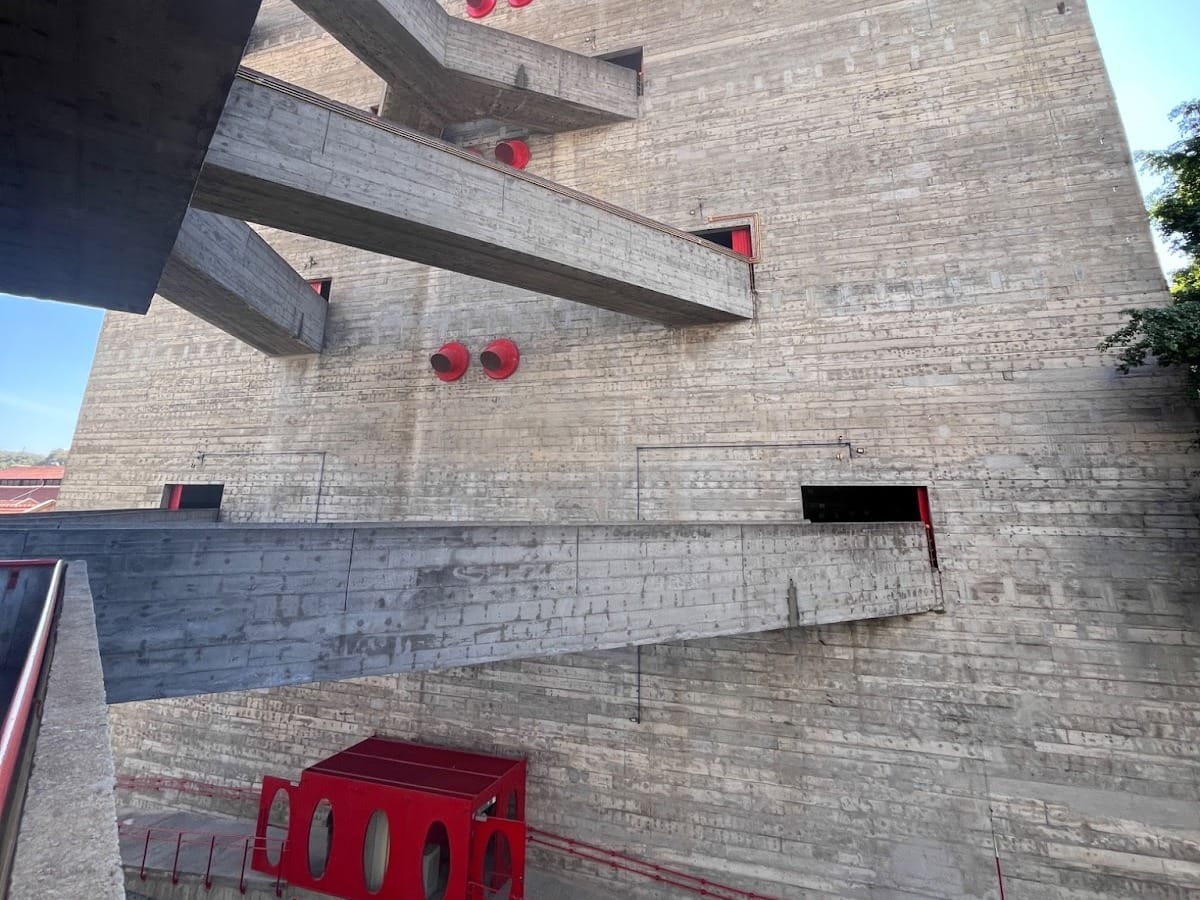
In general, Lina's approach was to build unfinished spaces that would be completed through use. A humanist architecture that sought dialogue between the modern and the popular. Or how to turn the modern into a popular meeting place. She restored and refurbished the factory buildings and warehouses and built new structures incorporating two concrete towers connected by open-air pedestrian walkways, with high edges, no railings, at a great height. Walkways that impress, give vertigo, and stir a certain death drive in anyone who leans over the edge. The towers' windows and their shutters are iconic: striking in a photo; unforgettable in person. I remember them and something beats hard inside me; it is the thrill of having been in places I had only seen in books.



The SESC centers are non-governmental initiatives with public and free access, featuring fee-based activities depending on the neighborhood where they are located. SESC, pronounced sésqui, stands for Serviço Social do Comércio: an organization linked to the national business federation, created in the 1940s to provide health services and cultural activities. The SESC centers are primarily aimed at the well-being of their employees and their families, but they are open to the community at large. And they have everything, including medical offices (Monday through Saturday) and dining halls at accessible (laughably low) prices.
It is a project that orbits a poetic and extinct yet above all pragmatic idea: for businesses to prosper, workers must prosper. A humanist project of labor, something that sounds to us like social justice because it is also a fight against the expansion of sordid places in everyday life -- those that, as Juan Perón used to say, inevitably create sordid people. I do not (yes I do) want to dream big, and yet all I can do is imagine a SESC right in the heart of Once and another in La Matanza.

SESC São Paulo
SESC São Paulo has 43 units across the state, funded by the Sistema S, a trust fund organized by industrial employers for social development. The concrete SESC centers are not shells but fortresses of collective leisure, custodians of lazer, material conditions for loosening up and resting. It is unproductive expenditure as public policy, in buildings where one takes a break from the unjust life, from isolation and from screens. This architecture is not just form and style: it is a political project. A concrete way of organizing well-being, leisure, and togetherness.
The staging of concrete as a material is imposing, where structure takes center stage and disrupts an enormous, green, and lush context. These are sublime, busy, living, and brutal buildings (but not Brutalist, which is an architectural movement from another place, another time, and another spirit). They are giant, spectacular gray monsters with a soft heart. Full of people. A crowd that has more than enough gathering and congregation spaces. Spaces of shelter, shade, and refuge. Spaces of lazer. A beauty that does not seek temporality but transcendence, like the classical.
A high quality of life also means having free gathering places that bring the community together in activities that improve daily life. Addressing mental health also means creating free sports facilities, with everything needed to fulfill oneself. Designing policies to prevent people from falling into destructive and devastating addiction means creating spaces with initiatives that literally pull you away from crack. It is no coincidence that SESC 24 de Maio sits right next to Crackolandia (from crack), a neighborhood renamed by those who inhabit it.
SESC 24 de Maio
A facade links the exterior with the interior. It can do so with walls. It can do so with windows. It can do so with doors, and also without them, as many of São Paulo's modern buildings do. As SESC 24 de Maio does, where there are no entrance doors because everyone is welcome. As Vilanova Artigas himself said, "buildings that are the specialization of democracy where all activities are lawful." It is the continuity of space that fosters social integration.
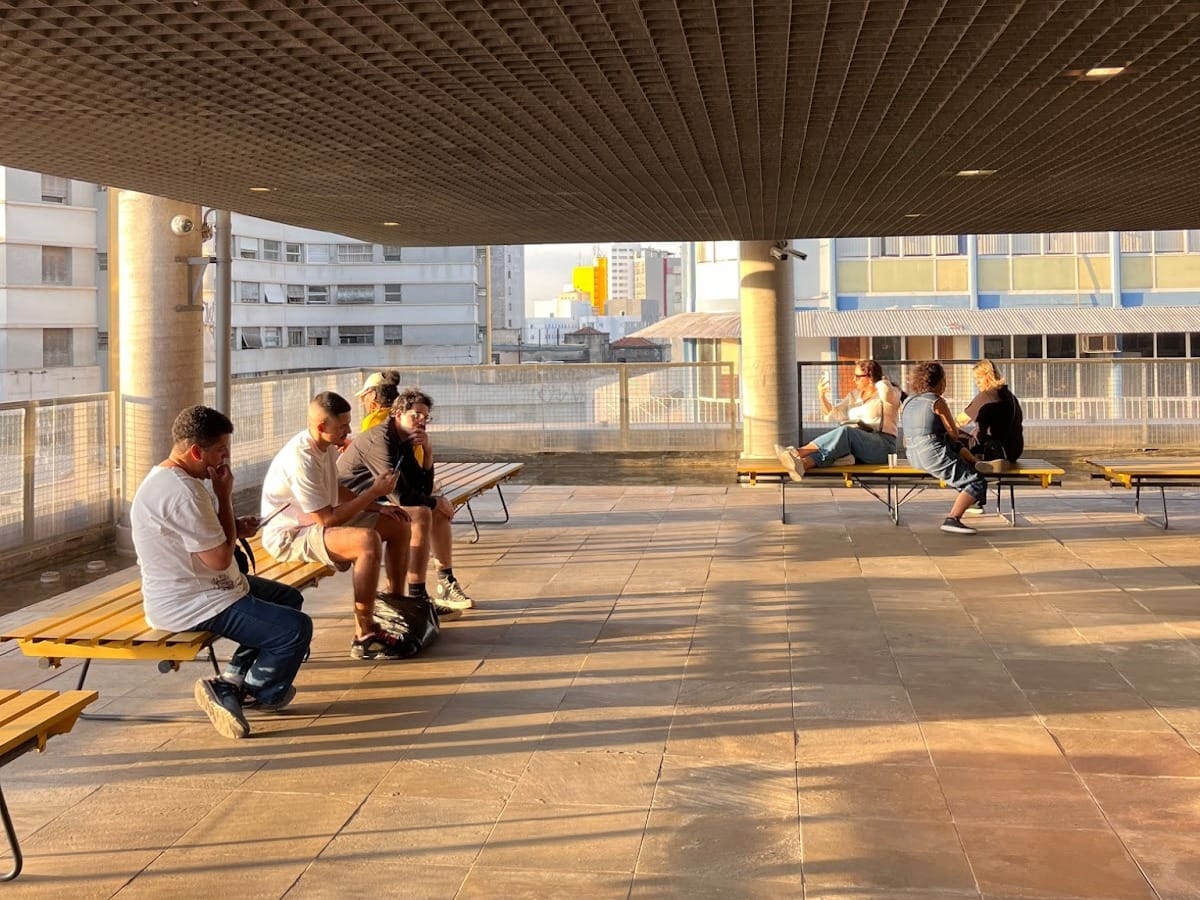
SESC 24 de Maio (2017) is a publicly accessible, free-entry building with fee-based artistic activities. A six-story structure approachable in three ways: by elevator, stairs, or ramps. And the ramps are inclusive not only for movement and circulation: they are corridors for ascending and descending that invite conversation and greetings, encounters and coexistence. It is in the open and fluid experience they offer that visitors can move without barriers and stop to interact, observe, or rest at any point along their journey. That is how Paulo Mendes da Rocha envisioned it (look him up and shed tears of emotion).
The second-to-last floor, in particular, is of absolute beauty. There is the smell of coffee, the sound of a pool heard from afar, and a water channel to dip your feet in. In the center, a roofless void through which rain can enter, and the channeled floor ensures that the spectacle of nature is not interrupted by any mundane concern. They are stacked plazas: each floor is one, with its own theme and activity.

Some time ago, Manuel Becerra pointed out an urgency that only made me travel to São Paulo again: "It is essential that families have routines organized around daily dialogue, around collective leisure. Words and tenderness are essential. And for that, material conditions are needed, above all, but not only." Community spaces that brave the elements to open up, that invite leisure, rest, and enjoyment, are above all a refuge.
And I understand that this piece and what it describes seems like an ode to beauty -- and it intends to be -- but the modern architecture of São Paulo is not just a technical or aesthetic pursuit; it is a national project for development with growth. And the architects of the São Paulo school are professionals in service of their homeland.
________________________
São Paulo changed my life in many ways. It gave me back a spark and brought me closer again to this business of expressing myself through words. Not inviting every person I meet to live the experience is keeping a secret that only lives out loud. São Paulo is chaos, and within that chaos it is living, moving nature. Because to move, to mobilize, is to keep on living.
I wrote several more things about the trip, which you can read at https://medium.com/@agustinasojit/
You can also travel for inspiration -- follow Ale Csome. Who, understanding the limits of reality, was of course not going to leave anyone out: the trip was filmed in its entirety, shot and edited by Fran with a lucid and generous eye, so that everyone, wherever they may be, can experience it. Ale announced a new trip to Rio de Janeiro for September this year to visit some of these gems of carioca architecture.