Magaiba, Argentina's first successful memecoin

16 de sep. de 2024 — Juan Ruocco 🧙♂️

On Monday, March 4, 2024, at 11 in the morning, I sat down at my computer and saw this conversation in a Discord group:
-Hey guys, should we make a Magaiba memecoin?
-Yeah, let's do it.
-What do we need?
-10 SOL
-Great, we'll pool it by Wednesday.
At that moment, the "devs" team was formed. Pablo Wasserman, Juan Ruocco (me), Ox, and F8. On one side, the two hosts of the weekly show Circulo Vicioso and community mentors; on the other, two developers with experience in Solidity, the programming language of the Ethereum virtual machine. Their technical background suggested using Ethereum as the first choice for creating the token, but all the successful memecoins at the time were on the Solana network. Which is, in turn, a sort of copy of Ethereum but with lower transaction costs, allowing for greater speculation with smaller amounts. An ideal characteristic for the meme ecosystem that was in full swing.
From that conversation, the entire Circulo Vicioso apparatus was set in motion for the first time to bring the project to fruition. It was the first time the community was going to test its firepower. OX and F8 "wrote" the smart contract (the code that predetermines all behavior of the coin) and found an image to serve as a logo. We created a multi-signature wallet for all necessary transactions.
On Wednesday, March 6, during the broadcast, we announced the arrival of the MAGAIBA Era and publicly challenged the audience to pool the necessary amount of SOL (Solana's token) to bring the project to life. In less than 12 hours, the Circulo Vicioso community raised the 10 SOL needed, which at the time amounted to roughly 1,800 dollars.
The whole trick behind Magaiba was to ensure an equitable distribution to all members of the "Club" (as CV followers call themselves), and that they wouldn't sell the amount they received, in order to give the coin a chance to live. If the guys sold everything as soon as they got it, they would completely destroy the project. Only mental unanimity around holding could make the memecoin survive more than a few hours. Magaiba was not just a cryptocurrency but also, and above all else, the chance to measure the propaganda capability of the "Club."
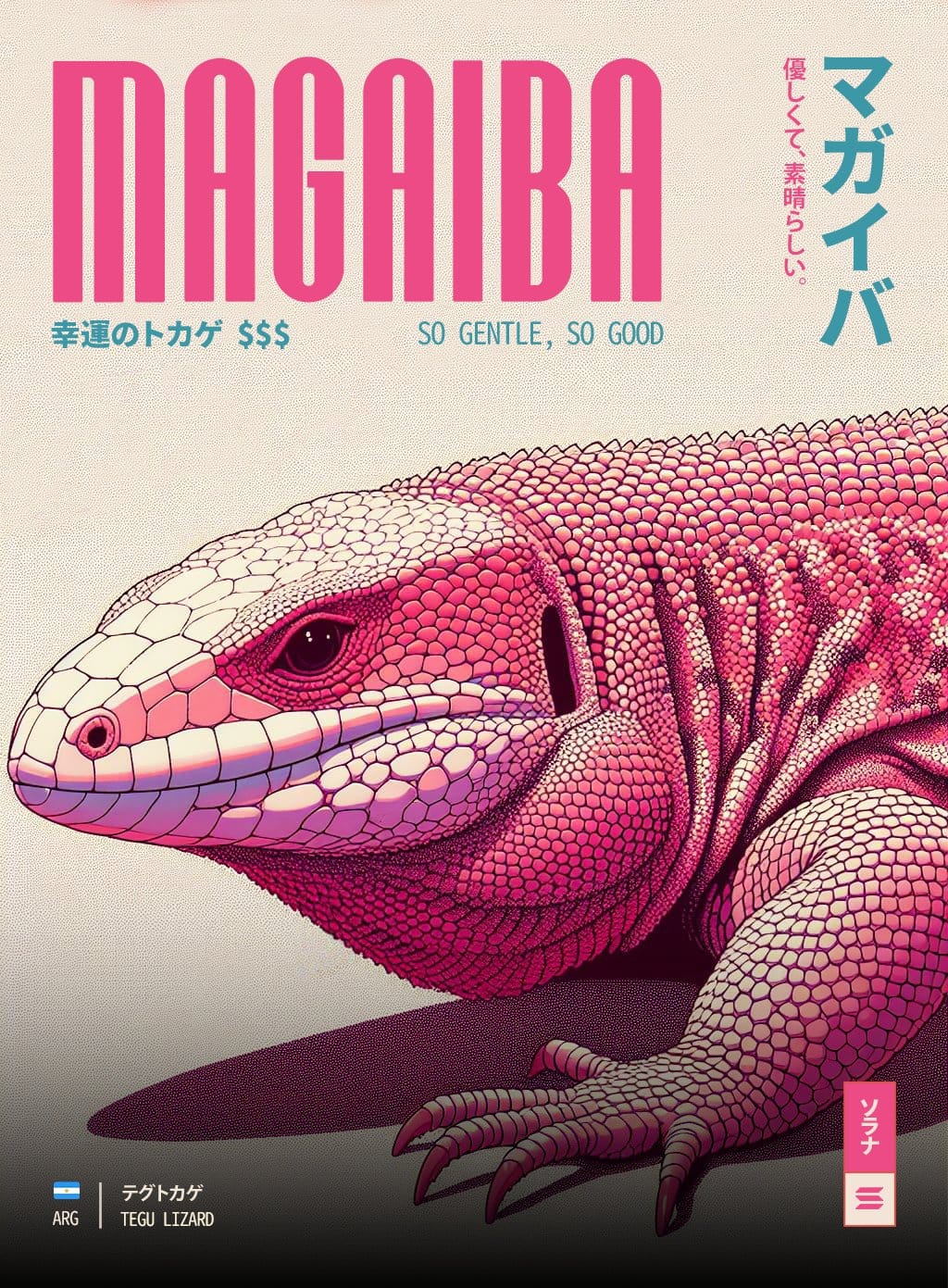
But, who is Magaiba? It's common for Pablo and me to close the show by watching short videos from Instagram, YouTube, and TikTok. In particular, animal videos: they could be monkeys, pandas, various reptiles. On one occasion, we started watching videos of a tegu, an Argentine red tegu lizard.
His name was McGyver and he was cared for by Ice, his owner, an Asian girl living in California. Her accented pronunciation made it sound like she was saying "Magaiba" instead of "McGyver." That's how the name stuck, and the meme was born for the Circulo Vicioso community. As usually happens when a community goes overboard with a meme, it becomes the center of attention for a few days, weeks, or however long the hype lasts. Magaiba was, until that point, the best meme in the Circulo Vicioso lore.

The MAGAIBA Era
Magaiba is a limited-supply coin, with 1 billion units created and no more that can be generated. The distribution was done as follows: 150 million went to the Circulo Vicioso community airdrop, 100 million to the treasury, 700 million to the Raydium Pool (burnt LP tokens), and 50 million were burned. Later, another 70 million from the treasury were burned so there would be no doubts about the fate of those tokens. As a result, the current circulating supply is around 880 million tokens.
To receive the Magaiba airdrop, you had to paste a valid Solana address in a channel on the Circulo Vicioso Discord server. To prevent outsiders from joining, the server was closed to new members for 24 hours. During that period, about 240 addresses came in, and 24 hours later they received the delivery of 710,000 magaibas. At the peak of the coin's frenzy and price, when it reached two cents per unit, that airdrop was worth roughly 14,000 dollars.
In less than 48 hours, the Circulo Vicioso community, together with the "devs," had created the project, raised the necessary funds, and distributed all units among followers. Everything happened at the speed of light. On Thursday, March 7, in the morning, Magaiba was a reality. The guys could already see their balance in their wallets, and one of the strangest and most fast-paced moments of my life was beginning. The MAGAIBA Era.
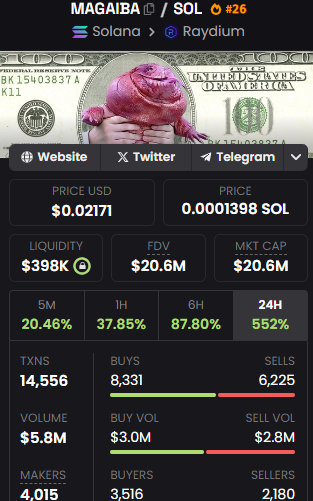
Five days later, the coin's total market cap reached 20 million dollars. Each unit peaked at 2 cents, and the liquidity pool had gone from 2,000 to 300,000 dollars. Through Magaiba, up to 5.8 million dollars per day were traded, between buys and sells.
Escape velocity
The meme had spread like wildfire across the internet. The community's work creating images, videos, songs, a 24-hour YouTube radio, edits, and other tools from the meme arsenal was tireless. Magaiba grew so fast and so early that it had to have its own Discord server, separate from Circulo Vicioso's. The Telegram channel gathered 2,000 users. Every morning felt like going to war. Everyone's routine was to wake up, turn on the computer, enter Discord, and man a battle station.
At first, Magaiba captured the attention of all of Argentine Twitter and then, as the price held its upward trend, the coin spread to other networks. Instagram and TikTok began to have their own content. Local shillers (users dedicated to hyping cryptocurrencies) initially rejected it but later joined the wave. Various entrepreneurs from across the financial and crypto sectors did the same. We received messages through all social networks with requests to make over-the-counter purchases (custom deals, directly with the treasury without going through the liquidity pool) for amounts ranging from 5,000 to 10,000 dollars.
Major national media outlets also covered it, including Ambito Financiero, A24, Yahoo! Noticias, Corta, and iProUP. They all published stories about the phenomenon, which even reached international news portals like RT en Espanol.
The meme was so powerful that it achieved what is often called "escape velocity," the equivalent of what a rocket does at launch. A rocket needs a massive energy source to overcome Earth's gravity. The same happens with a meme, which needs a massive amount of attention, modification, and replication to break out of its original niche and become something "global." Magaiba reaching users in Hong Kong signaled that the project had already crossed every imaginable boundary for its leaders and for the community itself.
The controversy
The coin's appearance split the local crypto community in two. On one side, those who understood what the game was about. On the other, a bunch of crypto ecosystem "thought leaders" (such as journalists, developers, and semi-entrepreneurs) who believed that this phenomenon could "damage" the reputation of cryptocurrencies, as if that weren't a common part of their development and as if it hadn't already happened in far worse situations.
From the very beginning, those of us who took on the role of project leads always said the same thing: Magaiba is a game, it's a joke, and only those willing to lose their money should put any in. On the other hand, the total transparency about how it was distributed and the fact that the treasury had been burned were clear signs that the team never intended to rugpull, as the jargon goes (a scam), as we would later see on a national scale with $LIBRA.
Every cryptocurrency lifecycle has a "new" technology or feature that becomes a keyword or gimmick to hype the industry. This has been the case with every wave. Bitcoin, ICOs, DeFi, NFTs, the metaverse. Memecoins seem to be the new hype train of this new crypto growth cycle.
Everyone who spoke for or against Magaiba had participated in at least one of those hype cycles, which generally left more people devastated than anything else. The key to Magaiba, and the distinction from the rest, was that the project was always self-aware, and its guidelines and fundamentals were always crystal clear. Few things are more satisfying (and adrenaline-inducing) than watching the news channel of the country's largest media group try to prove that your coin is a scam and fail miserably.
.@julitolopez so gentle. pic.twitter.com/zK18FbDNFq
— MAGAIBA 🦎 (@magaibasogentle) March 24, 2024
The happiest days were always magaibero days
It's very hard to recreate the mood that the entire Circulo Vicioso community experienced during the first five days of Magaiba's life. Beyond all the experience, this is what will stay with me forever in my memory. Watching in real time how a hundred or two hundred people coordinate to create memes, build new communities on Discord, Telegram channels, Twitter accounts, a 24-hour radio station, songs, images, and videos about Magaiba is and will remain priceless.

Every day felt like a new battle. Nobody wanted to sleep, nobody wanted to miss anything. As this intensity continued, the rewards appeared: new players joined Magaiba, well-known figures and entrepreneurs from the crypto and trading world in Argentina reached out to buy and shill Magaiba.
Memes flowed from the catacombs and the price validated the energy invested in the project. The only question was how long it would all last. But it truly didn't matter: during those days, the feeling was one of total and absolute victory. The Club Atletico Circulo Vicioso had memed its coin into becoming the most successful one in Argentina, and possibly in all of Latin America.
It's likely that in the new Bitcoin and crypto bull cycle, new coins will appear, Argentine ones even, that surpass what Magaiba achieved. But none of them will be able to say they were the first. That spot is already taken and will forever belong to a red tegu lizard, Argentine, gentle and good.