Fernando Montes Vera: The Author Who Anticipated the Incels and Created a Transmedia Novel
1 de abr. de 2026 — Ariel Pukacz
If The Reed College Massacre were published for the first time today, it would be accused of being responsible for the shooting attempts that have occurred since the rise of the Argentinian libertarian party, the platform for the worst of American culture (xenophobic and racist discourse, the right to bear arms, etc.). It would be seen as a manifesto to unleash madness, much like The Turner Diaries, the novel by racist William Pierce, which inspired Timothy McVeigh in the Oklahoma City bombing. But the difference is that Fernando offers a critique, not an apology, even though the boundaries between fiction and essay are blurred.
"By accident. I won a scholarship by accident," explains Fernando Montes Vera, about how the hell he ended up spending a year (2009/2010) on a university campus that became the setting for his novel The Reed College Massacre. It later won the award given by the now-defunct Dakota Publishing in 2012.
Like many literature students, he had no idea how to break into the job market outside of the hellish call centers. But with a bit of cleverness, he managed to work as a Spanish teacher for foreigners. "The job, if you liked it, was the best. If you didn't like it, well, it was a nightmare," Fernando summarizes. Until one day, by chance, he heard that a college was looking for Spanish teachers and applied. He thought it was an exchange program in Argentina; the offer didn’t explain much, and the orientation meeting only multiplied his doubts. "They started talking about how beautiful the campus was, and about the squirrels... Why are they talking to me about squirrels?" The situation was both comical and inexplicable, and with no teaching background, Fernando began to pass the various evaluation stages. In one of the activities, he replicated a sketch from Chá Chá Chá, the convention of Batmans of Mercosur. Perhaps due to its bizarre nature, or the “out of the box” aspect of his class, he ultimately landed the job as a Spanish teacher. Three Doritos later, he found himself in the midst of a progressive campus in a city whose motto is "Keep Portland Weird," in the state of Oregon, in the northwest of the United States.
Reed College was the perfect excuse for chaos: students used the college experience as a free pass for sexual, alcoholic, and psychotropic experimentation without any consequences. Studying was a secondary task.
The cultural shock was absolute; he felt depersonalized. Americans were not like in the movies; cultural colonization had lied: they spoke differently, acted in a much more border way. This estrangement led him to conduct a sort of anthropological study on what was happening on campus: an institution run by adults treating its students, also adults, like babies. Reed College was the perfect excuse for chaos: students used the college experience as a free pass for sexual, alcoholic, and psychotropic experimentation without any consequences. Studying was a secondary task. The seven-figure monthly fee was for experiencing the campus, more than for learning.
"Now there is more information, but access to scholarships is classist. The fact that you know which scholarships exist, where to find the information, whom to ask for a letter of recommendation, all of that is classist. Very few people have access. When you analyze it objectively, it’s designed for the rich, especially here. So it was about sharing the experience of seeing it as an outsider and someone who also chose to say 'okay, I saw it and I didn't like it, it's perfect if you like that life,' demystifying the whole scholarship abroad thing," explains the author, who also clarifies that the first version of his novel leaned more towards horror. In fact, the file's title was Campus Terror. It later morphed into Neverland, because his intention was to tell about the limbo between adolescence and adulthood that Americans experience during higher education, a stage that does not exist in Argentina: it’s not unusual here for someone in their twenties to have a coworker who is twice their age, and it’s not about an internship arranged by a university, but a real job to make a living.
 Roberto Chuit Roganovich
The Reed College Massacre ultimately became a novel about student massacres. But its title is misleading, because the work does not depict a single massacre; rather, it discusses a "pop tradition" of the American idiosyncrasy: the fanaticism for guns, the spectacularization of violence. One of the first ideas one encounters in the novel is that "Americans don’t have fun; they just lose control." The focal point is the Argentine teacher Mariano Bustamante, who travels with a scholarship and becomes disillusioned with the institutional dynamics, rife with racism and xenophobia. The Reed College Massacre is an almost prophetic novel: it predicts inclusive language and also the use of the internet to conspire, denounce, and troll. Published in 2013, it captured the zeitgeist of an era that had not yet begun.
When asked if it is a novel that could be published today, Fernando reflects: "Now it would be read differently. If I hadn't published it before, it would now be read as a parody. But I wrote it before."
Fernando portrays the institution as a Kafkaesque mediator that is impossible to access, with which it is impossible to communicate, as if one were speaking to an AI that has a couple of preset responses, impossible to humanize. He also exposes one of the great American hobbies: conspiracy theories and mass shootings. Within the pages of the novel, we encounter the Argentine movement Ningunismo and Bohemian Grove, a sort of precursor to Jeffrey Epstein's island, in addition to several nods to shooters like Korean student Seung-Hui Cho and Elliot Rodger (who, due to his manifesto, became one of the fathers of the incel culture).
The Reed College Massacre is an almost prophetic novel: it predicts inclusive language and also the use of the internet to conspire, denounce, and troll. Published in 2013, it captured the zeitgeist of an era that had not yet begun.
The possibility of a shooting was ever-present on campus. The faculty was on alert. How it would happen and who the attacker would be were common topics of conversation during Fernando's stay. He began to hear anecdotes, rumors. Being a college with a liberal stance, there were no security cameras. It was a paradise for a massacre. "I remember having a conversation with one of the professors there. I asked her if for her the issue of shootings was something. 'Of course, it's something we think about,' she told me. They live with it."
The countless hours of idleness allowed him to stew ideas, but it wasn't until he returned to Argentina for the holidays that he opened a Word document and started typing. Fernando already had two-thirds of the novel completed when he learned that Dakota Publishing was opening a call for writers, at that time, under thirty years old. He put in a lot of effort for three weeks to finish it. Dakota's catalog mainly consisted of American authors belonging to alt lit and mumblecore cinema, like Tao Lin and Megan Boyle. Even the name of the publishing house, the building where Mark Chapman murdered John Lennon, was a good omen that The Reed College Massacre had a chance of winning. And so it did.
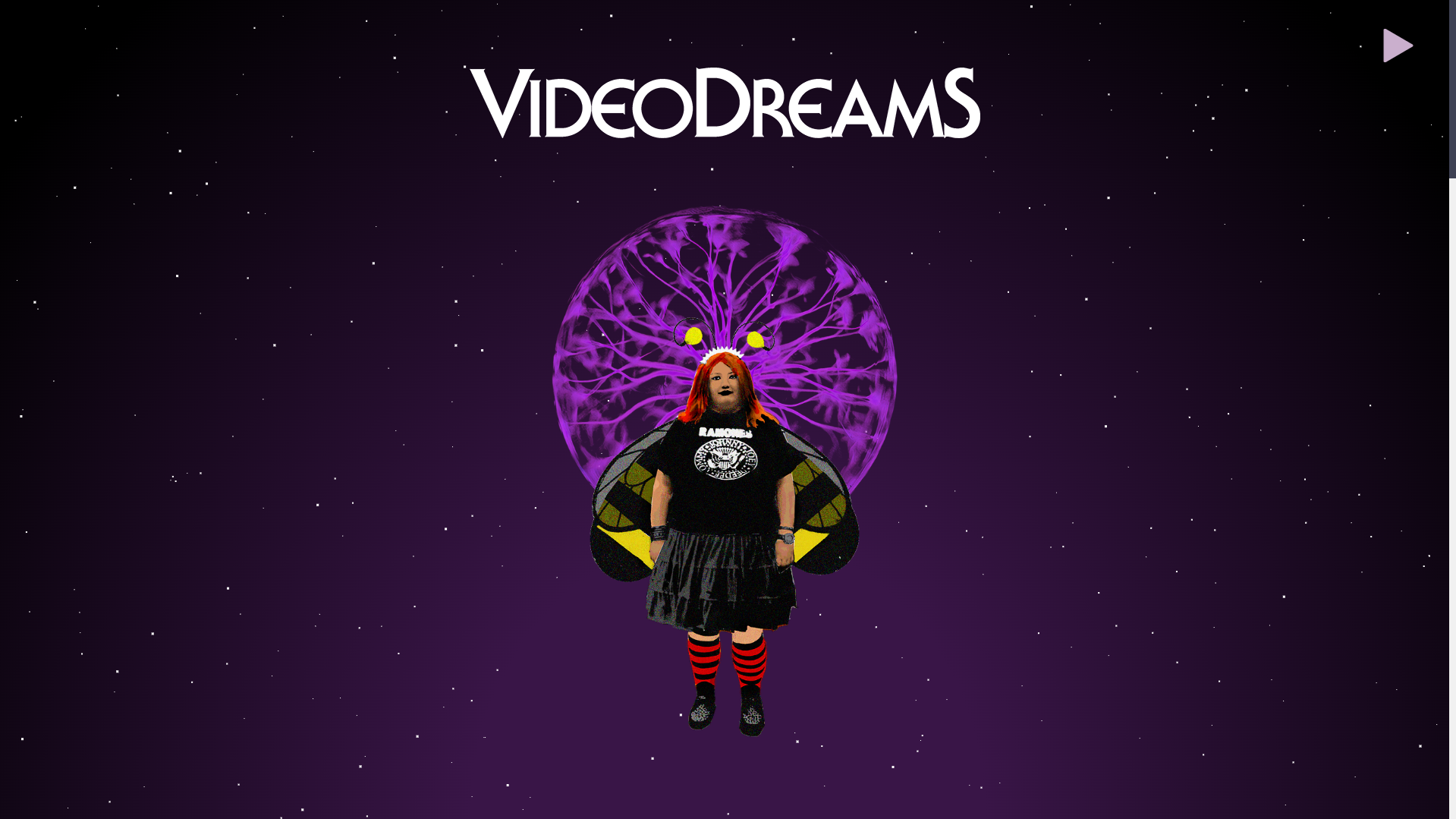
The novel generated interest from the press, was featured on the cover of the Argentine Ñ supplement, but Fernando did not publish again. In Argentina, he had many jobs, including teaching Spanish in the Ezeiza prison for foreign inmates. Friends, acquaintances, and writers were convinced that this prison world would be the setting for his next project. But Fernando wanted to create a visual novel. This is how VideoDreams was born.
VideoDreams
"I remember that the first draft was in an Excel sheet; I started transcribing viral, funny videos. I thought it could be like a zapping of YouTube," explains the author. It was originally called Lancaster, in homage to the castle that appears on the notepads from the nineties, and it was a traditional novel. Fernando recalls thinking, "now I'm going to write another novel, and someone will want to publish it. Or at least someone will want to read the draft," but there was barely any response. The literary world was impenetrable, and it was made clear to him that the publication of The Reed College Massacre seemed to have been mere luck: he was an outsider in that scene, not part of it nor welcomed.
Having discarded the idea of publishing in a traditional format, the project took a different direction and took nearly a decade to come to fruition. Although its final version took shape during the pandemic, it was launched as a website in 2022. In the about section of the page, Fernando lists the languages and programs he used to bring it to life: HTML5, JavaScript, Unity, C#, Live, Reason, and Dall-E Mini. Because VideoDreams was born as an album of songs inspired by vaporwave, accompanied by a music video. He was obsessed with the intersection of the analog and the digital, with the shift of eras, with the nostalgia for faulty devices (with noise, with interference), which had to be tied with wire to extend their lifespan. In those obsolete technologies, enchanted, inhabited by ghosts, he found a refuge, a portal to the world he wanted to tell.
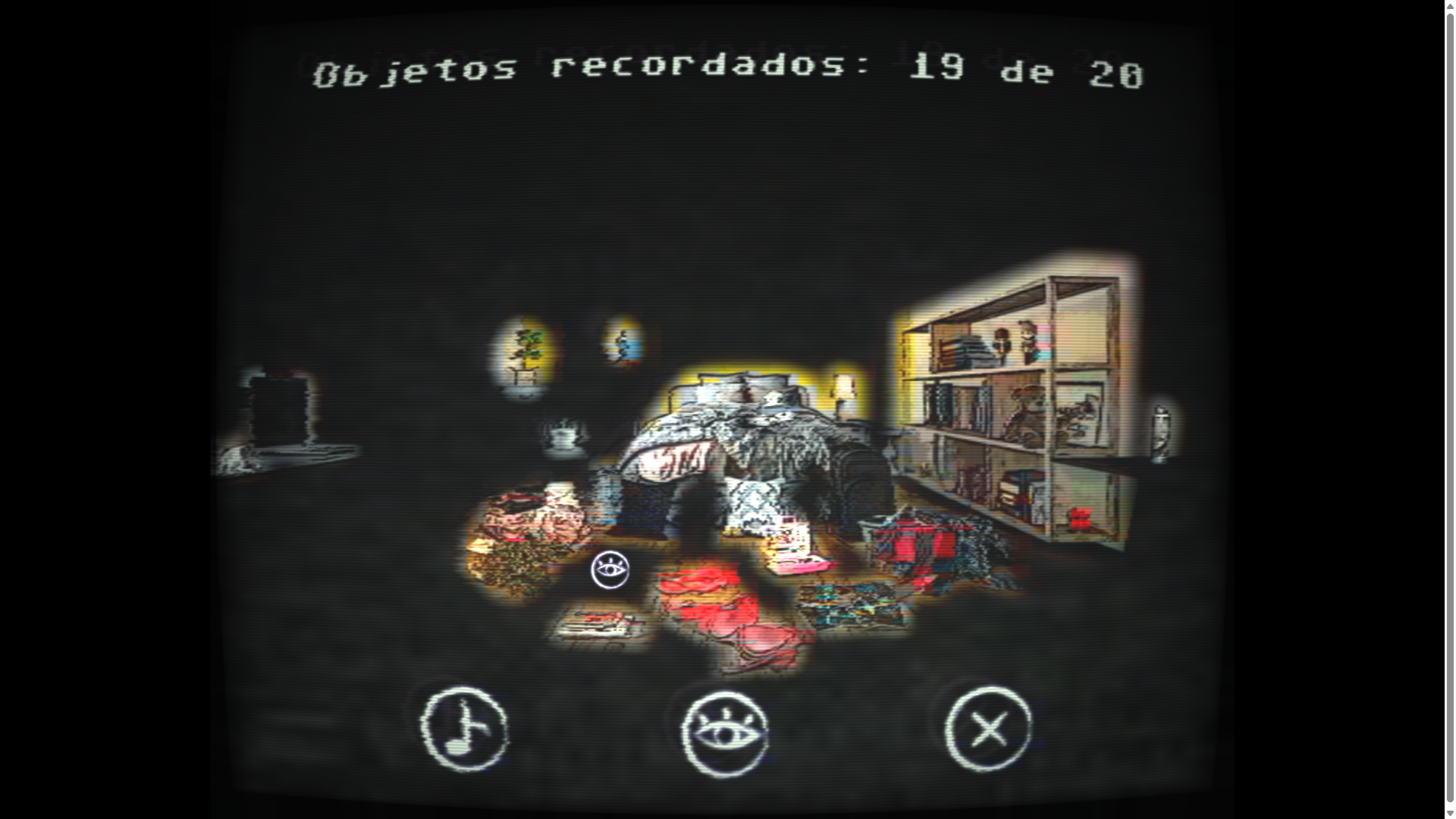
Until that moment, VideoDreams was a traditional novel with a soundtrack. But over time, the archive began to accumulate links to bizarre pages, YouTube videos, Facebook groups. It transformed into something else, a kind of modern grimoire, unique. But the sum of these elements was not arbitrary: they fit into the story, creating an archaeology of what was being told. The external links functioned as footnotes, novels within the novel, much like David Foster Wallace did in Infinite Jest.
“Cherry Fix, a non-hegemonic artist on the brink of nonexistence, navigates the discrimination of an exclusionary and racist underworld in Buenos Aires in the 2010s when she becomes embroiled in a criminal intrigue: influencers of all ages livestream their deaths as hatred becomes the most popular token, in the blockchain of trauma,” Fernando summarizes.
 Rocco Fregoti
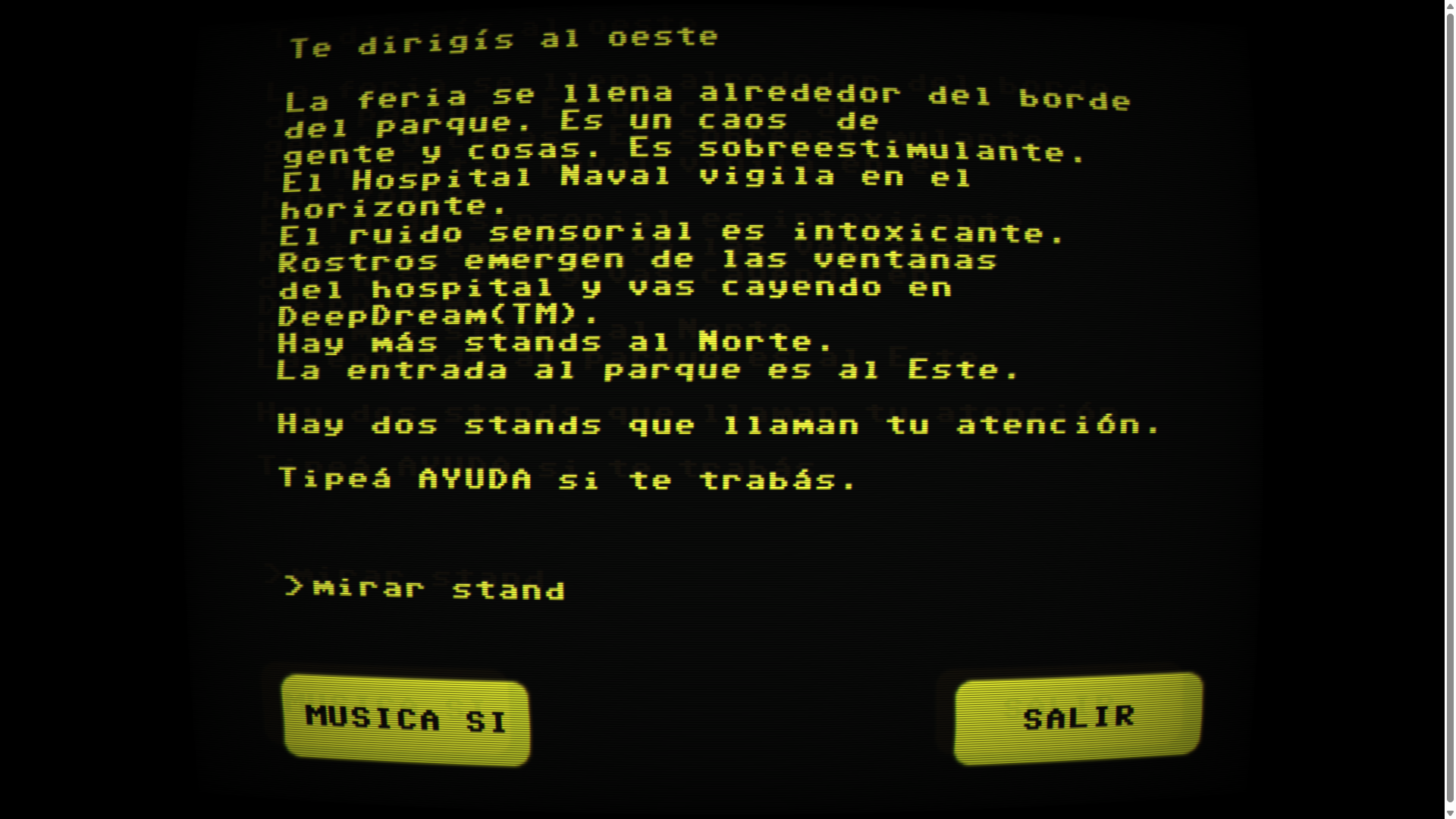
At its core, VideoDreams is a graphic adventure inspired by the classic Maniac Mansion: you have to navigate a series of microgames to advance the plot. The first thing that appears is a tube screen inviting us to type directions to go to Parque Centenario and explore the stalls. But Fernando has been benevolent (with the players? With the readers?), and the games can be skipped to go straight to the literary part. VideoDreams is a kind of evolutionary step from Japanese visual novels: interactive literary works where the text has some possibilities of variation in the style of Choose Your Own Adventure. It never reaches the extremes of Alternative Reality Games, where the immersive experience brushes against the borderline like in the movie The Game by David Fincher, where one can receive phone calls or be compelled to go to different geographical points to search for clues.
“I like the idea of transmedia because you’re telling different things through different media. I think, for example, a multimedia work operates on a multimodal text where you use many modes or many media for a story, but I believe that when you have a little video game that tells one story and an album that tells another and that runs through the entire work, that’s transmedia,” explains Fernando, who originally didn’t think his work would be an internet hybrid, but rather a novel with a QR code.
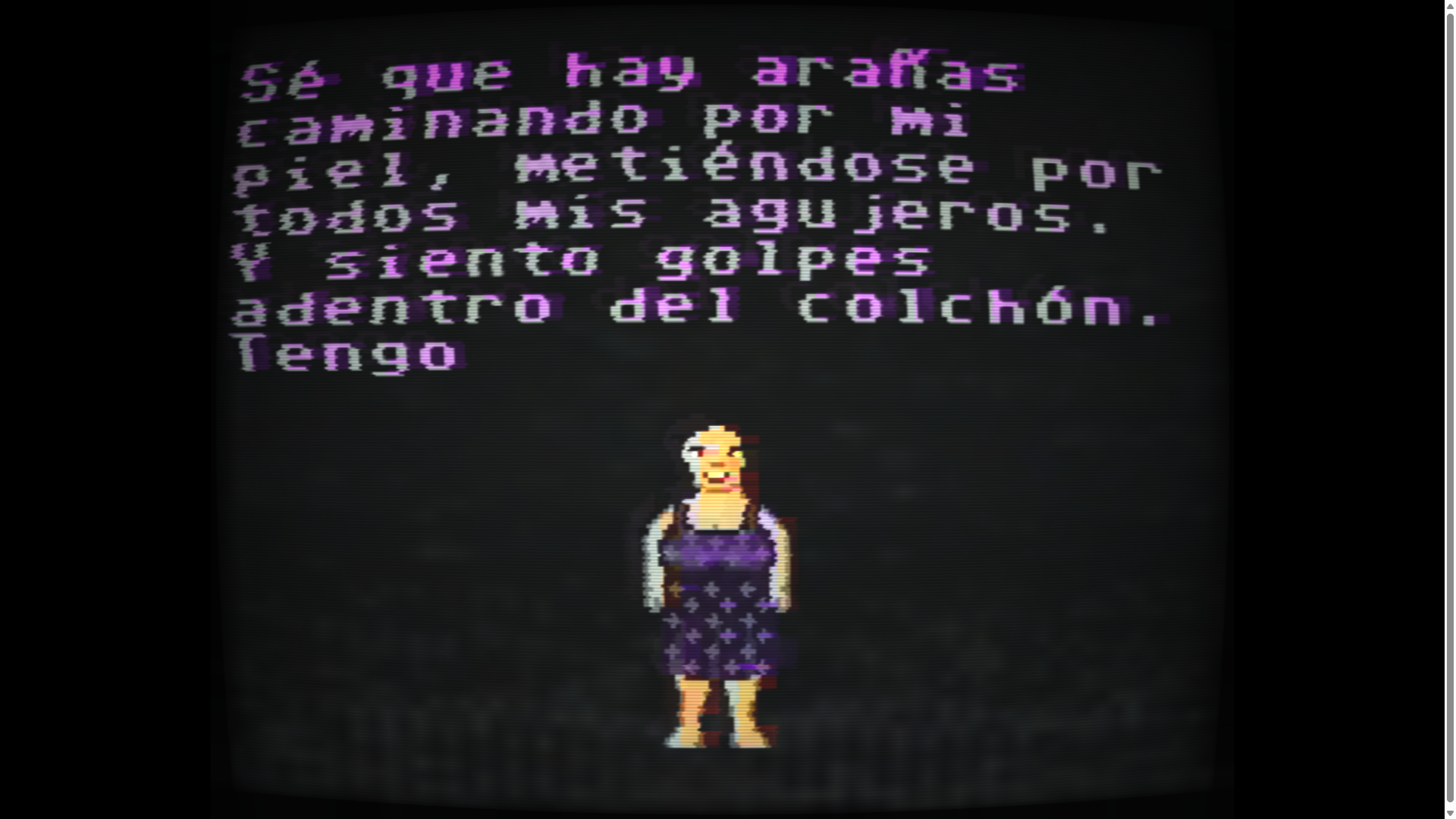
Like The Reed College Massacre, VideoDreams encapsulates a private dialogue with the most extreme and underground aspects of culture, with ghosts, with one foot in Argentina and the other in the global sphere, whether through cultural colonialism or the access to information that the internet has provided us. It’s a journey through an internet that no longer exists, through dead websites, through a lost innocence, but one that the Geocities/mIRC/ICQ generation remembers. The novel/game recovers old videos from gossip shows, conspiracy theories, and cults, obsessing over self-diagnosis of illnesses, with the pasteurization of the different as identity. While its two works operate on different logics and platforms, it’s evident that they were created by the same person, because the obsessions are the same.