Milei, Libra, and the Crypto Bard of the Scam
15 de feb. de 2025 — Juan Ruocco 🧙♂️
In the early days of his inauguration as President of the United States, Donald J. Trump launched a memecoin endorsed by himself. In a few hours, the coin reached a market valuation of 11 billion dollars, peaking at 74 USD per unit. With that it surpassed the likes of Dogecoin (DOGE), Shiba Inu (SHIB) and Pepe.
From that event, the odds that Javier Milei would replicate the play went up to 100%. It wasn't a matter of whether he would do it, but when. The answer to this question came on Friday, February 14 at 7:01 PM, with a tweet that no longer exists because the president -- and his team -- deleted it. But the internet never forgets.
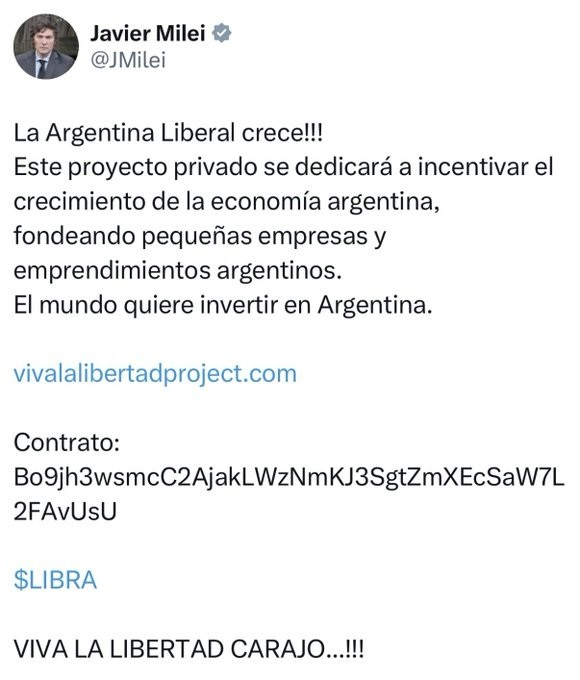
President Milei announced $LIBRA, which would end up being a shitcoin, but with a small detail. It wasn't as a joke or gag, but as a legitimate project to attract investments and "develop Argentine industry," according to what he expressed in his tweet. Quickly, the tweet was met with enthusiastic responses from figures like Ariel Sbdar, owner of Cocos Capital. Hours later, Ripio, a well-known local crypto platform, was already allowing trading of $LIBRA in its experimental trading section, Playground.
¡Ya podés conseguir $LIBRA en la sección Playground de la app! 🎡 📲
— Ripio (@RipioApp) February 15, 2025
El nuevo token que impulsó el presidente Javier Milei ya está disponible en Ripio, antes que en cualquier otro lugar 😎 pic.twitter.com/ErCM3Fbd5Q
The "joke" didn't last long. After reaching the not-at-all-negligible sum of 4 USD per unit and a market capitalization of 4 billion dollars, $LIBRA crashed like having your brain's connection to the Matrix unplugged. In a matter of minutes, all the money that had flowed in was redistributed from retail buyers' wallets to the wallets of those who controlled the project, the classic "rugpull" (the vivid image of pulling the rug out from under your feet), becoming in one fell swoop an outright scam.
Memecoins Sells But Who's Buying
The line between a scam and a memecoin is very thin. The main metric to consider is the amount of coin units concentrated in the top wallets. This determines the possibility of a rugpull. If a couple of wallets concentrate a significant number of units, the risk that these wallets will sell everything at once, crashing the price to near zero, is extremely high.
In this case, and according to the analysis of several internet users, the top 10 wallets supposedly concentrated 80% of the total supply. There was no chance this would end well. For example, during the launch of Magaiba, the official team account concentrated 10% of the total supply and that was already cause for suspicion -- imagine 80%. The main wallets were linked to KIP Protocol, by Julian Peh, both based in Singapore. According to journalist Manuel Jove, the connection to Milei was allegedly made through the entrepreneur Mauricio Novelli.
Julián Peh, de Singapur, sería quien está detrás de la LIBRA, con la empresa KIP Protocol. Se juntó con Milei y a Adorni en octubre. Hubo otro participante: Mauricio Novelli. Es argentino y dueño de NW, una empresa de cursos financieros que promocionaba Milei en 2023.
— Manu Jove (@manujove) February 15, 2025
Esto… pic.twitter.com/HEJVHffoyM
However, beyond the scam or the scheme of pump & dump (inflating an asset to sell when everyone's buying, the rugpull methodology), the central problem is that Javier Milei, President of the Argentine Nation, promoted the coin under the banner that it was a "productive project"; that is, far from a memecoin or a speculative vehicle, he presented it as an investment with real backing. The endorsement Milei gave the memecoin is what caused $LIBRA's monumental price explosion.
The Idiot Leader
However, the main effect was that what was completely damaged is the idea that Milei is a "genius" or a statesman. Any reading from a libertarian or convert held that he was practically the reincarnation of Bismarck, or of Roca, to put it in local terms. But since yesterday what emerged is a portrait of a leader who is, at best, careless and manipulated, and at worst, complicit. Either way, their leader is an idiot. Welcome to politics.
Milei enjoys (enjoyed?) a great reputation in the United States thanks to his liberal-libertarian ideology and is seen as a guarantor of Argentine markets thanks to his orthodox fiscal and monetary policy and his -- until now -- successful fight against inflation. But the question is: how can one keep believing in a statesman who is unable to distinguish between a serious project and an outright scam?
The disorientation caused by the event, besides giving us one of the legendary Twitter nights, also showed the disorientation of the Milei troops themselves. Quickly, the movement's leaders deleted their supportive tweets, some tried to deflect the conflict claiming a hack that never happened, and then four hours of radio silence followed during which Twitter users had an absolute field day.
Shrapnel of War
When the situation had already escalated to an out-of-control level, the president's team finally took action. They deleted the original tweet and put out an excuse where they also took the opportunity to attack the caste. True to their plan of never playing defense, they tried to attack and apologize at the same time. For some, the strategy wasn't bad; but reality doesn't always bend to communication strategy.
The clumsy backpedaling exposes the president and his inner circle, who seem quite vulnerable to promoting pyramid schemes, as had already happened during the campaign with the company CoinX. In other words, this isn't the first time Milei promotes a scam. But it was never at this scale, and never carrying the weight of the presidency.
This adds an additional blow to the narrative of never backing down. He had already shown signs of this after the massive march in support of the LGBT community, and now adds a new retreat. Perhaps this is the most significant thing of all. For this we can draw on two cinematic metaphors that illustrate what happened.Depredador y la otra de 300.
In Predator, the team led through the jungle by Arnold Schwarzenegger faces an unknown enemy that always seems to be one step ahead and at an advantage. Until in one scene where they mow down a forest with bullets, they find a trail of the mysterious alien's blood. Arnold delivers one of the most iconic lines in action movie history:

In 300, the Zack Snyder film based on the homonymous comic by Frank Miller, a small group of Spartans faces the massive army of god-emperor Xerxes. And while all the soldiers are annihilated by the invading army, one Spartan manages to throw a spear that cuts open Xerxes's face. Until that moment, the people had never seen their leader bleed; suddenly,
Editor's note: I'm writing this from Mar del Plata, a few hours before doing a theater show, and I think while contemplating the immensity of the ocean that it's not advisable to bleed in a sea full of sharks.
Update on a Case in Two Jurisdictions
In this update to the text, which I'm making at the end of July -- almost five months after the $LIBRA case and the publication of the original text -- I need to recount what happened both in the days that followed and in the subsequent months regarding, primarily, the judicial and legislative fronts open in the case.comisión investigadora en el Congreso de la Nación Argentina. El caso por ahora se da en dos jurisdicciones: Estados Unidos y Argentina. Veamos.
In the days that followed, the presence of a supposed "entrepreneur" associated with the crypto world was revealed as fundamental, someone who was allegedly the mastermind behind $LIBRA. Hayden Mark Davis, a 28-year-old American, co-founder and CEO of Kelsier Ventures. He was the main architect of $LIBRA and admitted to being an unofficial advisor to Milei, with prior meetings in Buenos Aires since 2024. US justice has him as the main defendant and has charged him with market manipulation, fraud and embezzlement of more than 100 million dollars.

The Case in the United States
In New York he was called to testify, denied having committed fraud or inside trading (trading on privileged information) and attributed the crash to the unexpected deletion of the post by Milei. In other words, at the first opportunity, he threw Milei under the bus.
US justice is also investigating financial movements of 12 million dollars to tax havens, shortly after meeting with Milei, and more than USD 100 million withdrawn from liquidity, including 57 million dollars in USDC that remain frozen in the project's wallet.
Fernando Molina, a prominent Argentine data analyst who played a major role in the forensic reconstruction of money movements across different accounts, shared a few days ago a series of transactions made from Davis's wallet in the moments leading up to and following the launch. In simple terms: in the hours before and after the tweet, key wallets moved millions of dollars in a pattern consistent with a coordinated pump & dump.
¿A quién le envió Hayden Davis 1.275 M de dólares el 13/02, un día antes del lanzamiento de $LIBRA ?
— Fernando Molina (@fergmolina) July 9, 2025
No es la única transacción interesante 👇 pic.twitter.com/T4SF7ZcknI
On the other hand, Dionisio Casares, son of Wences Casares -- one of the most important entrepreneurs in the global crypto ecosystem and perhaps one of the people with the most Bitcoin on the planet -- stated that for several days before the shitcoin's launch, several top-tier entrepreneurs were aware of the project and warned about the risks, but that their warnings were ignored by the government's inner circle.Milei estaba por hacer una jugada en este sentido.
Additionally, he stated in an interview for Unchained Crypto with journalist Laura Shin (a reference in crypto journalism) that a high-ranking Argentine government official received a payment -- either a bribe or a "consulting fee" -- for Javier Milei to promote the cryptocurrency $LIBRA on his social media. Although he didn't reveal the name of the official, his testimony strengthened the line of investigation pointing to an organized operation with political cover.
Some sources consulted by this outlet confirmed that from Javier Milei's inner circle, a sum close to 50 thousand USD was requested in exchange for a greeting from the president during the Tech Forum, in a quasi "Meet & Greet" style like that of a rock band. Obviously, the meetings don't have a fixed price because officially they don't have a price. But we know how unofficial transactions work when there's a deficit of legal funding.
The Case in Argentina
The investigation of the $LIBRA case, after several back-and-forths in which jurisdiction was determined, fell to Federal Court No. 1 of Judge Maria Romilda Servini. She is the central magistrate of the main case, with several lines of investigation.
She received by lottery the first complaint at Comodoro Py and the case from San Isidro was accumulated in her court following the appellate court's jurisdiction ruling. She delegated the investigation to prosecutor Eduardo Taiano in February, who gave momentum to the investigation. The prosecutor ordered multiple measures such as the request for banking information and sworn declarations from Javier and Karina Milei (since 2023). The lifting of banking secrecy at the Central Bank and freezing of assets of those implicated, including Novelli and Manuel Terrones Godoy, another crypto YouTuber associated with several web3 gaming projects that ended in rugpulls. And he accepted the requests for investigation of Javier Milei, Karina Milei, Novelli and Hayden Davis, among others.
The Congressional Investigation
The Congressional Investigative Commission for the $LIBRA case was created on April 8, 2025, in the Chamber of Deputies and is intended to investigate the government's role in promoting the cryptocurrency and potential political responsibilities. It has 28 representatives from multiple blocs:
Union por la Patria: Pablo Carro, Juan Marino, Rodolfo Tailhade, Sabrina Selva, Itai Hagman and Carolina Gaillard.
La Libertad Avanza - CREO: Gabriel Bornoroni, Nadia Marquez, Nicolas Mayoraz, Paula Omodeo.
PRO/MID: Cristian Ritondo, Silvana Giudici, Martin Maquieyra, Oscar Zago.
UCR, Encuentro Federal, Coalicion Civica, Innovacion Federal, Frente de Izquierda and other blocs with 2 legislators each.
Since its formation, the ruling party managed to paralyze its progress by not appointing authorities, causing a 14-14 tie in the election. In that context, the commission restarted activity coordinated by parliamentary secretary Adrian Pagan, without a formal president. The opposition denounced systematic blockages at every step: witnesses not showing up, requested documents not being delivered, and the ruling party's constant maneuvers to delay any meaningful progress. This dynamic turned the commission into an arena of political confrontation rather than a genuine investigative body.
Key Takeaways from the Case
The judicial direction the $LIBRA case may take enters the realm of conjecture. What we can distill is an analysis of what has already happened. It's clear that Javier Milei's inner circle has a problem when it comes to raising money. Whether from inability, lack of knowledge, or deliberate greed, the result is the same: they got involved with international actors of dubious reputation and ended up in a scandal that could have been avoided with basic due diligence.
Secondly, the entire $LIBRA case arose from a deep ignorance by Milei and his circle about cryptocurrencies. Had they made a serious memecoin -- what a paradox -- they would have raised a sum that would exceed by 10x or 20x what Davis gave them, without legal problems to worry about. But all of this was already foreshadowed in the relationship between Milei and Novelli and the different Ponzi schemes that the president promoted.
Third, the lost opportunity for the Argentine crypto ecosystem to show itself as what it is: an innovative space, with excellent human resources and globally impactful projects. An opportunity that they hope to recover at this year's DevConnect.
Fourth, the uselessness of investigative commissions, or rather the total effectiveness of investigative commissions at arriving nowhere. With that also dies the opposition's wet dream of turning the $LIBRA case into a good excuse for impeachment.
Lastly, but not least importantly, the judicialization of Milei's administration leaves him, as happens with almost every president of this century, at the mercy of the judiciary. The $LIBRA case is one that won't be resolved now or next year, or perhaps within the next five years, but it will be there like a sword of Damocles hanging over the head of Javier Milei, as a reminder of who has the last word in Argentina.