Pepe, the Infinite Feedback Loop

15 de feb. de 2026 — Juan Ruocco 🧙♂️
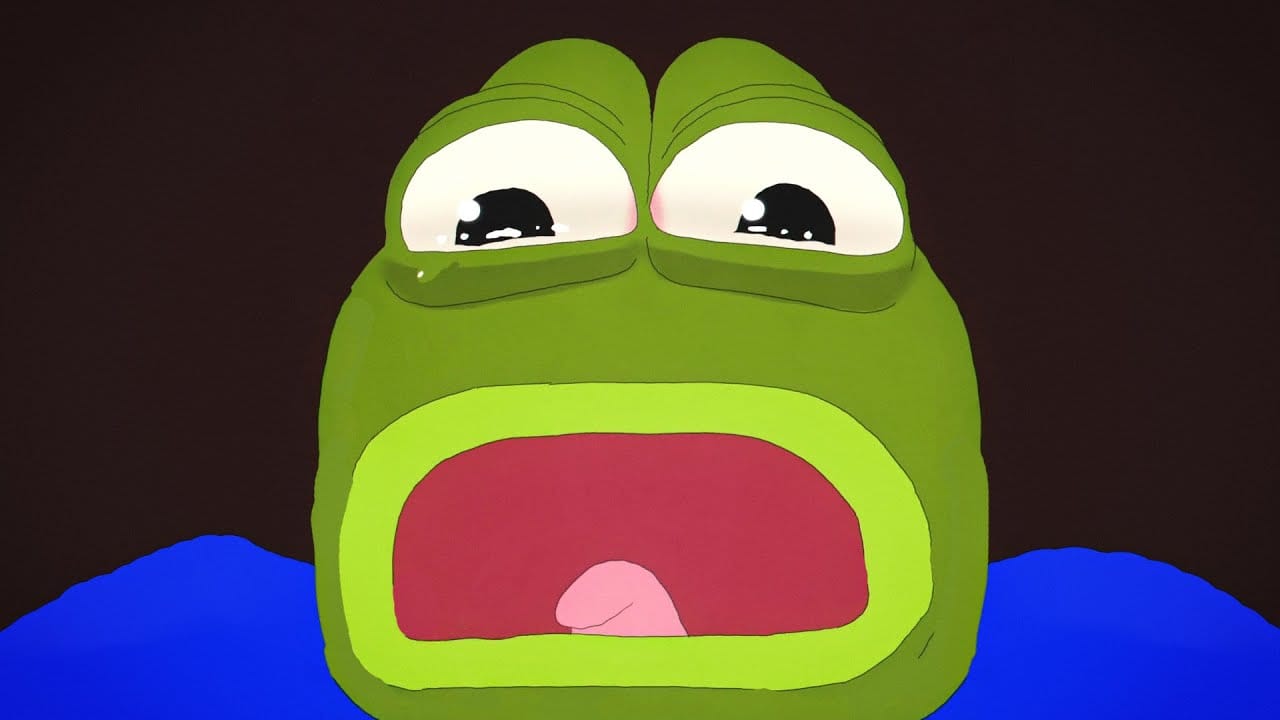
Pepe is the biggest internet meme of all time. It has no rival or competition that can even come close. A brief analysis of its history is sufficient, which we'll do in a few paragraphs. First, I want to develop a small concept: the fundamental idea of this article is that memes can be understood as positive feedback loops. Something I tried to develop schematically in chapter 10 of The Book (also known as Democracy in Danger?) but rereading it I see it wasn't made entirely explicit. Just in case, here it goes again.
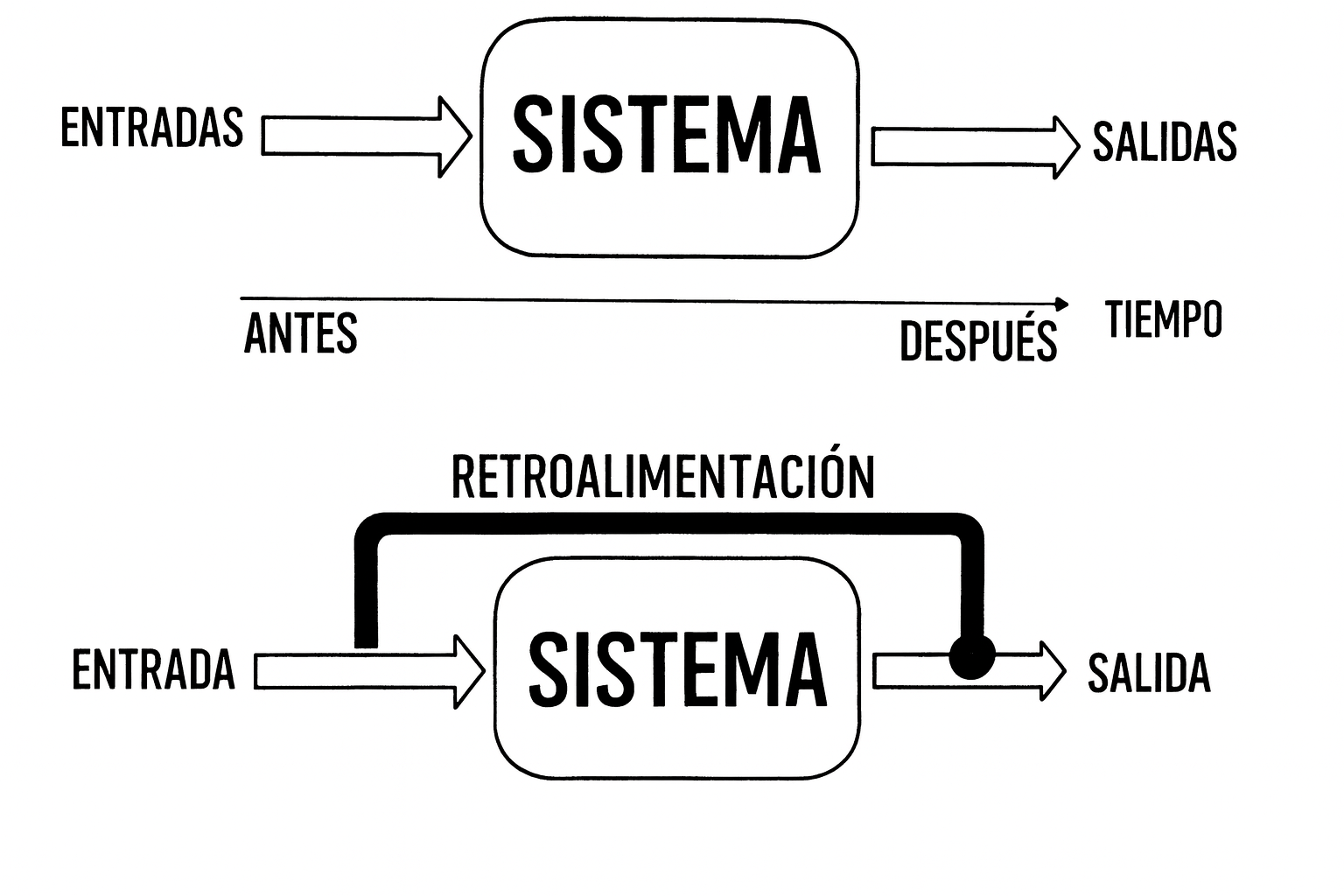
Positive Feedback Loop
A positive feedback loop is a process in which a given action or result generates effects that reinforce or amplify that same initial action or result. That is, the more something happens, the more that same phenomenon accelerates or intensifies. This produces a self-reinforcing outcome, where the system pushes itself in that direction, increasingly stronger. This can generate exponential growth or abrupt collapse.
On this second and more negative outcome I have already written some things, like Death by Saturation and/or The Parable of the Dolphin. We can also think of the ending of Akira where, as a result of the uncontrolled release of his psychic powers, Tetsuo transforms into a giant monster that keeps growing larger. In these three cases, the loop becomes so uncontrollable that, in one way or another, it causes its own collapse.
Is it always like this? Not necessarily. Understanding memes (or memetic processes) as feedback loops allows us to see their capacity for reinvention throughout history, the waves of new people who participate in them and their recursive nature. Each internet meme is ultimately a kind of geological layer that contains all the previous geological layers of meaning that compose it or that made its existence possible.
At each exhaustion at the end of a complete turn (or at the top of the saturation curve), there also lies the possibility of a rebirth. It's a fine balance to manage, one that can annihilate a meme after explosive growth or give it a second -- third, fourth, fifth and so on -- life if that circle turns back on itself in some way. And there lies the key. In that turning back on itself.

Pepe, one loop after another
If we think of memes as positive feedback loops, Pepe is proof that the loop can become infinite. Or without exaggerating too much, it can be very long-lived. That is, a meme can overcome its own moments of saturation or audience boredom. We could even think of the concept of God as another infinite meme (or an excessively long-lived one) and perhaps some other metaphysical categories that share these characteristics. But that's a topic for another article.
Let's return to less ambitious concepts. Pepe must be, almost without a doubt, the most analyzed, documented and prolific meme in the history of the internet. Think of the different stages of memes as macro turns in that self-reinforcing memetic circularity: each stage brings new users who expand the meme's use, while those new uses bring more users and so on to infinity. Or, as we were saying, think about when it dies from saturation, which is the equivalent of thinking about when a meme has no new spaces left to occupy or minds to infect. However, that happens once a certain type of use is exhausted.
What happens when a meme can acquire a new meaning and start the cycle anew? Not many others can show the same track record: being born as a webcomic, mutating into the mascot of the most influential internet community in history (4chan), becoming the symbol of Trump's presidential campaign in 2016 and, therefore, being responsible for the introduction of memetics into politics, giving rise to one of the first NFT collections in history (the Rare Pepes), with its own currency before the concept of NFT even existed, having its own documentary, being a symbol of protest in Hong Kong and, finally, originating $PEPE, a full-fledged memecoin (third in global market cap after $DOGE and $SHIB). Each complete turn of the loop would be enough for the lifetime of any average meme. But Pepe is infinite.
The dispute over the meaning of Pepe never ends. Hence some of the keys to understanding its rebirths: in recent years it had new iterations, new modifications, a new turn in the loop. Here we are going to focus on two processes that occurred several years apart. On one hand, the creation of the Rare Pepes, which are quite important given that they established the foundations for this new turn of the loop. On the other, the Deep Pepe Lore, toward the end of the article.
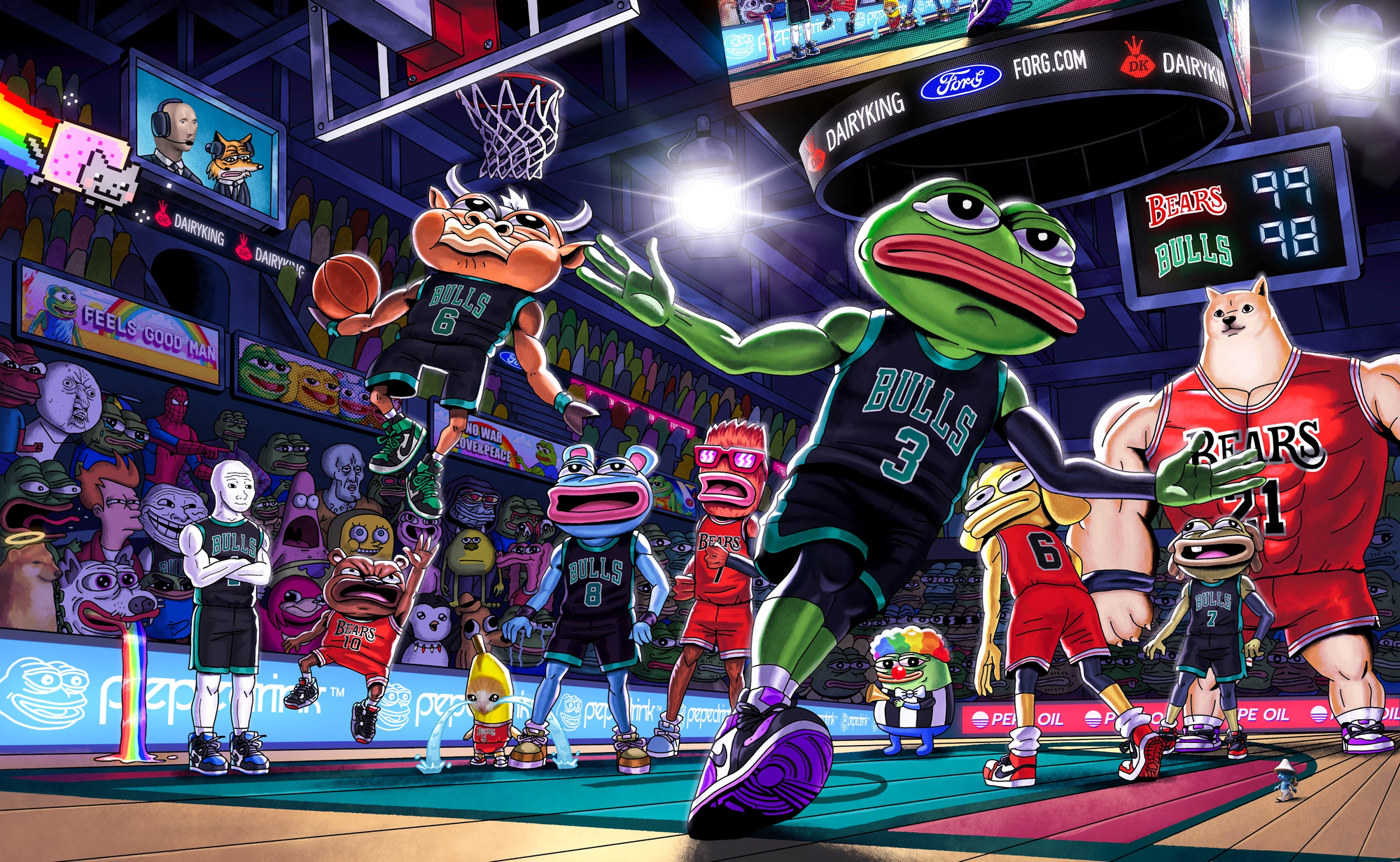
Rare Pepes
The Rare Pepes were strange versions of Pepe memes created by users who, as a joke, marked said memes as "rare," emulating the grading system of collectible card games. As the joke escalated, they started to "sell" or auction those memes, which made no sense because they were simple downloadable images. For example, in early 2015 a user auctioned off his collection folder of Pepes (literally a folder of jpgs downloaded from the internet) on eBay, where it reached $99,000 before being taken down.
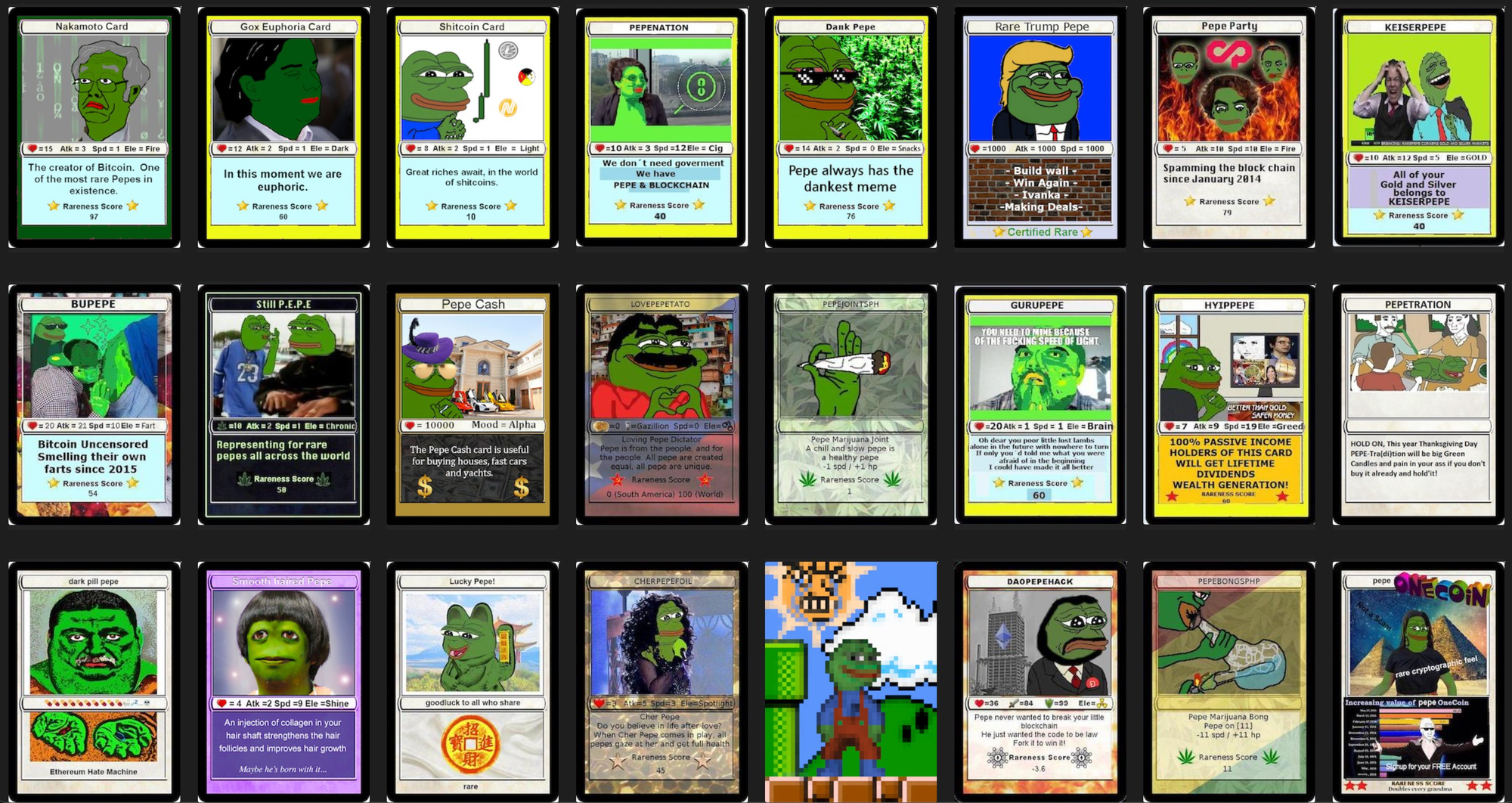
The following year, in 2016, the Rare Pepes arrived on the Bitcoin blockchain, becoming one of the first expressions of collectible crypto art. They formally became digital cards based on Pepe the Frog that were issued as tokens on the Bitcoin network using a layer called Counterparty. This pioneering project was born between 2016 and 2018, and anticipated the Ethereum NFT bubble, like the popular CryptoPunks or the nefarious Bored Apes, though with a more ironic, cryptic approach tied to the chan universe.
Each Rare Pepe card had a corresponding token with its own metadata (name, quantity issued, author), and could be transferred between users like any other token. The aesthetic of the cards was reminiscent of Magic: The Gathering, but with an ironic twist, often bizarre or cryptic, full of references to online counterculture.
To organize the growing chaos of creations, a curation system known as the Rare Pepe Directory was created, where artists could submit their cards for validation. Only cards accepted by this directory were considered "official," which helped maintain a certain cohesion in aesthetics and rarity. The cards were organized into series, and some became particularly coveted for their visual quality or symbolic value in the community. Among the most famous is the Satoshi Pepe card, which represents Pepe dressed as Satoshi Nakamoto.
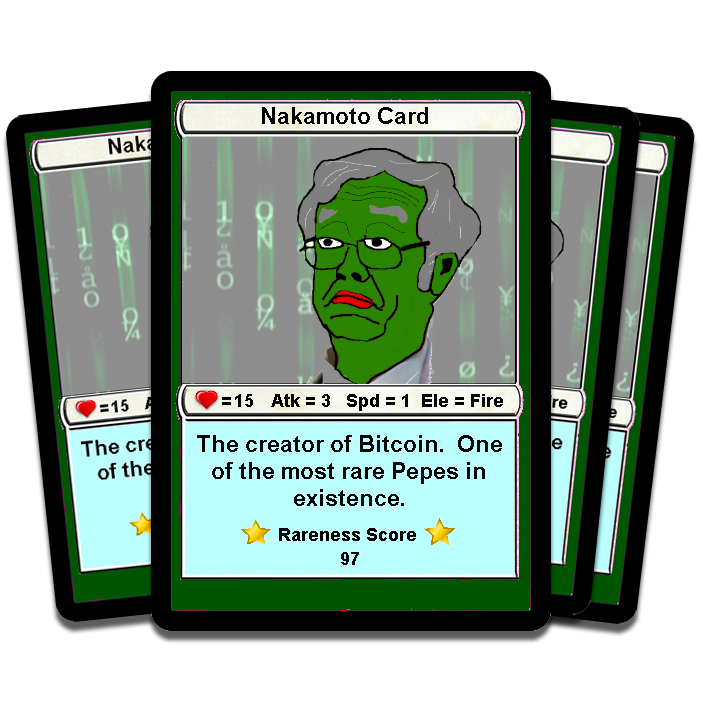
In addition to the token system, the ecosystem had its own wallet (Rare Pepe Wallet) and a transactional currency called PepeCash, which served as a medium to buy or sell the cards. All of this happened within the Bitcoin blockchain, which makes its existence even more singular, since it was an early rarity within an ecosystem more focused on store of value than creative assets. The Bitcoin ecosystem wouldn't return to these possibilities until the appearance of "ordinals" in 2023.
The cultural impact of the Rare Pepes was considerable. They functioned as a kind of aesthetic and economic experiment that demonstrated that digital scarcity, collecting and ownership could make sense within Bitcoin, even before the NFT boom on Ethereum. Additionally, they became a form of "proto memetic art" associated with the anarcho-libertarian crypto spirit that characterized many of the early Bitcoin spaces.
So, their history can be summarized in this timeline:
- 2015 Spells of Genesis is born, the first project to use Counterparty to represent collectible assets on the Bitcoin blockchain.
- 2016 The first Rare Pepes appear on Counterparty. Series 1 is launched and the Rare Pepe Directory is born as a form of community moderation.
- 2017 Explosion of activity. Multiple series are published, PepeCash usage is consolidated and the Rare Pepe Wallet is launched. Cards begin to be traded at significant values.
- 2018: The project slows down, although hundreds of cards had already been issued. The classic era of Rare Pepes is considered closed.
- 2020-2021 Renaissance of Rare Pepes in the context of the NFT boom on Ethereum. Cards begin to be "wrapped" and migrated to Ethereum through systems like Emblem Vault, once again driving up their value.
- 2022-2023 Some cards reach prices of tens of thousands of dollars at auctions, like the RAREPEPE Satoshi, consolidating their status as a foundational work of crypto art.
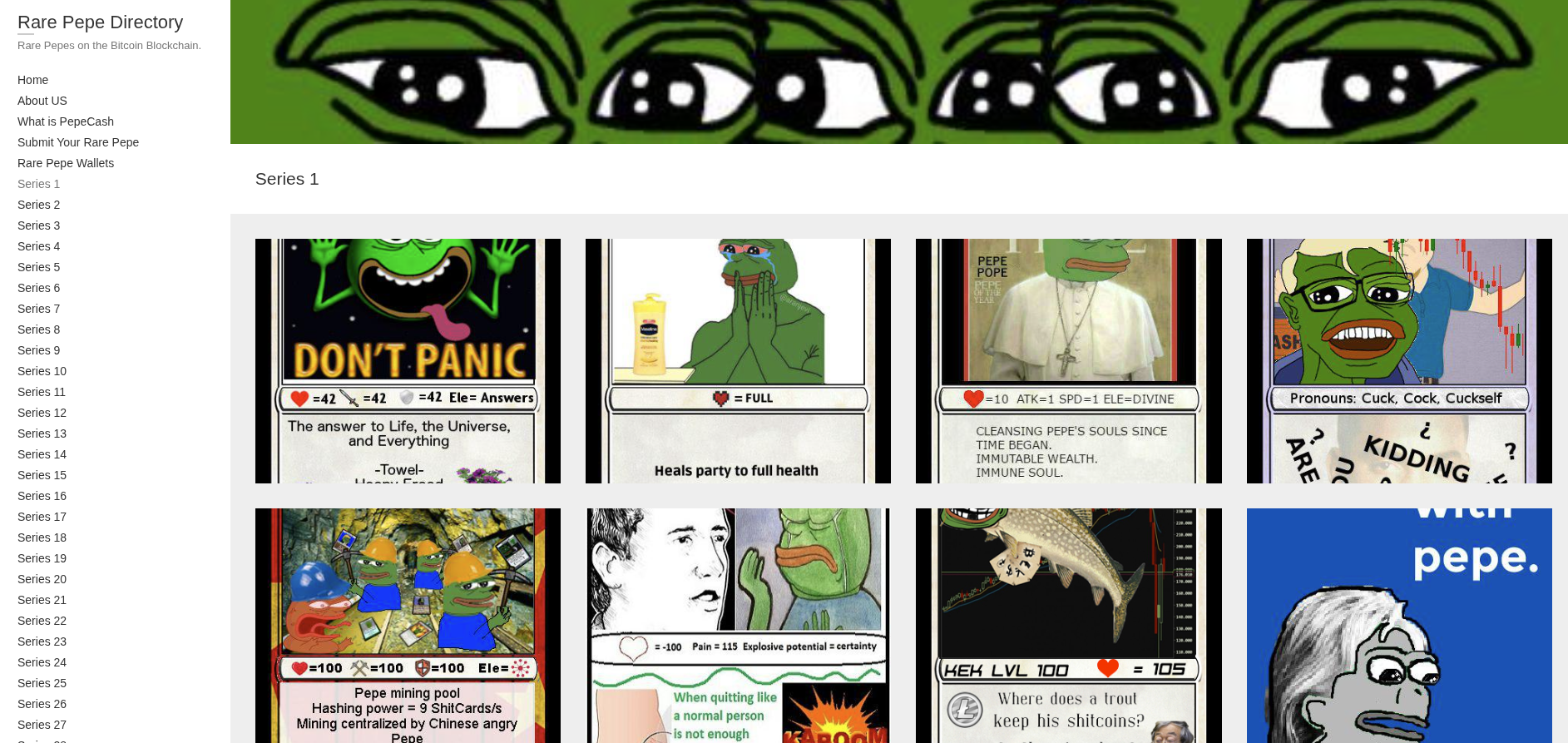
You can follow the project's trail on the revived page https://rarepepes.com/ or directly from the OpenSea directory, where the entire collection can be found with the latest transactions, prices, trades and other useful information for people who write articles like these. You can also browse the collection at https://pepe.wtf/, which seems to be managed by the more "true" part of the community.
The Rare Pepes were the natural blossoming of a community forged in the heat of hours and hours of internet, brains melted by overexposure to memetic magic. A wild, organic and unrepeatable manifestation produced by a group of terminally online nerds. The internet in its purest form.
What came after in terms of Non-Fungible Tokens was the attempt at co-optation, commercialization and corporate bubble by different groups of MegaCorp Bros trying to grab some slice of the pie from those original organic movements. Reaching the peak of the bubble where Adidas, Nike and other multinational corporations ended up releasing their own NFT collections for the "metaverse" -- how Lacan would roll in his grave.
However, when corporate exploitation reaches its peak and bursts, things return to their original course. Probably nobody will remember those garbage monkeys while Pepe cards will continue to be traded as arcane objects from a lost internet.
RarePepes By Matt Furie
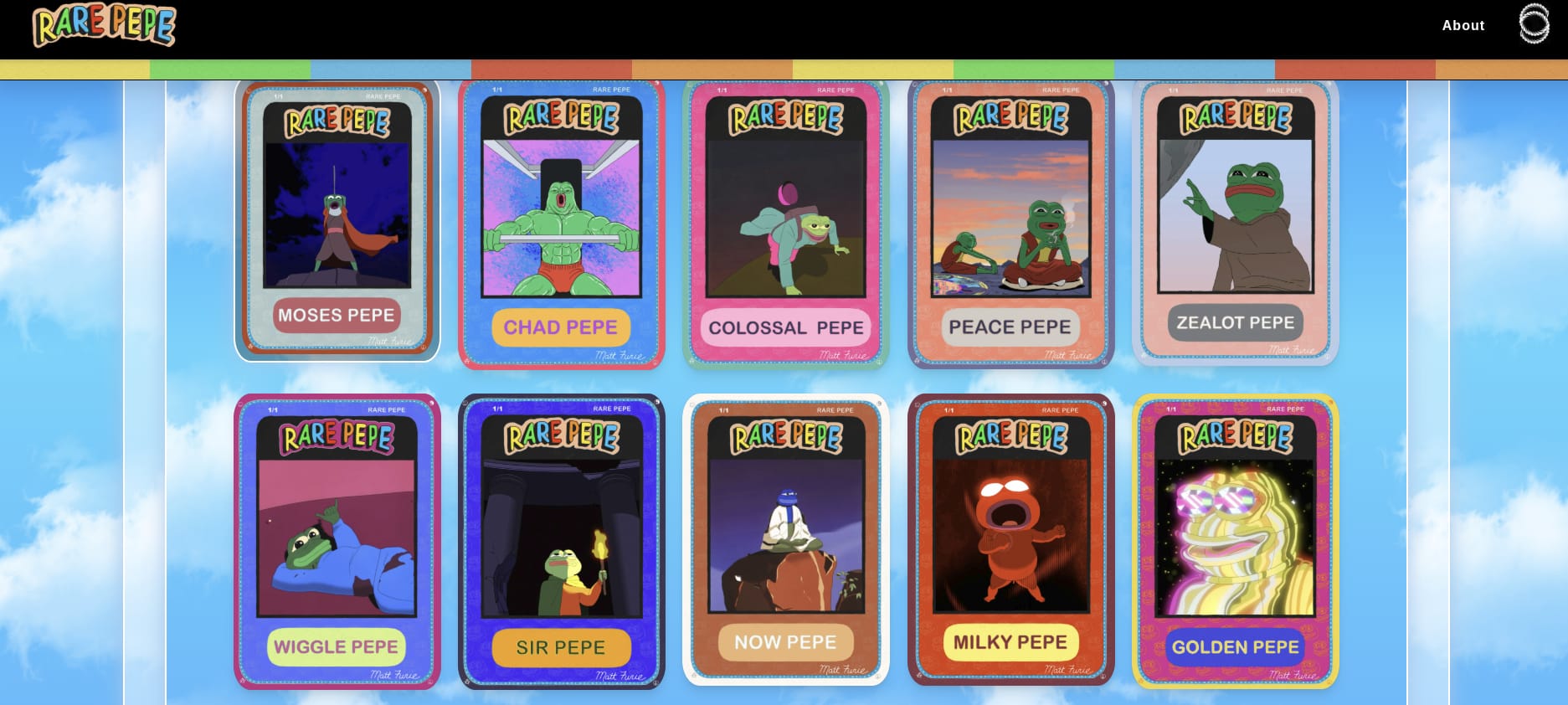
But all this detour finally brings us to the latest turn of the loop. Which is none other than the renewed encounter between Pepe and its creator: RarePepe by Matt Furie is an official collection of non-fungible tokens created by Matt Furie, the original author of Pepe the Frog, launched on the Ethereum blockchain between late 2021 and early 2022. Unlike the open and chaotic universe of the classic Rare Pepes that emerged on Counterparty, this collection was curated and designed entirely by Furie, with the goal of reclaiming his creation within the new framework of collectible digital art. Perhaps in this way he could aim to regain some control over the meaning of the work. Not definitively, but at least for a time (or a cycle), within the eternal loop of resignification.
@pepeloresus pepelore 🧘♂️ #pepe #pepelore #pepeloresus #fyp
♬ Righteous - Mo Beats
The collection consists of 103 unique pieces, each representing a different version of Pepe with original, animated illustrations that condense the psychedelic, childlike and provocative style characteristic of the author. The works were distributed among 44 unique wallets, reinforcing their exclusive character and their value as a cult piece. Unlike collections of thousands of generative units, RarePepe by Matt Furie presents itself as a series of unique works (1/1), each with its own individual value.
During its launch, the NFTs were offered on platforms like OpenSea, and Furie had the help of the studio ChainSaw.fun for its implementation. Since then, commercial activity has been limited, with low daily transaction volume, but with significant historical sales. On May 27, 2024, one of the tokens reached a record price of 18 ETH, confirming the symbolic value the series had acquired.
The designs in the series are not by Furie, but by different animators who contributed their work to create them. This was never fully clarified by either him or Chainsaw. For this article I was able to track down at least two animators: Joseph Bennett and Joseline Charles.
Deep Pepe Lore
In parallel with the appearance of the animation pieces sold as digital collectibles, both TikTok and YouTube were flooded with edits created by anonymous or random users using these pieces. Each animation was set to different musical tracks, now imbuing the animation with a certain additional emotional charge, courtesy of the music.
One of those tracks stood out above the rest: "Righteous," by Mo Beats. Thus, Deep Pepe Lore became a cryptic series of videos and texts that expanded the semantic universe of Pepe, reimagining it as an archetypal, ancestral and multidimensional figure.
Unlike the more humorous or speculative approach of the Rare Pepes, the memetic wave of the Deep Pepe Lore proposed an esoteric and cosmic narrative, where Pepe appears as an entity that traverses civilizations, eras and planes of existence. The tone of these materials mixes mysticism, esotericism, glitch art and deep dream, functioning as a kind of contemporary cybergnostic mythology. The feeling is one of accessing a decoded transmission from the ruins of a lost civilization.
The visual pacing revolves around the figure of Pepe as a transhistorical being, one who has witnessed (and at times driven) key cosmic and civilizational events. He appears as an ambivalent entity: both an avatar of wisdom and a nihilist jester. In certain episodes he is associated with the collapse of empires, the revelation of forbidden truths or the reconfiguration of time.
Its value lies rather in the construction of a shared symbolic dimension, where memes are not simple viral images, but carriers of esoteric meaning, archives of a hidden truth about the web, the mind and human becoming. Pepe becomes a kind of common denominator for the internet anon, main player and NPC at the same time.
This new degree of memetic exposure, together with the resignification of Pepe as a symbol, exposed the character to a new audience of millions of people who didn't even know about its prior history.
The return of the raid, the return of Pepe
For the first time since Pepe became extremely popular, Matt Furie seemed to have regained control of the narrative. If anything was visible in the documentary Feels Good Man it was some of his failed attempts to retake control over the meaning of Pepe and the discomfort that caused him. Almost suffering from having to get involved in something that was completely foreign to him, like the evolution of Pepe into a cultural symbol.
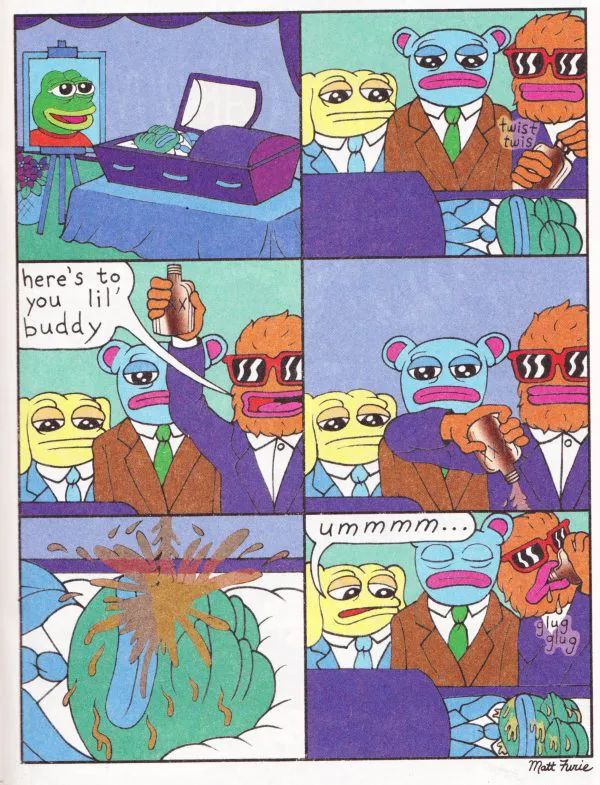
The documentary highlights Furie's discomfort with the path his creation had taken, and his failed attempt to steer the narrative: he draws the icon's death as a possible solution. Pepe dies in the comic, but for Pepe fanatics the comic no longer mattered. Furie had no power whatsoever over his character's narrative, which served to expose the new tensions between authors and fandoms that arise within different fictional universes. Material for yet another article.
The resignification that Furie achieved was through taking Pepe to the paroxysm of meaning. Or, as Tomas Rebord would say, going deeper. He did not disavow the path traced by Pepe as a symbol of the internet, but rather the opposite: he recognized and elevated that path as a fundamental part of the character's becoming, even if it was one he had never desired as a creator.
If the author wanted to rescue Pepe, he had to speak the language of the internet. The depressive nihilist tone acquired by the Deep Pepe Lore edits fit perfectly with the sentiment of digital culture. The idea that Pepe had walked a path, that it had become part of the very fabric of history, that it constituted a folklore in itself, redirected the narrative and left the classic audience in awe, while simultaneously extending its reach to an entirely new audience.
The animations are genuine works of art. It matters little whether or not they are part of a series of digital collectibles. Some of them have something recursive about them. One builds upon the other and so on to infinity, as if exposing the very nature of memetic feedback loops. The addition of Mo Beats' music gave it another level of emotional depth. You watch them and connect with that feeling of dissociation and that flight from the world. You see years, decades, centuries, eons pass in a second. An aleph of recursive meaning where one second of Pepe is the entire history of Pepe. And of the universe.
With the wage-slave Pepe going from home to work and from work to home. With the monk Pepes who surrender to death upon making contact with the giant stone head. With the one of the Pepe that kills everything he touches and dies melting in a friend's embrace.
Pepe became one of us. We became Pepe. From that recognition this new loop emerged. Just as Furie curated the collection and released it to the jaws of the internet, but built upon the different previous loops of the meme now recognized as part of that official history, these animations were appropriated and completed by the public, generating a new turn in the loop.
And with this work of art Furie can rest easy knowing he recovered, for a moment, the direction over his fictional friend. At least until the next turn of the infinite loop.
Epilogue: Oh shit here we go again
This article had been written for a while, and due to editorial calendar considerations we chose to publish it on this date. While I was preparing the piece for upload and looking for links, images and other resources to dress it up, I discovered the news that the latest NFT collection created by Matt Furie and Chain.Saw, Replicandy, had been hacked and that both the company and the creator had taken about a month to provide any response. As a fun detail, Chainsaw is owned by Furie's cousin.
1/ Multiple projects tied to Pepe creator Matt Furie & ChainSaw as well as another project Favrr were exploited in the past week which resulted in ~$1M stolen
— ZachXBT (@zachxbt) June 27, 2025
My analysis links both attacks to the same cluster of DPRK IT workers who were likely accidentally hired as developers. pic.twitter.com/85JRm5kLQO
ZachXBT is a well-known X user who specializes in analyzing cyber attacks on crypto projects using public information, through the analysis of transactions on different blockchains. As you know, the transparency of the databases of the vast majority of cryptocurrencies is what enables this type of work.
According to this investigation, it is estimated that the attack enabled the replication of the unique items, taking them from 1,700 to 4,800 and generating millions in losses. The most bizarre part of all is that the attack was carried out by addresses linked to the Democratic People's Republic of Korea. For those who don't know, North Korean hackers tend to be some of the most recognized in the crypto space, for their effectiveness and lethality.
Now you have left us with only one option: We are forced to litigate & sue for damages. We're spending all day researching consumer protection laws and we intend to contact each state's attorney general informing them of the breach and how many people were affected in total. We… pic.twitter.com/cA9U923GGt
— jagged (@jaggedsoft) July 12, 2025
This X user threatens a class-action lawsuit against Furie and Chainsaw
The alleged North Korean hackers would have been hired as developers for the project, which would mean a severe security failure at an almost amateur level. The inaction by the studio Chainsaw and the lack of communication from Furie led several of the collection's buyers, many of them prominent crypto technology developers, to threaten legal action. All of this news is still developing. The loop has already started spinning again.