Polymarket: Collective Intelligence and Prediction Markets

2 de sep. de 2025 — Santiago Medina
There are things you fear because you know you're going to like them. A lot. My two main ones are coke and gambling. They're pretty similar: emotional intensity, speed, the feeling of knowing it all, of being able to do anything. The financialization-flow management combo is claiming an ever-larger share of social activity and competing with the great structures of the 20th century -- like schools, armies, or prisons, replaced by lifelong learning, mercenaries, or house arrest -- or substituting other mechanisms of social coordination. Meanwhile, we're starting to bet on the future, but not as in a horse race -- more like a universal stock market.
The Wheel of Fortune (what the hell is Polymarket)
Polymarket is a crypto platform where you can buy shares in massive bets on future events. How do you make money on Polymarket? By being right about the outcome of an event -- say, who's going to be the next president of Chile. But you can also trade by riding the fluctuations in market perception.
In other words, I can buy "No" on the Ukraine war ending this year when it's worth almost nothing, and sell it if something happens in two weeks that makes it a more plausible option. Prices range from $0 to $1, reflecting the probabilities of the event occurring (according to market opinion, of course). When the bet resolves, winners receive one dollar per share. So if you bought "No" at 0.20 USDC, you earn 0.80 USDC.
Crypto and venture capital titans like Vitalik Buterin and Peter Thiel have invested in this platform, which currently faces restrictions on operating in the United States but remains, arguably, the most popular prediction market in the world. There's everything: politics and economics -- what tempts me the most -- but also culture, sports, and technology. Not all of us are experts in something, but there are topics we follow more closely, and that's what draws you in.

Postmodern Investments
In 1990, Gilles Deleuze publishes Postscript on the Societies of Control, where he synthesizes what he considers a new model of society, the successor to Foucault's disciplinary society. Since the mid-20th century, the structures of confinement designed to organize production had been collapsing: the army, schools, even the family. What remains are "ultrafast forms of open-air control."
I keep quoting:
While the different apparatuses of control are inseparable variations, forming a system of variable geometry whose language is numerical (which doesn't necessarily mean binary). Confinements are molds, distinct modules, but controls are modulations, like a self-deforming mold that would change continuously, from one moment to the next, or like a sieve whose mesh would change from one point to another.
Control replaces confinement with continuous variation. Currencies, once made of gold, are now a series of fluctuations. Everything becomes a stock, and the future -- in the most essential sense of the word -- once a program, a conquest, or an invention, is just another asset to be managed.
The individual becomes a cipher -- a token on the Ethereum blockchain, via Polygon, in Polymarket's case -- a cluster of data operating within the gigantic network of a society turned enterprise and market. They're no longer a worker in the modern sense (part of a production cycle for which they receive a wage, etc.) but rather an investor of their own labor power, their time, and whatever liquidity they have. The masses, converted into data, interact through a specific technological interface, where the most diverse informational and emotional dynamics come into play. It's worth asking what could emerge from the mix of Large Language Models (LLMs) and Polymarket.
Within this social framework, the pursuit of profitability has a wide range. Moore et al (2012) argue that even Ponzi schemes can be considered investments, insofar as actors are aware of the unsustainability of certain projects but bet on getting in early and getting out before the system collapses.
Prediction Markets and Collective Information
I like to think there are the curious, the hunters, and the insiders. Recently there was a bet that within 24 hours there would be an earthquake above 7 on the Richter scale. A big one, in other words. Hours later, the Russia earthquake struck, endangering Chile's coasts with a potential tsunami. It's impossible to predict an earthquake (unless you believe the HAARP project has the juice for that). But someone may have analyzed public or semi-public information and become convinced it was going to happen soon. In this sense, we can offer a conspiratorial reading of this betting market. But there's more.
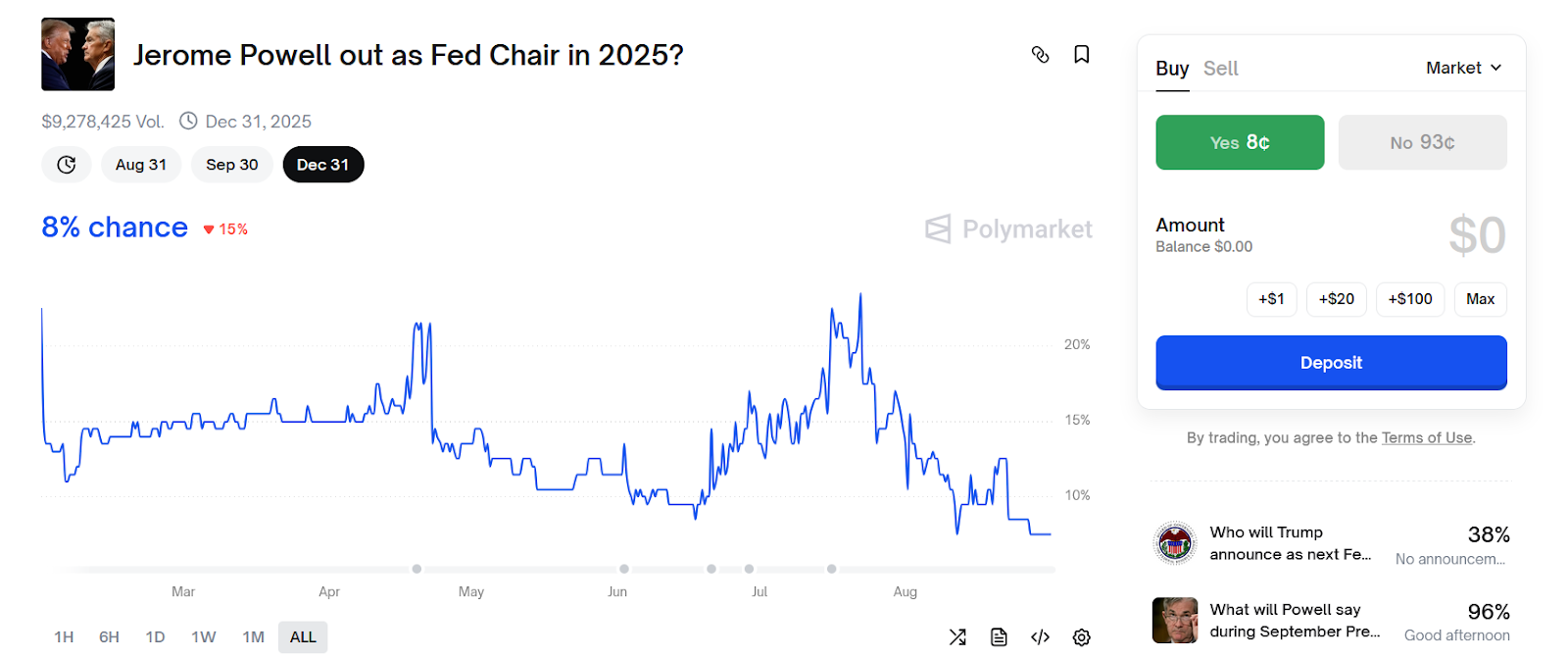
Since the last Trump election, attention was drawn to how prediction markets outperformed polls when it came to anticipating results (example). And recently there was a huge stir on Polymarket: an American political back-and-forth could have sent shockwaves through the global economy, in a butterfly effect whose consequences we can't measure. The potential ousting of Jerome Powell (chair of the U.S. "central bank," the Fed) by Trump was put up as a bet and barely commands an 8% probability, as measured by the market, even amid institutional turmoil.
So far, it's been right. But why do prediction markets actually "predict"? The explanations are quite utilitarian: a poll depends on good faith and willingness, while a market pays for the most honest, reliable, and well-reasoned information an individual (turned event trader) can muster. That alignment of incentives would give rise to a collective intelligence.
If we suspend belief in the concept of consciousness for a moment, many things resemble intelligence: coordination among insects, trees that don't intertwine their branches, plants that exchange nutrients to help each other, or geometric shapes forming organisms in the Game of Life. But I don't want to go full hippie.
Without going so far as to say everything has a soul -- more like the opposite: nothing does -- we can think of Polymarket as a collective intelligence interface. Complex systems in which we aggregate the information handled by different agents -- this is very Hayekian; if I offend, my apologies. Precisely, following the great national Austrian: how the hell do we translate all those perspectives (the expert ones, the bold ones, the idealistic ones, the meme-driven ones) into a single variable? Easy: by running all that information through the sieve of a binary system (yes or no; at most, a few options) and then letting the elements float in a pricing system.
Emergent Intelligence and Government Intelligence
Polymarket is so precise at measuring the dynamics of public opinion that it's used as a benchmark for, say, this study on the implications of U.S. Executive Branch policies (Trump) on the perceived independence of the Fed. And not just that: these folks at the Navy propose using prediction markets as indices for managing security threats (!). Basically, they propose a framework for intelligence analysts to extract the best possible info from each trade placed on the platform. Above all, where to look.
It's quite striking that they actively propose searching for bets on conflict escalations they might not be seeing. In other words, the U.S. military considers this collective information construct a relatively reliable source. These indicators would then be cross-referenced with traditional intelligence methods (OSINT, MASINT, HUMINT, etc.).
While we're at it, this is somewhat useful for all of us. You can be your own intelligence analyst. These military folks propose three methods of data interpretation:
• Cross-referencing information across different bets (which end up building a general picture). Tensions rising between two countries while the price of a certain commodity increases, suggesting a trade blockade hypothesis rather than a military escalation.
• Anomaly detection: terrorist attack threat in Santiago, Chile; a Chinese blockade against Pakistan; or a North Korean nuclear test over -- I don't know -- Russia. Wild hypotheses that, once suddenly placed in a bet, deserve attention. Also, sudden shifts in a previously consistent bet, like a slight move toward the idea that Ukraine might take Moscow.
• Sentiment analysis: here the goal is to measure the degree of individual confidence and, from there, collective consensus around a hypothesis. Because a collectively consistent bet is not the same as a volatile one.
At the same time, this adds another layer of complexity: Polymarket, thanks to its design, has the ingredients to become a theater of intelligence and counterintelligence. Government agents' disinformation against the information built by the internet's hive-mind. The latter have an incentive to produce honest and reliable information -- because they'd make money if they're right -- but the former -- i.e., the CIA -- has tons of cash to burn placing decoy bets designed to destabilize the landscape of public opinion. This is a fun hypothesis but not much more. I haven't found documented cases, but the ingredients are there. The thing is, the effect could be short-lived due to regression to the mean. We'll see.
Returning to Deleuze and the shift from confinement to control: if information gathering used to be locked inside the Pentagon building, today it's being carried out collaboratively in the open air.
Beyond Hayek
Economist Helen Wu proposes thinking of Polymarket not as a neutral space for democratic information aggregation (the Hayekian thesis) but as a sociotechnical assemblage with specific sociological and informational structures. In other words, it's not a data potluck: it's the blueprint of a Cathedral. Through empirical study, Wu concludes that in each prediction, a competition forms among specialized traders who drive the information and wield disproportionate influence over price formation.
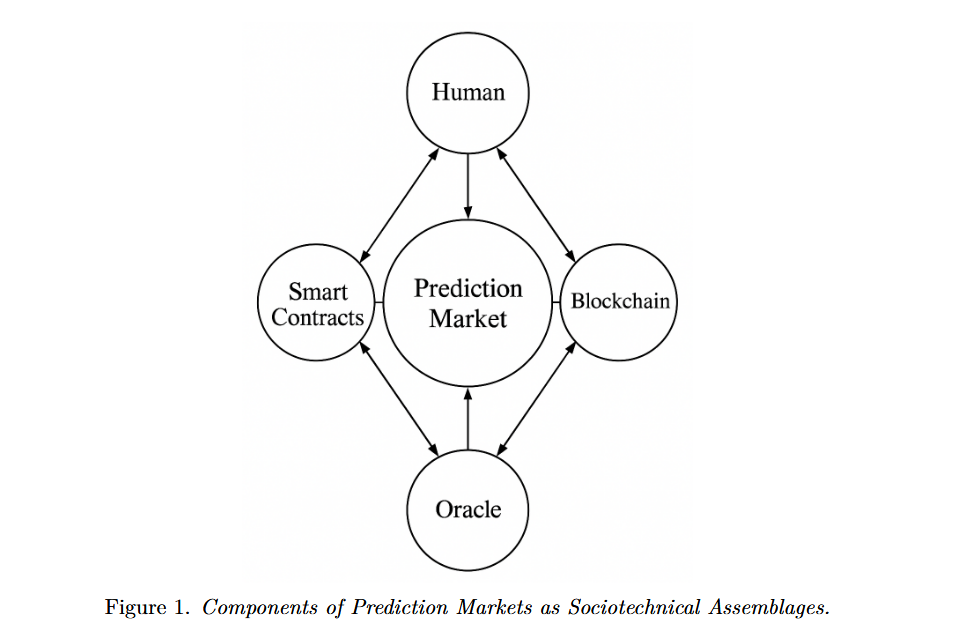
The use of the concept of "assemblage" points to a posthuman dimension in Polymarket. Agency is distributed between humans and non-humans, represented by the Automated Market Makers and the smart contracts that distribute the money and mediate between events in Real Life(TM) and the outcome accepted by the system. Predicting here isn't just about predicting the future, but also the outcome that Polymarket will accept, in its own timing and terms.
High-frequency traders leverage the AMM's mathematical structure to capture small margins on numerous transactions. Information specialists exploit the blockchain's transparency to identify and follow influential traders. Retail participants provide capital that enables sophisticated traders to profit from information advantages, creating incentives for informed participation.
On Polymarket, anyone can be an oracle. As blockchain infrastructure, it allows us, on one hand, pseudonymity (nobody necessarily has names, only ciphers) but also the monitoring of each wallet's trades. That way, we have access to every user's track record. Triangulating that information can even give us intelligence data, as the U.S. military folks proposed in the paper we mentioned earlier. Polymarket opens a Bitcoin-era accessibility paradigm for a market that was born hyper-regulated: the first prediction market was the Iowa Electronic Markets in the '80s, run by the University of Iowa, centralized and limited in participation.
We can also ask Who Watches the Watchmen: the prediction resolution model consolidates the elite dynamic that emerges from the trades. A trader pays a certain sum and proposes a credible outcome, which kicks off two hours of refutation (if anyone wants to). In case of dispute, the verdict is settled by consensus among UMA token holders, a token specifically designed for this process. In the end, whoever successfully proposes the resolution receives their deposit back plus a reward.
From the Inkwell
Markets are not abstract entities but material interfaces of communication between very diverse agents (some even non-human, from Wu's perspective). Banknotes, for example, are a certain type of paper issued by a certain type of institution, used under specific parameters and situations. They have circulation limitations but traceability advantages, if you will.
Polymarket is an interface with certain characteristics that make it unique: pseudonymity, strong incentives to develop complex and well-founded theses, minimal frictions for monetary circulation (money used to travel at the speed of horses and ships; the internet gave it the speed of light), traceability of user decisions and not so much of the money itself, which is relatively easy to launder digitally, and a tokenization system that simplifies World Events and transforms them into "Yes" and "No" options, facilitating the processing and production of information by reducing the repertoire of signals. Money circulates, information circulates, but identities and central regulators do not.
There have been legends within Polymarket, like the Frenchman Theo, who made 85 million dollars (!) betting on the U.S. elections. The epic of the handle and the hacker ethic seem to emerge, at times, from the rubble left behind by tech oligopolies.
Managing the future in an open and decentralized way still has consequences yet to be revealed. Agents hedging their own bankruptcies. Politicians getting paid for actions they're about to take. The standardization of triangulations between different predictions that ultimately help us monitor extreme situations like wars in real time. Light doesn't behave the same way if it's being observed or not. Why would human action?
Polymarket is playing 5D chess. Timelines intertwine and we'll no longer know if we're entirely in the present. Whether we'll be entirely in the future.