Psychoanalysis: A Freudian and Argentine Critique of Emotional Flat-Earthism
In contrast to the “emotional flat-earthism” of magical solutions and individualistic coaching, Argentine psychoanalysis proposes an epic: inhabiting the enigma. It is not a matter of healing with recipes, but of historicizing trauma in order to transform it into a fiction with vital power.

23 de feb. de 2026 — Julián Ferreyra
In the midst of a widespread crisis of experience, psychoanalysis brings forth an epic of subjectivity, a violent and dark version of personal history. It is appealing because we all aspire to an intense life, amidst our secular and trivial existences...
Ricardo Piglia
Neurosis, Time, and Territory
The Freudian era, and Sigmund himself, grappled between rationalism (logical spirituality) and occultism (aestheticized paranoia). Two versions of deciphering that were far from antagonistic for their practitioners and followers. Our era is different: biodescodification that mixes esotericism and eugenics, evidence-based cognitive-behavioral astrology, positively cruel psychology, family constellations grounded in neurotransmitters, super-ego confessionals via AI, among other examples hipsoterists.
Without corporate or evangelizing intentions, critically warning about the problems and ravages of over a century of homo psicologicus, these lines aim to outline the growing advance of “novel” rhetorics regarding the psyche. But it is nothing more than a simplistic return to pre-psychological ways of thinking and intervening in behavior, which includes common-sense conceptions about key terms like “affection,” “emotion,” “anxiety,” “mental health,” or “healing,” with a strong individualistic root, erasing all relational dimensions. The emotional flat-earth theory thus refers to the pathological fixation on measuring feelings and a denial of the conjectural nature of emotions. It considers that every state of the soul can be unequivocally transcribed, judges any hint of misunderstanding as conspiratorial, and fiercely tames the slightest expression of ambivalence. It is ultimately an emo of the 2000s but with a CEO's ambition.
We will try to recall some bad news that since the late 19th century, Freudian ethics has contributed to better reading the garments of naturalism, proposing a modest methodology, yet capable of producing lasting effects (far from the solemn or lethargic cliché, what happens in a session, through transference, is rather an Attack, Attack, Attack!) regarding discomfort but also in relation to ways of desiring and enjoying. And if the referred action is clinical in its ethical dimension, such therapy will be closer to the vitality of the common bond than to the garish exits of nihilism or altruistic comfort.
We will not ridicule those who either occasionally or militantly subscribe to new age methods of soul treatment. Not out of compassion, but to recognize that in many cases, these methods constitute a response to the barbarities that the medical discourse first and the hegemonic psychological discourse later inflicted on those who suffer.
What is proposed here is part of a current of thought that I unceremoniously call Argentinian psychoanalysis, in clear reference to our territory, which is, ultimately, where we suffer and enjoy.
Enigmatic free association
What is association if not a free yet enigmatic expression? An impossible, necessary, and failingly passionate utterance. The “evenly floating” attention, a rudiment that modulates listening and one of the few non-negotiable technical precepts of psychoanalysis, aims at a just distribution of the wealth of what is heard: listening intervenes to operationalize the enigmatic capital. Gleichschwebend has generally been translated as “evenly floating,” although it could well mean “equally distributed.” Freudian listening would be a distribution that equalizes, giving relevance to the subaltern and lowering the price of grandiloquence. A kind of significant justice.
There is a tendency to resist associative freedom for the same reasons that one shies away from the enigmatic, namely, the difficulty of a feeling that does not rely on external validation. In psychoanalyzing (ourselves), we find that deciphering an enigma merely rewrites our history as mythology, while turning the individual myth (me, mom, dad, my triumphs and miseries) into a support or platform for other enigmas that will no longer be solely our own. Nothing to do, then, with the accusation of therapy being “intellectual fluff.”
(Not) remembering, then historicizing
Our history is not made up solely of memories. Returning to the question of the enigma, we will say that besides the method, the object to be deciphered matters, an action that in one way or another implies a historicity.
It is not only what leaves marks that serves as raw material for recollection, but also what barely left a trace. This is the basis for the work of historian Carlo Ginzburg, a Freudian in his own way, which is particularly indispensable in the face of subjectivations ravaged by immediacy and unanchored from any tradition. I refer to a subject analogous to that of the Suburban Man by the argentine singer Pappo: without history, without time, and without memory.
 Naoto Naka
“I can’t think of anything,” something often heard in sessions, is not necessarily a sign of laziness or lack of creativity. Nor is it a sign of forgetfulness as a repressed memory. For a lagoon to exist, there needs to be water, and sometimes there are no thoughts because there was never a memory of what actually happened. As the popular saying goes, which I attribute to another great Freudian, the Argentine thinker Arturo Jauretche: “Some muddy the waters so that the lagoon seems deeper. But how deep will the lagoon be that the pig crosses at a trot?”
Freud's greatest discovery was not positing that there is an operation beyond/within consciousness (something intuited by wise men, philosophers, and even the wild soul doctors of his time), but rather noticing that this unconscious has its roots in what was seen and heard prior to perceptive maturity. In other words, that there is subjective experience, and therefore trauma, long before a “self” can be mobilized that forgets and eventually remembers. Those first subjective experiences endure as a mark and constitute a territory/reservoir bordering on hallucination and delirium.
This fact undermines the foundations of any pseudo-therapeutic proposal based solely on the agency of the self and the belief that the will of the conscious individual is what will enable emotional transformation.
 Luis Paz
An example of what Freud would include in The Psychopathology of Everyday Life (1901): we remember something (let's say, from early childhood) and we are not clear whether that memory is our own, borrowed, or a border mix between what was supposedly experienced and what I was told happened that day, the photos I saw, the anecdotes from family gatherings, etc. The most intimate and cherished memories can easily come from the Other, and it is no simple metonymic coincidence that remembering refers to agreeing, which is characteristic of an agreement.
Unconscious and repetition
The aforementioned discovery (that there is psychic life prior to the ego-subjective experience) imposed an obstacle on the method and demanded a complexity from the theory to be able, like a tai chi movement, to turn that obstacle into a turning point in the cure, a possibility to address what is purely a thing and resists all meaning.
Technically, if there is no possibility of remembering, it is also impossible to "make the unconscious conscious": there is no association because there is no chain, thread, or fabric to cut/remember. And someone who does not remember may act, for example, through silence. Or worse: they may become ill. Here lies the etiology of the disproportion between what we expect/demand of ourselves and others, as well as phenomena that are sometimes vulgarized but have their clinical specificity, such as acting out, the passage to action (slipping, sometimes even without breaking anything), or the wide spectrum of panic attacks.
Thus, from a theoretical standpoint, resistance will not be an obstacle but will instead become an indicator of the strongest problematic core, the repetition, which Freud drew from Nietzsche's poetic philosophy, designating it as the psychic experience of the eternal return. This discovery occurs in the clinical confrontation with a very tricky issue: not necessarily does someone want to heal or leave behind those satisfactions that are as dear as they are harmful. In other words, there is a beyond the pleasure principle, and therefore both analyst and analysand will require something more than good intentions to undertake a therapeutic process.
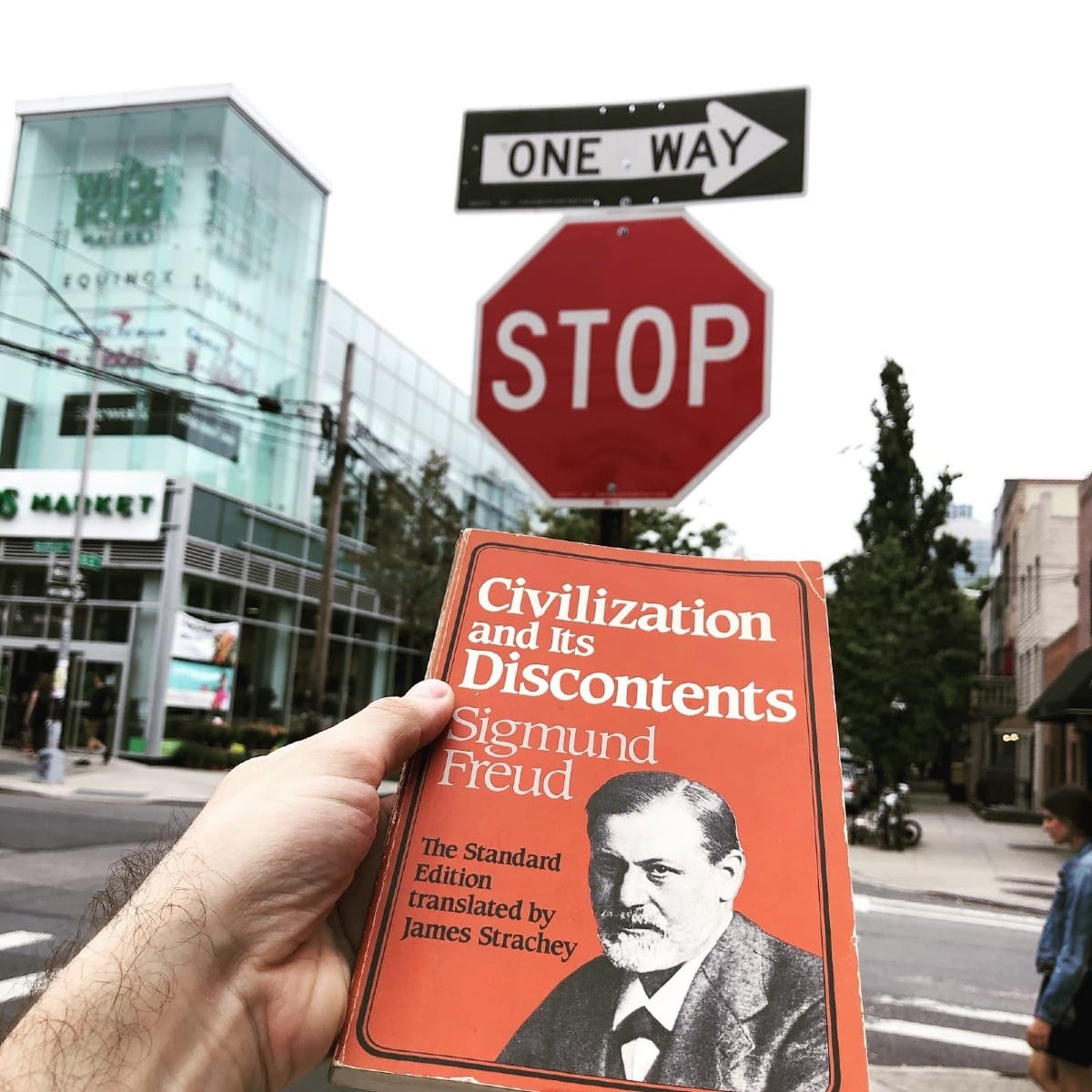
Interpretation, as a maneuver, must be subordinated to a larger strategy, the management of transference, to address what is at play beyond mere words and confession. The genealogy of Freud's work is analogous to the diachrony of treatment: at the beginning, everything goes more or less well, there are effects stemming from remembering and signifying, but then the wheel stops, and we confront the fact that what hurts and commands us is as trivial as it is overwhelming. First, we deal with what overflows with meaning and then with its absolute lack. Or, in other words, we anguish at realizing that there is no longer any magical discovery to enlighten us and that, even less so, it will come from the analyst's sleight of hand. Without exaggeration, it is a mourning similar to that which occurs when we stop being children.
Some key texts to read this epistemological transmutation: Remembering, Repeating, and Working Through (1914), Beyond the Pleasure Principle (1920), The Ego and the Id (1923), and Inhibition, Symptom, and Anxiety (1925). This period is often canonized as "the turn of 1920"; it is also simultaneous with a theoretical return to repression and, above all, to the revision of the causes and treatment of anxiety. This last aspect and many others will be brilliantly formalized by Jacques Lacan through the subtle and enigmatic notion of object a. Not coincidentally, in his Seminar XI (1964), he posits that the four fundamental concepts of psychoanalysis are, in pairs, the unconscious and transference, drive and repetition. That said, be cautious with the problematic consumption of Lacanese.

To recap, the dream and its interpretation will matter, but not without having delineated the navel of the dream (a kind of black hole where all flow of meaning is lost) to then construct that primary scene overflowing with relevance. In the vast emptiness, a literary creation made in analysis, a real fiction. And all for what? To return to the neurotic their capacity to love and produce, understanding love as a gregarious passion and produce as creative potential, whether one is an artist or a worker. It may seem obvious or tautological, but what we are attempting is the realization of forms of satisfaction that are genuinely fulfilling.
Ficcioanálisis
From the technical obstacle, we return to the method. Here we would locate Constructs in Analysis (1937), a conjectural trick of the analyst aimed at producing not an answer but an enigma, provoking a cause rather than a direct effect. Or, in a simple yet not imprecise way, to construct a discussion where the sterile ego-affirmative nature of "I can't think of anything" or "I know it all and can't stop repeating myself" prevails. In the face of emptiness, a confrontation with the dimension of truth. Therefore, "... in many cases, one has the impression, to put it in Polonius's words, of having captured one of the sturgeons of truth with the bait of lies", says a Freud as enlightened as he is cunning, demonstrating that a value as celebrated today as "transparency" might not represent truth.
If constructing, which is to fabricate a shanzhai of memory, implies an artifice to scaffold the fragility of our experience, we could well rename what we do as ficcioanálisis. Similar to the hyperstition of the accelerationists or the Fictions of the argentine writer Jorge Luis Borges. The unconscious birthed by those insignificant elements that refer to a trace, mythical in its mnemonics. It is a dangerous passion, and therefore it is worth noting that:
- not everything enigmatic is decipherable;
- not everything deciphered constituted an enigma.
But beyond the danger, it is a potent passion as it allows for the impossible task of inventing, as a calculated exception, humanly artificial enigmas: psychoanalysis dignifies by seeing and listening to fiction where there was simply misery, producing an associative response.
The Detective and the Wizard
Sherlock Holmes solves mysteries because he embraces a radical discomfort: he holds the enigma until the end. He achieves this by constructing a case (clinical): in all his feats, there is a newly produced symptom that includes and challenges him, using a third party/witness, Watson, who is tasked with narrating what would otherwise be pure delirium.

It is no coincidence that Conan Doyle, like many of his time, was an enthusiast of the occult sciences, and he worked hard to mix empirical measurement with the capture of forces from beyond; but he did so with sobriety, separating his personal whims from his work. The detective as Master of mystery, crime as an excuse to reveal the reverse of positivism. Similar to Freud, who decided to leave his fascination with the occult (thought transfer, telepathy, and prophecy) outside the consulting room, giving us only a few traces in his written work (Psychoanalysis and Telepathy from 1920, Dream and Telepathy from 1922). A precaution motivated by knowing that his young science would not withstand the accusation of "witchcraft," but rather by betting on a more effective method: starting "from the soul" (Seele in German, whose root recalls the familiarity between soul and psyche) to produce effects on an ontologically new materiality, a psyche made of body and lapses, that Other scene where nothing can be unambiguous.
In other words, let’s say, a third position in relation to spiritualism and naturalism, which, by valuing the saying over the phenomenon, avoided one or the other form of psychic extractivism, making the familiar and everyday the heart of the strange (we are talking about the uncanny or unheimliche) and preventing the strange from imposing itself as a priori destiny or external fatality. The word as a condition for the enigma and not the other way around.
The distance from the "wizard" Carl Gustav Jung finds part of its explanation in this crossroads. Jung knew more than his own patients. Beyond the gossip, this was the clinical reason why he distanced himself from Freud. Oscar Masotta characterized Jung's theses based on certain "pre-existing truths" (archetypes), as an idealistic system where the spirit is already constituted, capturing knowledge and placing it on the side of the therapist. It thus becomes an absolutely empty knowledge that avoids/saves the need to interrogate the objects of enjoyment.
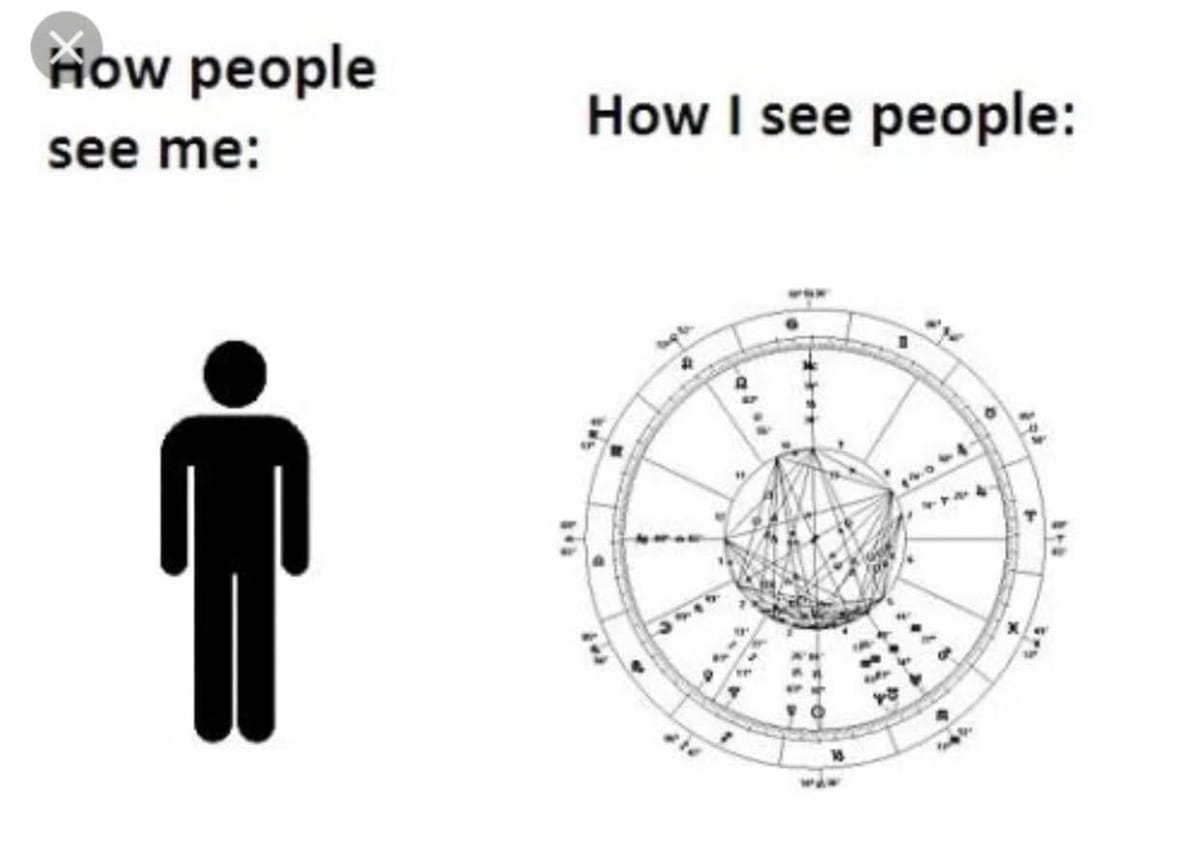
Freud, much more humble before knowledge, was kantotemist: he limited himself to making Oedipus the founding myth of a categorical imperative placed on incest, a desire and its prohibition.
It's the Parents
One possible reading of the tragedy of Oedipus: he believed as his own an enigma that belonged to an entire community (Thebes, filiation, divinity, and power), depoliticized it, and read it through the lens of his family novel. And not content with that, he decided to resolve it, degrading a laborious opportunity and obtaining little more than an obscene literalness.
When Freud uses the myth and turns it into Complex (a logical structure that combines inexorability, necessity, and contingency, articulating a non-linear temporal conception), he is operating the tragedy, allowing himself to be taken by the enigma of hysteria ("I no longer believe in my neurotic," vulgarized as "my hysterics lie to me," is less distrust than hospital suspicion) to listen in that singular drama an input of the double Victorian morality and the decline of medical scientology.
Thus, the complex is not a picaresque fable involving the kid, the mom, and the dad, nor an abstract delirium of phalluses, castration, and law. It is a way of constructing reality: a universally modern technology of the self that organizes experience while degrading power relations in familialism, sexuality into eroticism, desire into need, among others. It’s no joke; it’s about the subjective-anthropological remainder that affirms and prohibits incestuous commerce, being one of the foundations of what we call [The malaise in] culture (1929).
The Oedipal journey, akin to that of the king of Thebes or any Hero with a Thousand Faces (whether Christ or Skywalker), begins in joyful innocence, passing through doubt, fear, and disillusionment (the castration complex) to then inscribe a symbolic impasse or inscription (the burial of the complex).
The outcome: a model of premature response to castration (even though we semantically associate it with mutilation, impotence, or worse, it is the metaphor that a spicy Freud found to refer to the utmost symbolic lack of being, no more, no less) that in the less unfavorable cases (wild neuroses, people like us) will be inscribed through repression: what is morally inappropriate is repressed, but above all, what was experienced passively as excessively pleasurable, symptomatically conjugating pleasure and prohibition.

The Oedipal knowledge is as robust as it is precocious, and far from ceasing in early childhood, it tends to repeat itself when we have long stopped being children and in the presence of people who are not mom or dad, whether in a romantic, work, or political-representative relationship. Below, I will revisit the relationship between enigma, sexuality, and knowledge, but for now, we can state that:
1. how we stand in front of the enigmatic is the best clinical indicator to locate our position in Oedipus and, therefore, our relationship with reality;
2. tragedy without a hero and hero without tragedy are two crude forms of neurosis, with the cancellation of the enigma being the origin of passivity.
An Oedipus without a complex, unoperated and intentionally left in a raw state, literally literalized, aestheticized in its childishness, is the foundation of monstrosities like biodecoding (“new Germanic medicine”), family constellations, or certain uses of astrology: its suggestive and performative power is achieved by reducing the filial complex to mere familialism, being more than just a joke or meme: “it’s the parents” (or the stars or the energies) as a response to anything. That’s why returning to myths is as important as refraining from literalizing them or giving them an applicative use.
Let’s provide a definition to illustrate the above: family constellator is the person who perverts the neurotic’s family novel into a soap opera, washed but relentless in its justifying and blaming zeal. In other words, someone who suggests with due obedience an individuality as tyrannical and atomized as it is familialist and dependent. It’s like an analyst but of pre-Freudian systems, who replaces the vitality of the past with morbid “past lives.”
Every neurosis is, if not cared for, a neurosis of destiny, a self-fulfilling prophecy. The calamity present in the notion of destiny, especially its neo-behaviorist use, does not lie in the fact that something bad is going to happen, but rather that it is going to happen/is happening, but never has already happened; that is, the exclusion of the past, the omission that something bad has already occurred and will happen again if it is not remembered/processed/historized. A repetition more akin to the identical, a succession (in the legal sense) that adds causative factors, accumulating them like feedlots and generating pulsional starvation. The result: a deadly remainder of zero. Nullification, causal denial: “...after all, you lose nothing”. Ultimately, tragedy read in its literalness implies the end of history, or rather, its non-beginning. A Big Bang without subject/time.
Hence, despite the lucidity of its authors, D&G, Anti-Oedipus, whose subtitle is Capitalism and Schizophrenia, is not free from reductionist drifts, or if you prefer, from swapping psychologism for sociologism: that all the ills that afflict me are due to my parents is no less crude than asserting that all malaise originates from capitalism, even when both premises are true.
Far from concluding but attempting an approach contrary to common sense, to the cliché that uses rudimentary Oedipal elements as a catchphrase, or to the grand fictions like Woody Allen's where the Oedipal-neurotic subject is sometimes well caricatured and sometimes not so much, we leave the complexity of Oedipal technology, its clinical-daily relevance, and the biopolitical implications of listening to the encrypted enigma that emerges when we talk about “mom and dad.”
Individuality and Delirium
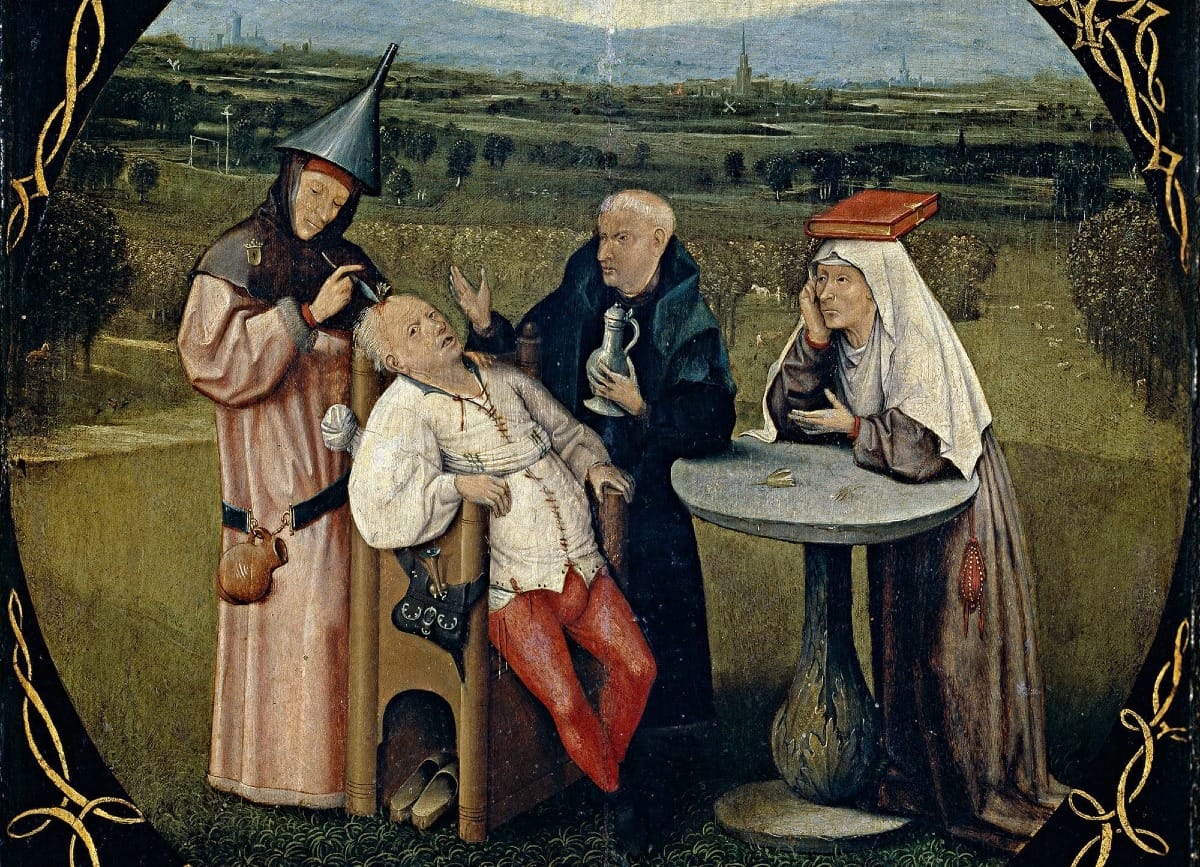
The relationship between the individual and their freedom is structured like a folie à deux. Without imaginary distance, a delirious source acquires hegemony, narcissistic rather than discursive, over another normalized delirium, producing a body-appendage, morbid yet exultant with suspicion and cruelty, evoking the sinister image of Siamese twinning; or its current correlate: the crypto-subject lumpen who monetizes their iris and acquires their brain implant, an inverted mirror of Bosch’s The Extraction of the Stone of Madness (1494!).
The obsessive wall of every neurosis makes desire pedal in the air, engrosses it, and impoverishes it in the enunciation of the “I” (“I, me, mine” would say George Harrison). From so much interest in the interior, a burial in life is consummated. In short, a desire condemned to individual misery, even when the same is covered in sumptuous excrement. If this endeavor is successful, individual freedom is guaranteed, and the crime of self-reference will be as perfect as death. A “healing” is conjured that, when realized, takes away that part of our flaw that was the only interesting thing we had.
“Knowing oneself” could be thought of as a normalized pathology, with disinterest, cynicism, or unconsciousness not being its reverse but mere reactive formations. Its genuine opposite, the subversion of that epistemic-ombilical drive, consists of an extrospection: the transmutation of the subject into some cause where knowledge is not confirmatory, vindicative, or Oedipal (all forms of Master/Slave knowledge). We appeal to the care of the self of the ancients, profaned with lucidity by Michel Foucault, who places human desire in the intimacy of the relationship with the Other, demonstrating the limitations of modern psychologistic subjectivation and its continuation, neo-individualism, which captures the singular in the illusion of individual freedom.
Singularity and Community
According to the poet Hölderlin the free use of one’s own is the most difficult. If one does not arrive too late, Freudian work can exhume the remains of the atomized body by inviting one to narrate beyond oneself, beyond the known and even the remembered. Narration, the experience of conviviality, of the embrace in strangeness: “do not know yourself, know that ancient thing in you that is born by participating in a new cause.”
All this work will culminate at the edge of the aforementioned obsessive wall, leaving a horizon clear, a methodological conclusion: that human desire is what allows us to overcome the illusion of interiority, sublimating it, as the partial drive that it is, into simple intimacy. The intimate, always improper for being plausible of sharing, a singularity necessarily common.

That which we call “meaning” must be found within a project, in a transcendence even earthly. A calm escape towards the future that puts interiority and its knowledge in its place: it will be crucial but as history, necessary in the present as reminiscence.
“I will never be polipsy”
Between human cause and effect lies a flawed gap called desire. Exploring this void without extractivist haste or canceling lethargy, and generating feelings from there—original for their anachronism—is the task of a psychoanalyst, their desire turned into profession. Neither puritanical hippie nor the aggressive passivity of the tip.
Cause/affect would be closer to psychoanalysis. A position that is anti-scientific yet never obscurantist, it warns of something central that science often overlooks: access to truth requires a profound subjective transformation; in other words, to grasp the truth, a symptomatic spirituality is necessary. To subvert the cause is to assume it after the affect.
Psychoanalysis goes beyond the psi; before being a prefix referring to the soul, it is a policing function. As the kids would say, refrain from building a case like a watchman or any of its variants: etiological cover-ups, biodescodifications without codes, fashionable past-life fantasies. Today, it is the psinfluencers who best perform this function of emotional policing.
Consume what is trafficked
The old works, but Freud is not old: he is an anachronism yet to come. It’s not about returning to Freud; the issue is that if there is a willingness to listen to what is pure failure, Freud returns. Even more: Freud returns despite himself and our opulent, immature narcissisms.
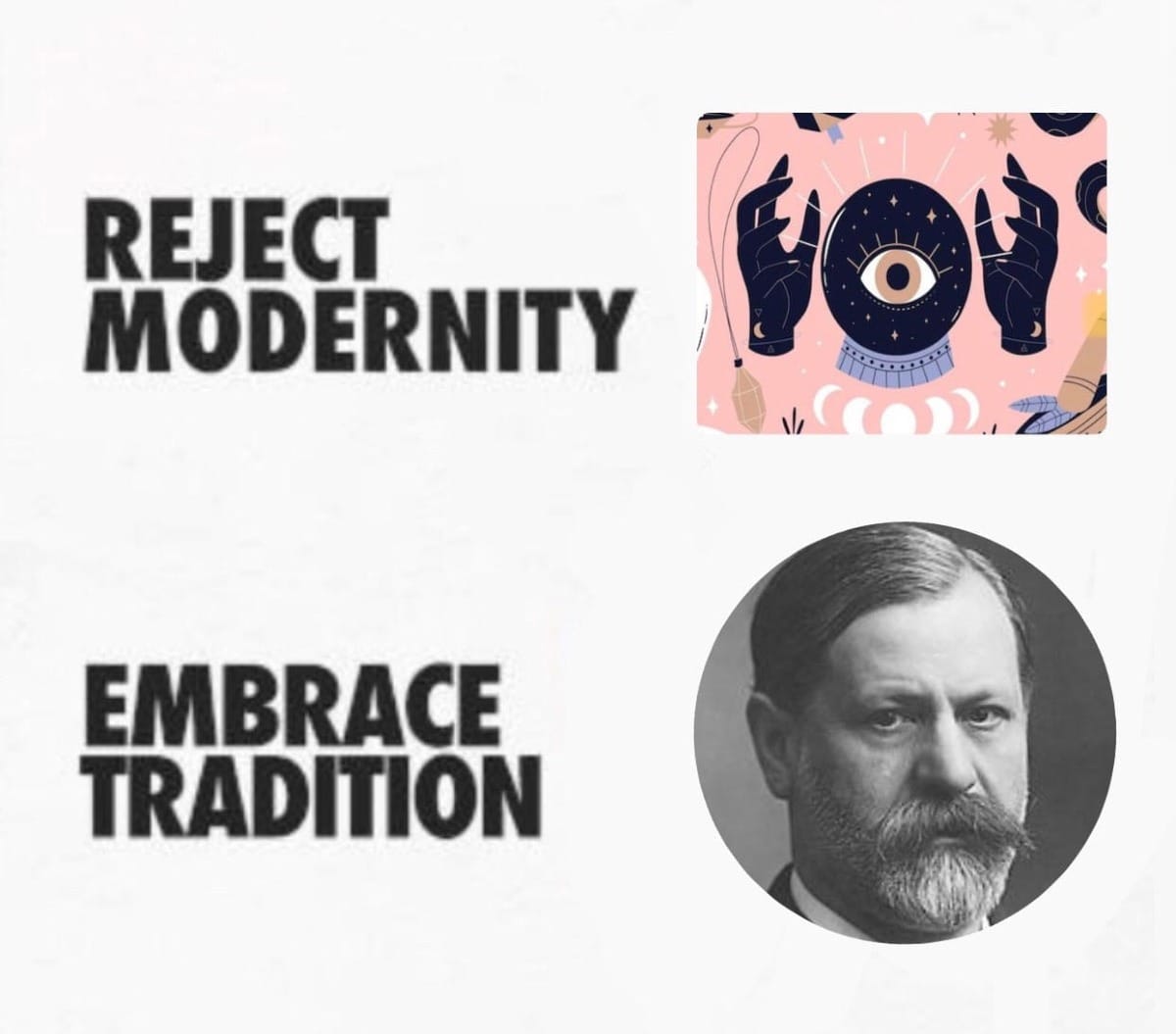
To ignite, just like to guide, does not mean to order someone to read or analyze themselves, but to persuade. It’s no coincidence that in the guidance of the cure we attempt this kind of ignition: that one’s own words produce effects, avoiding being stuck in the role of confessor, teacher, master, or guru. Otherwise, we would be like any astrologer, who is not the one predicting the future but the one futurizing the immediacy, passing off a generic recipe as a special destiny: a real estate agent of anticipated uncertainties that reduces the singular to the generic, the political to the individual, transcendence to immanence, the thing to the sign, and desire to suggestion.
Against emotional flat-earthism we battle, trafficking what we consume: the emotional power of Argentina, the pride of contradiction, mental health as a political issue before being a diagnostic compendium; or psychoanalysis as a cursed fact, with an intrusion that is often virtuous in the public space, including health institutions. The creole culture, closer to being (Kusch) than to existence, has produced super inventions to alleviate the tragic, such as tango, our sophisticated popular humor, the barbecue as a communal ritual, and even a Pope who underwent psychoanalysis.
Psychoanalysis is complex, difficult, and at the same time powerful, basically because it is labor-intensive. Although it may sometimes sound clichéd, nostalgic, or ill-intentioned, it is due to our “culture of work” that the Freudian invention has resonated so well in these lands. The (analytical) work does not dignify; it is dignity (in the flawed) that mobilizes the (psychic) work. A work that grants the right to a desire.