Psychohistory of the 21st Century: Can AI Predict Society’s Behavior?
Asimov’s psychohistory adapted to the 21st century: how the physics of complex systems and AI analyze social inequality, predict voting behavior, and even model “cybercommunism.” Exact science or ideological bias?

30 de mar. de 2026 — Emilio Méndez

In the Foundation saga, Isaac Asimov tells the story of Hari Seldon, a scientist who develops a discipline called psychohistory. This is a statistical theory that allows for the prediction of societal behavior through mathematical models. Thus, he concludes that humanity is inexorably heading towards extinction, prompting him to devise a plan to rebuild civilization on a distant planet called Foundation.
As is the case with all great works of science fiction, Foundation hides behind a plot about distant futures and interplanetary travel a discourse on the deep philosophical debates that characterized the era in which it was written, specifically the first half of the 20th century. Can human behavior be captured by physical laws, like those that describe the trajectory of a falling apple or the orbit of planets? Should social sciences, once they reach a sufficient level of maturity, succumb to mathematical language, as natural sciences did in their time? What happens to free will then? Does it mean there are imperceptible forces guiding historical events, making our ability to decide merely an illusion? Let's dive in.
Can human behavior be captured by physical laws, like those that describe the trajectory of a falling apple or the orbit of planets?
By the time Asimov was writing his novels, the foundations of the branch of physics known as statistical mechanics were already laid, and the author may have drawn inspiration from the theories of Austrian physicist Ludwig Boltzmann.
To understand the kind of postulates in statistical mechanics, let's consider a gas in a closed container. The system consists of billions of molecules that, when viewed individually, move in trajectories that are hardly distinguishable from absolute randomness. More precisely, to predict the position of a molecule in the future, one would need to know the position of every other molecule in the container colliding with each other, which is virtually impossible. However, if we view the gas as a whole, a continuous mass moving as a single body, its behavior becomes predictable: we know exactly how much it will compress under a certain pressure or how much it will expand if we increase its temperature. Boltzmann even derived formulas that allow us to know the distribution of speeds of the molecules in a system without needing to know their chemical identity, whether it’s oxygen, nitrogen, or a shoe.
So the outcome is unpredictable at the level of its fundamental constituent elements (the molecules), but at the collective level, an ordered behavior emerges.
In Asimov's novel, psychohistory operates in a similar way: while we cannot predict the individual behavior of a human, societies, viewed as macroscopic organisms made up of millions of people, like gas, could behave as a predictable system.

It wasn't until the 1980s that the development of computing allowed what had previously been science fiction to become a field of research in its own right. The physics of complex systems was born.
This branch of physics aims to extend the application of statistical mechanics tools to more general systems: from the flow of opinions within a society to the distribution of economic income, from the human brain to the collective movements of birds. Any system composed of individual components that interact can become a subject of study.
A key concept in complex systems theory is the idea of emergent behavior: the system viewed as a whole exhibits behaviors and properties that have nothing to do with the characteristics of the individual units that compose it. Just like in the example of gas molecules, the whole is not equal to the sum of its parts.
Thus, what matters is not knowing the details of the individual elements but rather understanding how they organize and interact with each other. That’s why physicists proposed the simplest possible models to detach from micro characteristics and focus solely on macro or emergent behavior. Let's look at an example.
The social atom
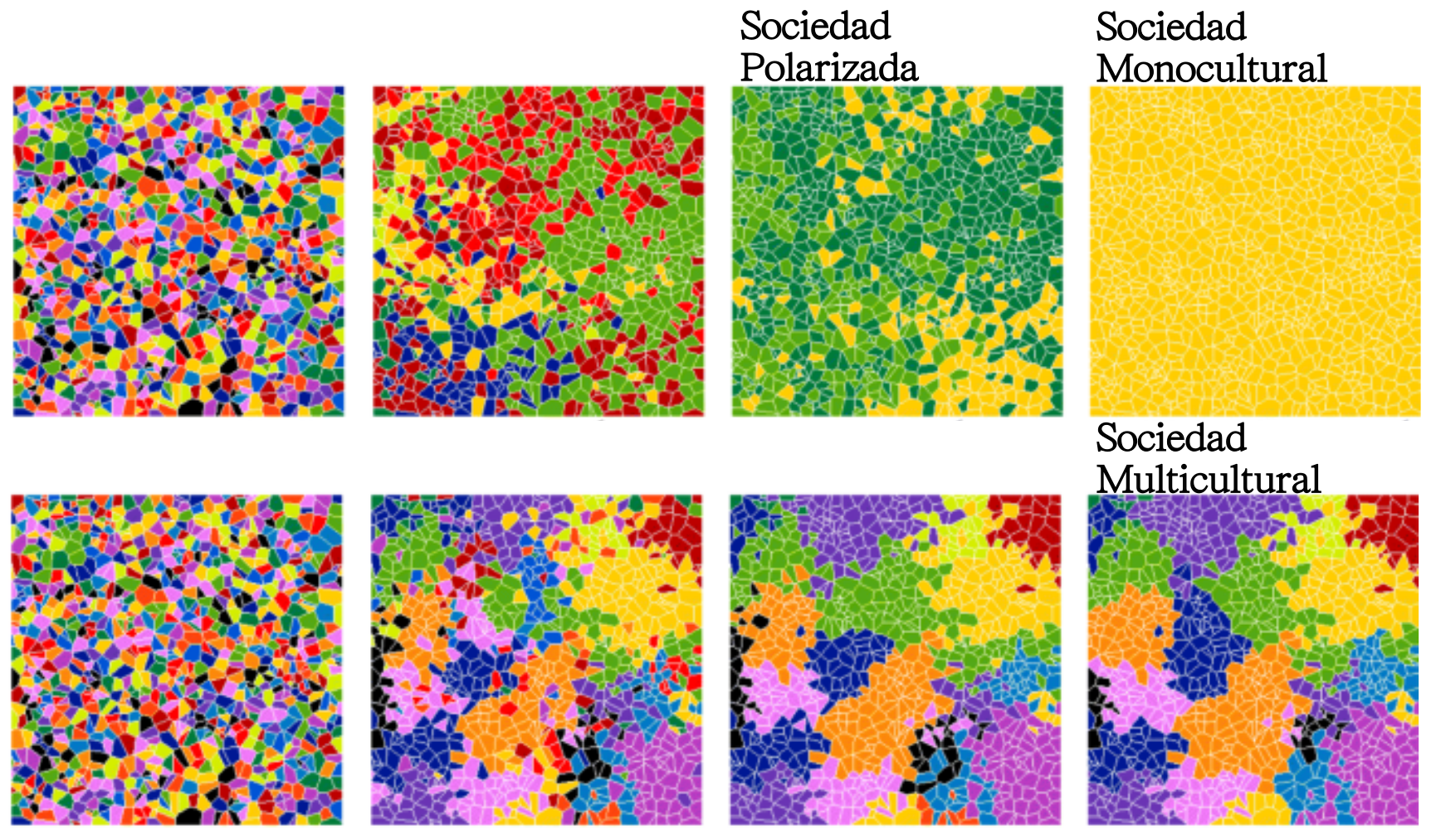
One of the first attempts to reproduce the idea of psychohistory was the so-called Axelrod model of cultural diffusion, developed in 1994. This extremely simple model represents individuals in the population as interconnected nodes in a network, each characterized by a series of cultural attributes (ideology, religion, opinions, etc.) that interact in the following way: At each step of the simulation, a node can randomly copy an attribute from a neighboring node and adopt it as its own. When the system reaches a static state, meaning no changes in the global attributes are observed over time, the simulation stops (see image).
Despite its almost offensively simple nature, this model allows for the reproduction of complex social behaviors such as the emergence of monocultural, multicultural, or polarized trends, depending on the conditions under which the simulation is conducted.
To what extent is what we think a product of rational analysis of reality and not merely the result of a mimetic process with those around us?
If a model where an individual's opinion or culture is based exclusively on random exchanges with their neighbors exhibits such complex emergent properties, an uncomfortable question arises: To what extent is what we think a product of rational analysis of reality and not merely the result of a mimetic process with those around us?
After all, it’s not very different from what political scientist Jaime Durán Barba suggests when he says that politics is no longer about convincing with arguments, but about connecting through emotion, segmentation, and Big Data.
Over the years, various research groups have added new ingredients to Axelrod's model, including the influence of the media and social networks, and today this type of analysis is standard within the field. For further exploration, this and other results from the so-called socio-physics can be found in Mark Buchanan's book "The Social Atom."
Scientism vs. anti-scientists, the war continues
On a philosophical level, there’s a lingering question behind the propositions of complex systems physics: Can social sciences be studied with the same mathematical formalism as physics?
The question is not new and takes us back to the debate between positivists and antipositivists that dominated much of the 20th century. In a hyper-simplified way, it could be summarized like this: on one side, the philosopher Auguste Comte was the first to propose that societies do not fundamentally differ from physical systems and therefore their study should be approached with mathematical language.
Less fundamentalist but in the same vein, the Argentine Mario Bunge advocated for the scientific method as an ideology, a way to overcome the factional debate dominated by particular interests. In fact, Bunge is now mentioned as an influence by several members of the socio-physics community.
This radical positivism was eventually refuted by, among others, the physicist Thomas Kuhn, who coined the concept of paradigm. According to him, empirical knowledge is always tinted by the ideological-historical-cultural matrix of the observer, and therefore one cannot aspire to access a universal law that describes the behavior of societies.
A deeper analysis of this dichotomy can be found in the book "Complex Systems" by Rolando García, an Argentine scientist recognized for his contributions to the theory of complex systems and meteorology, as well as for having played a notable role in the "Night of the Pencils."
Despite everything, the debate remains alive, and it’s enough to turn on the television to witness heated discussions about whether economics is an exact or social science. Watching the figures defending each position, one wonders Is mathematics right-wing?
Perhaps, even if just as a mere exercise, it might be interesting not to take sides in this debate solely guided by the fact that, in practice, the voices advocating for mathematical thinking predominantly come from the right side of the ideological spectrum, often as a justification for austerity policies, while on the other side, the coldness of Excel spreadsheets is criticized and the importance of ensuring that numbers align with people is emphasized. Again, we must ask ourselves whether we are forming our opinion through rational analysis or ideological affinity.
Econophysics: The Less Considered Left
A clear example of how mathematical thinking can also be leftist is found in Karl Marx himself. Marx's philosophy, termed "scientific socialism," contains several elements that could fall under the umbrella of scientism, in addition to its name. For example, the idea that societies follow an evolutionary path leading them to transition from feudalism to capitalism, and then to socialism, is inherently systemic, as it does not rely on the ideology or will of individuals but on emergent properties that occur over macro time scales, similar to the conception of complex systems physics. Although the mathematization of economics was not yet developed in the 19th century, Marx dedicated several years of his life to studying algebra and numerical calculus, and in his work "Capital," he supports some of his postulates with mathematical formulas. A series of Marx's mathematical manuscripts were even published posthumously.
All of this may help us understand why physicists working in the field of so-called econophysics, a sister discipline of socio-physics, far from the funding spheres of capital that encompass most economics research centers, have somehow continued the mathematical study of the phenomenon of inequality.
Just like in Axelrod's model, where each individual is represented by a node with cultural attributes, econophysics simulates each economic entity as an agent interacting with others through the exchange of money.
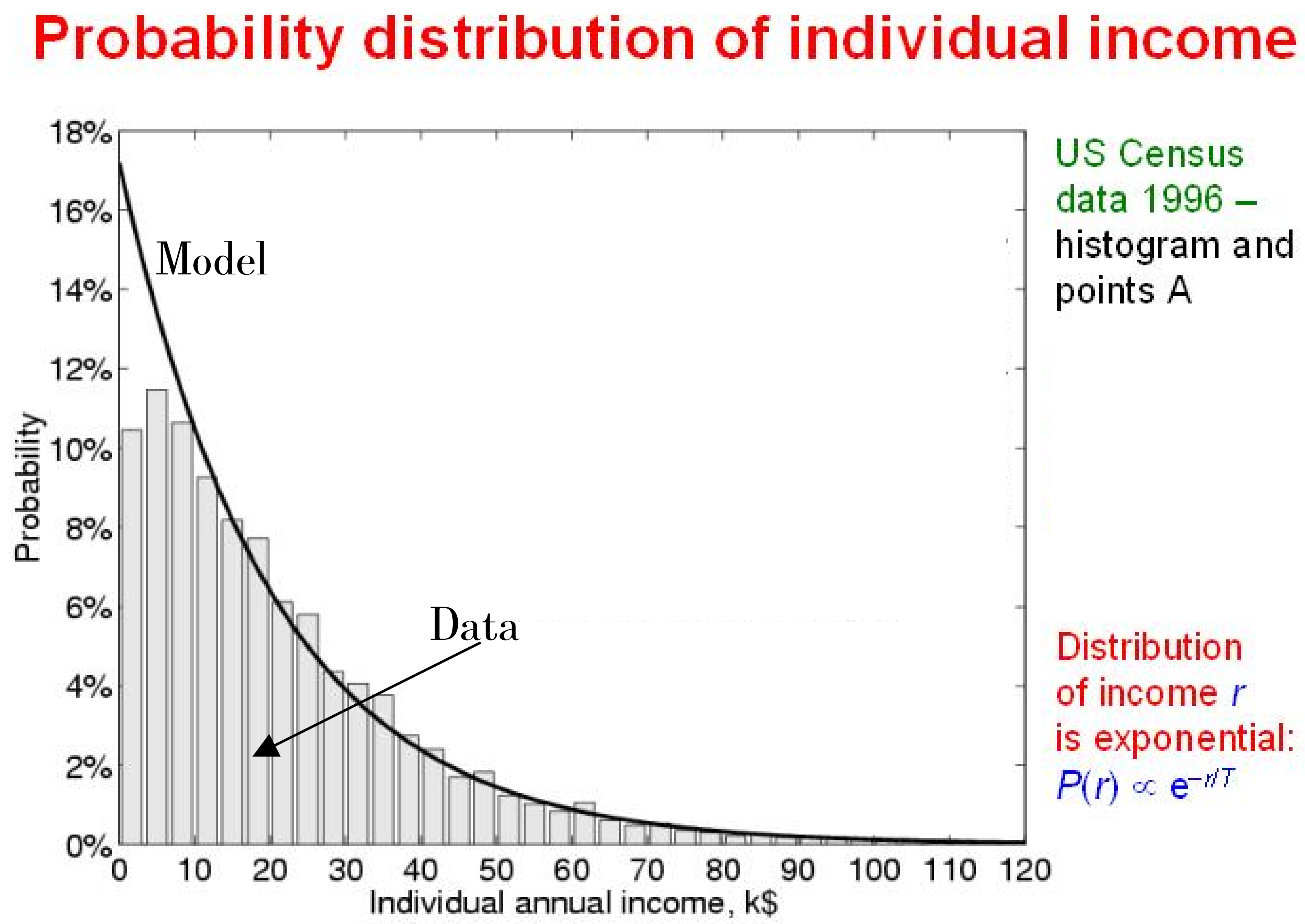
Based on this idea, Victor Yakovenko, one of the leading thinkers in econophysics, dedicated himself to studying income distribution using the same statistical tools with which Boltzmann deduced the energy distribution in the molecules forming a gas. The coincidences were surprising: Yakovenko's results align very well with the income distribution of families in the United States, for 97% of the population (see image).
Correlation does not imply causation. For example, the fact that the prison population mainly comes from lower-income sectors does not mean that being poor increases the predisposition to crime. This is a common mistake that algorithms often reproduce.
At first glance, this could be seen as a naturalistic justification for inequality. While this is true, there is a second part of Yakovenko's analysis that reaches the opposite conclusion: the missing 3%, which does not fit the statistical model, represents the highest income segment of the population. This means that the theory fails to reproduce the distribution of very high-income agents. At this point, Yakovenko proposes dividing society into two classes: the class that depends on their labor for income, which represents 97% in the database used, and a 3% whose income is high enough to multiply without the need to produce, which follows a much more unequal distribution. In conclusion, the data indicates that income distribution is much more unequal than the model suggests because a small portion of the population reproduces their capital in a multiplicative manner. Not even Bernie Sanders could have expressed it better.
Cybercommunism
When interpreting the results presented, an important clarification must be made: both Axelrod's model and Yakovenko's study do not intend to establish predictive tools. Rather, the logic behind these experiments is to show how, based on very simple models, emergent properties similar to those observed in real systems can be obtained. This is a typical mechanism of physical thinking: simplifying the model to understand the core of the phenomenon being studied. In other words: if the phenomenon can be reproduced with a simple model, then the emergent behavior does not depend on the complex details of the real system. It is far from resembling psychohistory.
However, all these developments occurred prior to the revolution of AI and the so-called 'Machine Learning.' Could these technologies make the leap and predict the future behavior of entire societies?
The first thing we must clarify in this regard is that behind these glamorous names lies nothing more than statistics, and the main novelty compared to past approaches lies in the ability to work with gigantic databases, whether of social, cultural, economic, or linguistic phenomena. This allows algorithms to identify patterns that would not be visible at first glance.
While these techniques share with socio-physics the idea of mathematizing social relationships, in some way their modus operandi is, while complementary, opposite: while socio-physics attempts to start from simple models to understand the fundamental mechanisms of the emergent phenomenon, computational algorithms will extract details that are imperceptible at first glance scattered across enormous databases to detect correlations. For example, a LLM will select each word it writes based on the frequency with which each word was used in the past following the sequence of previous words. So if one writes "Alice in the land of...", the next word will be "Wonders," because in the training database that combination is the most frequent.
 Mariano Vilar
That said, in recent times we've seen astonishing applications of AI and machine learning algorithms, both in the realm of solving complex problems (disease detection, genomics, automation) and in their ability to mimic human language and reasoning.
The hidden trap under the rug is that correlation does not imply causation. For instance, the fact that the prison population largely comes from lower-income sectors does not mean that being poor increases the likelihood of criminal behavior. This is a common mistake that algorithms often reproduce.
On the other hand, AI algorithms are very good at "interpolating," meaning they generate outputs (texts, images) similar to the data they were trained on, but they are very poor at "extrapolating," or generating new content that differs from everything that came before. This seriously limits their predictive capabilities.
In addition to this, despite all the achievements, technology still cannot solve the problems of poverty and inequality. After all, the algorithm will be useful for the task it was created for, and behind most of these initiatives are large companies whose interests are limited to economic profit. It's hard to believe that an AI burdened with that original sin will be able to resolve social dilemmas if it doesn't represent an economic benefit for the company.
So, it begs the question: besides taking a defensive stance regarding these technologies, highlighting the dangers they pose to our cognitive sovereignty, could we consider whether another kind of AI is possible? Can we envision an AI for social justice?

We don't have to look far to find examples of algorithms designed for economic planning. Long before AI, during the government of Salvador Allende in Chile, the Cybersyn project was developed, a sophisticated network of teletype machines that aimed to communicate, in real-time, factories across the country with a single computing center in Santiago. There, the government processed and analyzed information about value chains and made decisions using statistical criteria.
While the results of this project seemed promising, the truth is that the coup interrupted it, and we don't know how it might have turned out if implemented in the long term.
Are we willing to give up democracy if an algorithm proves to be a more efficient system of government for organizing the economy, even in terms of social justice?
Building on this legacy, and considering current technological advancements, some thinkers like Paul Cockshott, a declared bungist, have begun to think about applying computing to the organization of an egalitarian society, which they call Cybercommunism. The basic idea is that if machines were programmed for the right purpose, that is, not to maximize profits but to maximize the well-being of the people, the Marxist dream of a planned economy would become possible. Pure and simple Technocracy.
This idea also emerges interestingly in the book "The Walmart Republic" by Leigh Phillips and Michal Rozworski. According to the authors, if AI has proven incredibly efficient at organizing gigantic human structures like the megacorporations of Walmart or Amazon, nothing would prevent extending this to the management of entire societies.

This proposal raises a new dilemma: are we willing to give up democracy if an algorithm proves to be a more efficient system of government for organizing the economy, even in terms of social justice? How would that efficiency be measured, considering there will always be conflicting interests? In any case, someone would need to program that machine and ensure it operates transparently, which brings us back to the issue of who owns the AI. If we believe that where there is a need, a right is born, shouldn't we promote the development of autonomous AI to guarantee sovereignty? Is it time to think about Cyber-Peronism?
All these questions make it clear that the discussion about the mathematization of society is no longer abstract and has concrete political and social consequences. While we are far from realizing psychohistory, Asimov's concept has long ceased to belong exclusively to the realm of science fiction and poses significant challenges for the times ahead.