

Quantum Teleportation: Is It Possible?
Quantum teleportation: is it possible or is it just smoke and mirrors? A review of the main theories (the EPR paradox, the “love equation”) and experimental advances in the Quantum Internet.

18 de feb. de 2026 — Emilio Méndez
Have you ever dreamed of leaving work and instead of taking a subway, three buses, and a train, stepping into a little device, pressing a button, and magically materializing in your dining room?
If the answer is no, it’s probably because you’re already working from home. If, on the other hand, you’re willing to sell a kidney to make that dream come true, I invite you to dive into the world of quantum teleportation to find out if this is possible or just a bunch of hot air.
Before we tackle teleportation, let’s start by reviewing a concept explained in the article on quantum computing: the Q-bit. We can think of a Q-bit as a non-binary bit: it can be in state 0 and 1 simultaneously. However, the Q-bit is shy and hasn’t come out of the closet yet, so if you go and ask it (measure) its state, you’ll get either 0 or 1, one or the other, much like what happens with the famous Schrödinger's cat.
Now let’s suppose we have two Q-bits, and we create them in such a way that they are in a superposition of states 00 and 11. This means that if we observe the system now, we have a 50% chance of measuring 00, a 50% chance of measuring 11, and a 0% chance of measuring 10 or 01, which would be the other two possible states.
The interesting part is that measuring the state of one of the two Q-bits is enough to know the result of the other. If I observe one Q-bit and get 0, then the other will also be 0; if I get 1, then the other will also be 1.
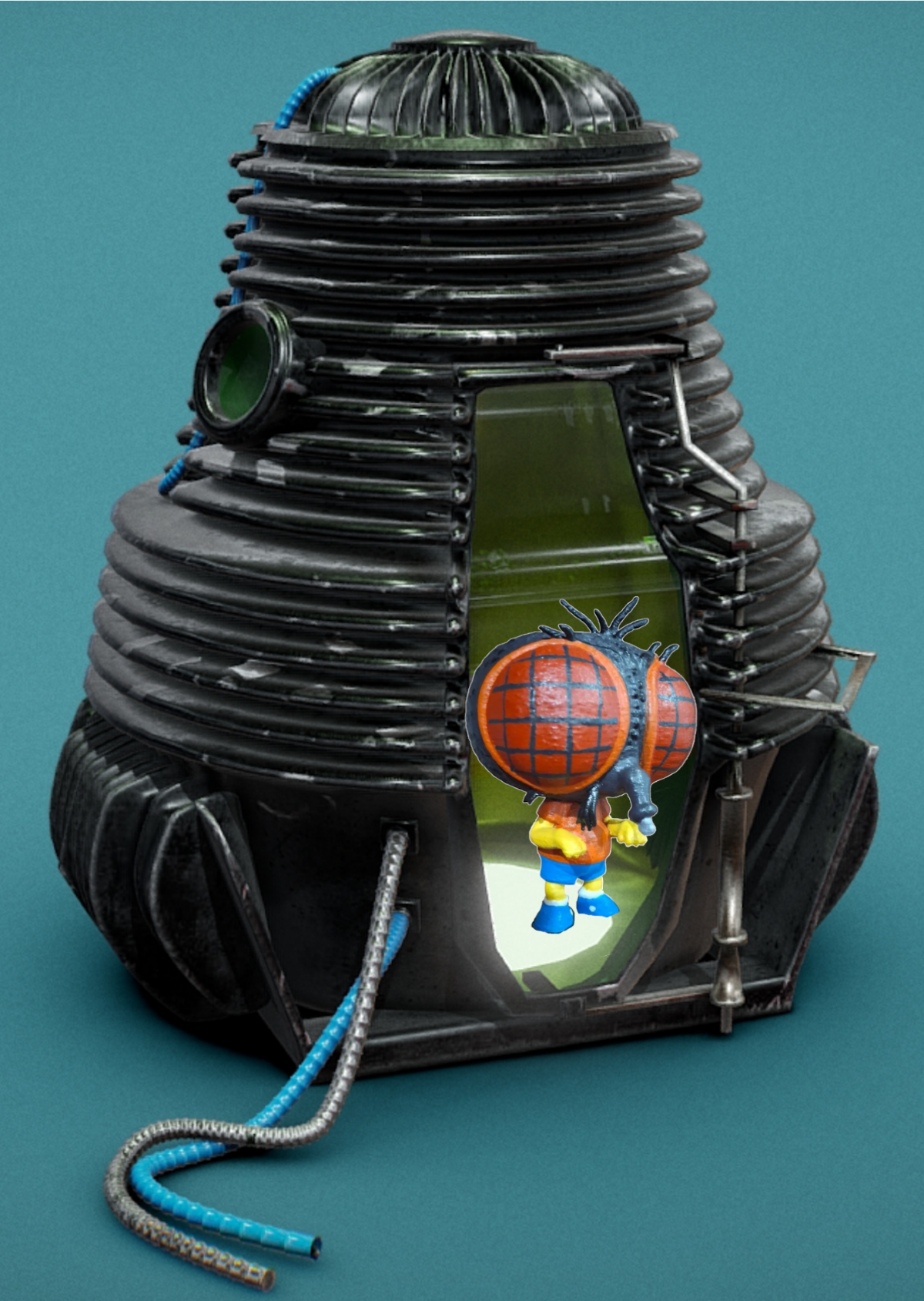
This type of system is known as an EPR pair, and it sparked a lot of controversy. The drama reached its peak when Einstein threw shade at quantum theory with his famous quote, "God does not play dice," later rephrased by Indio Solari in the song Motor Psico. Let’s see what the issue is.
The Spooky Paradox
At that point (we’re talking about the mid-thirties), Einstein and his crew were convinced of one thing: nothing can travel faster than light. It turns out that the EPR pair experiment contradicts this postulate: If we separate the two Q-bits that form the pair by light-years, and then observe one of them, the value of the other will be automatically determined. This means that this information "traveled" light-years instantaneously, violating the limit imposed by the speed of light, which Einstein called spooky action.
This apparent contradiction was called the EPR paradox, named after Einstein, Podolsky, and Rosen, who published a paper attacking quantum theory. They argued that the decision of whether the system is in state 00 or 11 must be defined before they are separated, only we cannot access that information directly.
How is this story resolved? Years after the paradox was posed, a series of experiments unanimously determined that the big winner of the dispute is… -drumroll- quantum theory. The scientists who designed these experiments were awarded the Nobel Prize in Physics in 2022, but Einstein, Podolsky, and Rosen were no longer around to know the truth.
The paradox is resolved like this: while it is true that there is an effect that travels instantaneously from one Q-bit to the other, that is, faster than light, an observer next to the second Q-bit will not perceive any change when the first Q-bit is discovered, and unless someone sends them the result (which can be communicated at most at the speed of light), the value of their Q-bit remains an unknown. So the principle that nothing can travel faster than light should be replaced with no information travels faster than light.
A Love Story
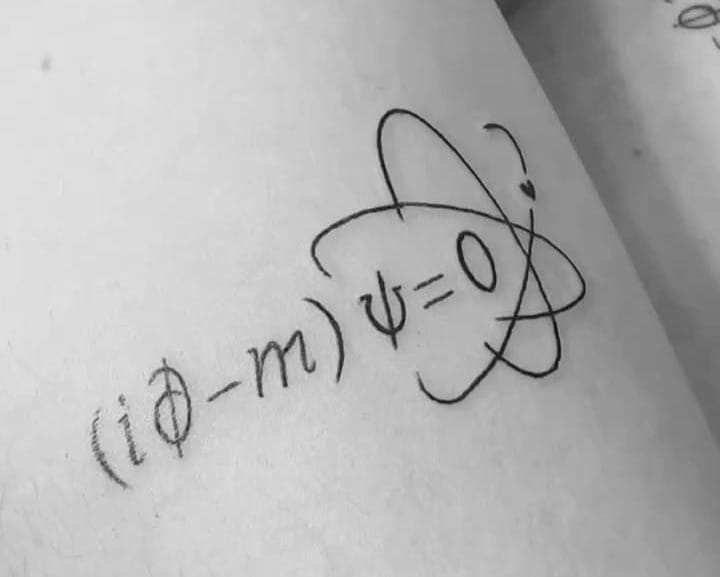
As the phenomenon of EPR pairs became popular, it didn’t take long for a romantic to associate the fact that particles can "feel" each other even when they are far apart with a loving bond. That’s why Dirac’s equation (which describes the formation process of a type of EPR pair) was dubbed the love equation. In fact, there are several photos circulating online of people (yes, extremely nerdy) with the equation tattooed on them.
Quantum Teleportation
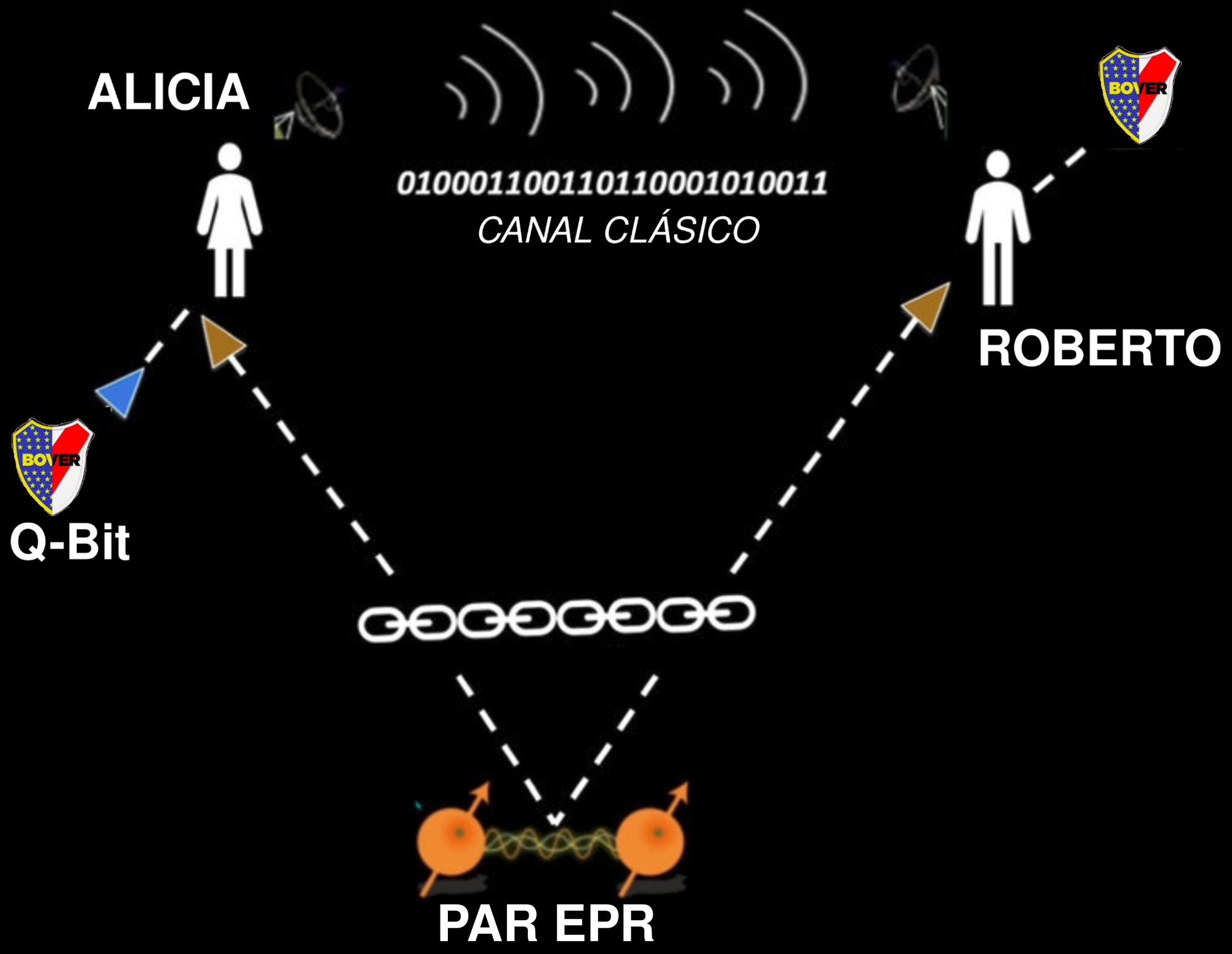
Now let’s explain how an EPR pair can be used to achieve quantum teleportation. For this, we’ll enlist the help of our friends Alicia and Roberto. Applause in the room.
Let’s suppose Alicia wants to teleport a Q-bit to Roberto, with the result of the Boca match.
-First, an EPR pair is generated, meaning two Q-bits (let’s call them particles) entangled in state 00 + 11. Alicia will keep one of the particles and Roberto will keep the other. Now they can separate to an arbitrarily far distance. Let’s say they move to different planets because the real estate crisis makes it impossible to afford rent on Earth.
-Then Alicia will interact her EPR pair particle with the Q-bit that indicates whether Boca won, in such a way as to generate an entanglement between the two. Since Roberto’s EPR particle is intrinsically linked to Alicia’s, it will also feel the effect of the interaction with the Q-bit, even though he cannot detect it.
-Next, Alicia will perform a measurement operation on her EPR particle and her Q-bit simultaneously; by doing this, the Q-bit collapses to a random state and thus Alicia loses the information stored in it.
-Finally, for Roberto to uniquely reconstruct the Q-bit in his EPR particle, he needs to know the result of Alicia’s measurement, so she must send him the data through a classical communication channel, for example, the internet.
At the end of the experiment, Roberto will perform an operation on the Q-bit based on the result he received, thus reconstructing a Q-bit identical to the original, while Alicia will be left with a system that has lost all information about it. Teleportation completed. To transport a larger number of Q-bits, it's enough to generate more EPR pairs in the first step and repeat the process several times.
Some observations:
-As we can see, the Q-bit did not physically move from Alicia's location to Roberto's, but that wasn't necessary: generating an identical system at Roberto's location is enough to consider that teleportation occurred.
-While Roberto's particle is modified "instantaneously" when Alicia makes the measurement, he needs to know the result in order to reconstruct the Q-bit. This information (a bit, 0 or 1) is transported classically, so it cannot travel faster than light. Thus, the principle that no information can travel faster than light holds true.
One might then ask: what was the point of all this if I still had to send a bit classically? The thing is, a system of Q-bits contains much more information than its bit counterpart, so the single bit that travels classically represents a minimal amount of information compared to what was transferred.
-Alicia loses all trace of the Q-bit when she makes the measurement, which also fulfills the no-cloning theorem, which simply states that quantum physics prohibits copy-pasting. Sorry: the lazy quantum corner is not going to exist.
The path to Quantum Internet
Just tell me already if I’ll be able to teleport home after work!
The short answer is no. Or at least, we’re a long way from that. However, there are several technological developments based on quantum teleportation that could have a significant impact in the coming years.
One key aspect we didn’t mention in the previous section is that quantum teleportation is completely invulnerable to eavesdroppers. Even if someone intercepts Alicia's communication containing the measurement result, this information is not enough to reconstruct the Q-bit. That’s why quantum communication could be the basis for a new type of cryptography that is much more secure than the current one, which is threatened by the development of quantum computing.
It is this concrete technological application that drives million-dollar investments and the efforts of large research groups to improve the teleportation technique.
Before listing some of the latest advancements, it’s worth mentioning what these blessed Q-bits are made of. The answer is that there are several systems that can be used as Q-bits, and one will be chosen over another depending on the application for which they are used. In the case of quantum computers, Q-bits are typically made of a type of superconductor called Josephson junctions. In contrast, for quantum teleportation, Q-bits that can travel as fast as possible are needed, so the most suitable option is simply: light. Yes, light can store quantum information. How? Through polarization, which is the direction in which the electromagnetic field that forms a photon (the particle responsible for transmitting light) oscillates. Thus, this bit represents a 0 or a 1 depending on whether the photon’s polarization is vertical or horizontal.
Now that we know what it’s about, let’s review some milestones:
In 2004, Austrian scientists achieved teleportation across the Danube River.
Also in 2004, a group from the same country teleported the state of a Calcium atom. This means that teleportation is not limited to photons.
In 2022, a Chinese group successfully teleported photons over a distance of 1200 km via satellite.
In 2024, a group of scientists from Northwestern University managed to teleport photons through a fiber optic cable.
In 2025, China set the record for the longest distance of a quantum communication: 12,900 km between Jinan (China) and Stellenbosch University in South Africa.
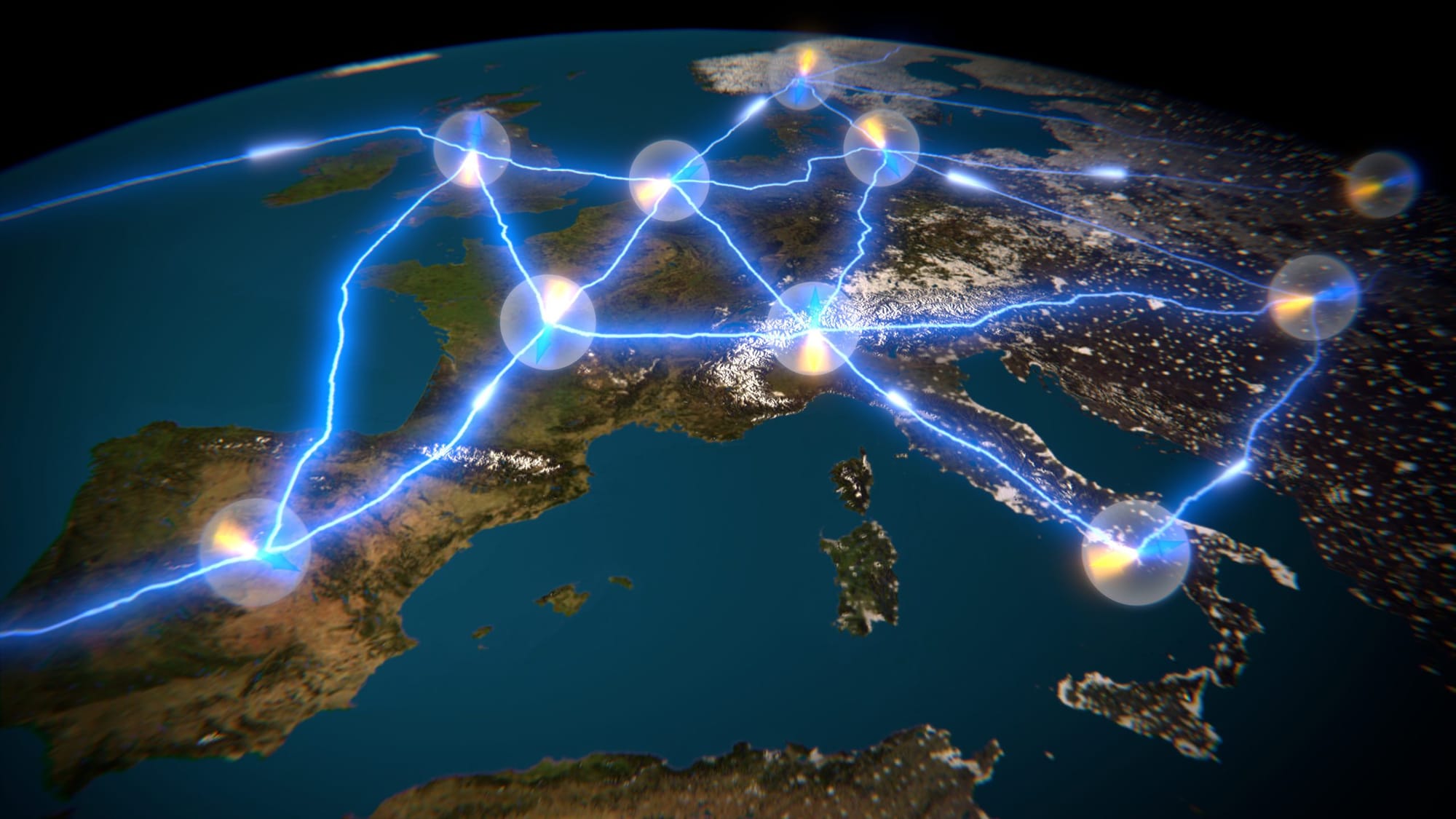
These recent developments pave the way for the creation of a Quantum Internet, which is nothing less than a network of computers that transfer information through quantum channels. Again, this would represent a significant leap in cybersecurity for users accessing this network. In this regard, there are several initiatives: in addition to China's efforts to lead in this field, the European Quantum Internet Alliance and the National Quantum Initiative in the United States stand out, both aimed at securing national computer systems against potential cyberattacks. There are even people already thinking about Quantum Blockchain to safeguard crypto systems from potential attacks by quantum computers. All this poses a risk for developing countries, which may become vulnerable if they fall behind in implementing these technologies. It then becomes crucial to refinance development projects like those promoted by Juan Pablo Paz, a pioneer of quantum computing in Argentina, during his time at the Ministry of Science and Technology, which are currently stalled.
As you may have noticed if you’ve made it this far, it’s clear that quantum teleportation is much less spectacular than you imagined. There’s no Dr. Spock traveling through the stars, nor will you be able to send your dog via email, but there are concrete applications that will gradually become more present in our daily lives, and getting an idea of how these new technologies work is still fascinating. As with everything, sometimes scientists have to resort to a bit of marketing jargon to attract new audiences to the mysterious world of physics. Personally, I think that compared to the self-help gurus promoting outlandish therapies based on "quantum physics," the sin is forgivable.
This article is free because we think it matters. But it's not free to make. 421 survives because a group of people choose to support it. If what you read is useful, join them.