The Terror of Raising Rabbits
7 de mar. de 2026 — Maia Debowicz
When a romantic relationship ends after several years, one party often claims, "It was a failure." As if the fact that something comes to an end means it wasn't worth it. Love reduced to the tyranny of time. Ever since I adopted my first rabbit, Duchamp, the first question people ask me is: How many years do they live?
People see a rabbit and think of death. At first, I would explain, informing them that with good care, they can live up to twelve years, with some cases reaching fifteen. That question gets asked so often, it's so unoriginal, that the sound of the phrase anesthetizes me. I respond, "No one knows when they will die." The lack of precision creates discomfort in others, dissatisfaction.
People see a rabbit and think of death. And when they think of death, they glimpse their own. That scares them. It makes them feel small, fragile.
I could choose not to live with rabbits and the pain that comes with it, but I choose to do so. Every relationship carries a certainty of pain. The risk of seeing the other suffer, the danger of accidentally causing harm, the possibility of being harmed.
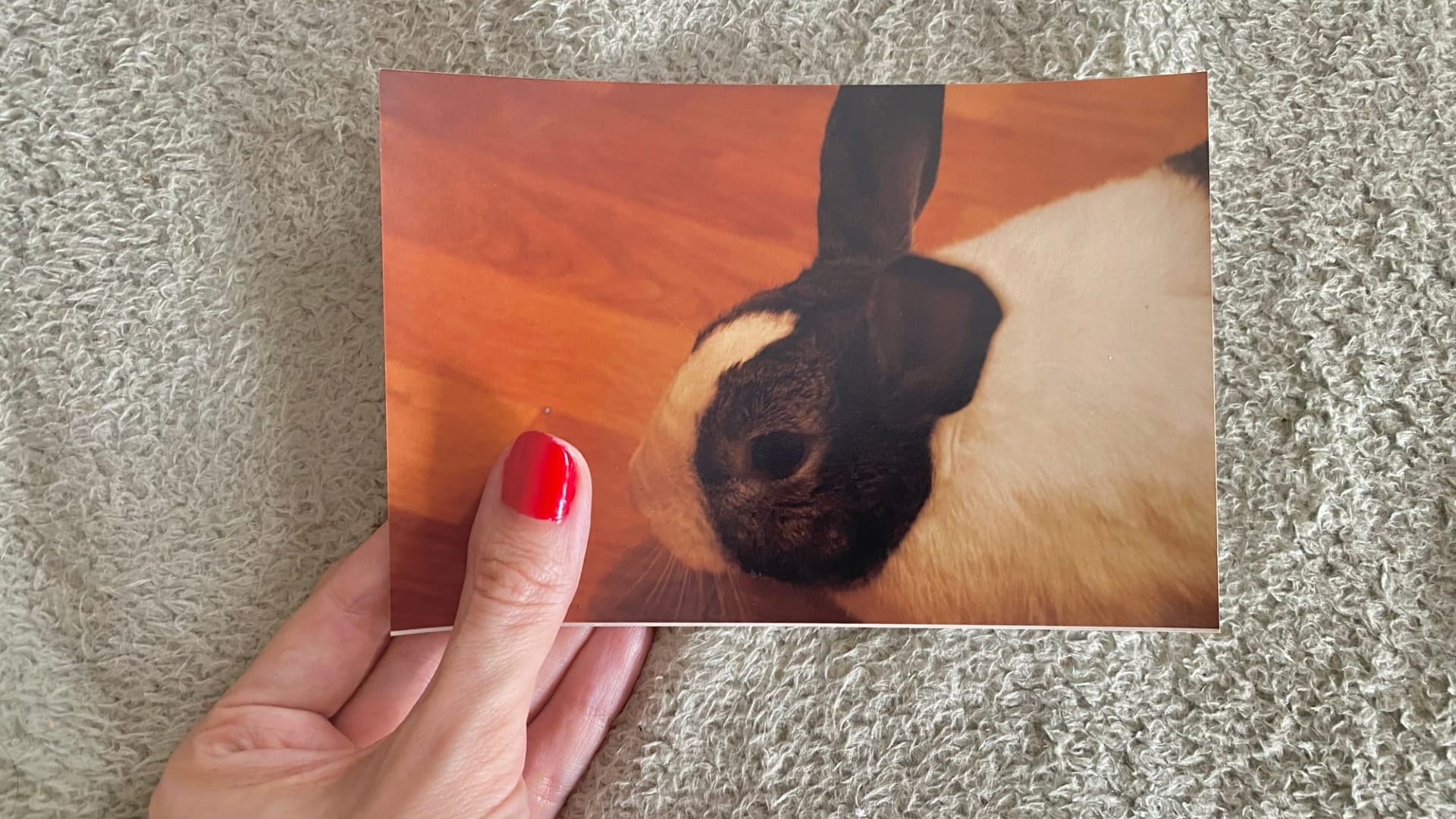
Duchamp's fur was dark gray and white. He would accompany me to the door every time I left the house, and when I returned, he would be waiting for me, sitting like a dog. I keep a photo of him in the top drawer of my nightstand. Since 2016, I've lived with eleven rabbits. It wasn't planned; it just happened. An accident. Some accidents can be beautiful, brief miracles. At that time, I had a rabbit named Warhol, a Giant of Spain with caramel-colored fur. There are over forty-five breeds of rabbits. Warhol took pride in belonging to the second largest breed, after the Flemish Giants. He was supposed to be a dwarf, but he grew and grew, turning into a huge, furry ball with endless long ears. Warhol had many personalities, just like any person. By the end of one summer, he lost his enthusiasm; nothing could cheer him up. I could smell death. Death has a sour scent that seeps into the walls of the house. I searched for strategies to prolong his life, to prevent him from leaving me. I adopted a Polish doe, white with blue eyes. She-Ra. The vet assured me that Warhol wouldn't be able to impregnate her because he was older. But it happened. An accident. Some accidents can be beautiful, brief miracles. In April 2016, five rabbits were born in the kitchen of a small apartment, just like the life of five rabbits. White, each one identical to the other. Three survived; the other two passed away in less than a month. To this day, those three rabbits live with me: Godzilla, Mothra, and Rodan. Three kaijus, Japanese monsters. In April, they will turn ten years old.
People see a rabbit and think of death. I look at a rabbit and think of life.
When the two rabbits from the first litter died, She-Ra was already pregnant again. Weeks later, six rabbits were born. I contemplated the inevitability of death from the moment the kits emerged hairless from their mother's body. The vet assured us they wouldn't survive; they were premature, a mix of two very different breeds. None of them died.
Over the years, some rabbits from that second litter have passed away. Each ending left me with something. Death carries sadness, but it isn't always heartbreaking. Sometimes, it's a touching scene. A gesture of gratitude. A sweet farewell. A natural step. When an animal dies, the bond doesn't end. They linger like ghosts, spirits that aren't scary. They just exist, roaming their favorite spots.
I have the romance between Warhol and She-Ra tattooed on my right arm. I look at it often because I miss seeing them together, and I also look at it to remind myself that the impossible is relative.
Accidents no longer happen at home. If one rabbit fades away, we give refuge to another; I try to maintain the same number. Eleven. Caring for an animal consumes part of our lives, as it should. These aren't symmetrical relationships, as they can be with some people. One party loves differently than the other.
Everyone has a heartbreaking story about a rabbit, a childhood tale that haunts them like a trauma. People seek me out to vent, to unload their horror stories. I do an exercise to toughen up; I clench my fists, bite my lips, hold on, and try to distance myself from the pain of others. There's a common misconception about rabbits: that they are the perfect pets for children. A child doesn’t know how to care for a rabbit, because generally, adults don’t know how to do it either.
So, fragility takes on a double layer: it’s fragile to need care, but it’s also fragile to not know how to provide it.
Five basic things about rabbits:
1-They can't live on a diet of carrots like cartoons showed us.
2-They can't live locked in a cage.
3-They can't have cables within reach.
4-They can't be exposed to strong winds near their ears.
5-They can't be bathed; they clean themselves autonomously.
Rabbits carry terror on their backs. I understand them; I sense the language they speak. They make imperceptible sounds, but I hear them. When they sleep, they dream and twitch their noses, flick their ears, shake a hind leg. One must endure the mystery, access them within the limits they impose. At night, rabbits are very active; they run, jump, and traffic secrets. Some early mornings, I sleep fitfully, waking up to spy on them; I don’t intervene, respecting the intimacy of a species to which I don’t belong.
Some rabbits are hyperactive like ferrets, while others sleep a lot. Little panda bears. Some are open to domestication, while others lean towards rebellion. No animal should have to adapt to our expectations or lack of love.
Gabo Ferro sings, "What terrifies you defines you better." People are afraid of rabbits because what scares them is loneliness. Being abandoned. Short-lived animals expose us to grief, a constant training. Love exposes us to loss; it's the price we pay for wanting and being wanted.
There's another question I always get asked: Why do you like rabbits? I never had an answer.
Two years ago, I ran into my kindergarten teacher, Gabriela, in the same place. The last time I saw her, I was 95 centimeters tall. Now we were talking at the same height; we are both adults. I told her about my rabbits. Before she said goodbye with a kiss on the cheek, she gifted me the answer to that mystery. "I remember how you were always at Luján's house; that girl had a rabbit." There are fragments of my childhood that faded from focus, but when Gabriela mentioned that scene, a part of my memory became clear. I remembered that rabbit, how I would stroke its back, wanting to have one, two, three. My mom never let me. Eleven. We grow up to do everything our parents forbade us.
I don't want a life without rabbits.