Red, the First Color: An Analysis of King Charles III's Portrait

24 de ene. de 2025 — Agustina Sojit
The blood of all men of all nations being red
the Communist International named red its banner color
Pope Innocent IV gave cardinals their first red hats
saying a cardinal's blood belonged to the holy mother church.
The bloodcolor red is a symbol.
Carl Sandburg - The People, Yes
1
The first time you picked a scab and immediately licked the wound, you learned there is something salty in the way we taste. Watching that small amount of blood well up is a tiny pleasure, like the glass of soda that comes with coffee. It is a light, watery red; not the dark, thick blood or the clotted kind that, if you are a woman and/or menstruate, you will grow accustomed to seeing. Menstruation, incidentally, is a cultural preparation against the tragic hemorrhage that leaves you paralyzed if you have never encountered it.
The bright red that appears when you pull off a scab is striking because of its contrast with the skin. And I am obsessed with placing a tiny piece of toilet paper on it and watching it absorb all the red until it is soaked through and turns brown from contact with oxygen. An exquisite, homemade alchemy, but no less magical for it.
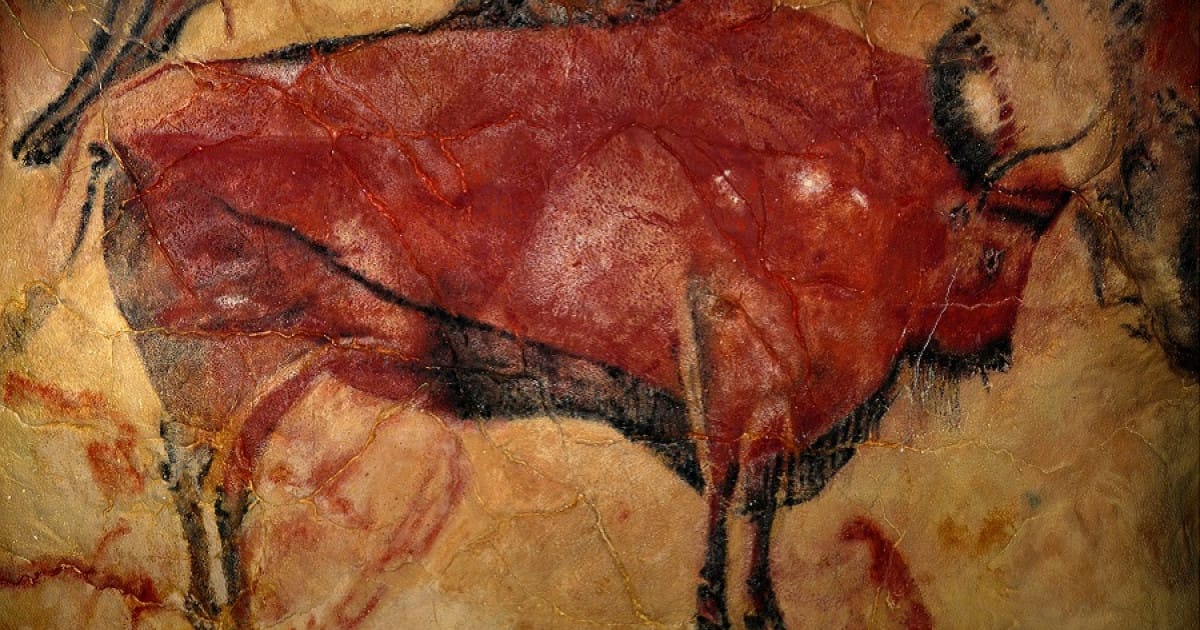
Blood is perhaps the first red in our lives and is -- almost certainly -- the first color in the life of art (pictorial and cave). The earliest paintings of homo sapiens, 75,000 years ago, are in that tone. For centuries, quality red pigments were scarce and served as stores of value, barter currency, and objects of trafficking and theft. Ochre, carmine, or cinnabar were obtained from insects or minerals such as mercury sulfide, of a beautiful and deadly chromatic intensity. A panorama that changed with the discovery of the color purple, which was derived from mollusks and yielded tonalities ranging from red to violet.
2
The term rojo (red) comes from the Latin russus, which for the Romans was a specific shade: a strong red, an intense red. From it also derive the French rouge and the Italian rosso. In Spanish, however, the use of this term is not documented before the 15th century, though other words existed to name it. The most widespread were bermejo, colorado, and encarnado. In Old Russian, red also means what today we call beautiful or lovely.
Red cannot be produced from other colors; it is a primary. It is the first in the chromatic scale. It corresponds to the lowest frequency of light discernible by the human eye. It sits at the edge of the visible spectrum, just before infrared light. At the boundary of what we can see without the aid of mediation. It is a limit, a restriction. Beyond it lies the invisible but also the forbidden and the absent, that which sparks and feeds our imagination and our fears simply because we cannot see it. Is this perhaps why we associate red with the forbidden and with sin?
Every color has thousands of symbolic associations and meanings. Color gives us "an enormous vocabulary in the visual alphabet," as D.A. Dondis argues in A Primer of Visual Literacy. Red is a flagship color: it symbolizes love, sex, seduction, passion, strength, fire, ardor, protection, and good luck, but also hatred, anger, danger, tragedy, and war. Red is the soil of Mars, the Roman god of war. The uniforms of various armies were dyed red to camouflage the blood from wounds. Red is the Phrygian cap, used in the ceremonies for the liberation of slaves. Red is punzo, a very vivid red that owes its name to certain wild poppies. And the punzo badge of the Federalists.
Red stands out, alerts, stimulates the production of adrenaline, raises body temperature, and quickens the pulse. Like a good pair of red lips. It is a warning. It alerts predators to toxicity or a strong, spicy taste. Red is tension. It is communism. And it is also peak capitalism: Coca-Cola, Ferrari, and Valentino each have their own reds. They say that when you open an animal, the sight of blood makes you hungry. It is the red that stimulates the appetite of scientists in laboratories and of any of us in a restaurant painted that color.
Red flag. Code red. In the red. Red button. The red carpet. The Red Scare.
In China, it is the color that wraps the money in gifts; it is good luck. Red means a drop in Western stock markets and a rise in Eastern ones. In the Roman Empire, the symbol of wealth and economic well-being was red, an expensive, scarce, and hard-to-obtain color; for that reason, only emperors and senators wore something red in their attire. Red is also power.
In Catholic liturgy, it symbolizes the fire of charity and the spilled blood of Christ, and it is used on the feasts of martyrs, at Pentecost, and for the Holy Spirit. Red speaks of the ultimate sacrifice of Jesus, through whom we are redeemed. Red too is the cross of Saint George, emblem of the struggle against the Muslims and the mystical vision of Richard the Lionheart during the First Crusade.
3
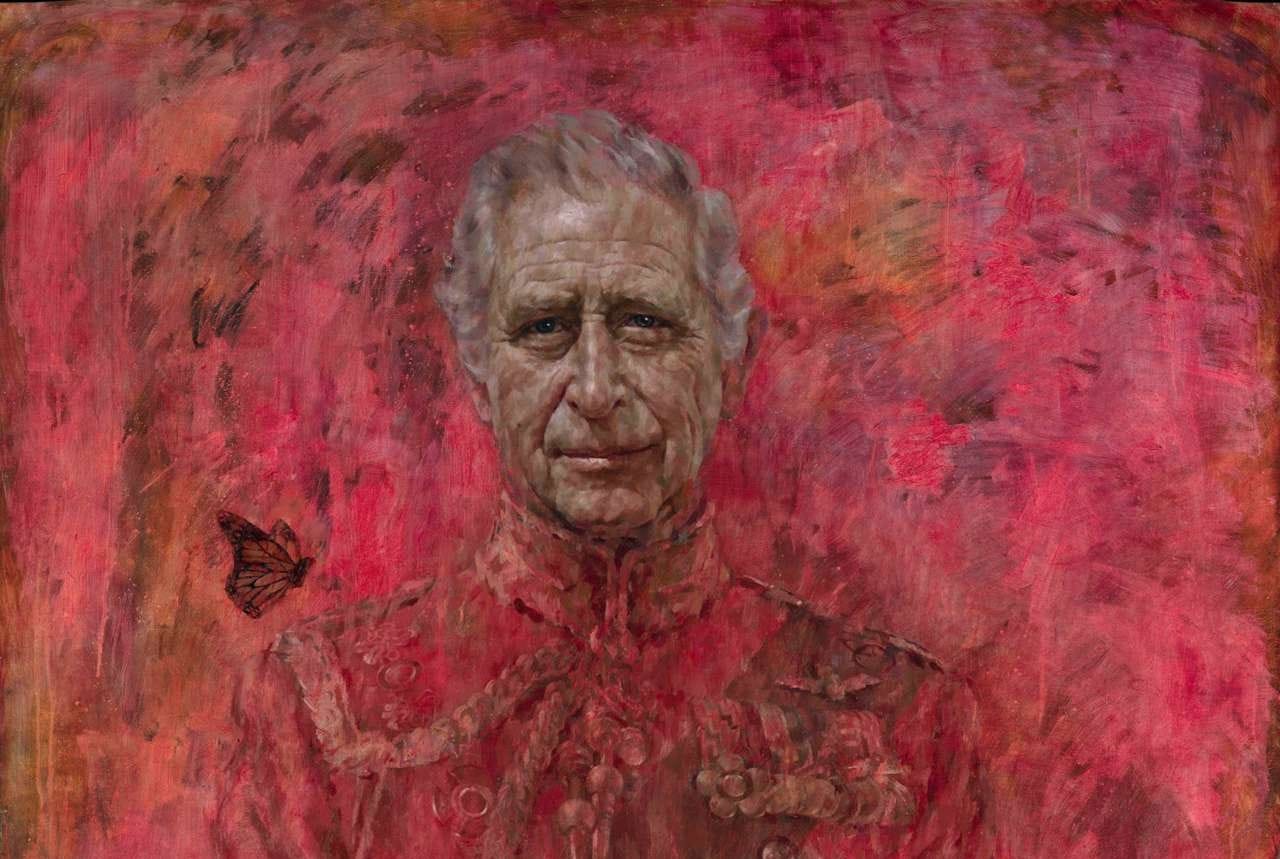
On September 8, 2022, Queen Elizabeth Alexandra Mary Windsor dies. On May 6, 2023, at Westminster Abbey, her son Charles, Prince of Wales, becomes the current King of the United Kingdom and the Commonwealth realms. And a year later, his official portrait by Jonathan Yeo is unveiled. This one:
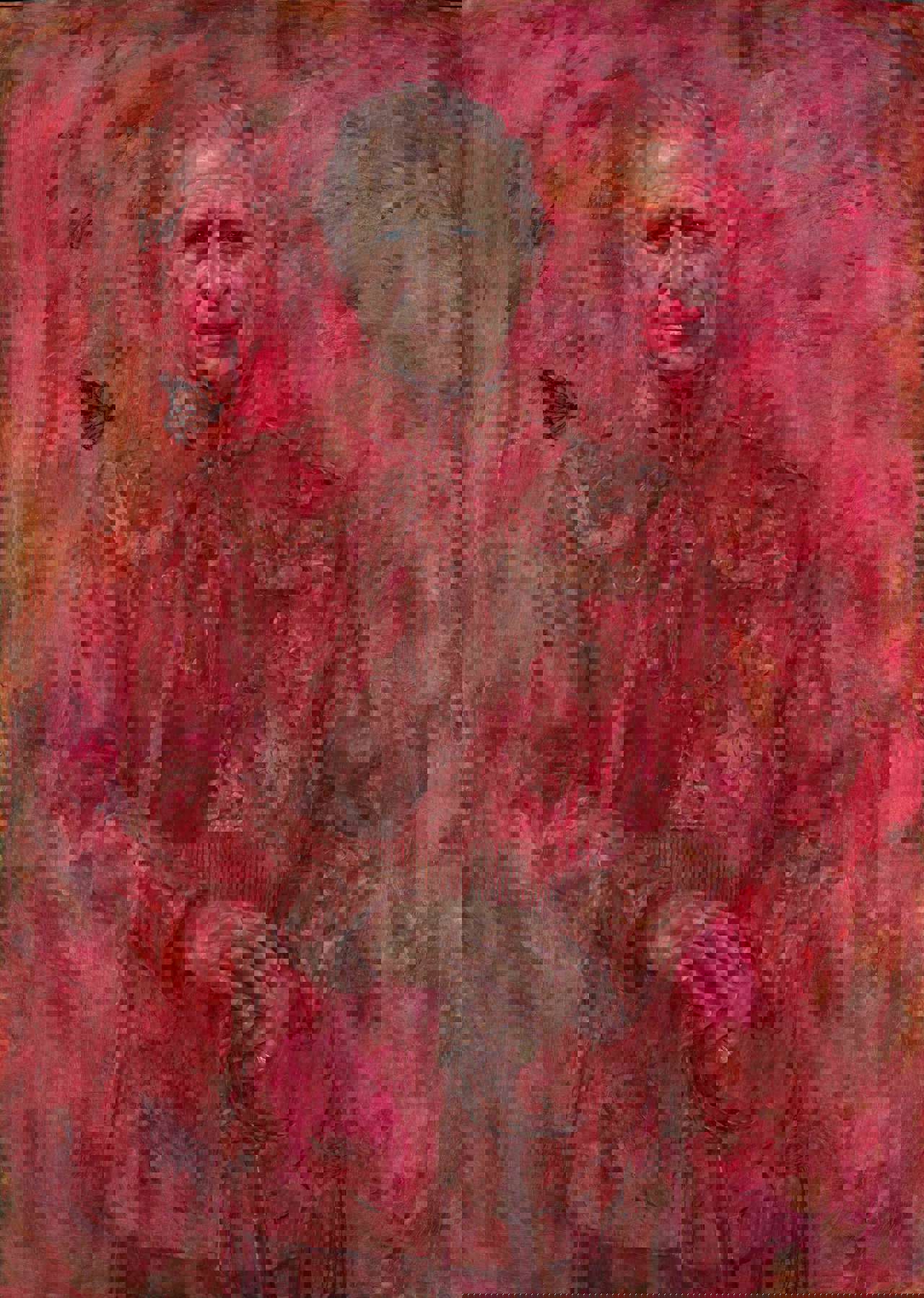
Some art critics have spoken of the red in this painting as a dramatic device to represent the weight of the monarchy and the fragility of the individual. Is that really the case? As a nearsighted person with astigmatism, the first thing I saw was a blur and then a head floating in that blur, and then the connections began to emerge and the details appeared. One painting always leads me to another, because the hyperlink predates the internet; it is a reflex of the mind to spend less energy and more quickly complete what we are seeing. It was as if the figure of the King, I thought, were reflected on the glass of an entirely red Rothko.
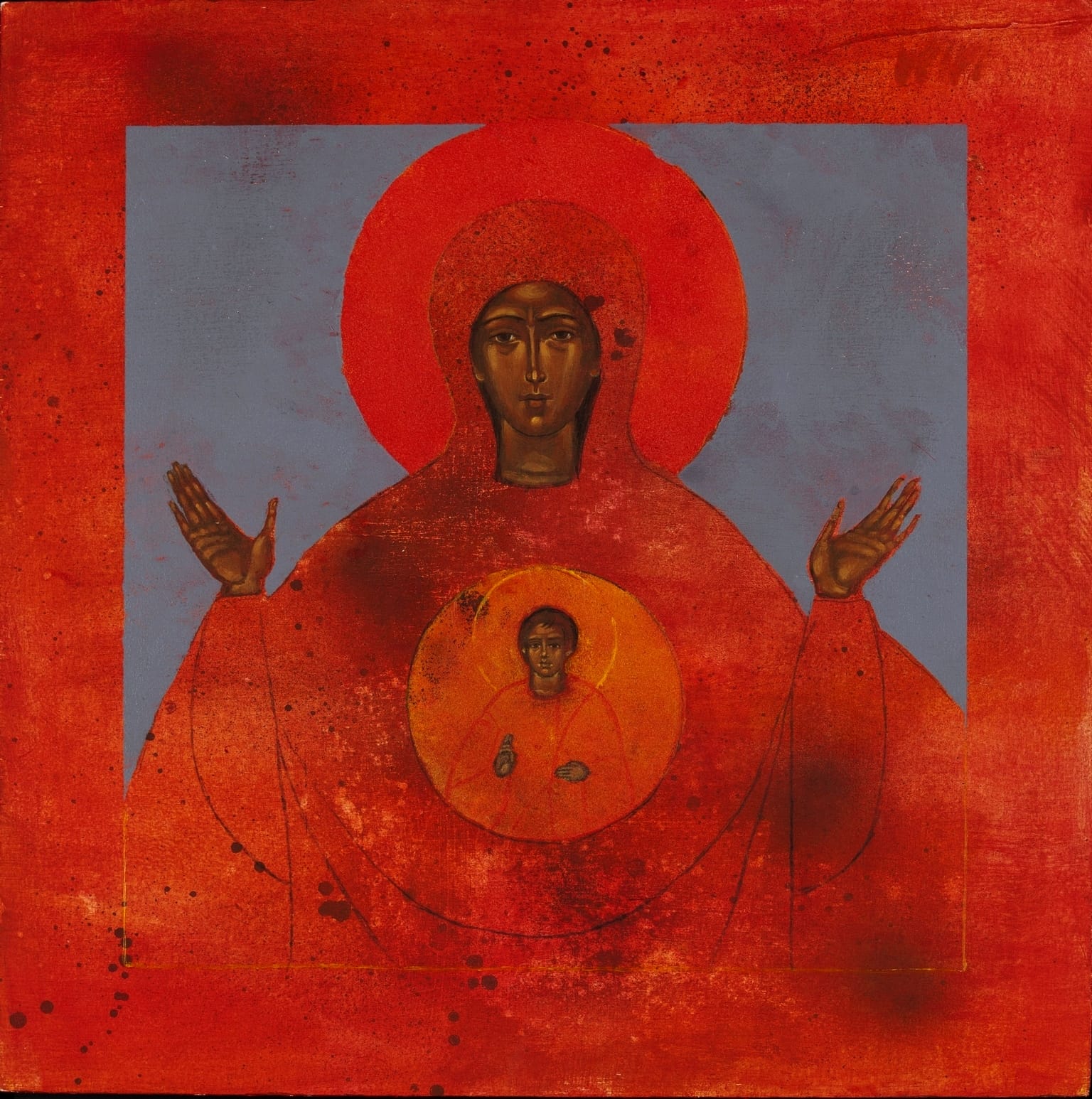
When I saw the portrait of King Charles III, I immediately remembered the monochromatic painting of the Theotokos (Mother of God in Greek) Oranta, or Virgin of the Sign, by Sylwia Perczak. The Theotokos is a type of Byzantine Marian icon in the Eastern Orthodox Christian tradition, where the Virgin Mary appears in an attitude of prayer, with arms raised, no longer holding her Son but offering him, while he appears in her womb or on her chest, representing the Incarnation, God made Man, in the Divine Temple that is his Mother: "Your womb has become a holy table, bearing Christ the heavenly bread. All who eat of it shall not die," recites an Orthodox hymn. Here the red is a symbol of divinity but also of sacrifice.
This color on the Theotokos, as used by the Polish artist Perczak, identifies her as the "Woman clothed with the sun" from the Book of Revelation (12:1), or Amicta Sole: "A great sign appeared in heaven: a woman clothed with the sun, with the moon under her feet and a crown of twelve stars on her head." Amicta Sole is an iconography of medieval origin that, in some interpretations, refers to the indestructible Church, and in all canonical readings to Mary, who intercedes at the Last Judgment to redeem us through God's forgiveness. Woman and Mother of the Child who defeated Evil -- sometimes a serpent, sometimes a dragon or devil -- just as Saints Michael and George, whose red cross is the flag of England.
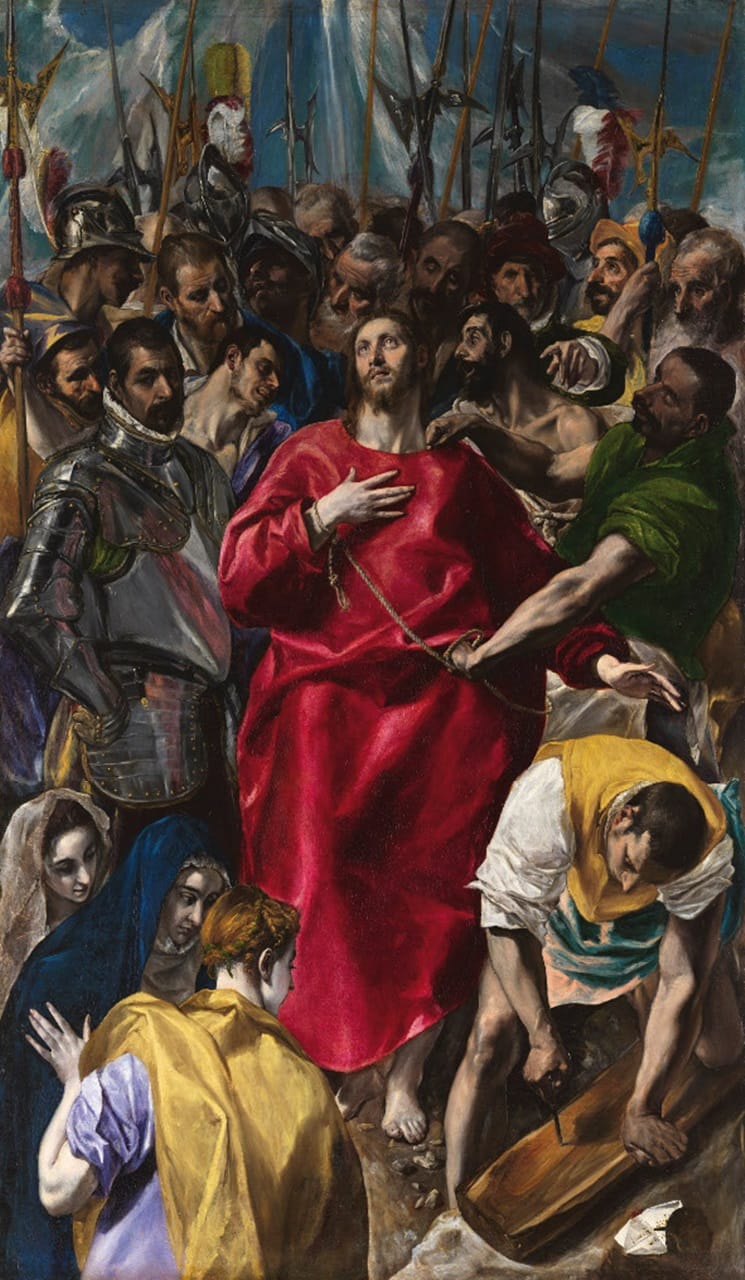
Another painting that came to mind when I saw the royal portrait was The Disrobing of Christ, by Domenikos Theotokopoulos, a.k.a. El Greco. An artist whose early training was in post-Byzantine art, specializing in icon painting. This brilliantly colorful canvas, where we see Christ dressed in his entirely red tunic before his crucifixion, is now housed in the sacristy of Toledo Cathedral. It was somewhat controversial in its time for having figures positioned above the head of a Jesus without a halo -- artistic decisions that did not respect the iconographic principles imposed by the Council of Trent.
Controversy was a hallmark of El Greco, for whom, as an artistic principle, color in painting is more important than drawing, and imagination and expressiveness more so than faithful representation. The painting of The Disrobing of Christ recently circulated on X (Twitter) because someone also thought of it when they saw the photo of Luigi Mangione being led away by the New York Police Department (NYPD).
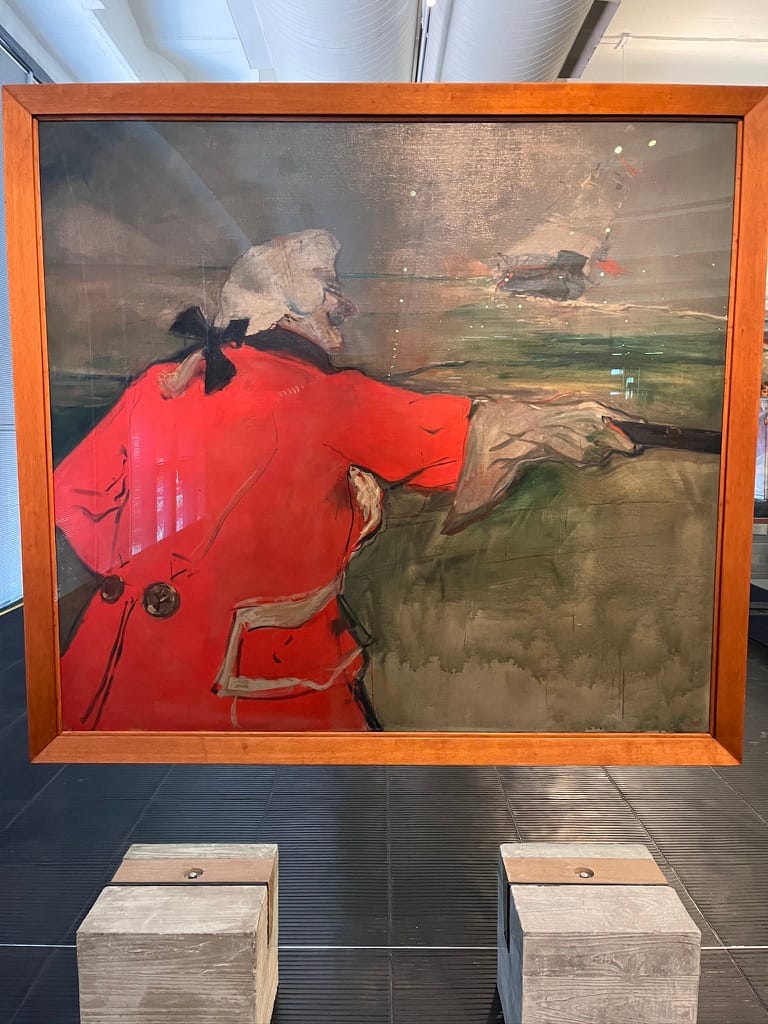
The portrait of King Charles III also reminds me of one of the last works by Toulouse-Lautrec, which shows, from behind, an elderly figure dressed in his 18th-century admiral's uniform -- it is The Admiral Viaud, a friend of the French painter who accompanied him in his final days -- watching a ship recede into the horizon of a churning sea, in muted colors -- perhaps as the painter saw his own life slipping away. Thus the human figure stands out despite being off-center from the classical position, with loose brushstrokes where the line blurs and what is central is the color that creates contrast.
The work was made as part of an unfinished series due to the death of the French painter. Today it can be seen at the Sao Paulo Museum of Art, Brazil, an emblem of the design of the Italian-Brazilian architect Lina Bo Bardi, who has her own signature red: o vermelho da Lina. A red that, for her, in contrast and superimposed onto concrete, is nothing other than the blood pumped from the heart of the work flowing through the entire structure.
The more you look at a painting, the more details you see. And so in the royal portrait, life appears -- that fleeting whim -- like a butterfly on Charles's shoulder. A butterfly that is a symbol of resurrection but also of the fragility of our existence, and therefore stages death, the Last Judgment, sin, and all that slips through our fingers. Could it perhaps be the Queen who has died so that Charles may now be King?
The butterfly has been associated, from early on, with the human soul freed from the body upon death. In Christian art it symbolizes the resurrection of Christ. And before that, in Greek mythology -- as Aristotle argues in History of Animals -- the butterfly is a symbol of Psyche, the goddess of the soul. In Chinese art, when it appears, it is a reference to a riddle in the Zhuangzi, a very ancient text, and speaks of the dissolution of human egoism into nature. By the 17th century, the butterfly -- and especially the red butterfly, like the one in the King's portrait -- also came to be associated with diabolical creatures and the burning embers of perdition.
Cezanne said that "when red achieves its greatest richness, form reaches its fullest expression." The red in the figure of Charles is presumably not meant to overshadow him but to magnify him and make us forget, for a moment, that he is a man so that we see him as a King. And yet, what feelings does it provoke? There is something about this portrait that leads me to so many other works. But the paintings I thought of when I saw it are paintings that move me, spiritual paintings where red gives life, strikes, and pierces. And here, what happens (to me)?
The red, with its vital force, is diluted in Charles. A King out of time, stripped of what once made monarchies magnanimous and imposing. It is a portrait that seems to feign something, an artificial deceit, without contrast or passion. There is only one greatness in what we see, and it is the greatness of red, failed and incomplete. And that lack is what binds you to keep looking for what is not there.
Despite all the historical, symbolic, and emotional weight, the intensity of red fails to permeate the man who wears it. It does not even devour him. All the fire of red is extinguished and hangs too large, at the same time, on a king destined to remain in the background.