RollerCoaster Tycoon was a hit because it was a great game

16 de sep. de 2024 — Juan Ruocco 🧙♂️
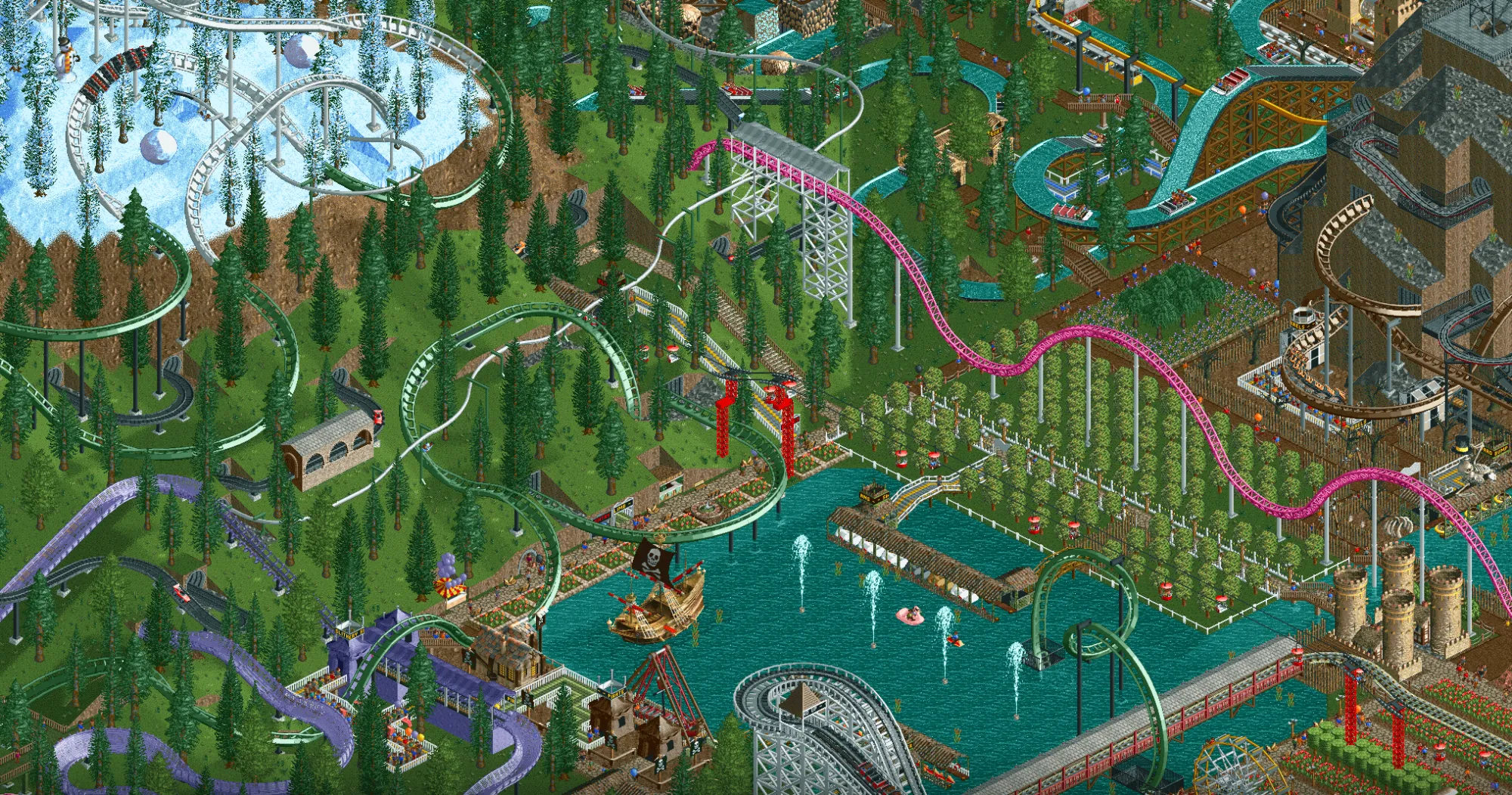
RollerCoaster Tycoon is a simulation video game series that lets you design and manage amusement parks. It was developed by Chris Sawyer Productions and published by Hasbro Interactive in 1999. Since then it has had several sequels and expansions, with the latest title released in 2016. None managed to replicate the success of the original, which was the best-selling PC game of '99, and the following year it nearly repeated the feat, surpassed only by the legendary The Sims.
But that alone doesn't explain the place the game still holds in the memory of those of us who played it, nor its legacy in the gaming world. RollerCoaster Tycoon was a hit because it was a great game.
Commercials for RollerCoaster Tycoon | From the channel @Bradly105
RollerCoaster Tycoon puts you in the role of an amusement park manager with full control over its design and operations, from building rides to setting ticket and food prices. You can hire staff, research new technologies, and manage finances to grow your park, though one of the most memorable parts is the ability to design the most thrilling roller coasters or the most relaxing family attractions. You have the freedom to create almost anything, because the game offers a wide variety of pieces and tools to design and customize your rides.
At the same time, you have to manage your park efficiently. This means keeping visitors happy, making sure there are enough restrooms and food stalls, hiring staff to keep it clean and safe, and managing finances to avoid bankruptcy and achieve the objectives of each level.
Park management follows very simple rules, with very clear trade-offs regarding prices, number of visitors, overall park condition, fun/boredom levels, visitor opinions, vandalism, and a long list of other factors. It's all about finding the right balance and creating a positive feedback loop that leads you to win each scenario.
Although all of this would be impossible without that flawless interface, which allowed the player to manage the park through an "operating system." I believe that's where the genius of RollerCoaster Tycoon lies.
Gameplay of RollerCoaster Tycoon | From the channel @10minGameplay1
The genius of Chris Sawyer
Much of RollerCoaster Tycoon's legacy has to do with the particular genius of its creator, who had started his career in the '80s working on games for ZX Spectrum and Amiga. Chris Sawyer would culminate his body of work with RollerCoaster Tycoon, but he also developed other simulation games such as Transport Tycoon and Locomotion, focused on managing transportation systems. Despite his success, Sawyer maintains a relatively low profile compared to other developers in the industry.
He programmed the entire game by himself in Assembly, a low-level language that is much harder to code in but far more efficient in its use of computational resources. Greater complexity for the programmer, more benefits for the players. This allowed the game to run without any issues on any reasonably capable x86-architecture computer of the era, which contributed to its success. And on top of having programmed the entire game alone, in an extremely complex language, RollerCoaster Tycoon didn't have a single bug.
Added to all this are features unique to the game itself. A fondly remembered isometric perspective graphic environment, spectacular physics that allowed designing roller coasters while respecting the concept of G-force, and a hyper-simple and intuitive graphical interface that simulated that of an operating system of the era. And it's on this point that I want to go deeper.
About Chris Sawyer | From the channel @techstories3891
A love letter to Windows 98
The decision to give RollerCoaster Tycoon a graphical interface similar to that of an operating system was quite innovative and contributed significantly to the gaming experience. Those were the heyday of Windows 98, and the game somehow emulated that interface. This made actions feel more intuitive for players who were familiar with using computers. The arrangement of windows and menus could feel familiar and ease navigation within the game. A love letter to the windowing system of the pre-Windows XP era.
This operating system-style interface allowed for considerable gameplay depth by providing easy access to a wide range of management tools and options. It also enabled greater customization and control over the design and operation of the amusement park.
This aesthetic may evoke today a nostalgia for older operating systems and computer software, which could resonate especially with players who grew up during the era when RollerCoaster Tycoon was released, but the truth is that the scarcity of resources turned into a technical triumph. The simplicity, intuitiveness, and effectiveness of the management system make the gaming experience complete.
The fact that building a roller coaster from scratch or hiring security staff are actions with the same level of complexity simplifies park management tasks and allows you to keep track of both macro management (advertising, visitor volume, visitor happiness) and micro management.
Fandom content about RollerCoaster Tycoon | From the channel @MarcelVos
In The End (emotional)
Nowadays, the original versions of the game can be found on stores like GOG or Steam, in addition to the open source version called OpenRCT2 and the tons of quite entertaining content about RollerCoaster Tycoon, where creators try to build the longest roller coaster or things like that.
For me, it's one of the classics worth revisiting when you have several days off and/or on vacation, to dive back into the titanic task of creating a successful amusement park.