StarCraft: Rise and Fall of a Strategy-Game Titan
Blizzard turned real-time strategy games into a global phenomenon, thanks to StarCraft, LAN cafés, and the power of Korean hype.
29 de oct. de 2025 — Juan Ruocco 🧙♂️
April 21, 1999
I was turning 12, and a friend of my parents gave me the trendy new computer game: Tomb Raider. On the cover was a voluptuous woman, armed and wearing minishorts. The obvious exaggeration of feminine traits (big breasts) to attract a male audience made me cringe. As a kid I was particularly disgusted by sleazy adults. I installed the game. It took a while. When the installation finished, I restarted the PC and double-clicked the icon: black screen. I tried again: black screen. Once more: black screen. The Pentium 166 my father's meager salary could afford in the late '90s didn't have enough power to run it. That day I learned what a graphics card (GPU) was.
Chewing anger and frustration, I went to Pata's, the neighborhood video-game store. They let me swap it and handed me a binder of game covers so I could choose. I flipped through a few until an indelible image hit me: a mouthless alien with orange eyes and violet skin. Now this looked like a real game –who cared about the tits? I asked for it; after a moment in the stockroom they brought it out. That's how the first copy of StarCraft (SC) found its way into my hands. I came home with double anxiety: would the damn game work? I installed it and double-clicked the spaceship-like icon –a Wraith, as I'd learn later. Uncertainty, anxiety, fear of another failure. On a black background, Blizzard's block letters appeared. High-quality cinematics. The game not only ran –it was a blast.
That day I played 12 hours straight.
StarCraft: the Perfection of RTS
StarCraft was released in 1998 –the same year Zidane ruined Ronaldo's Brazil; the year Nintendo launched The Legend of Zelda: Ocarina of Time; the year Magic: The Gathering debuted the Urza's Saga block; and Boca Juniors began a legendary run. Sega's Dreamcast arrived with Sonic Adventure –a kind of swan song for the decade's best. By any quick review, 1998 may have been humanity's last truly great year –but it was undeniably one of the greatest years ever for video games.
StarCraft came from the then-mythic (now disgraced) Blizzard Entertainment. It's a real-time strategy game (RTS), which –unlike turn-based strategy– is played in continuous time. Turn-based strategy had dominated since 1991 thanks to Sid Meier's Civilization. But another ultra-nerdy boutique studio, Westwood, codified the RTS playbook with the acclaimed Dune II. Westwood deserves its own article –from licensed Dungeons & Dragons and Dune to its home-grown Command & Conquer franchise, with Red Alert 2 (plus Yuri's Revenge) as a high-water mark.
In this landscape of titans, StarCraft landed as a "space-age" counterpart to Warcraft: Orcs & Humans from the same company, mirroring Warhammer's dual fantasy/sci-fi model –much as Westwood bridged Dune and D&D.
The Basics of RTS
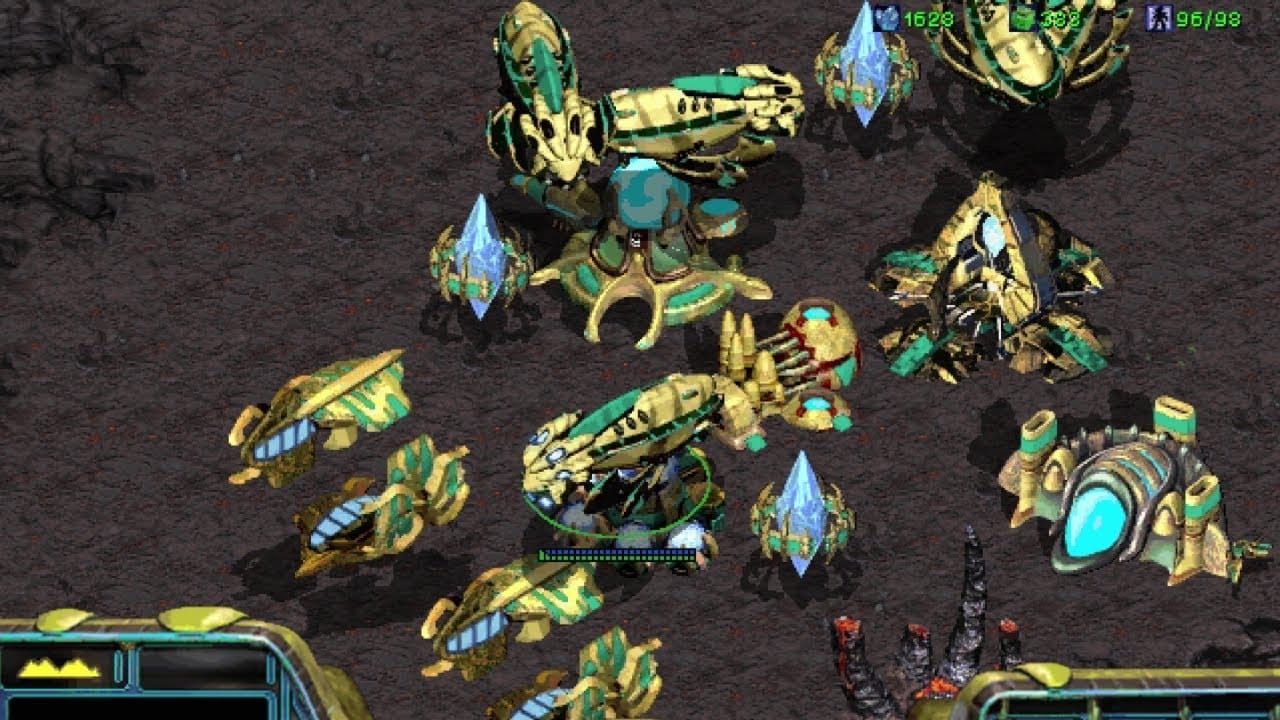
In RTS, players basically fight each other on a fairly limited-sized map where victory usually consists of the complete annihilation of the enemy. This is not always the case, since in games like Age Of Empires there are other ways to win. But annihilation is the most common.
This is basically achieved through four actions:
1.- Accumulate resources. In StarCraft there are two types: minerals in crystal form and vespene gas. The combination of both allows the construction of structures and units.
2.- Build a base. Building different types of structures is necessary to train units and obtain their upgrades.
3.- Build an army. Each race builds its own units to face its opponents.
4.- Use the army to annihilate the enemy. Army management is often as important as its production to victory.
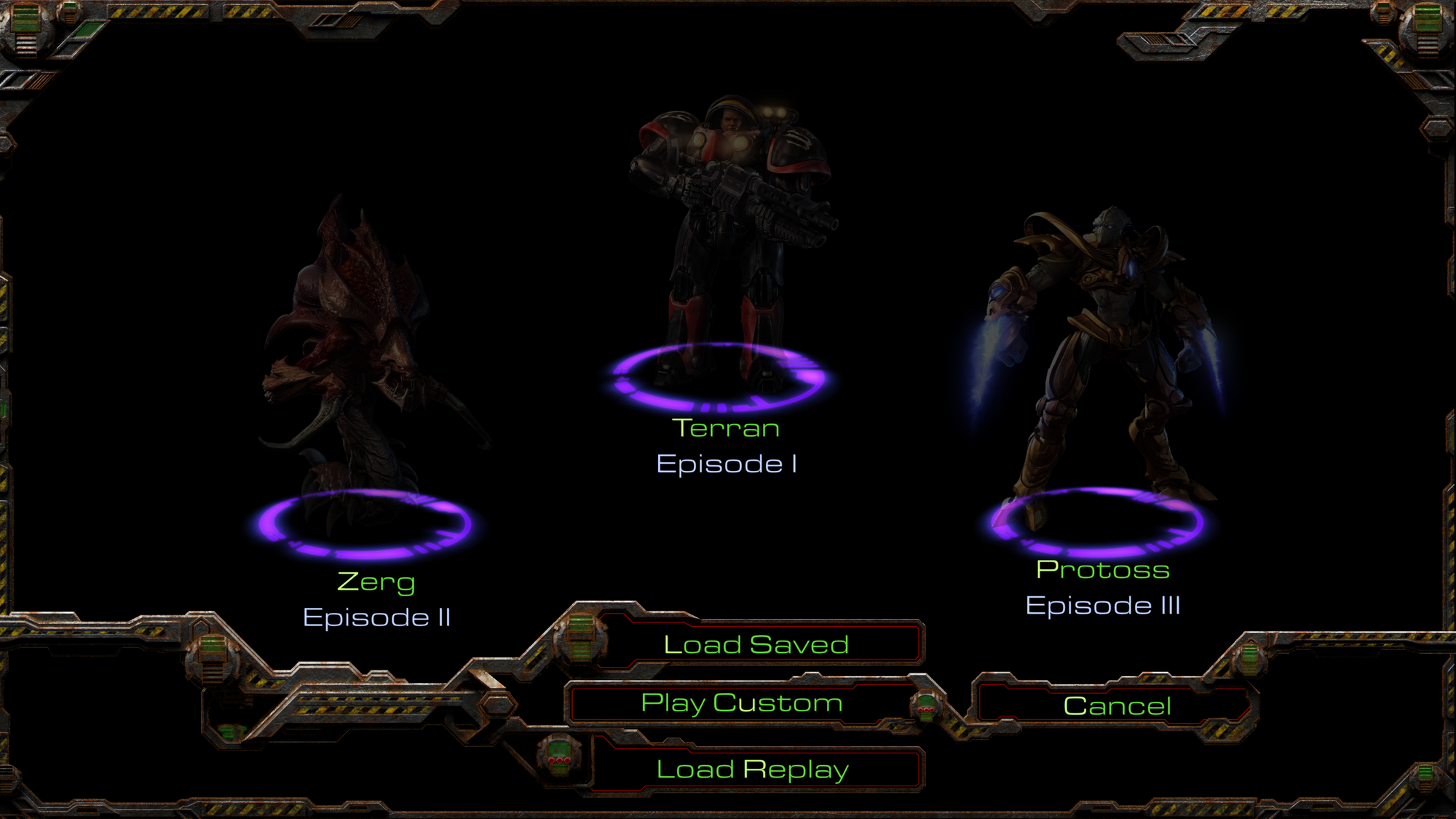
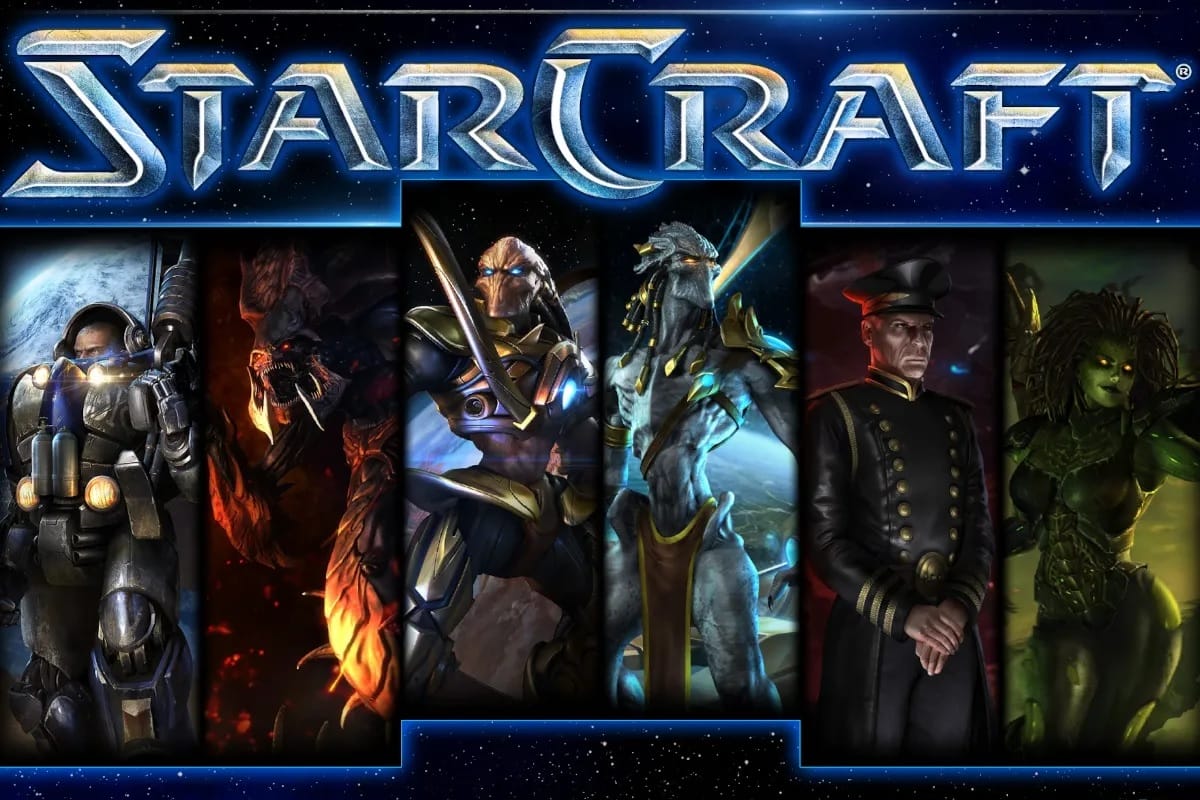
The first three actions are "macro" –economy, resources, and production. The fourth is "micro": precise unit control to secure decisive advantages. In the SC universe there are three species –Protoss, Terran, and Zerg, balanced in a rock-paper-scissors triad so no race dominates outright. Since the galaxy is too small for them, they must exterminate each other. Battles play out on maps with limited space and resources, signaling difficulty and player count.
Tera's cyber
Around the age of 15, most people my age were going out dancing. I, on the other hand, wore sweatpants until I was 17. I didn't like the club scene except for the occasional graduation party, but I did enjoy going out at night. Back then, the big novelty was internet cafés –"cybers". Rows of PCs where, for one or two pesos an hour, you could get online and play a wide array of LAN or online titles. The classics were Counter-Strike 1.5, Diablo II, Age of Empires, Warcraft III, and later Vice City and others from the Grand Theft Auto series. Some expanded their offerings to include Day of Defeat, StarCraft, and Command & Conquer: Red Alert 2. This was the basic recreational diet of the Argentine born between '85 and '90.
The first cyber that was successfully installed in Villa del Parque (in Melincué almost on the corner of Cuenca) was run by Tera, a Korean of suspicious origin and with a tendency towards bad habits: sleeping on top of a cardboard, "bathing" with a tap in the patio, smoking non-stop and filling the place with prostitutes. An ideal environment for growing youth. Cyber were the equivalent of Temporary Autonomous Zones (TAZ), places where the norms of society were suspended and replaced by a kind of spontaneous tribal government. Tera's cyber used to be open all night.
Shortly after going, I started talking to Tera’s attendant—a bargain-bin Keanu Reeves look-alike who went by Galford. We chatted about StarCraft, and he suggested we play a match. I was convinced that I was going to destroy him because after having spent the entire game campaign I had discovered that if instead of building one barracks I built two simultaneously I could double the growth speed of my army. We played an 8 minute game and he crushed me mercilessly. There I understood the feeling of unrest that must have invaded the Polish army when it faced the Blitzkrieg of the Wehrmacht for the first time.
While my body was still warm, Galford said beating Tera was impossible. That the Korean was waiting for it to get too late to play multiplayer SC against other Koreans connected in his native country. One night, after having vigorously swallowed Pikito's breaded cutlet with mashed potatoes and being on the verge of a gastronomic coma, I stayed to watch him display his magic. It was an impressive sight. He hardly touched the mouse, he commanded everything from the keyboard. His fingers reached grotesque speeds. He seemed to have evolved an adaptive advantage for StarCraft.
Korea's Role in the Boom
That's how I came to find out that in South Korea the StarCraft it had become a scale phenomenon that turned it into a national sport. The KeSPA (Korea eSports Association) had been operating since 2000, an association approved by its Ministry of Culture and Tourism created with the aim of promoting the nascent electronic sports industry.
By 2002, South Korea's two main television channels (Ongamenet and MBC Game) dedicated to the activity, they partnered with KeSPA and created two competitive leagues of SC where a select group of professional players fought to obtain the national championship, with live broadcast. Between both leagues, they managed to distribute 4 million dollars in prizes. The league operated until 2012, when it was decommissioned to migrate to the new version of the game: StarCraft II.
The market exploded. Leagues and TV broadcast schedules multiplied and thus a simple strategy game developed in the US became Korea's national sport. The finals of a league filled stadiums with 50,000 people and several million more joined on television. Technology brands such as Samsung and Intel and Korean telephone companies (SK Telecom and KT) were quick to support the new industry. In exchange for sponsorship, they got tons of advertising on the most watched programs. From these leagues he came out a legion of players who would carry SC constantly towards the limit, constantly updating game strategies and the competitiveness of games, making Korea the greatest power in StarCrafton globally.
Lim Yo-Hwan, considered one of the most emblematic players of SC Brood War (the game's expansion) dominated the scene under its pseudonym SlayerS BoxerS (or simply Boxer): won more than 500 league games broadcast on television, twice the World Cyber Game Championship and pocketed prizes totaling $400,000 annually plus an extra $90,000 from sponsors, according to esportsearnings.com.
The OnGameNet Starleague (OSL) was the heart of the StarCraft: Brood War competitive. It was played in South Korea between 1999 and 2012, organized by the OGN TV network, and was the first eSports tournament with national television production. It was not a stream but open TV, with sponsors, full stadiums and commentators with celebrity status. For more than a decade, the OSL defined Korean gaming culture and set the standard for what would later be known as "electronic sports".
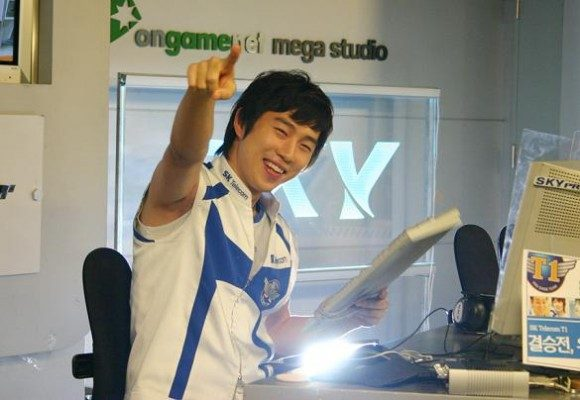
The format was simple and brutal: 1v1, direct elimination. Hundreds of players went through offline qualifiers until they reached the main draw of 16 or 8. From then on, everything was broadcast on TV: best-of-5 sets, prizes of around $40,000, and finals with tens of thousands of people in open stadiums. The maps –Lost Temple, Luna, Python, Blue Storm– were as iconic as the players. Each season featured a new battery of community-designed maps, adjusting strategies, builds and balances between species.
The OSL made legends. BoxeR; the general Terran that brought micromanagement to art; NaDa, the perfect macro machine; iloveoov, his disciple who dominated with brutal economy; Jaedong, the Zerg who made the swarm a religion; and Flash, the total synthesis, with mechanics, timing and a cool mind. The finals Flash vs Jaedong (Bacchus OSL 2009) they reached more than two million live viewers, a figure unthinkable for a PC video game at the time.
More than a tournament, the OSL was a media laboratory. There the modern professional player format was invented: corporate teams, contracts, merchandising, franchise leagues. It was the model that they later imitated League of Legends, Dota 2 and CS:GO. In Korea, teams like SK Telecom T1, KT Rolster o Samsung KHAN they were as recognizable as football clubs.
Its ending was slow but inevitable. With the launch of StarCraft II, in 2010, Blizzard changed streaming rights and cut off free access to content. OGN lost exclusivity, the teams migrated and the OSL ended in 2012. But his DNA was still alive: in 2016 the Afreeca Starleague (ASL), direct heir to the format, the maps and the old commentators.
The Birth of a Language of Its Own
The impact of StarCraft in video game culture it is really difficult to measure. I start with something very simple: StarCraft: Brood War it required a 90 MHz Pentium processor or equivalent, at least 16 MB of RAM, 80 MB of free hard drive space, and a Windows 95 or higher operating system. The game asked for such humble requirements in exchange for one of the most complete experiences of its entire era, which immediately catapulted it to classic status. But in addition, and based on the competitive scene generated, concepts were introduced that would later be standard in the industry. The idea that we already explained about "macro" and "micro" resource management. The need for the game to be balanced, since it depended on it being fun and there could be multiple game strategies, consolidating the idea of builds and goals. The builds they are nothing more than production order strategies for each race/species according to the rival's race and the map. The notion that the micro is just as defining as the macro. The idea that a game has moments: early, mid and late game. And that at each stage there are specific opportunities for each player. Also accounting for how many actions each player carries out (the actions per minute or APM) as a quantitative way to establish game thresholds. For example someone with ~200 APM is amateur; pros exceed ~400 APM. All concepts that permeated other games or that were also taken from other games (the idea of a metagame was not born in SC), but they were magnified by the cultural impact of the franchise.
The Korean Model Goes Global
The structure of electronic sport modern was born in StarCraft: Brood War and it expanded with StarCraft II, but his descendants ultimately eclipsed their progenitor.
Between 2000 and 2010, StarCraft invented language: macro, micro, build order, timing attack, GG. Also the professional model: televised leagues, commentators, sponsors, salaries, militarized training and fanbases with flags. When League of Legends, Dota 2 and CS:GO they arrived, they didn't start from scratch. They copied Korea's competitive structure and adapted it to Western entertainment.
League of Legends he took the logic of the perfect 1v1 and diluted it into a 5v5 where the emphasis shifted from individual execution to serialized spectacle. Riot built the industrial-scale version: franchises, stadiums, scripted casters, merchandising. What in StarCraft it was a cult of precision, it became a seasonal novel. Dota 2 he inherited the technical intensity and culture of the player as a strategist. Valve replicated the myth of Korean geniuses with Chinese and European "pub stars". Counter-Strike: Global Offensive he took the television format that had been born in the OSL and applied it to the First Person Shooter: centralized production, leagues, rankings, media stars.
At their core, all the great esports of the last decade are reinterpretations of the Korean model. StarCraft he showed that a screen sport could exist; LoL and Dota they proved that there could also be narrative and global community. They replaced it on a planetary scale because they simplified access: less APM, more spectacle, less entry curve, more emotional connection. What in StarCraft it was technical elitism, in the new titles it became massive cultural consumption. But the structure remained the same: constant training, changing goal, live streaming and the promise that someone, in some corner of the planet, is going to execute something so perfect that it seems inhumane.
Starcraft II
The competitive scene of StarCraft II he was born on the hot corpse of Brood War. Blizzard launched it in 2010 with a clear mission: to globalize what until then was an exclusively Korean phenomenon. Where the OSL had been television, StarCraft II it would be streaming, franchise model and a 1080p show.
The core was the Global StarCraft II League (GSL), organized by GOMTV in Seoul. There the new canon was defined. The first gods were MVP, MC and Nestea, veterans of Brood War adapted to the new economy of build orders infinite and micro surgical. Then came the era of mechanical prodigies: INnoVation, Maru, Zest, Rogue. The GSL became an institution: more than a decade of television continuity, the same set, the same commentators and an audience that grew old with its players.
In parallel, Blizzard created the World Championship Series (WCS). The goal was to unite Korea, America, Europe and China into a single competitive circuit. For the first time, esport was formally global: regional tournaments, unified rankings and an annual final in the BlizzCon. Between 2013 and 2019, the WCS was the lynchpin of it all, although Koreans continued to sweep. Every year the names changed, but not the pattern: sOs, Zest, ByuN, Dark, Rogue.
Only in the second half of the decade did dissidents from abroad appear. Finland's Serral broke hegemony in 2018 by winning BlizzCon, the first non-Korean to do so. Behind came Reynor, Clem, Neeb, who maintained a European scene with its own identity. America never achieved the same weight, although it kept symbolic figures such as Scarlett or Neeb at its peak.
When Blizzard collapsed internally and the eSports project fell apart, ESL and DreamHack took over in 2020 with the ESL Pro Tour (EPT). Since then, the circuit has focused on IEM Katowice (Poland), the new cathedral of competitive RTS. It's the modern equivalent of a globalized OSL: all the big names, streaming on Twitch, and an audience that already understands the metagame without the need for paternalistic commentators.
Today the scene is smaller, more artisanal, but pure. Korea preserves the GSL as an annual rite. Europe has its online ecosystem. America lives off community events. StarCraft II stopped being the future of eSports and became a aficionado's cult –a living tradition maintained by a hard core of players, analysts and fans who understand that, in its precision, there is still something unrepeatable.
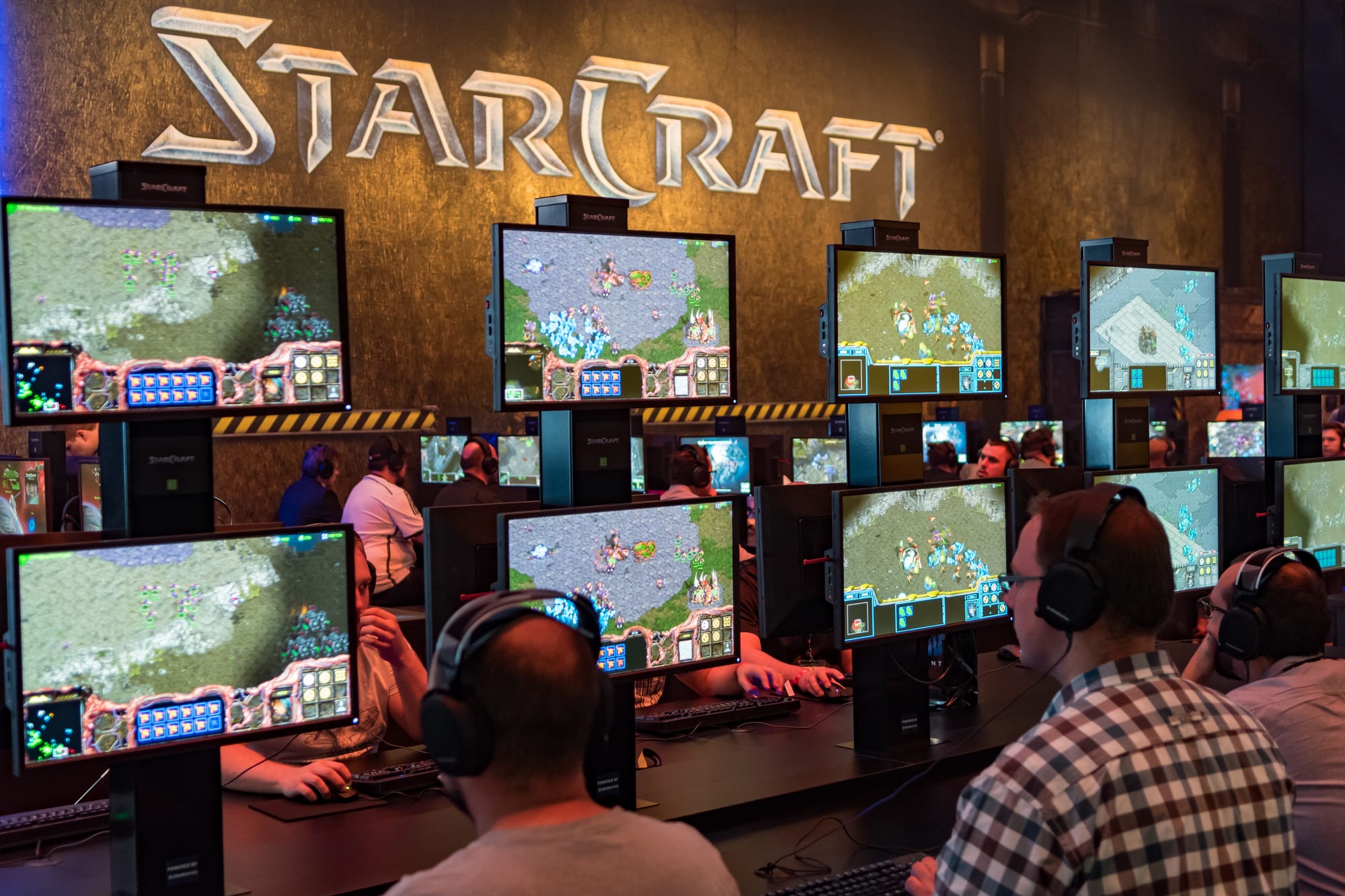
Starcraft, crypto and Team Liquid
In 2013, the Bitstamp exchange and the TeamLiquid community organized the Cryptocurrency eSports Tournament, the first StarCraft II tournament with Bitcoin-denominated prize. It was played online during the Heart of the Swarm expansion and offered 1 BTC to the champion, worth about $100 at the time (around $113,000 at the time of writing). It was a semi-pro event, an early crypto-esports crossover, years before cryptocurrency sponsorship became the norm.
Team Liquid was born in 1998 as a clan of StarCraft: Brood War. Its founder, Victor "Nazgul" Goossens, was a Dutch player obsessed with the precision of Korean play. In 2001 he launched TeamLiquid.net, a forum that became the collective brain of the Brood War western: guides, strategies, translations, infinite debates. For years it was a kind of competitive video game MIT, a place where games were analyzed frame by frame and the RTS lingua franca was built.
With the arrival of StarCraft II in 2010, Nazgul converted the clan into a professional team. He signed players like TLO, Jinro, HerO and TaeJa, and brought the blue horse logo to the world's big tournaments. Team Liquid represented Western resistance against Korean rule. At the same time, he was born from his community Liquipedia, an open encyclopedia that became the most reliable database in the competitive ecosystem. What had started as a forum ended up being the eSport Wikipedia.
When the cycle of StarCraft II sold out, Liquid mutated into a corporation. Came in Dota 2, CS:GO, LoL, Valorant and other titles, creating professional divisions with a business structure. In 2017 his team Dota 2 he won The International, one of the highest winning tournaments in history. It was the moment when the old clan stopped being a community and became a global brand, backed by the aXiomatic Gaming group, with investors from Hollywood and traditional sports.
Today, Team Liquid is a multimedia ecosystem with headquarters in the Netherlands, the United States and Brazil. It operates as a production company, agency and digital talent laboratory. Its Liquid+ platform connects fans and sponsors, and Liquipedia continues to archive every game on the global competitive circuit. Although I no longer compete in StarCraft, everything that defines modern eSport –infrastructure, statistics, professionalism and community– was born in its forum. The blue horse stopped running on Blizzard maps, but its DNA supports the entire industry.
StarCraft and Artificial Intelligence
In 2016, DeepMind (Google) chose StarCraft II like your advanced artificial intelligence laboratory. The objective: to test whether an AI could handle a strategy environment in real time, with incomplete information, simultaneous decisions and more than 300 possible actions per minute. Blizzard released an official API to allow AI agents to play against the game without information traps. DeepMind then developed AlphaStar, a neural network system trained with millions of human games and self-learning (self-play).
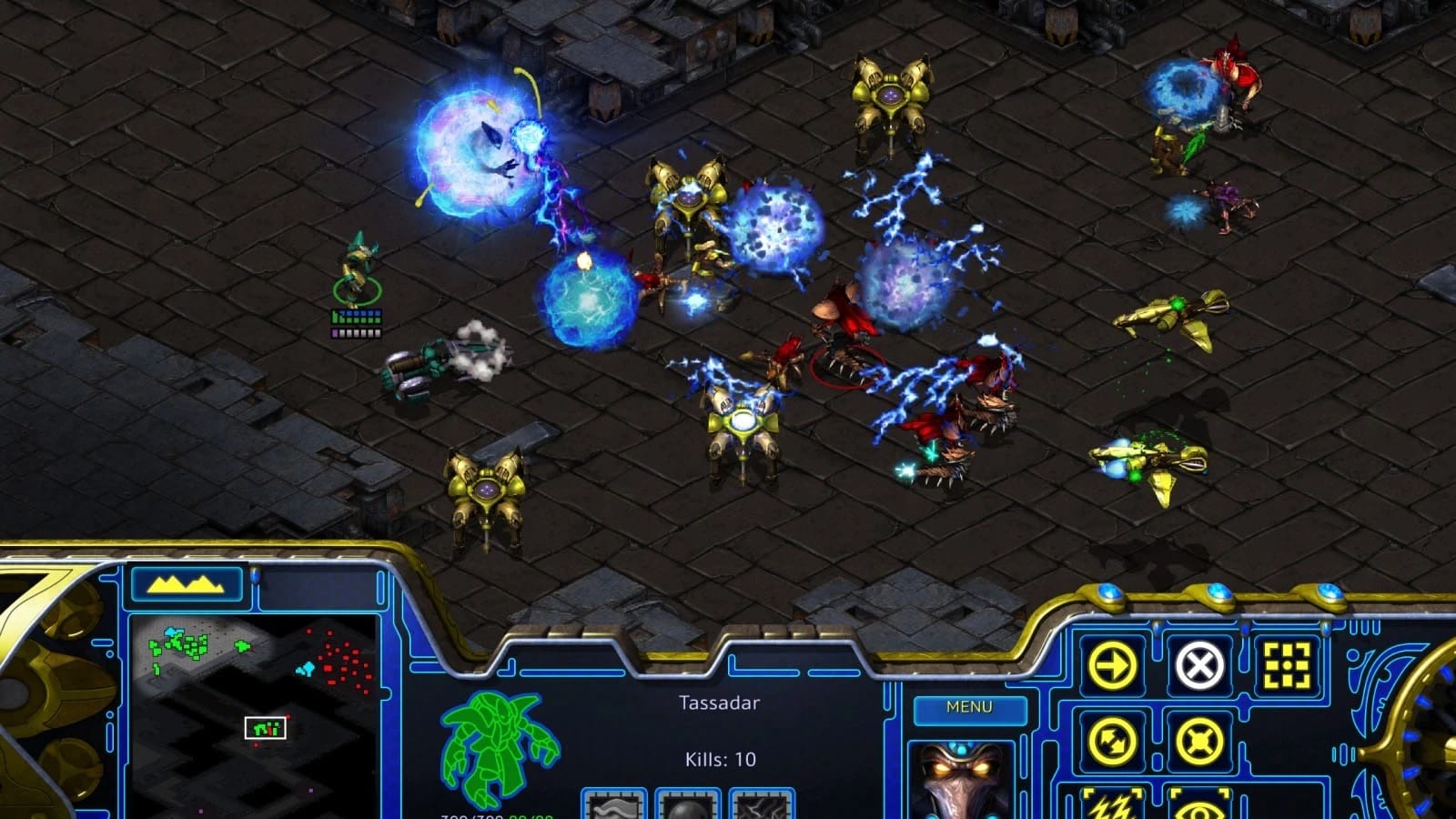
In 2019, AlphaStar faced professional players from the European league. The result was historic: they beat Protoss TLO 5-0 (playing Zerg) and MaNa 5-0, in vision conditions equivalent to human ones (without a complete map). Its APM was high, but above all efficient: it didn't have more clicks but rather they were better. AlphaStar didn't play like a human. It didn't scout or micro like a human, and he used movements that were not intuitive, but effective. In one match, he turned his Stalkers in near-perfect formation to reduce area damage, a maneuver that commentators compared to mechanical ballet. The experiment showed that an AI could master a game with partial information and simultaneous decisions, something much more complex than chess or Go. It wasn't brute force: it was prediction, adaptation and risk calculation. After 2020, DeepMind closed the project by achieving its goal: demonstrating that deep reinforcement learning could operate in open and dynamic environments.
October 28, 2025
I finish writing this article, which is actually the third or fourth version of it. I had already published this same article once in the magazine NaN and another expansion in vdpraxis, one of my extinct blogs. While I was rereading some of the data that appeared in the text, I discovered that my relationship with StarCraft he's kind of 26 years old. Even one more than with Magic: The Gathering. Two of the games I still play, with a regularity unmatched by anything else I've ever played. I also review all the impact that this game had on its history, on the competitive scene, on the games themselves, even on artificial intelligence. It is really immense, difficult to measure.
I think about all the stages, some closer, others further away, that I lived with StarCraft. His meteoric rise as undisputed king of esports. Its irreversible decline in popularity from simpler and more optimized versions. Its consolidation as community-supported play. Its use as a training tool for AI. Really an absolute titan, an inexhaustible source of happiness for many of us. I also think that even though I've been playing for so many years, like Magic, I never became PRO or anything like that. I still have a hard time beating the strongest AI in Single Player mode, and I hardly play competitive games.
But there is an ineffable happiness, almost of the order of mystery, waiting for the holidays, without having anything to do, lowering the blinds at home at two in the afternoon, pouring me a half-liter glass of cold coke and locking myself in to take out a ball of Marines, Marauders and Medivacs; put twenty tanks into siege mode and wait for an army of Protoss or a horde of Zerg to come and feel exactly the same adrenaline rush that was the first time I had to kill some Zerglings with a couple of Marines when I was 12.