Techno-feudalism: What Are the Main Projects for Private City-States
6 de abr. de 2026 — Diego Agrimbau
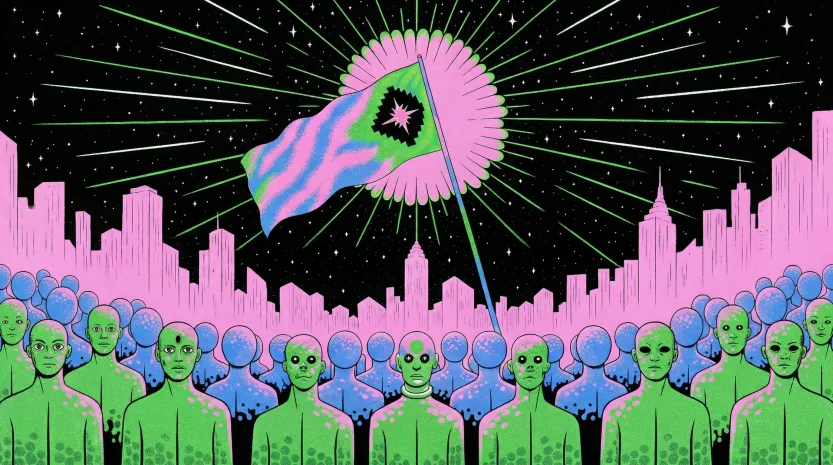
In Garage City, there were several neighborhoods: Lego Town and Playmobil Town (eternal rivals), Toy Car Neighborhood, and off to the side, the toy soldiers' barracks. The borders were closely guarded by He-Man figures and a few tin robots. The Lima Train traveled around the perimeter, transporting Rasti blocks, wooden cubes, and other goods used to build buildings, bridges, and all sorts of infrastructures. It was 1983, and decades away from the arrival of Minecraft or Roblox. So, my brother Nacho and I dedicated ourselves to constructing "Garage City" in my grandfather's garage. Of course, by nightfall, we were bored and would head off to watch TV without picking up the toys or tidying anything. Garage City remained there, motionless, silent. But at night, my grandfather Bruno would arrive in his Ford Falcon, tired and impatient with nonsense. The solution was simple: while he muttered curses under his breath and the Falcon loomed threateningly on the sidewalk, my grandfather would sweep away Garage City with a broom, gather up figures, buildings, and cars with a dustpan, and toss everything into a single box. In two minutes, there was no more Garage City. The He-Man figures mixed with the Rasti, Legos, cubes, toy soldiers, train tracks, dirt, and cars, forming a cruel and chaotic mass. And there they lay until my brother and I decided to build Garage City once again.
As the years went by, I ended up dedicating myself to comic scripting to keep inventing cities and worlds, with their neighborhoods, laws, inhabitants, and conflicts. All of us science fiction writers love to play mini-god of our own little world, designing the fate of characters, defining eras, creating rules and protocols, watching our creation grow until it seems to have a life of its own. And as readers, we experience something similar. All the nerdy kids and teens of the seventies, eighties, and nineties shared the cultural consumption of those monocultural times: Star Wars, Battlestar Galactica, Robotech, the books of Philip K. Dick, Christopher Priest, or Isaac Asimov. Then came Akira, Ghost in The Shell, Neon Genesis Evangelion. All of these were cultural consumptions that shaped our way of thinking and creating societies and their systems of governance.
Trust and obedience to the king or the Church made way for the rule of law, republics, and democracy. The problem is that nearly two hundred years later, we are still struggling with a model that feels small, uncomfortable, and outdated for today's world. Democracy as a model of governance no longer convinces anyone.
And it's highly likely that the same cultural consumptions that shaped the minds of other Gen Xers and millennials are the ones now defining the shape of the future world: Peter Thiel, Jeff Bezos, Larry Page, Elon Musk, Sam Altman, Mark Zuckerberg, etc. Of course, unlike science fiction writers, these billionaires are anything but humble; they are more like demiurges. They want their own Garage City, but for real. And with a bit more budget, of course. This time, the dystopias presented as warnings, like Blade Runner, 1984, or Fahrenheit 451, are not something to avoid but rather a user manual, a menu of options, a palette of colors for their shiny new social designs.
Hyperstition and fiction as a script for the real
The well-known essay "The High Frontier" by Gerard O’Neill (translated into Spanish as "Ciudades del Espacio", Bruguera, 1979), is a key example within the tradition of Speculative Fiction, illustrating how hyperstition operates. This term, coined by Nick Land and the CCRU (Cybernetic Culture Research Unit), describes fictions that do not merely imagine or predict the future but act as cultural engines capable of producing it.
In this sense, hyperstition is linked to the logic of self-fulfilling prophecies: an idea circulates, is taken seriously, mobilizes investments, projects, and collective imaginations, and ultimately creates the conditions for what seemed like fiction to become reality. Thus, certain speculative narratives operate as cultural viruses or anticipation devices, infiltrating the present and guiding the technical, political, and economic decisions that ultimately materialize the future they announced. This concept is not far removed from the Mental Virus of Scottish writer Grant Morrison, elaborated in works like The Invisibles and particularly in his Doom Patrol. This work owes much of its originality to the text Tlön, Uqbar, Orbis Tertius by Jorge Luis Borges. In this story, Orbis Tertius is a secret society of intellectuals funded by a wealthy American who despises reality. Their goal is to design a coherent and meticulous world to replace the chaotic and unpredictable real world. Any resemblance to the present is not coincidental; it is hyperstition squared.
 Dante Sabatto
Post-democracy and new order
Democratic states and bureaucracy are Western inventions that emerged in the modernity of the 19th century to surpass previous autocracies: nobility, kingdoms, and empires. The bureaucratic structure replaced authority. Citizens no longer had to obey the priest, the boss, or the strongman of the neighborhood. They only had to follow the laws, fill out forms, pay taxes, and vote when it was their turn. Trust and obedience to the king or the Church made way for the rule of law, republics, and democracy. The problem is that nearly two hundred years later, we are still grappling with a model that feels small, uncomfortable, and outdated for today's world. Democracy as a model of governance no longer convinces anyone and has yet to reinvent itself. The general flight has shifted to the right, seeking refuge in the populist personalisms of Bolsonaro, Milei, or Trump. When the structure no longer serves, we revert to authority. However, the old structures do not completely fall; we continue to vote every four years, pay taxes, and trust in the separation of powers. With less and less conviction, we continue the charade because we have no other option. This is where various theories of post-democracy emerge, led by works like “The Sovereign Individual” by James Dale Davidson and William Rees-Mogg, the writings of Curtis Yarvin (aka Mencius Moldbug), or the accelerationism of Nick Land. With differences and nuances, all have been embraced by the Techno-feudal Lords as theoretical foundations for their city-states, decentralized finances, the liberation of regulations, and the end of the annoying scrutiny of governments.
Network States and new forms of governance
Within the new forms of social organization based on technology, we have a wide array. But all, in one way or another, draw from the Network States of Balaji Srinivasan. A Network State is a community that first establishes itself online and then acquires physical territory in the real world. Unlike traditional nations, it is organized through voluntary adherence to a digital social contract and uses cryptocurrencies for its internal economy. The goal is to achieve international diplomatic recognition by reaching a critical mass of citizens and transparent governance. In this way, it seeks to offer a decentralized and efficient alternative to conventional state institutions of the 21st century. So let’s take a look, from left to right. The menu of Private Cities is varied and confusing. And not all of them are available to us.
Charter cities
At the hippiest, most empathetic, or pseudo-woke end, we find the most humanistic forms of neo-governance. The fundamental idea of this part of the spectrum is to respect the social whole and the common good. This is where the original theory of Charter Cities comes into play. The idea comes from Paul Romer, a Nobel Prize-winning economist, who proposes the creation of independent administrative zones within developing countries. The main idea is to bridge local bureaucracy and corruption. These cities function as laboratories of competitive governance that attract capital and citizens by offering clear rules, legal security, and economic efficiency. Of course, in this case, it does not entail a de facto secession from the host state, but rather the creation of an "exclusive zone" with its own laws and regulations, though not entirely independent.
Vitalik Buterin, creator of Ethereum, will take Romer's ideas and mix them with Srinivasan's Network States to shape his own experiment in self-governed community.
Zuzalu and other Pop-Up Cities
With the emergence of Ethereum, created by Vitalik Buterin, the ability to execute smart contracts (smart contracts) within a global network exponentially opened up possibilities for social organization. It was no longer just about issuing currency, but about the capacity to "certify" any agreement or property through the security of cryptography, without the need for state intermediaries. It is in this ecosystem that Buterin began to project his own organizational proposal: Pop-Up Cities. These territorial experiments, such as Zuzalu, function as temporary living laboratories where it is tested in real time whether code can effectively replace traditional bureaucracy.
Zuzalu did not operate as a permanent city, but as a Pop-up City that emerged for two months, between April and May 2023, on the coast of Montenegro, configured not as a traditional conference but as a living experiment for about two hundred people. This experiment was supported by pillars that define the cutting edge of new age technophile thought: longevity, biohacking, wellness, mindfulness, and all those trendy buzzwords among people with few problems. The inhabitants followed strict diets and participated in talks about aging mixed with cryptography, anonymity, and governance, as well as other issues, also close to classic science fiction, like “health sovereignty,” which proposes the creation of temporary jurisdictions capable of accelerating scientific research that state regulations often slow down. All in pursuit of living longer, younger, and more productively. Because, of course, that is another obsession of the technofeudal lords: hacking death and aging. Not coincidentally, Bryan Johnson himself, the ultimate influencer of eternal youth, is a regular guest at these types of Emerging Cities.
In Argentina, we have had other examples of Emerging Cities like Aleph City, created by the Growth movement, whose fourth edition is currently taking place in March 2026. Another similar experience is Edge City Patagonia, whose first edition was held in October 2025 (and the next one is already announced). In any case, both events have as one of their main missions to position Argentina at the epicenter of the global crypto ecosystem, before seceding and forming its own permanent city-state separate from the host state. In fact, the motto under which Growth operates is “Bring Argentina Onchain. A movement making Argentina the Crypto Capital of the World.” Just like that, nationalism in English, a sign of the times.
$UBI, Worldcoin, and World ID Passport
Since 2015, Sam Altman, former president of Y Combinator and later CEO of OpenAI, has been studying the topic of digital identity and Universal Basic Income. Years later, these concerns resulted in the emergence of Worldcoin, the cryptocurrency that began to be distributed among developing countries and had its greatest adoption in impoverished and inflation-ridden Argentina. To verify users' digital identity, biometric data was used through iris scanning with a mysterious silver sphere known as the “orb.” You would place your eye, provide your retinal fingerprint, and in return, receive a tokenized $WLD handout in your phone wallet. With the very unreliable guarantee that this data would remain private and out of reach of prying eyes. Nowadays, Worldcoin has mutated and is simply called World, as its main function is to serve as a decentralized passport based on ZKP (Zero-Knowledge Proofs) protocols. All of us who put our little eye in the ball (yes, me too), now have a passport that doesn't grant us entry anywhere, but states that we are human and not Levonne Smythorsmith.

As we explore the projects of secession and governance from left to right, Sam Altman will appear again. As a character in this multi-threaded narrative, Altman is one of the most fascinating. Traitor, unscrupulous, skilled, intelligent, but above all, strategic, he has developed supposedly humanistic projects like Worldcoin and Universal Basic Income, but he has also invested in projects that are on the other end of the spectrum, like PRAXIS. That’s still a ways off. First, we have the billionaires who want to make their “Earth Exit” into outer space.
Elon Musk, Mars City, Artemis, and Moonbase Alpha
Musk got tired of promising that thanks to his Starship Super Heavy rockets we would be able to colonize Mars. The plan, in theory, was to create a city-state, independent of earthly laws and jurisprudence. Musk was careful not to confirm or deny this specific issue, probably to avoid complicating future contracts between NASA and SpaceX. But a strange clause from the contract for the provision of services for his Starlink satellites circulated, which somewhat lifts the veil on his true intentions:
"Regarding the services provided on Mars, or during the journey to Mars aboard the Starship or other colonization spacecraft, the parties acknowledge that Mars is a free planet and that no earthly government has authority or sovereignty over Martian activities. Consequently, disputes will be resolved according to principles of self-governance, established in good faith, at the time of Martian colonization."
All of this was put on hold when Elon Musk finally decided to postpone all plans for Mars. He moderated his own and others' expectations, and in an unusual fit of humility, decided it was better to start with the Moon. Here again, the same nerdy kid who designs polyhedral trucks or a handheld flamethrower appeared to name it Moon Base Alpha, based on a 1970s science fiction series. Almost all the names coined by Elon Musk (Stargate, Grok, Millennium Falcon, Tesla, Optimus, etc.) are more or less obscure quotes, Easter eggs planted for other science fiction fans like him to revel in false complicity.

Moonbase Alpha merges SpaceX and Xai into a radical lunar infrastructure: data centers built with lunar regolith, electromagnetic accelerators (mass drivers), and permanent habitats that go far beyond mere exploration. While the Artemis program strives to maintain traditional interstate diplomacy, this project emerges as the first physical Network State in the solar system, where real sovereignty arises from absolute control of hardware, inexhaustible solar energy, and computational autonomy. By 2026, the Moon is positioned as a highly valuable real estate, initiating a planetary secession in which artificial intelligence claims its own territory of almost limitless silicon, far from the gravitational and regulatory constraints of Earth.
Jeff Bezos, Blue Origin, Orbital Reef, and O'Neill Cylinders
Of course, Elon Musk was not the only one to conclude that to avoid regulations and corporate compliance, the best option was to leave the planet. Jeff Bezos projects his vision of space sovereignty through Blue Origin with Orbital Reef, a station that functions as a "mixed-use business park" in low Earth orbit. The initial plan is relatively simple: launch a modular station that can accommodate between six and ten people, with laboratories, habitable modules, and ports for ships transporting crew and cargo. Experiments in microgravity, material and drug manufacturing, private space operations, and orbital tourism would take place there. Instead of a station funded and operated exclusively by states, like the International Space Station, Orbital Reef would function as a commercial platform for rent, where different organizations pay to use the infrastructure.
Elon Musk was not the only one to conclude that to avoid regulations and corporate compliance, the best option was to leave the planet. Jeff Bezos projects his vision of space sovereignty through Blue Origin.
In this sense, the project embodies a broader trend: the privatization of space infrastructure. If the international station represented state cooperation of the 20th century, Orbital Reef anticipates a different model, where near-Earth space begins to be organized as a private economic zone, managed by corporations and open to multiple clients. The long-term model is that of a complete private city in orbit, an idea inspired by the rotating cylindrical colonies of Jeff Bezos's mentor and professor, Gerard O'Neill.

In this scheme, space ceases to be an exploratory frontier and transforms into corporate real estate, where the "colonist" is, above all, a customer or tenant of Blue Origin's private infrastructure. The new governance systems of Orbital Reef are closer to being the regulations of a private neighborhood consortium than a new rule of law based on cryptographic bureaucracy.
Próspera by Peter Thiel and the Free Private Cities of Titus Gebel
Unlike Romer's Charter Cities, which still maintain democratic ties, Titus Gebel's "Free Private Cities" propose a direct contract between the "Operator" (the company) and the "Resident." Citizens are replaced by customers or users. There are no taxes, only service fees. Any disputes are resolved through private arbitration, completely eliminating the need for a state judicial system. It is the theoretical model that inspires much of what Próspera is today, a city-state driven by Peter Thiel, CEO of Palantir.
Próspera is a Free Private City located on the island of Roatán, Honduras, that operates under the model of a "jurisdictional startup." It was created under Honduran law for ZEDEs (Employment and Economic Development Zones, something “conveniently” very similar to the Argentine RIGI) to operate with almost total autonomy from the Honduran state, allowing it to have its own civil system, private arbitration courts based on British Common Law, and an independent tax scheme (with taxes close to 1%). Próspera is the practical implementation of Titus Gebel's ideas and Jarvin's neocameralism. In this enclave, governance is a service provided by a corporation; the inhabitants are not citizens in the traditional sense, but "residents" who sign a binding adhesion contract.
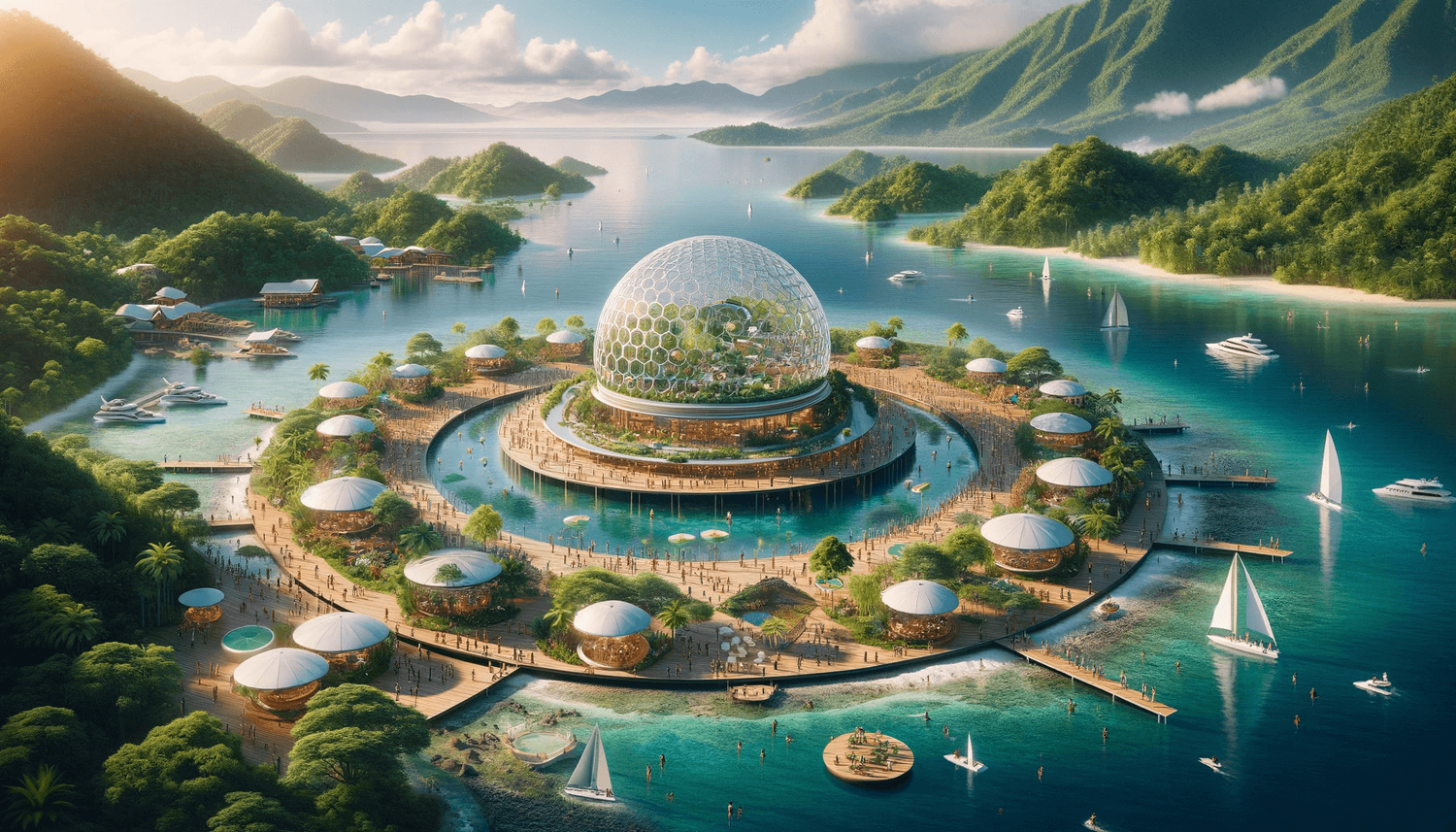
Currently, Próspera has become a center for biohacking and experimental medicine, as it is not subject to FDA regulations. Despite the Honduran government's attempts to repeal the laws that gave rise to it, the project remains firm through million-dollar lawsuits in international courts, protecting its status as a "island" of private sovereignty against national jurisdiction.
Pronomos Capital
Pronomos (from the Greek pro: in favor of, and nomos: law) is a concept associated with Nick Land that suggests capital not only operates within an existing legal system but also tends to generate its own rules, territories, and forms of governance. The idea implies that capitalism can produce new political and legal orders wherever it expands. The name was also adopted by Pronomos Capital, an investment fund driven by figures like Patri Friedman (grandson of Milton) and Peter Thiel, which finances projects for new cities and special economic zones with their own legal frameworks. In this way, a theoretical concept about the organizing power of capital becomes a practical attempt to create territories governed by market-designed rules. Among others, Pronomos is funding projects like Próspera in Honduras, Itana and Alpha City in Lagos, Nigeria, and the most controversial of all due to its philosophy and aesthetics: Praxis.
Praxis, a tribute band to Albert Speer
Dryden Brown was, until recently, an unassuming stoner surfer. He could have continued like that, but no; eventually, he decided it was more interesting to start a startup in Silicon Valley and seek investors for his new idea: Praxis, the eternal city. No small potatoes here. Soon he secured financial backing from none other than Peter Thiel and Sam Altman, the metamorph who, we note, is well-served by all the buses.
Practically, Praxis operates on many of the principles we've seen in other Network States: traditional citizenship is replaced by a residency contract, taxes are not paid but rather services, and the approval to be a citizen/user rests in the hands of the board and its CEO/Emperor. But its major differentiator from other projects lies in the aesthetic narrative they have attempted to construct. Their ideology, termed heroic futurism, aims to restore Western civilization through monumental architecture and a rejection of bureaucracy. This is where they do not hide the inspiration drawn from Albert Speer, the architect of the Third Reich.
Traditional citizenship is replaced by a residency contract, taxes are not paid but rather services, and the approval to be a citizen/user rests in the hands of the board and its CEO/Emperor.
Germania was the urban project conceived by Albert Speer to transform Berlin into a monumental capital. Its colossal scale and the so-called 'Theory of the Value of Ruins' aimed to produce architecture designed to symbolically outlive its own time, enshrining the supremacy of the State over the individual. If Germania embodied the aesthetic of power of 20th-century totalitarianism, founded on the nation and the idea of empire, Praxis can be read as a contemporary and privatized mutation of that same monumental aspiration.
Both imaginaries share a form of heroic futurism, an architecture oriented towards transcendence and historical permanence. However, while Speer's project responded to the will of a dictator and the symbolic logic of the total State, Praxis seems to respond to another form of power: that of corporations and their financial elites. Where Germania aimed to be the visible center of a territorial empire, Praxis adopts the form of an enclave: the aesthetic bunker of an elite that imagines its own accelerated and expanded vital existence through biotechnology and genetic editing. A conducive space for the development of AI that, like true Cyber-Mengeles, aim to improve the human race and give billionaires' telomeres a good lift.
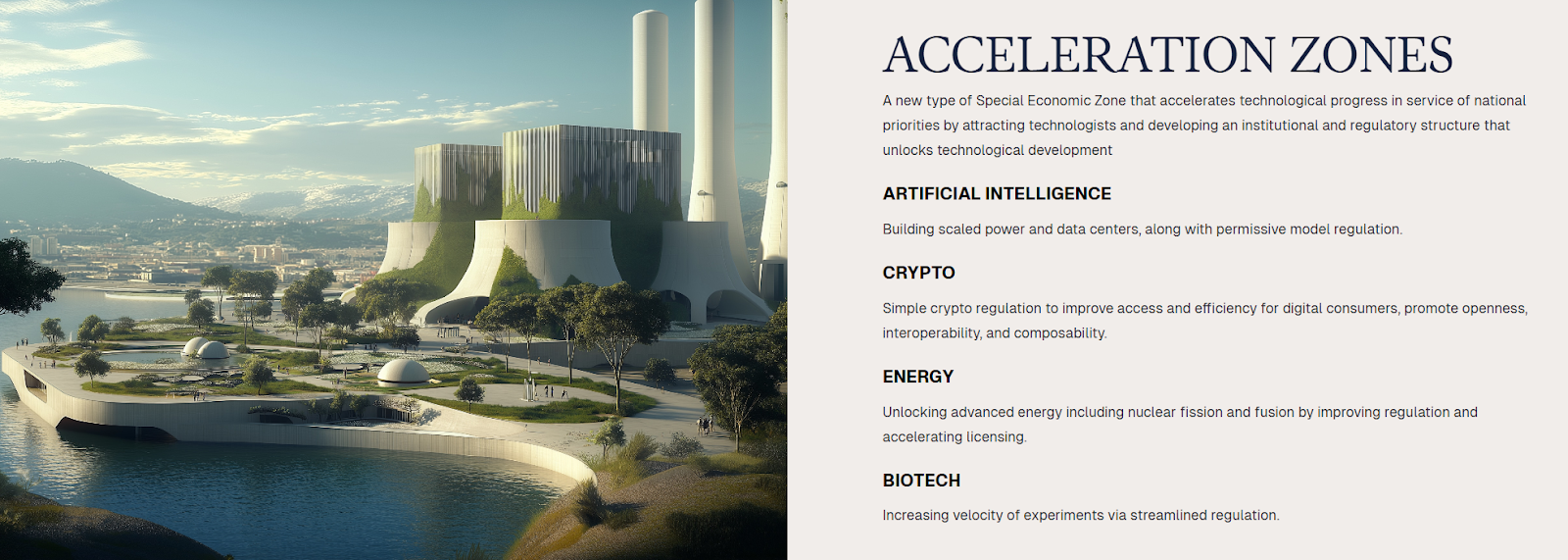
Dryden Brown, the former stoner surfer, made headlines in January 2026 due to a new diplomatic incident between Donald Trump and Greenland. What began as a geopolitical provocation ended up feeding into a concrete project. In 2019, Donald Trump suggested that the United States could buy Greenland, an idea quickly rejected by Denmark but revealing of the growing strategic interest in the Arctic. Years later, Dryden Brown visited the island exploring the possibility of building a city from scratch there. The episode fits well with the notion of hyperstition: hypothetical tweets that, when circulated with enough intensity, end up generating the conditions for their own realization. The circle becomes more suggestive when we observe that Ken Howery, an entrepreneur in Peter Thiel's circle, was appointed U.S. ambassador to Denmark, placing a figure from the same technological ecosystem at the diplomatic center of this new frontier.
At the intersection of venture capital and geopolitics, Greenland appears as more than just a territory: it is a potential laboratory to experiment with new forms of private sovereignty. Moreover, Greenland is an optimal option for a Network State based on AI and on-chain contracts: cold for servers, rare earths, massive water reservoirs, nearly unpopulated territory, and a sovereign status under discussion. The same conditions apply to Patagonia, which already has a tailored RIGI and an emerging Pop-Up City.
The market for real estate utopias
The offerings are varied. We can start speculating in this new emerging market: a little plot in Próspera, a studio in Praxis, a parking space in Orbital Reef. But it's not that simple. We're going to need a good amount of dollars; better said, bitcoins. Because the way to enter these possible futures is not through blood or place of birth, but by paying memberships.
The most progressive forms of governance, like those promoted by Vitalik Buterin or the ones explored by Santiago Siri in our country, promise horizontality, participation, and openness to diversity. However, those same virtues often bring difficulties: there is almost always an inversely proportional relationship between the degree of participation and the ease of reaching consensus. The intrinsic problem of democracy appears in both a parliament and a university assembly or a consortium meeting: governing implies tolerating others, their opinions, and their interests, especially when they conflict with our own.
It is urgent to seriously discuss the plans of these technofeudal billionaires and, above all, to imagine alternatives. Science fiction and hyperstition do not belong solely to them: they can also be sources of inspiration for those of us who do not want futures of exclusion.
Therefore, certain more verticalist proposals, organized not around the horizontal vote of participants but through more concentrated hierarchical and decision-making structures, tend to preserve themselves better from the permanent wear of internal conflicts. By reducing spaces for deliberative friction, they manage to maintain greater strategic coherence, even if it comes at the cost of sacrificing some of the plurality that horizontal forms seek to guarantee.
In this offering of possible futures, belonging to a private city will not be an option for the vast majority of the population. Because the fundamental premise of all these proposals is exclusion. They respond to the logic of any gated community. What is left outside, the undesirable, is as important as what is allowed inside. Just like in American Gated Communities, or in our private neighborhoods like Nordelta, before calling the moving truck, one must be approved by the consortium and its demographic curatorial criteria.
The responsibility of imagination
We can dismiss all these projects as dangerous whims of billionaires who no longer know how to spend their bitcoins. Bored, they invent new forms of competition and self-affirmation. It no longer matters who has the longest yacht or the highest stock value in their portfolio. The competition has shifted to who can determine the new social, economic, and cultural form of humanity. It is no coincidence that issues like wellness, mindfulness, or biohacking appear, mixed with topics like cryptography, governance, or sovereignty. Although it sounds grandiose, what is at stake is nothing less than the design of the successor to Homo Sapiens, something that cannot be achieved without modifying genetics, mind, culture, and society.
The truth is that these actors are taking on a question that, in reality, concerns us all: how to imagine and organize the future. The difference is that they have the resources and time to turn their ideas into real cases. They can experiment, make mistakes, and start over again and again. That is why it is urgent to seriously discuss the plans of these technofeudal billionaires and, above all, to imagine alternatives. Science fiction and hyperstition do not belong solely to them: they can also be sources of inspiration for those of us who do not want futures of exclusion, manipulated genetics, or transhuman dictators, but possible forms of governance and democratic cooperation.
The danger is that time is running out. There are multiple threats to face, from declining birth rates, climate catastrophe, nuclear war, another pandemic. Or the worst: the ominous Falcon that is already on the sidewalk with its lights on. It’s better that we start imagining alternative proposals that are more inclusive. It’s that, or accept that we’re all going to end up swept away and piled into the same box.