The Milei Anomaly

13 de abr. de 2022 — Juan Ruocco 🧙♂️
In the Foundation trilogy, one of the literary classics of science fiction written by master Isaac Asimov, the protagonist Hari Seldon invents psychohistory: a new science that mixes mathematics, statistics and psychology whose objective is to predict human behavior. Psychohistory is based on a fundamental axiom, which is that a sufficiently large mass of individuals is governed by measurable probabilistic laws. Unlike the natural sciences, here the object of study are human societies and populations, but the method is the same: large quantities of data, variables and formulas.
Based on the psychohistorical predictions, Hari Seldon discovers that the galactic empire is heading toward an inexorable dissolution and a period of anarchy lasting thirty thousand years. The only chance for humanity's survival is to shorten that period of anarchy to a single millennium through a specific plan. A sort of recipe for minimizing the impact of the catastrophe. And so, Seldon creates the Foundation: an institution that, from the remote planet of Terminus, will be in charge of executing that plan. The whole saga is about the success or failure of the Foundation.
But there's a problem. There's the possibility that the Foundation will fail. This is due to the potential existence of an unpredictable individual with a high capacity to distort reality and historical destiny. An anomaly, which in the book goes by the name "the Mule." If we take this analogy to Argentine political reality -- after all, it's about an anomalous individual's ability to redirect the course of history -- we might well ask: is Javier Milei an anomaly? Does he have the capacity to reconfigure Argentine politics? In this article, the first of many on this blog, we will try to explore this question.
Following his media appearance, libertarian economist Javier Milei has been subjected to a series of analyses and journalistic articles attempting to capture or explain the phenomenon. From treating it as a purely media phenomenon (based on his hours of TV exposure, which are extremely high) to a grassroots expression of the crisis, and from being dismissed as an eccentric outsider with no real chance of winning elections, even as a buffoon. He has also been analyzed through the lens of other ideological traditions. As a mere resurgence of Menemist discourse. As a purely media phenomenon. However, before going into those analyses, it's worth asking what Milei represents.
Javier Milei defines himself as a libertarian, a problematic term because in the Spanish-speaking tradition, "libertario" is synonymous with anarchist and is at the same time the literal translation of the English term "libertarian," which means two concepts that are in principle irreconcilable end up overlapping. In this case, what Milei represents is a very particular version of libertarianism: anarcho-capitalism, which is not the same as philosophical anarchism. And within the global spectrum of libertarianism, Milei identifies with one of the most radical currents, the Austrian School of economics.
The novelty he presents in political terms is bringing the idea of Austrian liberalism to the Argentine political menu. In fairness, I was completely unaware of the Austrian School until Javier Milei's appearance. Basically, what the Austrian School proposes is the same as the more extreme version of American libertarianism: freedom above all else and the state as a criminal organization. In practice, this translates into a political program based on the elimination of taxes, deregulation, privatization and the definitive abolition of the central bank.
Added to this, Milei builds another quite efficient ideological operation, which is to link this anarcho-capitalist tradition, apparently completely foreign, to a local tradition. And not just any local tradition, but that of the "founding fathers" of Argentina. Especially Juan Bautista Alberdi, author of the 1853 Constitution and a renowned liberal who, as Milei sees it, proves that when Argentina followed the ideas of economic liberalism, it was a prosperous country. Whenever it got lost in the fog of statist governments, it declined. This is an ideological construction that allows Milei to claim to be even more founding-myth than Argentina itself (and even more so than) Peronism itself. "The happiest days were always anarcho-capitalist."
The emergence of the Milei phenomenon is inseparable from its context. Since 2011, Argentina has been living in a state of permanent crisis. In the same decade that its modest neighbor Bolivia, with an inclusive social model and fiscal discipline, doubled its GDP, Argentina kept it the same. Of course, it's much easier to double a small GDP than a large one, but the comparison serves to illustrate that Argentine economic performance has been very poor across different administrations over the last decade.
In the period from Cristina Kirchner's second term to the present, there were three governments with poor results: currency devaluation, destruction of international reserves, GDP stagnation, growth of peso-denominated debt, growth of dollar-denominated debt, destruction of real wages, inflation, and all kinds of indicators showing a country in permanent decline. Each of these three governments had completely different political and ideological orientations.
However, when political leaders are asked about this poor performance in terms of governance, depending on their political alignment, the answer is more or less the following: it's the previous one's fault. For Alberto, the disaster is Macri's fault; for Macri, Cristina's. At some point, this blame chain stops being convincing and a broader question arises: are the current political parties capable of governing? And it is in this gap where Milei seizes his great opportunity.
Alberto inherited a country with a serious debt problem but the lack of political will undermined all attempts to rebuild the economy. Macri received a country with strong macroeconomic imbalances but with low indebtedness. Instead of reducing the fiscal deficit, he financed it with dollar debt, the worst of all possible decisions. And Cristina, who during her second term spent every last cent accumulated during Nestor's two terms, the latter of which was already showing signs of strain.
Another answer, slightly more up-to-date but equally systemic, is failure as a consequence of the lack of long-term consensus. This is the shared thesis of the "new wave" of professional politicians. If we think of Cristina and Macri as an "old guard," the "natural successors" of both camps who tried to introduce a new political paradigm, with less confrontation and more negotiation, were Horacio Rodriguez Larreta (representing the center-right of PRO) and Sergio Massa (representing the center of Peronism). Both lost to Milei, who, by the way, was the one who attacked them the most.
Javier Milei has managed to capitalize on this feeling of permanent failure in exceptional fashion, and without it he wouldn't exist as a political figure. It's in this context that Milei explodes as a phenomenon, making his appearance by questioning the system as a whole. This operation is foundational in the Milei strategy that we could call the TML (Milei Libertarian Thesis): the entire political class, regardless of ideological sign, be they right, center or left, are all guilty of Argentina's crisis; there are no innocents, and Milei comes to sweep them all away.
The paradox of Milei's foundational gesture is that, contrary to what the economist himself would be willing to accept, it is a typically populist gesture, as characterized by Ernesto Laclau in "On Populist Reason," where the fracture, the division, meaning the creation of a "them" and "us," is not a manipulation but an essential element of political articulation. Milei's "us vs them" is: us (the citizens, the people, the Argentines) against them (the political caste). This is a classic element of populism.
And this is perhaps the, by no means negligible, novelty that Milei represents. Well, for Milei, nationalists and republicans are the same thing, they're part of the same bloc, and he represents the new. In this sense there would be a new divide between the political establishment (understood as the whole of the traditional political class, with its different ideologies and affiliations) and a libertarian "outside" that arrives to "blow them all up." The same Laclau would note that this mirrors the Peronist founding gesture of 1945, where Peron articulated workers' demands by fracturing the political field into Peronism vs anti-Peronism.
Although it's far too premature to state it categorically, this new dichotomy seems to be starting to permeate the different strata of the political establishment. For the past few weeks, various news portals have echoed a survey that circulated within the political sphere (reliable in the sense of being professional): "You agree more with Milei's approach (even if you disagree with his methods) or with the traditional political class?" Approximately 50% chose Milei. And these are not minor numbers. There are two characteristic responses from the system against this result.
These responses can be characterized as systemic, that is, from professional politicians who try to demonstrate that the anomalous candidate doesn't have enough expertise to compete with them. Something like the political immune system trying to eliminate the virus. The first is the typical Peronist response: "he's one of Macri's." That is, deny the anomaly and reduce it to the already known. The second response, more typical of the center-right, is: "he doesn't know how to govern." That is, a credentialist argument.
Why? Because they have the opposite effect of what they intend: the statements seek to discredit him, but the discrediting is a symptom that they consider him at least a considerable enemy. Until just a few months ago, he wasn't even that. It's this paradoxical mechanism that propels this type of candidacy and, at the same time, exposes the cracks in the political system.
Another by no means negligible factor within the Milei anomaly is anti-communism. A topic we explored in other articles like this one, this one and this one; but which has become an identity marker for a lot of young people with heavy exposure to internet forums like Reddit, 4chan, Rouzed, Hispachan, and a long etcetera. While in its most literal version, anti-communism is simply opposition to communism, in its memetic version it serves to discredit any form of progressivism. In this way, Milei and his circle use the label as an extension of the caste concept: those who oppose his reforms are "communists" and therefore enemies of civil society. Again, Milei has the high ground because the high degrees of state intervention over the last decade have proven, at minimum, inefficient. Any force calling for less state intervention automatically sounds reasonable when the state has failed so spectacularly.
It should be noted that there's a latent danger in the "anti-communist" meme too, which is that those who subscribe to it are also prone to crossing democratic limits and explicitly or surreptitiously vindicating the 1976 military dictatorship. While it's not a direct relationship, neither is it a phenomenon to be dismissed lightly.
None of the above can be taken as an attempt at electoral prediction. The success or failure of the TML strategy ultimately depends on historical timing and millions of factors that may (or may not) align to deliver an electoral victory. As of today, the possibility of an electoral triumph for Milei's space is neither confirmed nor ruled out. But as we said, that's not so important for our analysis.
But what's important for us is whether, beyond the electoral future, the Milei anomaly has the capacity to reconfigure the political system or not. That is, whether his us-vs-them operation is successful. Let's consider that while Donald Trump lost the election, Trumpism is still there: from the Republican politicians who still cling to his figure, to the social movement that his candidacy set in motion and that today operates with a life of its own, even independently of Trump.
And the permanence or not of a "liberal camp" depends on another factor also made explicit by Laclau, which is the unsatisfied demands that a politician can articulate. It's not only necessary to have a division between a "them and us" but to create a chain that articulates unsatisfied demands that are not being addressed by the existing political class. These unsatisfied demands are nothing more than the systemic failure outlined above, and the important thing for Milei is that there's no sign of this changing; that is, there's no sign that the political class will solve its problems and therefore Milei's rhetorical fuel won't run out.
What's novel about Milei is that unlike the "moderate" options, Milei chose the path of going straight toward the ideological extreme most opposed to Peronism, something that the rest of the professional political forces (UCR, PRO, FIT) always handle in more diffuse terms. In general, non-Peronist forces always stay between center-right and center-left, whereas Milei went directly to the hard right. The gamble is: if Argentina's shift rightward deepens, Milei is in a much better position than the traditional parties. If the opposite happens, well, at least he already moved the entire spectrum one or two notches to the right, which is already a political achievement.
The most simplistic analyses may speak of a triumph of "anti-politics," that it's all been a media implementation "from the top down" and that Milei is the candidate of the media-economic establishment. I believe that's an erroneous reading. I believe Milei has a very active grassroots base and that his digital communities have genuine commitment. For example, the "Operation Cocker" case is quite illustrative: it was a digital operation carried out voluntarily by a libertarian community from a Telegram group with more than 20,000 participants. This operation was coordinated on the internet and was named "Operation Cocker." The term comes from a tweet by user @heraldobosio who described the operation to manipulate elderly Macri supporters into believing that Macri endorsed Milei.
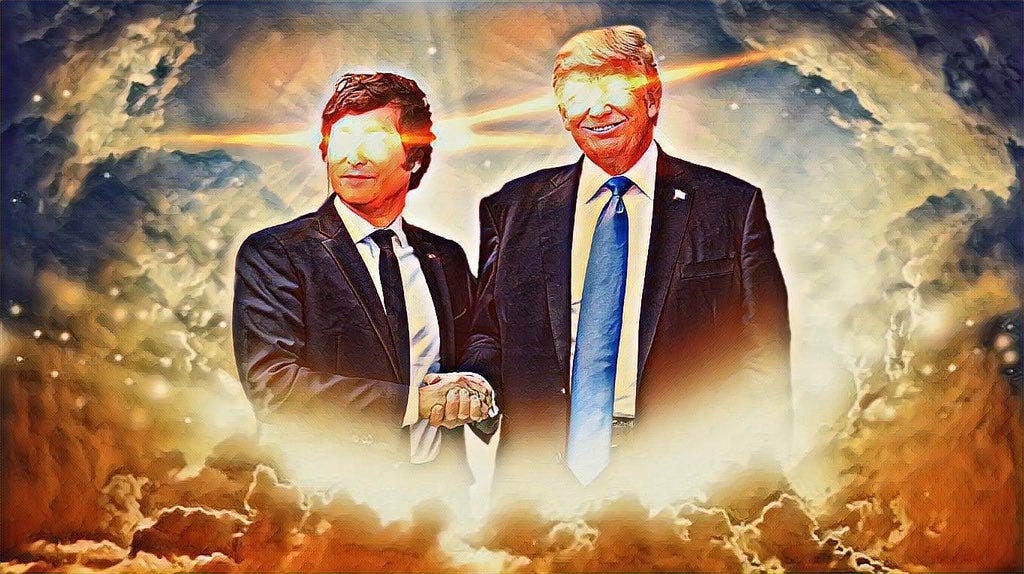
The objective of Operation Cocker was precisely to make elderly Macri supporters believe, through very low-quality memes, that Macri supported Milei and not Maria Eugenia Vidal (Larreta's candidate). So they started flooding various WhatsApp and Facebook groups of elderly Macri supporters who were inclined toward Larreta's candidate. Whether this case was successful or not, it's significant because it shows that it was a grassroots operation with genuine commitment from a community that decided to push in favor of Milei for free. This can be seen in the permanent proliferation of memes featuring Milei on the internet, where they portray him as a superhero, as a general, as a founding father. The level of cultural production around Milei is massive and largely organic.
While after years of more or less statist governments, the radical shift toward a minarchist policy seems a bit far-fetched, one shouldn't overlook the precedent of the Alfonsin-era hyperinflation. It's worth remembering that convertibility was a response to the worst crisis in the country's history. Menem came to power as a Peronist promising a "productive revolution" and ended up governing as the most liberal president in the country's history, privatizing absolutely everything. Milei, paradoxically, could be the Menem of this era if the crisis deepens.
Finally, and to close this extensive article, I return to the opening question, to conclude that Milei is in some way an anomalous figure in Argentine politics, but that this anomaly is not detrimental to the candidate (as the systemic responses try to show) but rather the opposite: the anomaly is his greatest asset. The question isn't whether Milei is normal or not, but whether his operation of fracturing the political field will succeed. And for that, what we must watch isn't the polls or the debates but the unsatisfied demands of Argentine society and the capacity of his movement to channel them through the internet, why not. However, even if the Milei political project turns out to be a failure, what will happen to the liberal camp he built? Will it persist like Trumpism, with a life of its own? That is perhaps the most important question of all.