the parable of the dolphin

8 de ene. de 2023 — Juan Ruocco 🧙♂️
We can find traces of "the truth" even in the cruelest situations in life. As David Mamet says, humans tell each other stories because through them we learn things about life. Perhaps, in fact, there is no greater introduction to the universal truths of existence than tragedy.
It was the summer of 2016 and the Argentine coast became the stage of a drama that would have no direct consequences but whose influence accompanies us to this day in the form of a parable.
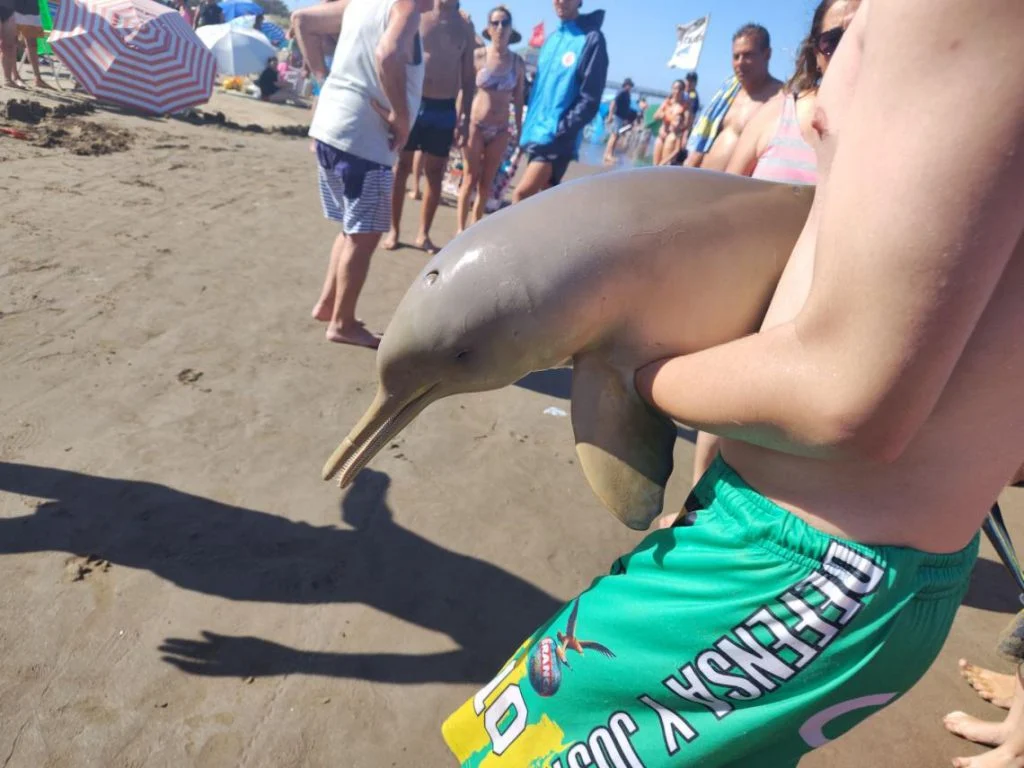
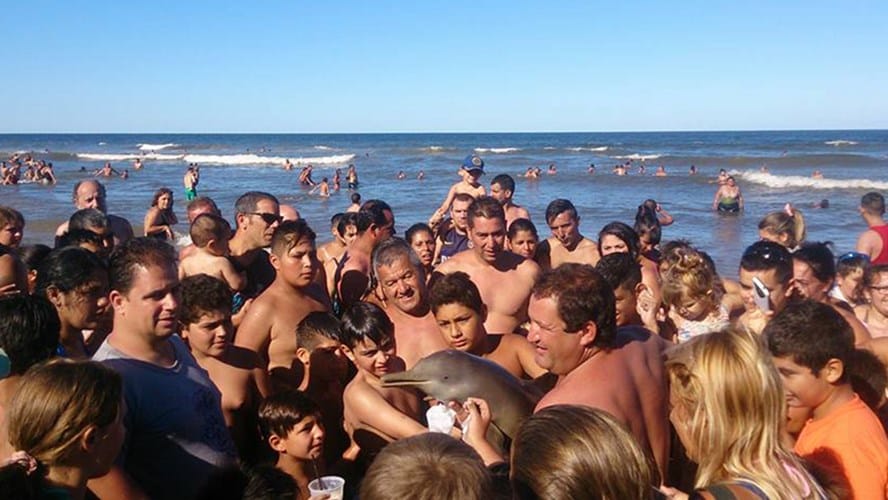
On the morning of February 16th, a dolphin of the species Pontoporia blainvillei (also known as Franciscana or Tonina) appeared on the shores of the beach, I believe, of the seaside town of Santa Teresita. This species is native to the estuary of the Río de la Plata and is only found along the coasts of Argentina, Uruguay and Brazil. It was declared a "natural monument" of the Province of Buenos Aires on November 17, 2017 by law 14992, as a result of the incident I will describe below.
For the bucolic rhythm of the Atlantic coast in general and the beach towns near the Bahía de Samborombón in particular, the appearance of a dolphin, even if it is just a small specimen, is an event of considerable magnitude. The equivalent of seeing a unicorn for a medieval peasant, a magical occurrence capable of shattering the coastal monotony produced by sand, churros and brown water.
While the proper thing would have been to return it to the water, the people who surrounded the animal could not help but get carried away by the excitement and celebrate this unique event the way any Argentine would: lifting the animal above their shoulders and parading it around like a football player who has just won a championship. Who wouldn't have given in to the temptation of taking a victory lap on the beaches of Santa Teresita with the dolphin on their shoulders?
But, oh cruelty, the dolphin urgently needed to return to its natural habitat. The thick, oily skin of the species that provides warmth in the cold waters of the Buenos Aires coast is a death trap on land. As expected, the dolphin died.
Herein lies the tragedy: those who hoisted the dolphin like a trophy did not realize that their astonishment, fascination and, why not, genuine love for the cetacean was killing it. Thus, Argentina produced one of the most incredible photos of recent times, one that somehow encapsulates our relationship with idols: killing them with love.
In contemporary Argentine neo-language, this paradox is usually called "toxicity." A toxic relationship is one where mutual fascination produces incessant pain. In this case, there was no mutual fascination since the poor tonina could not even consent to that victory lap. If we are to be precise, this was, plain and simple, a culpable dolphinicide.
In this sense, and following in some way Darwin's idea of "natural selection," we can say that in the case of the dolphin inhabiting the Argentine Atlantic coast, its charm and beauty were an evolutionary disadvantage. Attracting the attention of many Argentines can be lethal.
Digital Dolphins
Now, the amusing thing about this behavior is that it is not limited to the Atlantic coast and dolphins alone; in the digital realm, it repeats itself constantly. Given the dynamics of social media where users compete all the time for the attention of their peers and those who do it best are rewarded materially or symbolically, dolphinization is a constant danger.
We can define dolphinization as a parabola. Both in a literary sense and in a mathematical sense. In its literary sense, we can relate it to cautionary tales, or tales with a moral, very common for example in the Gospels. It seems that Jesus himself had an obsession with this type of narrative and went around explaining to his peers what the kingdom of God consisted of through these metaphors. "The parable of the prodigal son," "the parable of the good Samaritan," "the parable of the talents" and many others that anyone exposed to Christian/Catholic doctrine can easily recall. In its mathematical sense, the parabola represents a curve with a very clear characteristic of certain symmetry when cut in half by a vertical axis. Wikipedia says on the matter: "In projective geometry, the parabola is defined as the envelope curve of lines connecting pairs of homologous points in a similar projectivity or similarity."

If something has a parabolic rise, a parabolic descent is to be expected.
Twitter became fertile ground for the dolphinization of some users. The most significant case we experienced this year, and the one that fueled the creation of this post in the first place and this article in the second, was the emergence of "el niño de las tortas" (the cake kid).
Joaquín Nahuel is a boy who specializes in baking and who began gaining notoriety on social media in early 2021. The boy met a series of conditions to be the object of the public's love: he was a child, he made incredible cakes, he had been in an accident where part of his body had been burned, and he came from a very humble family. It seemed that the boy's goal was to pay for reconstructive surgery with the sale of his cakes. Up to this point, the story seemed like a Fellini film.
Joaquín's emergence coincided with the great success of Masterchef, a Telefé reality show where contestants had to cook complex dishes under the watchful eye of a very strict jury. One of the judges and the most beloved by the public, Damián Betular, was a pastry specialist.
This combination of fortuitous events caused an unusual number of users on the platform to begin showing their love, oh no, to the boy. There would be no problem with this, but as we have seen above, the love of many Argentines at once can be lethal. The boy had a meteoric rise, met various celebrities who ordered cakes from him like Carlos Tevez, Wanda Nara, Carmen Barbieri and even Betular himself.
Along with this, some questions began to arise about whether it was right for a child to work, to have such a level of exposure on social media, what the role of the father and mother was in the whole affair -- in short, a series of endless debates typical of Twitter. His arrival on television was an indicator of a dizzying ascent.
Shortly after becoming a kind of favorite mascot of social media, the cake kid left the platform. It seems that the user @sangrexeneize made a joke about Boca Juniors' performance pretending to be the cake kid. The subtlety was not entirely grasped by the boy or whoever managed his social media, and the inevitable happened. Trying to repair his mistake, @sangrexeneize delivered the definitive sentence: "sorry Joaquín, I love you." The parabola had been consummated: the sudden overexposure caused a symmetrical movement. A fall as sudden and thunderous as the rise.
This is a pattern that inevitably repeats itself, not only on Twitter but on other social media platforms as well. A user appears who for some reason seems likable, entertaining, fun or simply attractive. People start celebrating them, which generates a feedback loop: the user, riding on their popularity, begins to generate more attraction. New users drive their popularity even higher. Until inevitably the overexposure generates some conflict. This is where each user's mettle shows. The conflict can either strengthen the individual's growth or bury them. Perhaps the first to have suffered this parabola was Hugo Basilotta, the owner of Guaymallén, who started his upward cycle as a likable boomer generous in giving away alfajores, but who then had a conflict with an influencer that unleashed a side not much celebrated on social media. It is worth noting that in Basilotta's case, the user actively sought that exposure, so we can speak of self-induced dolphinization.
The latest or newest case of dolphinization I have in mind is that of "Toto" Massa, son of the economy minister Sergio Massa. Toto appeared on social media as a kind of interlocutor or bridge between certain young Twitter/influencer users and his father. With the arrival of the World Cup, Toto went to Qatar with the goal of covering the World Cup until a user discovered that the sponsorship of the adventure came from YPF, so "Toto" fell under the firepower of Twitter's libertarian wing to the cry of freeloader, etc. etc. Meteoric rise and symmetrical descent.
So dear readers, now you know: if for some reason at some point you find yourselves in the spotlight of social media and out of nowhere a horde that claims to love you appears, the best thing you can do is get down from the shoulders of those who say they love you and go back to the sea for a while, or to whatever natural habitat is yours.
Avoid the tragic fate of the natural monument of the Province of Buenos Aires.
[UPDATE JANUARY 23, 2025]
It happened again. It will happen again.