The Secret Law of Coincidences
Taking action is a probabilistic game: the more you act, the more nodes and interconnections you make possible in the future. But you have to know how to leverage them.

13 de dic. de 2025 — Mufa
A few nights ago, chatting with my closest friends, we ended up in a deep conversation about having a sense of professional purpose. Especially about an idea pessimists hate: that if your intention is intense enough, and you go for it with enough force, "the planets align" and your goals get met. That quasi-mystical intuition is, in my opinion, a true but overly pretentious shorthand for something much more earthly: the power of networking.
One of my friends argued –quite rightly– that people who preach this are influenced by survivor bias. Basically, we only hear the stories of those who win, ignoring those who tried the same thing and failed. And it's logical: the people who say "if you put in energy and tenacity, the rest will fall into place" are the ones who actually made it, so they can connect the dots and rationalize it that way. My reading is different. That "law of attraction" is just a poetic way of describing how it feels in your gut when things go well: it's like the universe is on your side. That's the emotional way to explain it. In reality, it's a probabilistic game. And it works on a delay.
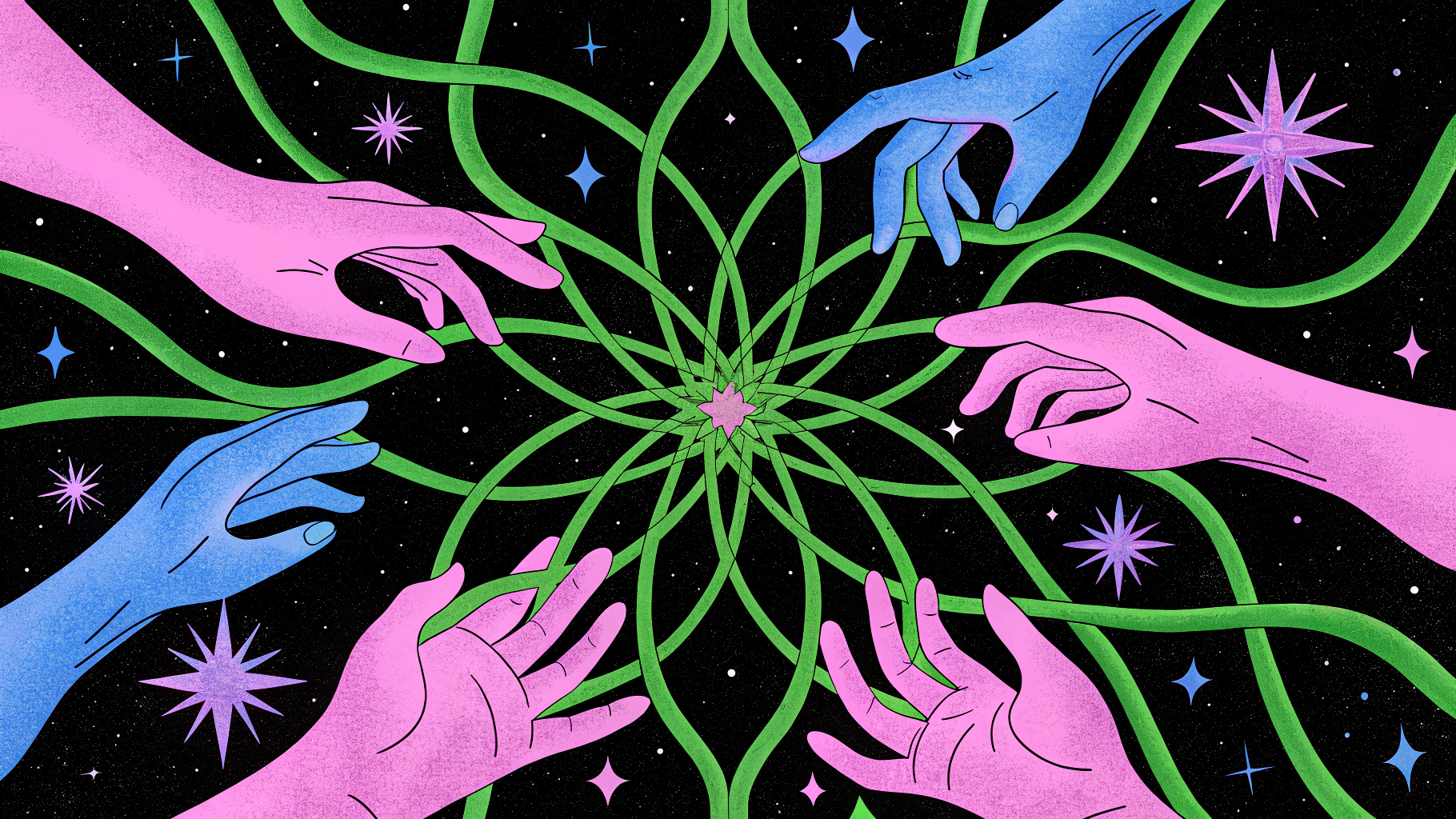
As my friend Pak said on UBSN: when the number of actors involved in a given scenario increases, the number of possible relationships doesn't grow linearly –it grows exponentially. In this context, the more actions that put you out in the world (an idea, a project, a presence, a gesture, an intervention; being valuable, communicative, or simply fun), the more "nodes" you create in a network of possible interconnections. Each action generates new nodes, and those nodes weave a web of possibility that opens new doors –almost always unexpected ones.
Yes, there are talented, tenacious, good people who never see that "happy ending" or their own cosmic conspiracy. Why? Because most of the time they're missing the other key skill you need to put points on the board: it's not just generating nodes –it's leveraging them. There are incredible people who generate nodes and never use them, and there are mediocre people who squeeze every last opportunity and look like they live blessed by the gods. I don't deny my luck –I've had it in many ways– but I'm aware that this luck only exists because I'd already created an absurd amount of potential around myself. The effect isn't immediate. Creating points and knowing how to connect them into constellations is an art.
So when you catch yourself gloating that the people you hate are going to do poorly, but then you see them landing good opportunities thanks to how well they exploit these nodes, you have to ask yourself: aren't I just resenting my own lack of action on what I already have within reach? It took me years to admit one of my deepest professional learnings –one that later became my layer-zero framework, totally unnatural to how I used to see the world: volume beats quality.
If you're obsessed with the perfect piece and you spend months holed up polishing it (or doing nothing at all out of the existential dread of being judged), by the time it hits the world, nobody will care –and it won't have the impact you expected. Your signal arrives late –and exhausted– into an ecosystem that kept moving without waiting for it. The helplessness that produces, and the sense that "the world is rigged" against you, can turn chronic. And it's increasingly common.
Later I understood that repeating and shipping consistently is worth far more than crafting a "hidden gem" or a "lost tape". The move isn't to assume there's some eternal tension between volume and quality. It's to ask which one builds you a network with more potential for opportunities that are more fun, meaningful, or lucrative. Which one increases your surface area of contact with reality.
Going back to the little story about "attracting what you want", we already know it's terrible literature. But it's worth looking at what it's trying to describe: operating with crisp intent becomes almost gravitational. The ability to make people want to be around you. To leave a positive impression. The power to make a space better simply by being there.
That's a weapon, too –ancestral, psychological, even political. Being a "force for good" in the places you inhabit –even if it yanks you out of your comfort zone at first, you insolent Zoomer– turns you into a gravitational node: more people seek you out, more opportunities appear, more quests open up. If you understand networking as a system of expanding possibilities, being contagious is the multiplier.
That said: you have to prune. Not every connection is worth it. Some circles are gravitational wells: they suck your energy, shrink your map, and give you back much less than you give. The flip side of generating potential is preventing it from stagnating. Being selective is part of the trick. If you want probability to play in your favor, you need a network in motion, full of bright people. And for that, you have to know how to say no.
This is also a form of cognitive sovereignty. In the face of the constant siege on our mood –and the permanent attacks on how we feel about our lives– use this as counterplay: turn your internal state into a vector that alters the network. Use the enemy's logic, inverted. Become a deliberate generator of energy that lifts others. Because that's the part nobody says: when you generate energy in others, that network responds, grows, feeds itself –and eventually ties you back to your purpose.
It's not the cosmos. It's not the planets. Networking isn't "meeting people" or going to conventions. The exercise I'm proposing is to build and feed ecosystems where probability works in your favor. The universe doesn't reward intention –it rewards structure. Set up the board so things become inevitable, and you'll start to look lucky to the people who never learned the secret law of coincidences.