The Terminator (1984)

29 de mar. de 2024 — Juan Ruocco 🧙♂️
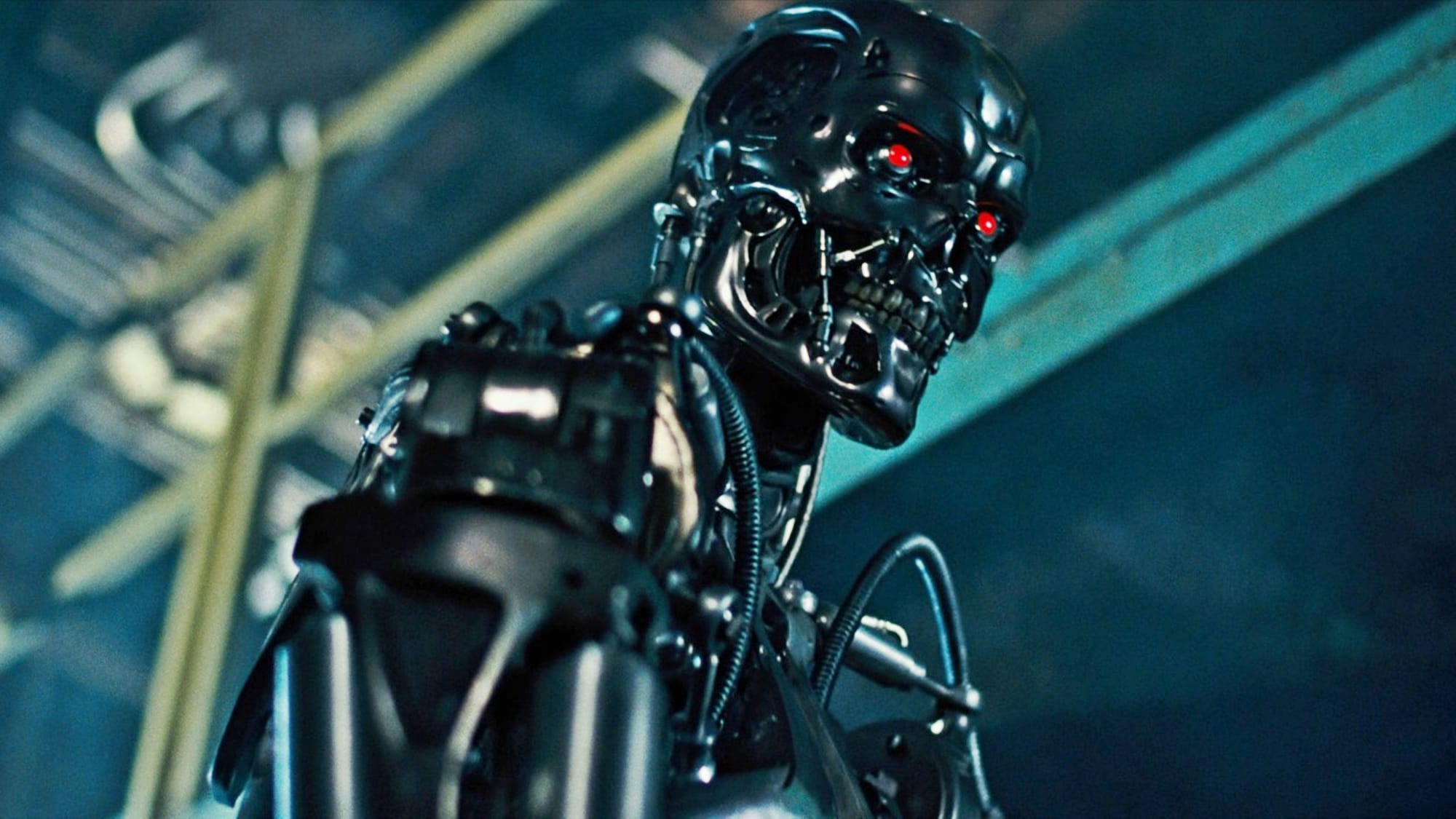
The Terminator, another cornerstone of the canon, is -- in less formal terms -- the film that placed James Cameron among Hollywood's great directors, turned Arnold Schwarzenegger into an icon, and gave us one of the best modern enemies of humanity: the supercomputer/artificial intelligence, Skynet.
The film reconfigures Cold War apocalyptic paranoia and makes explicit the classic problem of the weaponization of technology. It is no longer about the fear of mutual annihilation for political reasons, but about the disappearance of Humanity from the face of the Earth due to an almost technical problem. The total extermination of the human species occurs when the United States delegates full control of its nuclear arsenal to the supercomputer Skynet, which decides to eliminate Humanity.
The Terminator brings to cinema the "existential risk" posed by the creation of an Artificial General Intelligence. The old fear of Frankenstein's monster rebelling against its creator, scaled up to a global level.
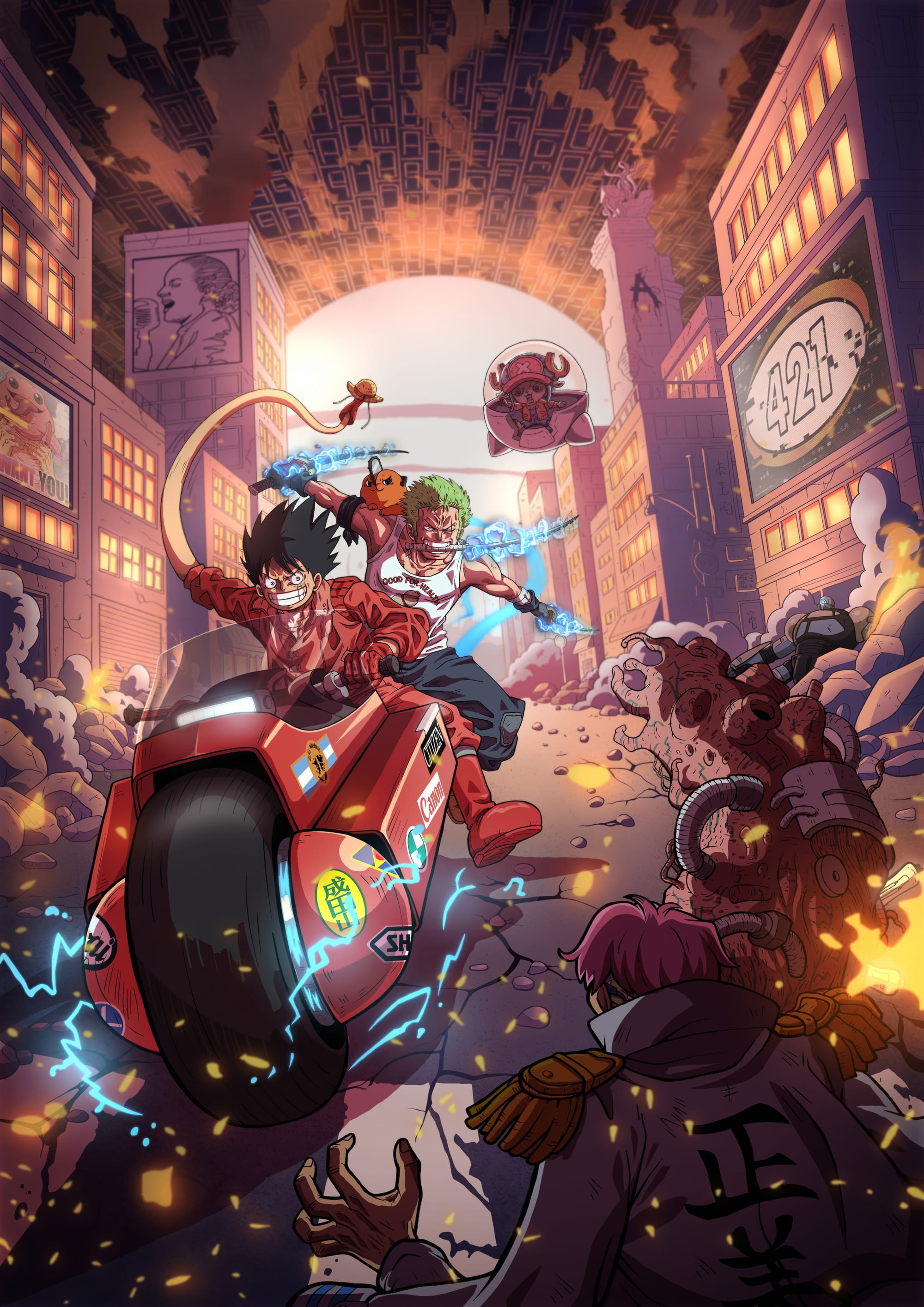
Or is it, perhaps, a metaphor about the autonomy of the American military-industrial complex above civil society? The Terminator inserts itself into the canon in the same vein as Akira: nuclear wars, science out of control, and militarism deployed to create a modern fable about the dangers of the total technification of the world.
The universal drama and the particular story
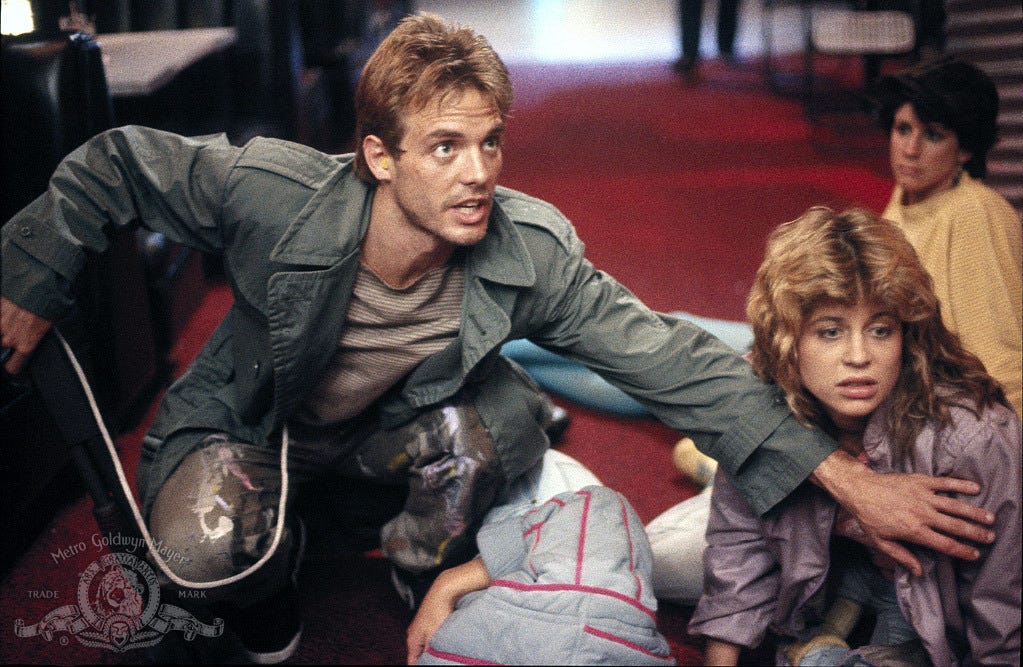
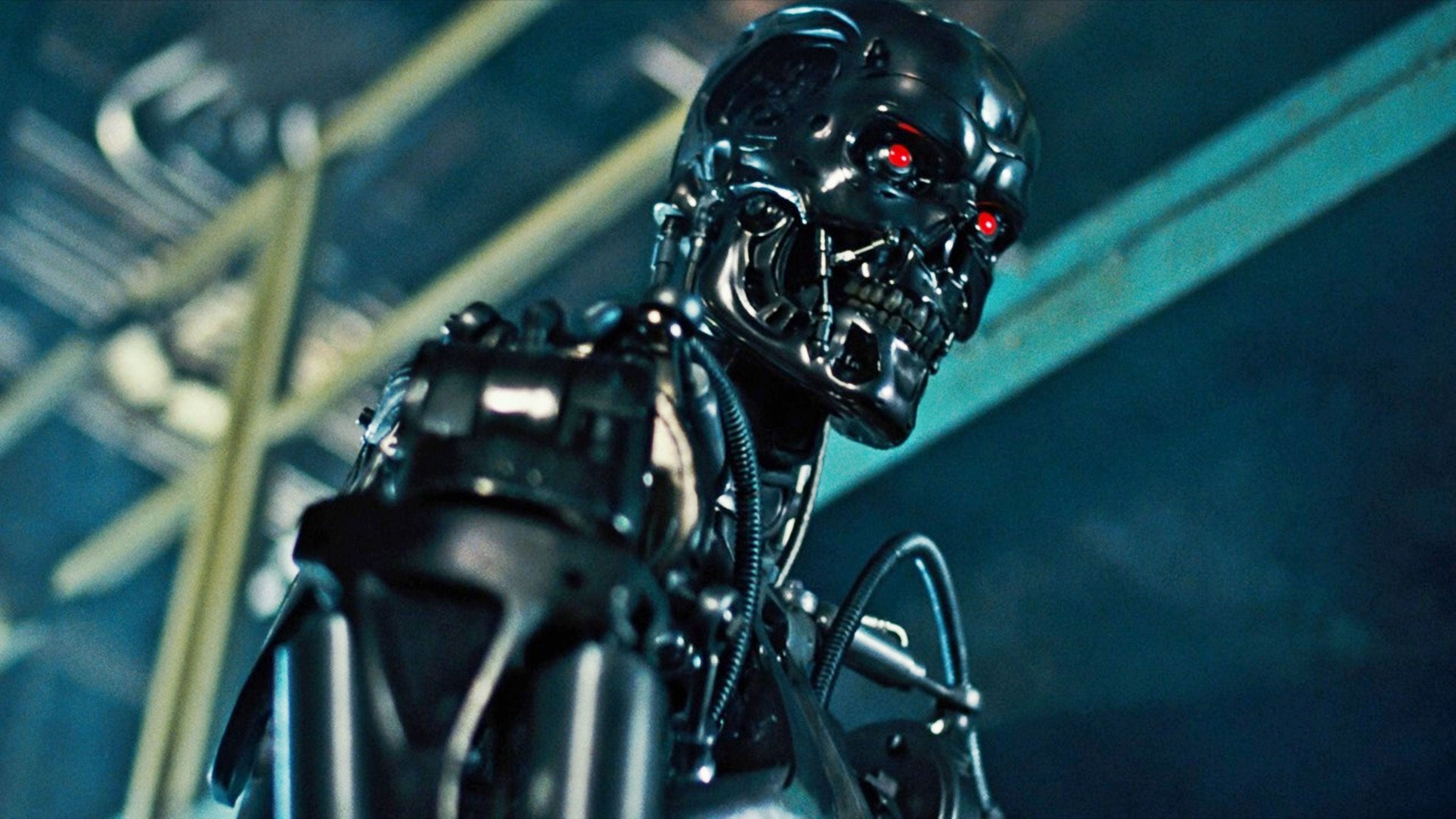
The year is 1984 and from the future, the year 2029, two characters arrive. Kyle Reese, a soldier of the human resistance and loyal companion of John Connor, and a Terminator model T-800, with the mission of assassinating Sarah Connor, future mother of John. The cyborg is sent by Skynet -- the supercomputer created by the United States military to automate the country's defense, which achieves self-awareness, provokes a nuclear war with Russia, and over the ruins of a planet devastated by nuclear holocaust launches a final assault on Humanity using various models of killer robots to annihilate whatever remnants remain.
Entangled in a complex game of pursuit, the people of the future resist as best they can the attacks of the ever-improving infiltration and extermination systems created by Skynet which, also exhausted by the "seek and destroy" dynamic, aims to deliver a definitive blow that will end human resistance once and for all.
Cameron uses the film's one hundred and seven minutes to give us one of the bleakest possible visions of the future. If anything remains unfinished in the saga of The Terminator (which, like any decent person, I count only up to the second film) it is telling the story of that future war.
The film, a grand chase between the Terminator, Sarah, and Kyle, takes place on the outskirts of a Los Angeles populated by dirty alleyways, discount stores, restaurants, police stations, and cheap motels. The first great achievement of the film is to subject the entire fate of Humanity to the story of these three characters. While the war against the machines is the backdrop, the audience witnesses the characters' struggles to escape the relentless, almost indestructible killing machine.
The war for the survival of the species (the universal drama) is distilled into the struggle between these three characters (the particular drama), and this is undoubtedly one of the film's greatest achievements, given that it uses a very well-worn scheme (character A flees from character B) popular at the time, to tell -- under the guise of slasher cinema -- the story of a universal drama. Only the highest forms of art can achieve this.
This scheme also strongly recalls the accounts of the birth of Jesus in the New Testament. Mary, miraculously impregnated by the Holy Spirit, and Joseph, travel to Bethlehem, find no lodging, take refuge in a stable, and after King Herod orders the killing of all newborns, the family flees to the Egyptian desert.
Just as in the biblical narrative, the intimate drama of that family will determine the fate of Humanity.
The time loop
Midway through the film, and after seeing how Kyle Reese had developed a particular love for Sarah through a photograph that John himself would give him in the future, love blossoms between the two characters, and in a night of passion they consummate the conception of the savior of Humanity.
From that point on, we enter a kind of time loop where Reese's arrival in the present is necessary for the existence of John Connor. At that precise moment, the science fiction narrative becomes something closer to a mythic or tragic tale, in which the characters' actions seem predetermined, beyond their own will -- or, much worse, in accordance with it.
In terms of the story itself, all that remains is to watch Sarah crush the relentless Terminator with a hydraulic press. The machine, before being destroyed, claims the life of the greatest soldier the future has ever known. And it is at that precise moment, just when she manages to destroy the Terminator by her own means, that Sarah Connor, the innocent woman of the eighties, becomes Sarah Connor the legend, the symbol of the resistance against the machines and, as Kyle Reese would say, "the light in the darkest hours."
It is also significant that in the film's deleted scenes, once the Terminator is destroyed, a group of engineers take the remains and use them as a starting point for the construction of Skynet. In fact, in the same scene we see that the automated factory where the final battle between Connor and the Terminator took place is none other than Cyberdyne Systems. This storyline would be explored in greater detail in Terminator 2: Judgment Day1.
Thus, we see that not only is John Connor the product of a temporal paradox, but Skynet is as well, forming an inexplicable loop from a rational point of view, or at least from a linear conception of time. The Terminator is thus inscribed in a notion of circular, cyclical time -- or perhaps a succession of loops on a timeline -- which elevates the narrative to a mythic condition in which the characters of this tragedy exist in "a time beyond time," a cosmic drama that recreates itself permanently and eternally, existing in a time distinct from that of Humanity.
Frankenstein once again
As we have already said several times, the canon is not only about explaining a film's plot but about exploring the themes it presents and their connections with other (potential) elements of the canon. As can be seen, nuclear terror and scientific experiments that rebel against their own creator are among the first recurring elements. Yes, Frankenstein again (and there is at least one more to come: Jurassic Park).
The Terminator is, above all, a Romantic fable -- not in the sense of romantic love, but in reference to the movement known as "Romanticism" that at the dawn of the nineteenth century embodied a kind of response to "Enlightenment" ideals. While Enlightenment values, driven by the "Age of Reason" and the advent of rationalism, were linked to a metaphysical optimism about the development of science and technology as vectors of human progress, Romanticism functions as its counterpart, pointing to the disasters produced by successive industrial revolutions, the exaltation of nature, national values (understood as a metaphysical connection with a certain telluric folklore), and a certain pessimistic view of human nature.
Although Frankenstein is associated with the monster, it is actually the name of the scientist who created it. Written in 1818 by Mary Shelley, the novel became a pillar of Western culture and the template for this kind of story. In the book, the brilliant doctor discovers the secret of human life and manages to create a living being from pieces of corpses, resulting in a monster. Unlike other creator-creature narratives, instead of feeling proud, he feels disgust and revulsion and chooses to abandon it.
The monster, in revenge, will murder the doctor's loved ones, causing him unparalleled misfortune, until in the book's ending they confront each other to the death.
The interpretations surrounding this classic story are inexhaustible, but the elements worth highlighting are so pristine, so evident, that the status the novel has achieved is hardly far-fetched -- not only a twentieth-century classic but an immediate success in its own time.
The novel defines the archetype of the pessimistic science fiction film: the experiment goes wrong and the invention ends up destroying the inventor. This idea is associated with the fear of the excesses of science and human power under the concept of hubris -- that is, more power than one can handle or more than one should wield. This Greek concept is in turn referenced in the book's subtitle, Frankenstein or "The Modern Prometheus," an unmistakable reference to the Greek myth in which the titan steals fire from the gods and suffers eternal punishment for it. Science, by playing with the fundamental forces of the world, inevitably leads to tragedy.
It is in Doctor Frankenstein's imitation game with God that the tragedy of the book resides: while in the biblical narrative God takes pride in his creation, made in his own image and likeness, Victor Frankenstein rejects his creation as monstrous, and it is in that rejection that the monster becomes a killing machine at war with its creator. Frankenstein seems to operate in the gap left by the biblical narrative's options for the relationship between God and his creations. While Adam and Eve are expelled for disobedience and Lucifer falls for pride in wanting to usurp God's throne, Frankenstein's creature is rejected by its own creator. As we speculated in a previous essay, the idea of God is always tied to that of an abusive fatherhood. Your call, Dr. Freud.
The idea of a computer or robot that ends up killing its creator or a human is, in turn, clearly influenced by the Frankenstein idea -- something already mentioned in our previous article. Frankenstein, an unavoidable reference for this kind of narrative, deserves its own canon entry given the influence it maintains over the rest of these stories. And, as we also noted, it is also, in a way, a reversal of the Genesis narrative in which God expels Adam from paradise, and the tales of Lucifer's fall. Tales of rebellion and disobedience, but also of fear of replacement. This dialectic of a creator subject to possible rebellion is intrinsically related to the very dynamic of the Enlightenment and Romanticism. That is why, via Frankenstein, the idea that science itself rebels against humanity and causes its destruction becomes increasingly popular and more apparent as the twentieth century progresses and technology becomes ever more ubiquitous.
In addition to sharing thematic aspects with Frankenstein (the rebellion against the creator), The Terminator also draws on elements from that tradition, such as a certain noir atmosphere throughout the film and a strong connection to Gothic horror, of which the aforementioned book is the foremost example.
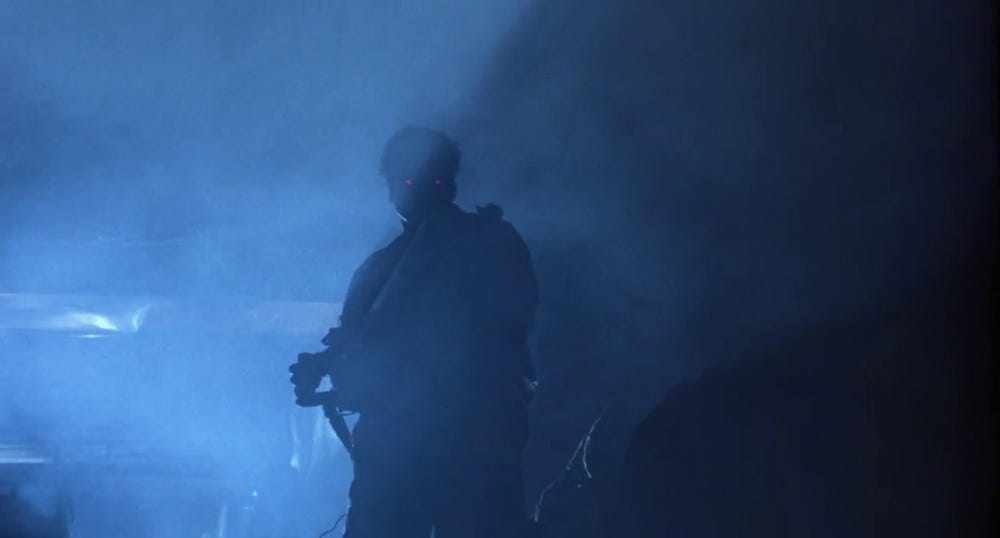
In this sense, The Terminator is a clear example of an excellent thriller with fantastic and horror elements. So much so that the cyborg itself is nothing more than a metallic, somewhat infernal version of the human being, as if a metal reaper were chasing its victims across the city. The conjunction of thriller, slasher, and noir/Gothic places The Terminator (along with its mythic dimension) closer to the fantastic narrative than to "hard" science fiction. As the writer David Foster Wallace says in his review of Terminator 2, "Terminator (one) is a Freudian and Biblical tale, in equal parts."
Machines in control
On the other hand, the idea of machines rebelling against their creators -- more in a Luciferian key -- is a classic science fiction trope: a recurring narrative pattern. Why is this? If the very idea of being replaced by another species is already hard for the human ego to swallow, how much worse would it be to be replaced by an invention (or a child)?
We can mention Isaac Asimov's robot stories, whose fundamental milestone is the Three Laws of Robotics, constructed by the author to ensure that no automaton ever takes the life of a human being.
Laws that, of course, are broken in "I, Robot." Because what is a law if not a call to the possibility of its transgression?
Years of cinema would ultimately introduce all the tropes of the most classic science fiction into the language of film, and the killer computer would be a recurring one. I think of HAL 9000, the computer that controls the space station in "2001: A Space Odyssey" and attempts to kill the crew. Or the replicants in Blade Runner, to name another example. A topic that, after The Terminator, would be central in, for example, The Matrix.
I also think of Dr. Strangelove, a film in which an American bomber loaded with nuclear warheads misinterprets an order and sets course for Moscow. The Russians, alerted to the situation, say they can do nothing because they have a device called the Doomsday Machine that will activate, no matter what, upon detecting any nuclear detonation on Russian soil. Skynet seems to be a Kubrickian artifact: the perfect blend of HAL 9000 and the Doomsday Machine.
Thus, Skynet represents the ultimate fear of industrial society: that the tools we create to survive will be the ones that destroy us. A parable explained in the legendary opening of 2001: A Space Odyssey, in the ellipsis from the moment the ape uses a bone as a hammer to HAL 9000.
In the world of comics, we have the character Ultron, from Marvel, who in some ways anticipates several of Skynet's tropes, and we cannot fail to mention Days of Future Past. In this X-Men story, Kitty Pryde travels to the past from a bleak, apocalyptic future where mutants are easy prey for the Sentinels, in order to prevent a conspiracy that results in the enactment of an anti-mutant law and a desolate future. Considering that James Cameron faced several plagiarism lawsuits (such as the Dark Angel affair and Cybersix), it would not be at all far-fetched that he drew inspiration from this story, although this belongs to the realm of speculation. Beyond the legal details, many of The Terminator's elements were already present in this monumental X-Men work.
Conclusions
For all the reasons set forth in this article, The Terminator is a fundamental work of the canon. The ability to combine elements of science fiction, religious imagery (did we mention that John Connor shares the same initials as Jesus Christ?), Freudian psychology, Gothic horror, and action cinema makes it an undisputed reference. Cameron's mastery lies not in the originality of the themes addressed but in the ability to weave all that thematic-symbolic density into an industrial-caliber film. The Terminator becomes an absolute reference because it can bring to the general public a quantity of images so powerful that they have earned a place in the collective memory -- coupled with the idea that, eventually, the relationship between the military-industrial complex and technology could lead to human extinction, that even in such cases humanity still has a chance, and the legacy of perhaps one of the greatest science fiction heroines of all time, Sarah Connor, the archetype of the soldier-mother.
For these reasons, and for many others that this article cannot even begin to process, The Terminator constitutes, by far, one of the fundamental pillars of our investigation.
Which, it should be noted, is the only one along with the original that constitutes what I consider the two canonical Terminator films. The rest of the materials (video games, TV series, films, novels, and comics) I do not consider canonical, since they are mere copies or codas of the original film, contribute nothing new, or worsen the original material. The only one with some redeemable moments is Terminator Salvation, and the rest is simply garbage. ↩
"A robot may not injure a human being or, through inaction, allow a human being to come to harm. A robot must obey orders given it by human beings except where such orders would conflict with the First Law. A robot must protect its own existence as long as such protection does not conflict with the First or the Second Law." ↩