The Thing (1982)
In this new installment of the Canon, we analyze John Carpenter's masterpiece that defined body horror, paranoia, and modern fantastic cinema.

22 de feb. de 2026 — Juan Ruocco 🧙♂️
Today we’re diving into one of those films that are cornerstones of cinema that we attempt to canonize in this series of articles. The truth is, it could have been any film by John Carpenter; in fact, until the last minute, I was almost sure I’d start with They Live (1988) because it’s a film almost built for subsequent philosophical exegesis.
However, we’ll save that for later, as Carpenter’s filmography, thanks to its conceptual richness, will allow us to return time and again, discovering something new each time. It’s no surprise. At least in Argentina, Carpenter’s films have a strong following; back in 2010 Matías Orta published his book (which I still need to read) about the director's work. It’s also worth noting the revival of Carpenter’s cinema by the author and scholar Ángel Faretta, whose theory on the "concept of cinema" has gained popularity among young internet hermeneuts.
Anyway, today we’re focusing on the acclaimed director, often misunderstood, who has a fantastic filmography in every sense of the word, whose introduction paves the way for us to incorporate new branches into our Canon. In this case, we’re talking about fantastic cinema, yes, science fiction too, but with elements of horror. Thus, we perhaps combine the last missing element in the construction of our selection. Under this triad, there’s nothing left to add.
The Thing: a dog, a helicopter, and a spaceship
The Thing (1982) begins with a scene that encapsulates Carpenter’s mastery. First, we see a spaceship approaching Earth. Then, the titles, and right after, a helicopter flying over Antarctica. Onboard the vehicle are the pilot and an armed man. He scans the vast snowy terrain through his sights. He spots a dog. He shoots at it. He misses every single shot.
They chase it to an American base: outpost number 31. There, in a sequence that mixes incompetence, poor aim, and ethnolinguistic issues, the pilot dies from a poorly thrown grenade, and the one with the rifle falls under American fire after accidentally shooting one of the base’s scientists. The dog, without any trouble, slips into the base.
Yes, all the tension, or as Hitchcock would say, the suspense of the film, is created with a sequence of three images: a ship in space, a helicopter, and a dog. Any human with an IQ sufficient to peel a banana could have a legitimate suspicion about the dog’s nature. The situation settles down somewhat when R.J. MacReady appears, our protagonist played by the brilliant and Carpenter’s go-to actor, Kurt Russell; the helicopter pilot from outpost number 31. He rightly suspects that something is off about the whole affair.
Thus, along with two team members, they lead an expedition to the neighboring base from where the helicopter came. Being Norwegians, they couldn’t communicate anything that happened to the Americans before being taken down. MacReady and his companions arrive at the ruins of the base and find a nightmarish scene. The base has been destroyed, set ablaze, and they only find lifeless remains: film footage from expeditions to remote areas, human bodies fused into a monstrous aberration, and a sarcophagus of ice.
They return to the base. Cut off from the rest of the planet, the team will have to deal with the situation on their own. Shortly after their return, they reveal the monstrosity found at the Norwegian base. Meanwhile, the newly arrived dog reveals its true nature and tries to eat the other Alaskan Malamutes at the base. Amidst gunfire and flamethrowers, the alien parasite is brought down. MacReady sits down to review the film footage and discovers that the Norwegians had found something near their base. He decides to go with the helicopter. They inspect the area, discover the alien ship, and the block of ice that the Norwegian mission had retrieved. They return to the outpost.
Blair, one of the scientists in charge and who performs the autopsy on the fused deformed body from the Norwegian base, runs a simulation on the infection time on planet Earth. In three years (27,000 hours), the entire planet would fall under the infection. Blair decides to destroy all elements that would allow anyone to leave the base for the outside world. Thus, the final stretch of the film is set up where the entire team, distrustful of one another, will start annihilating the others in an attempt to kill the alien parasite.
Antarctica, the Body Horror and the werewolf
The Thing is a complete Carpenter machine. It has it all. The location has a double effect: a remote place, an unexplored area. Antarctica, as a space to tell a story reduced to the space that contains it (the continent, the military bases), serves the function of a mansion, a house, or a village. The terror is confined to the location, and we don’t have to deal with the consequences of a global infection/invasion. This is the case with Jaws (an attack in a coastal town) or the case of Alien (infection on a spaceship).
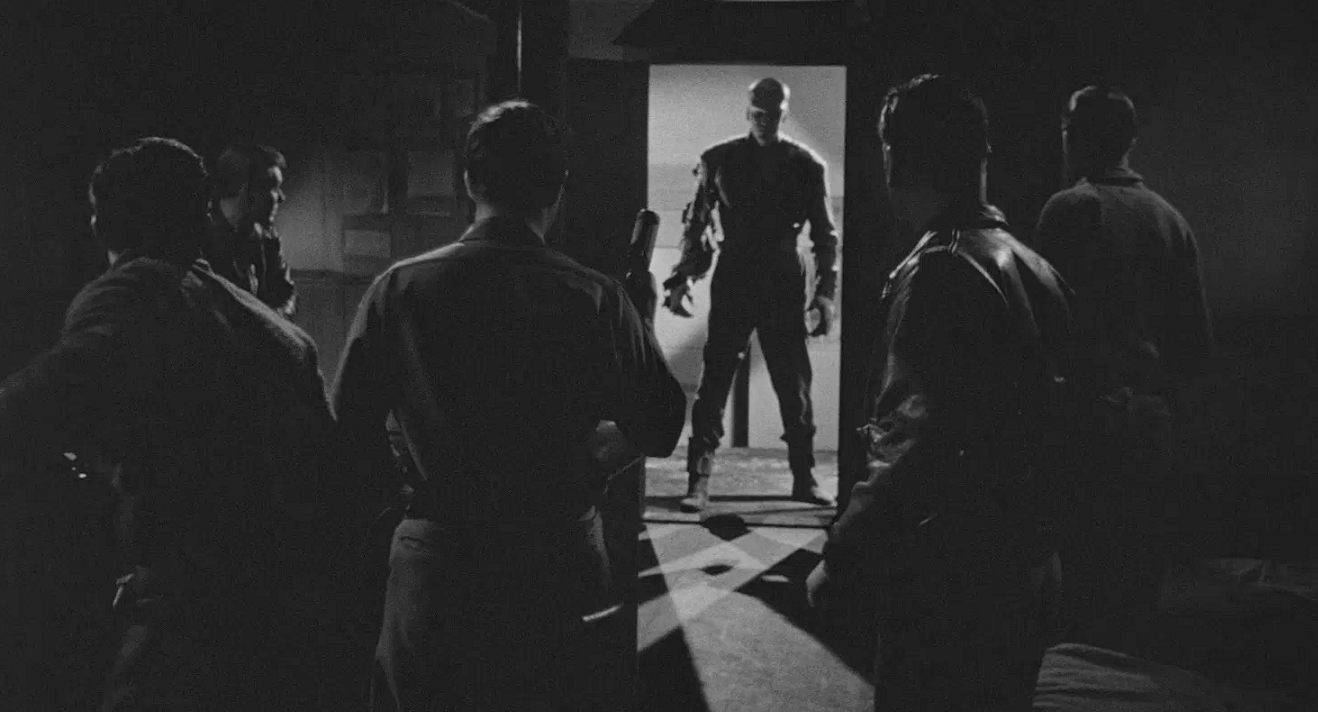
On the other hand, Antarctica continues to function as the last unexplored human space. It has some reminiscence of what might happen with the seabed or the depths of the Mariana Trench, with the caveat that it is a land space. A final frontier where the mythical space is still available. Let’s think, for example, about the now trendy memes about Hyperborea and neonazi esotericism, or the classic tropes of the "theory" of Operation High Jump. Yes, since the end of World War II, Antarctica has been "the last frontier" and can be the ground for Nazis, UFOs, and lost civilizations. Remember that all of this is already present in the original material of the film The Thing from Another World (1951) directed by Christian Nyby and an uncredited Howard Hawks. This material already contained all the tropes that would later be canonized in The Thing. The idea of an extraterrestrial in Antarctica would become canonical from then on, configuring itself as a quintessential setting for the fantastic.
The next success of Carpenter’s version is the introduction of what is now known as Body Horror. This particular form of horror cinema places special emphasis on the destruction and mutilation of the human body (and non-human as well). A genre that it shares with, for example, David Cronenberg in the soon-to-be-canonical Videodrome (1983). The deformation and mutilation carried out with practical effects gives a palpable material dimension to the invasion. It’s not an abstract concept or mind control, but a parasite. It’s like a space tick.
Lastly, but by no means least, is the fact of the invasion. In this case, unlike Alien, where humanity encounters an enemy due to human incursion into hostile territory, here it’s the complacency of a human community that is disrupted by an external agent. Unlike the other films we’ve been analyzing, in this case, the monster is not a problem of human creation, but rather a product of the universe’s hostility that humans occasionally encounter. In this sense, the extraterrestrial fulfills the role of an animal that attacks humans once established in towns, cities, or civilizations. It’s a break in the established human security system through culture and a return to a prior state of nature in which something as simple as guaranteed subsistence loses its effect. I think of films like The Jungle Book (1967), where the figure of the lion fulfills that role, albeit somewhat diluted because we’re not precisely in a "civilized" environment; I think of The Ghost and the Darkness (1996) and more recently, the brilliant Attack the Block (2011) as a descendant of this trope.
Now, if this monster isn’t Frankenstein, perhaps without looking for it, there exists another monster with which we can associate this invading parasitic extraterrestrial that copies humans. It is none other than the werewolf. The werewolf myth bears the same characteristics but, primarily, serves the function of being a shapeshifter. Of human appearance, it hides its beastly nature. In this way, it is an enemy that can only be discovered under very specific circumstances (full moon). Moreover, it is a monster that resides within the human community, destroying it from the inside. The idea of the shapeshifter persists in cinema in many forms: from the idea of the shapeshifter to the evil twin, to clones.
This is particularly terrifying for two reasons. First, the idea of not being able to distinguish a human from a non-human and what that implies. This topic will continue to be present in Carpenter’s cinema, especially in They Live. On the other hand, the idea that there is something that can assimilate, copy, and thus eliminate our precious individuality. As we can see, the trope works on many levels.
The fantastic intersects with science fiction
This is why The Thing (1982) is a canonical classic. Everything the film constructs is a sequence of successes and, fundamentally, a modern form of the fantastic tale. It’s also significant that the unintentional (or perhaps intentional?) crossover with the science fiction genre arises from the introduction of extraterrestrials into the plot. In this sense, the idea that fantastic cinema can also coexist with an intersection, with a hybridization, with science fiction is inaugurated. This is also present in Alien, for example. The irruption of the logic of the everyday, the appearance of the supernatural, can have a turn towards another great genre.
It’s, in another form, what happens with sagas like Warhammer 40K where science fiction and the fantastic are united in the same universe. In this sense, it’s a singular innovation within the frameworks of both genres. Of course, this is something that has been present almost since the beginning in what was known as pulp literature, which later had divergent branches in its purer variants but eventually crosses back organically when the narrative needs it.
In this sense, this hybridization is a way to introduce an irrational phenomenon (the break from empirical reality that involves the emergence of the fantastic) into a genre that tends to speculate on sequences of rational events, like science fiction. This hybrid genre eliminates the need for ultra-rational explanations in favor of a quest more related to the emotional. Scientific justification, unlike, I don’t know, Jurassic Park, is completely irrelevant.
For those interested, there is a video game based on the movie that was released at the time for PlayStation 2 and Xbox, which recently had a remaster. Additionally, there is a series of comics from Dark Horse that expanded the story, one of which features MacReady coming into contact with an Argentinian Antarctic base.
The Thing (1982) is a tale about paranoia, distrust, and the destruction of solidarity bonds stemming from the need for individual survival. This, combined with the chosen setting for the action, the tropes of alien invasion, and the sequences of physical horror, make it a fundamental piece of contemporary cinema.