The Vertical Society and How Life Came to Be Seen in 9:16
An overview of "reality" in vertical format. Who wins and who loses? The perspective of media, workers, and those of us who get high on statistics.

9 de dic. de 2025 — Ezequiel Bergonzi
There are many strong drugs, but none of them hits harder than attention. People are always talking about the algorithm and how it bends wills through likes and views. We all like to think we're immune to its charms, but the truth is that it's a stimulant that makes cocaine look like small talk between old ladies. Nothing really prepares you for the moment when one of your creations passes one million views (*).
The algorithm, whose name we invoke almost like the Hebrew Yahweh, found a way to make everyone pay homage to it: becoming a bishop of capitalism so that workers –who may have jobs that have nothing to do with communication– are now forced to become influencers.
Is everything bad? No. There is also a powerful tool here that can be used for good, to distribute information that would once have been impossible to access. For example, the genocide in Gaza is documented in vertical videos shot by IDF soldiers themselves. TikTok has trends created specifically by Palestinians to make their situation visible. The fact that everyone has a mobile device at hand to shoot, edit and publish a vertical video is a strong advantage in favor of the democratization of information.

The media understand that there is no way to survive if they don't implement these new digital dynamics. Ethics and essence are still fundamental when creating and distributing content from a journalistic perspective, and many media companies have started giving vertical content a central role.
(*) A brief tour of my career: I started as a staff writer at Agencia Universitaria de Noticias y Opinión, of the Unidersidad Nacional de Lomas de Zamora, Buenos Aires. Then I worked as a contributor for national outlets, later made the jump to radio, where I did everything from answering calls to being an executive producer, and finally reached my "final form": live director for TV/streaming and social media manager. I've created and managed accounts with videos that passed one million views. It does hit hard.
There Are No New Truths
We all have something to say, and social networks extend a constant "invitation". The algorithm needs that: enough users creating content to justify ad spending (YouTube, Instagram, TikTok) or to generate power dynamics capable of influencing state policy (X/Twitter). In the middle, the rest of us are just… common folk.
People chase disruption: trying to jump in, add their two cents, or invent some new terminology that will make them "transcendent". That's very hard in algorithmic times, because platforms need the protagonist to change all the time –or to be big enough to carry the brand without hurting interaction numbers. But the first big farce of this digital era is that there are no brand-new truths that need to be proclaimed. As with everything in life, someone already said it five thousand years ago, and those same logics can be applied perfectly well today.
Every guru will tell you the same thing: you need a hook to grab the viewer/consumer's attention. But throughout the history of communication there have always been tricks to attract listeners, readers and audiences. A thousand years ago, some guy would stand on a corner reciting royal announcements. Centuries later, journalists lined up to use the telegraph and send their cables to news agencies. Since there were so many and the telegraph operator didn't feel like standing there all day like a prop, they invented what we now call the inverted pyramid: the most important stuff first, and the fluff later.
Fast-forward again and we get to radio: the spoken word, fantasy and the eroticism of voices that made your imagination fly. And finally the screen, which is always ready to roll in the mud just so you don't look away.
The only truly new thing is the "democratization" of the internet and the accessibility of smartphones. The key is remembering where we come from, so we don't get blinded by the siren songs that always accompany new communication phenomena.
It's Never Enough
I repeat: nothing prepares you for the moment your content exceeds one million views. The rush when you see that number in your stats is instantaneous. Then the side effects kick in: you start learning how to read charts.
YouTube, for example, rewards your content with little messages that are the equivalent of a "good boy". Lines like "Well done! Views are 43% higher than your other Shorts, and this Short was shared more" or "Views have doubled" are efficient serotonin machines designed to encourage you to post more. And of course, the desired effect is achieved. Graphs, metrics, and that feeling that you're just one more piece of content away from conquering the world. Everything can warp in the algorithmic whirlwind.
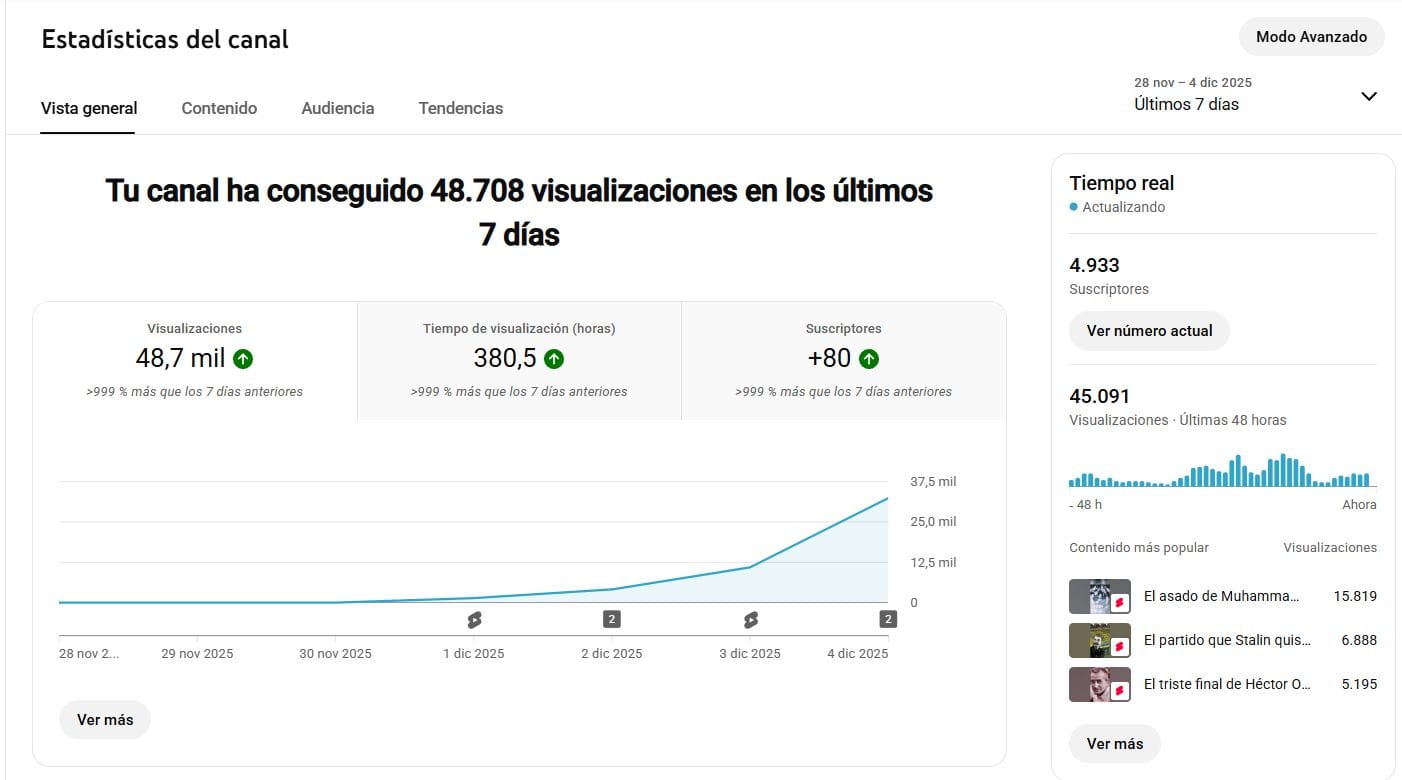
More views, more comments –what do people think? Why did this video flop and that one explode? A clip with millions of views followed by another with barely a few tens of thousands can tank your self-esteem in one shot. And yet, we're still talking about tens of thousands! It doesn't matter. Discovering stats that go far beyond single "views" is like finding sugar with extra sugar in it. It sounds absurd, but that's how it feels.
However, this phase that seems eternal can eventually become professionalized and actually useful to the common good. Because instead of chasing visits through trashy trends –dancing to the latest Dua Lipa single to earn five dollars– you can create content that actually conveys new knowledge.
The 9:16 Kitchen
It's not "blow into the bottle and it's done", as my boss –probably the best community manager in Argentine history– likes to say. It's much more meticulous than that. Many people think it's about sending some manipulative message, in full hypodermic needle mode (that old theory that says audiences passively swallow whatever the media feeds them). In reality, it's closer to playing blind man's bluff. You never really know how the algorithm is built, because that information is held tightly by the company that runs it. What you can do is detect what connected with your audience and build your strategy from there.
One of my accounts is @enunsorbo, focused on national stories and myths. With a million-view hit already under my belt (and on the belt of the very necessary team behind the account), I decided to "innovate" –as idiots like to say– and asked the audience to vote on what the next video should be. It bombed.
The other day I heard Instagram was rewarding very lightweight files. Videos with real potential drown in the scroll sea because they have the wrong title. SEO, SEM, CTR, KPI –these are some of the mantras we repeat to try to navigate the digital ocean with at least a minimal sense of direction.
That's why it's so funny when people accuse you of "running ops", spreading lies, or working with some conspiratorial agenda. No, ma'am, I uploaded it because it was the only thing I had ready. How was I supposed to know it would go viral? You wouldn't believe how many times I've stared at my metrics with a dumb look on my face because I couldn't understand how a really high-quality video had zero impact.
UNESCO, in a report on content creators, puts it this way:
"Although many creators manage to find strategic ways to gain visibility across TikTok, Instagram, X or YouTube, they recognize that success remains unpredictable, and that algorithmic logic forces them to adapt so as not to lose relevance –even at the cost of tensions with their own authenticity. Metrics and algorithms thus become both a laboratory of experimentation and a source of anxiety and fear due to their volatility. The perception of algorithmic censorship also affects editorial decisions, reinforcing the feeling of being conditioned by external rules."
The copy, the shots, the image quality, the timing, the exact minute you hit "publish", whether something works today and is already old news tomorrow… it's a lot. There's no way to do this every day if you're the kind of person who actually passes a psych evaluation.
Professionalization
I reached out to Nicolás Navarro (NN), manager at El Destape, and Ayelén Martínez (AM), social media coordinator at OLGA, to get a snapshot of the role 9:16 content plays in the media ecosystem. To avoid losing anything, here are the questions and answers verbatim:
-What place do vertical videos occupy in the cosmos of social networks?
AM: They play a very important role and they're a format that's here to stay. Instagram, besides constantly changing the algorithm, keeps introducing new formats, but 9:16 was embraced both by long-time users and by younger audiences. You always have to be innovating, though. Beyond the format, creativity is crucial to make the most of the content you want to share.
NN: Today, vertical video is the type of content that reaches the largest audiences on social media. I don't think that's because of something intrinsic to the vertical format itself, but because the algorithms are programmed to show more of that kind of post. The real novelty is that they allow a level of virality that used to be very unlikely. Any account can land a vertical with eight million views. It's not guaranteed, but before it was almost impossible. As for the rules of the game, they haven't changed that much: the video has to be engaging from the first second, it has to hold people to the end, and it has to generate comments. That was already true for long-form video.
–How do you avoid breaking with the ethics and essence of your product, given these new consumption habits?
AM: Retention is becoming more and more important because we live glued to the scroll. Platforms want you to stay on them as long as possible, just like brands want the sale or the click. Most users decide whether to watch a video or not in two or three seconds; if you lose them there, goodbye. And once you've grabbed them, you have to keep them. Shares and saves are back in the spotlight –that's how content keeps circulating. When it comes to ethics and essence, it depends on how much you're willing to let yourself be corrupted. If you want to reach a new audience, you'll have to tweak your style: make content more "PG-13", less niche, add some kind of striking hook. The essence can still remain in that content. When you're building a community, you always need to speak to the people who've been with you from day one, but to reach beyond that you have to give up certain things.
NN: I think whoever fights against the rules of the algorithm loses. In the case of El Destape, our mission is to get politics and economics onto the agenda. With verticals, we aim to put more or less the headline into the social media conversation. Then a percentage of the people who see that clip will look for the full video, the livestream, or the article we did on the topic. Translating a whole, complex article into a short video isn't really the idea; it's more about finding the most striking angle, something that can be understood on its own, stripped of context.
–Do you think longer audiovisual formats will make a comeback in the coming years?
AM: Yes, I do. Beyond format, the most important thing is still the story you want to tell. If that story is engaging, striking and dynamic, long-form content can absolutely blow up again. In fact, TikTok and Instagram already allow longer videos.
NN: It depends on what for. In politics, Donald Trump got a lot out of appearing in four- or five-hour streams — it made him look human and spontaneous. Milei also took a shot at a couple of four-hour livestreams with Fantino. For some things, long-form works. That's going to keep happening from time to time. I don't think culture is going to abandon short video. It would be like believing Spotify is in crisis because some musicians are releasing their songs on vinyl again. I was recently told that Disney stopped producing content for kids under 12 because that age group mostly consumes only short videos.
After Hours
Once I took a Cabify back home with an older driver. He was an ontological coach for companies and wanted to open a private practice. He was trying to improve his social media presence because he understood that the only way to "quickly reach"potential clients was through the views generated by content.
Several authors have written about the self-exploited worker; the best-known is philosopher Byung-Chul Han. I'm going to borrow a concept from Ignacio Ramonet that's also been repeated ad nauseam: the prosumer, a blend of producer and consumer. When Ramonet coined it, the prosumer was imagined as a digital citizen trying to play on equal footing with big corporations. Today, that's impossible.
What is it like to live in a society where the algorithm is just one more boss?
Jimerónica (JR) is editor-in-chief at Revista Mecha, a digital outlet focused on videogames, politics and pop culture. Mecha is much more about writing, so producing vertical video is an unwanted extra in a newsroom that privileges the pen over the lens. Juliana, from Sidéreo Cerámica (SC), has managed to gather more than 8,000 followers this year between TikTok and Instagram thanks to content filmed in the pottery studio where she teaches.
–What impact does vertical content have on your work? Do you think things would be the same if you didn't create vertical videos?
JR: A huge impact. In fact, when a video is horizontal, it creates obstacles and complications when I have to edit. It would be much harder for me to do my job.
SC: Right now, vertical videos are basically the main promoters of my content on social media — they're what reach people best. It's the pamphlet of our time. In my field, it's a combination of factors that keeps the flow of "clients" or students going. The videos help keep my networks moving, and they're currently my main calling card. It would be harder to get that movement of people seeing my work without them — not impossible, but much more tedious.
–What is it like to be an influencer for your own work? Do you feel comfortable doing it?
JR: I wouldn't say I'm an influencer, because I’m part of a collective project like Revista Mecha. Even so, I'm not particularly worried about exposure. I don't suffer because of it and I don't get much satisfaction from it either. But sometimes it is complicated to put yourself in front of a collective opinion.
SC: Horrible. Not only do I have to worry about creating a good product or being trained enough to give interesting classes, but I also have to dedicate a huge amount of extra time to making content. Platforms keep asking for more and more "natural" content that is anything but natural, and the only way to navigate the algorithms is to stick to these supposed rules nobody understands and spend hours and hours creating and showing every detail of what you do. I'm not an extrovert, so I never feel comfortable with a camera recording me. I try to find ways to make content that at least I have fun creating; if not, I get bored and do nothing, or I end up making empty content that doesn't help anyone — not the audience, not me as a creator. The worst part is definitely how much time I lose stopping my actual work to record, take photos, upload stories… Not to mention the extra hours outside the workshop editing posts and videos.
So, Now What?
So, buddy, what the hell do we do then? First, we don't lose our minds. Yes, artificial intelligence is already creating more content than humans, and most of it is crap. Yes, there are health problems that are getting worse because of dependence on screens and endless scrolling. And yes, there's a complex social problem emerging from the algorithm's need for interaction and how it can encourage, for example, violence.
But not everything is lost. Old people are right about at least one thing: humanity has existed much longer without the internet and cell-phone dependence than with these gadgets. Nobody dies because you didn't answer a message within an hour, and capitalism is not going to collapse because we stop churning out content.
Of course, the spell cast by big companies is hard to break. But you didn't die from not answering instantly, and you won't die from spending a day without watching TikToks. Eventually, a cult of boredom and a push for social detox — probably backed by some kind of legislation — will put some limits on this excessive consumption that, so far, has brought more problems than satisfaction.
And I'm definitely not doing myself any favors by saying all this, because as a content creator it's in my best interest to be consumed.
But, as a philosopher said several decades ago: "First, the country."