Tony Hawk's Pro Skater, Forever in Our Hearts

19 de ago. de 2025 — Fede 'okelfo' Lo Giudice
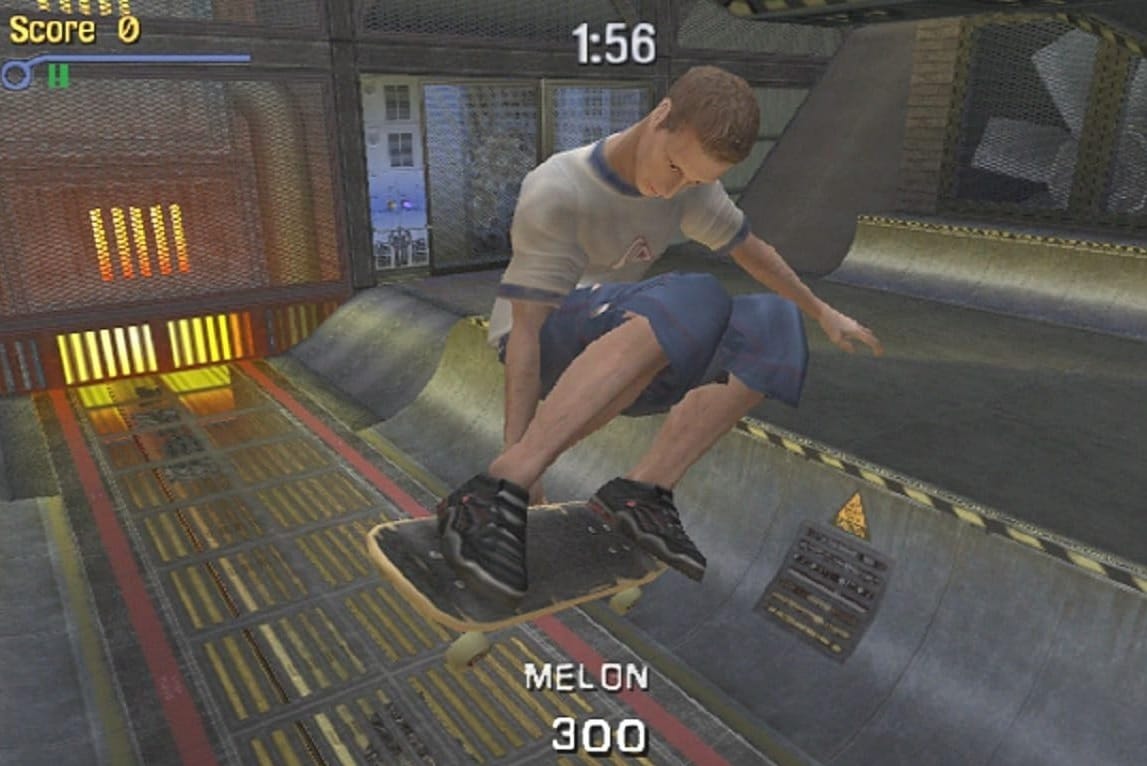
Sports games have been a console staple since the very beginning. From Atari 2600's Pele's Soccer and the curious Peter Shilton's Handball Maradona for Commodore 64 to the modern era with licensed Formula 1, soccer, golf, or whatever else you can think of, they've always been part of every gaming platform's lineup. Even though some sports are less mainstream, like skateboarding, there's still room for skateboard video games. And the one who saw the opportunity was skating legend Tony Hawk.
Let's take it step by step: Tony Hawk's Pro Skater, from 1999, is far from being the first skateboarding video game. That honor goes to 720°, by Atari, released in 1986 for arcades, followed by other experiments. On top of that, since in the United States skateboarding was always synonymous with being the coolest, most rebellious kid in the white suburbs, any other game could throw in a level where you rode a skateboard, like Teenage Mutant Ninja Turtles or Back to the Future. In those cases, it was more of a way to get around than an actual "skate game," but it was there. The truth is none of these games, most of them decidedly childish, made much effort to capture what it actually felt like to be a skater. It was more about simply riding a skateboard as an aesthetic statement.
Things changed in the '90s, when this subculture of feats, skill, and a bit of attitude started getting major media attention, and a "skater profile" took shape in pop culture. It wasn't so much about being a bad kid, but rather about being in your own world, self-sufficient, independent, and having just the right amount of apathy to be likable. The time and place made it mesh perfectly with the "alternative culture" a la MTV: punk, grunge, metalheads shaved instead of long-haired, angrier than they were party-goers. And the disenchantment with everything.
In this breeding ground, a 25-year-old Tony Hawk began his meteoric rise after winning the gold medal at the X Games in the Skateboard Vert category in 1995, which he would dominate in one variant or another until nearly 2003. That alone arguably makes him the most famous skater of all time. But as MTV stopped being a "music channel" and pivoted to reality shows, original programming, and more, at some point alternative sports started gravitating into the news cycle. Skateboarding was already well known, and Tony Hawk was recognized well beyond just the skating community.
"And ride, ride, how we ride" - Dead Kennedys, Police Truck
The Original Trick
When the giant Activision wanted to capitalize on skateboarding's popularity, they approached the small developer Neversoft to see what they could do together. Activision was in for a big surprise: they wanted a racing game -- a total snooze -- but found that Neversoft had built a semi-open map system where the fun was in pulling off tricks rather than skating from point A to point B. That's where the seed of Pro Skater was born, and all it needed was a face: Tony Hawk's.
Style met substance in a near-perfect marriage, and the cherry on top was a soundtrack that sounded like what Tony Hawk actually listened to: punk, ska-punk, and alternative. The furious, sarcastic "Police Truck" by the Dead Kennedys sat alongside "Superman" by Goldfinger with its horns, or the walls of guitars in "Here and Now" by The Ernies. Suicidal Tendencies crashed into Primus. There was even a track by Aim in case you were into hip-hop!
To top it all off, that same year at the X Games, Tony Hawk landed the first 900 in history, a trick where you spin two and a half rotations in the air (360+360+180), which generated a massive wave of attention. Naturally, the game sold like hotcakes and they immediately started working on replicating the success with a sequel that arrived a year later.
Tony Hawk's Pro Skater 2 allowed more freestyle moves, which extended combos and added complexity. More importantly, the soundtrack featured "No Cigar" by Millencolin, "Guerrilla Radio" by Rage Against The Machine, "You" by Bad Religion, and loads of other punk anthems that blended the classic with the modern. You could even unlock Spider-Man to skate with, taking advantage of the fact that Activision was publishing the Marvel superhero's games at the time.
The game was a revolution and an absolute sensation: a 98% aggregate score on Metacritic, over 5 million units sold across multiple platforms, and a near-untouchable cult game status. What's more, Tony Hawk became a full-blown celebrity: he showed up on Jackass, on TV shows, in music videos, everywhere. It was time to cash in.
A Saga That Aged Poorly
Tony Hawk's Pro Skater 3 and 4 were the first to launch on PlayStation 2, and that alone made them a phenomenon. The developers changed the game with the revert, a sharp skateboard move where after a jump (which usually ended a combo) you could flip the board, immediately link into a manual or whatever else, and extend the combo as long as your skill allowed. This let players pull off practically infinite combo chains, granting even greater freedom.
That said, the soundtrack was gradually starting to feel different. It tried to incorporate more music of the moment and align with what was playing on MTV. So while there were Ramones and Sex Pistols, Bad Brains and Adolescents, there were also tracks of the moment from System of a Down, House of Pain, and The Distillers, plus bands that, while fitting the game's aesthetic with older tracks, were by then mainstream hits like Red Hot Chili Peppers, The Offspring, and others.
They're still great soundtracks, but you can tell more people were getting involved in choosing the tracks, and there was a certain commercial pressure. What were Less Than Jake or Alien Ant Farm doing in there? The goal was no longer to "show" what a skater listens to, but rather to represent the sound of the era, to say "OK, there's something for you too." Instead of letting fans discover music from the scene, they put the music people already knew from TV into the game, giving it more mass appeal. It wasn't necessarily the wrong call -- in fact, commercially it makes perfect sense and the chosen tracks slap -- but it did start to reveal the saga's shifting identity.
"So here I am, growing older all the time" - Goldfinger, Superman
The saga, now well established, kept going with fewer and fewer surprises and ideas. In 2003, Tony Hawk won his last gold and retired from the scene, while the video game kicked off the Underground sub-saga, which added a storyline. Instead of controlling a professional skater, you built your character from scratch and got cutscenes where you'd fight with your skater buddy, become rivals -- it was basically a soap opera. The custom skater idea and putting yourself in the game is brilliant, but the entries came out so frequently that Underground quickly ran out of steam, making each release less relevant than the last.
The same thing happened with the soundtracks: they got increasingly eclectic. There was always some genuinely punk track left in there, but for example in Tony Hawk: Shred, from 2008, you already had stuff from Yellowcard, OK Go, and Vampire Weekend, as if they were just browsing the charts. But it wasn't just about forcing a "modern spirit" onto it. There was also "99 Red Balloons" by Nena, "I Get Around" by Beach Boys, and "School's Out" by Alice Cooper. Great songs or not, the aesthetic was absolutely and completely demolished.
The thing is, from the second half of the 2000s onward, the world is a different place: if you want to watch skaters, you don't have to wait for the X Games -- you look them up on YouTube. The same goes for music; and VH1 or MTV are more reality show channels than counterculture hubs. And Tony Hawk is now the star of his own meme: that nobody recognizes him. From 2010 onward, the guy's Twitter account is a never-ending stream of him visiting places and people telling him, "Hey, you look like Tony Hawk. Whatever happened to that guy?", "Hey, are you Tony Hawk? Why?", or "Ha, your name is Tony Hawk, like the skater?"

Tony Hawk's Pro Skater 5 came out in 2015 and finished sinking the saga, which by that point was like Dorothy's allies in The Wizard of Oz: no courage, no brain, and no heart. The saga had run out of gas and energy. And the truth is skateboarding was never like soccer or basketball, able to sustain a game every year, especially when a key aspect was the aesthetic and the "punk" spirit.
Community Take Over
During those years of decline and silence, the Pro Skater community took matters into their own hands and did the most punk thing you can do. If nobody was going to give them their game, they'd make their own however they saw fit. Thus was born THUGPro, a mod of Tony Hawk's Underground 2 for PC where fans carefully recreated every single original map, included all the tracks from every classic soundtrack, and revived the experience to turn it into a ball of nostalgia that has everything you associate with Tony Hawk. This mod is the perfect window to the past: everything in one place.
Everything seemed to be where it should: nostalgia in its place, skaters in the streets and parks, and gamers playing anything else. It all changed with the arrival of the pandemic, which beyond the health and humanitarian tragedy, produced situations whose consequences we're still paying for today. The rise of the new right, unsustainable consumption booms, the NFT craze, and so many other things created a world where the comfort of nostalgia carried a premium price tag.
Dropping Back Into the Ramp
In this context, the remake Tony Hawk's Pro Skater 1 + 2 brought the first two games back in a single package, now on the Unreal graphics engine so they'd look like a modern game. Like a sort of "greatest hits." You could replay the first two games, which looked gorgeous, compete online against friends, create your own skater, and use reverts on the classic levels. Naturally, it was a smash hit and reignited the flame in more than a few fans who could now enjoy the saga on modern platforms.
"Now I got a reason and I'm still waiting" - Sex Pistols, Holidays In The Sun
Now, could this rebirth sustain itself over time? The world had changed and the pandemic consumption boom didn't hold. Things returned, more or less, to the level of interest they had before the explosion, but with the consequences of what happened clearly marked. For instance, Microsoft bought Activision, including little Neversoft, which it transformed into Blizzard Albany, now a support studio for Call of Duty and Diablo. But since they were still eager to give it another go with Tony Hawk (because Game Pass needs to be fed somehow), they asked Iron Galaxy (responsible for the Steam port) to make Tony Hawk's Pro Skater 3+4.
Iron Galaxy made a continuity-focused game that gave 3 and 4 the same treatment as 1 and 2, but with one detail: Tony Hawk asked to review the soundtrack. "We wanted to maintain the essence of the original games, but also introduce new artists and songs," said Christopher Wilson from Activision Publishing in an official blog post. "Throughout the project, Tony added tracks and suggested using different songs by artists who appeared in the original games."
And just like that, suddenly, we have a new tracklist that's a perfect time capsule of what was and what is. Having earned its place as a defining work of the late '90s and early 2000s, Pro Skater is a snapshot, a memento, a memory: this is what skating was like back then. With a perfect mix of humor, precise controls, and soundtrack, this is the image of what it meant to belong to that circuit, to be with those skaters and spend time with them. The saga screams California and is the perfect identikit of the skater ideal. It's the past, pristine, stronger than ever.
Maybe there's a future for skateboarding video games, and the Pro Skater saga will find new ways to update itself and continue the story. However, hand in hand with Motorhead, Alice in Chains, De La Soul, Dead Milkmen, Sex Pistols, The Cult, and Wavves among others, Tony Hawk seems to have found his perfect form. It's not nostalgia -- it's a vision of a world where aesthetically it's still the year 2000. But the best thing it does is make you want to see what Pro Skater can do by teaming up with the skaters of the future.