Uma Musume Pretty Derby: How Japan's Girl Racing Franchise Was Built
Uma Musume Pretty Derby crossed the finish line in the West in mid-2025 and has been racking up accolades, animation, and more and more fans based on historical accuracy, high-level athleticism, and kawaii.

9 de mar. de 2026 — Ezequiel Vila
As far back as I can remember, my Uncle Hugo has been passionate about horses. He claims he never bet on them, but he has been a regular at the La Plata, Argentina. Racetrack since his youth, and now, at 72, he owns a horse named “Don Evasor” (Mr. Tax Evader), which he raises along with two friends. A few weeks ago, Don Evasor won the Tomero Prize, a 1200m race, and he showed me the video on his phone during a family lunch. At first, two jockeys pushed their mounts to break away from the pack while Don Evasor (with a jockey in green and white, I assume, because my uncle is also a fan of Banfield, a local soccer team) waited stealthily among the throng. By the second turn, positions began to settle, and two horses appeared to be coming out on top, but that parity was an illusion that quickly faded, as in the final stretch, the bay horse surged ahead and won by five lengths. One minute and thirteen seconds of pure adrenaline that ended in a crushing victory. I completely understood my uncle's smile because I’ve been playing Uma Musume on my phone for six months now.
Tomero Prize.
A noble colt-san
Uma Musume Pretty Derby is a mobile game (meaning designed for smartphones) launched by Cygames. It’s a Japanese developer founded by the marketing agency CyberAgent and partially funded by DeNA (the company behind Pokémon TCG Pocket) and Nintendo. Besides the video game, several anime series and movies have been released since 2018, establishing it as a multiplatform franchise. The premise behind this fictional universe is as unusual as it is effective: in the world of Uma Musume, girls are born as reincarnations of racehorses and, in addition to having ears and tails, they possess supernatural speed that allows them to enroll in Tracen Academy for horse-girls and compete for their dream of becoming racing legends. Of course, these kawaii equine girls, after the big races, celebrate with a pop concert alongside their competitors to entertain the bettors. Up to this point, nothing Japan hasn’t offered us before, but what truly stands out about Uma Musume is that all the horse-girls appearing in the game and series are actually reincarnations of real-life horses, most of them Japanese. This is how we have characters with names like “Special Week,” “Silence Suzuka,” “Vodka,” “Rice Shower,” or “El Condor Pasa.” But the identity doesn’t stop there: both personality, wardrobe, strengths, weaknesses, and the relationships between them and the plot of the anime are based on the real history of each horse. For example, the rivalry between Daiwa Scarlett and Vodka is based on the number of races they faced each other in, and the enmity between their respective breeders. Or, to add another case, the eccentric nature of Gold Ship (one of the umas with white hair, quite popular in the fandom) is due to the fact that the horse in question disliked entering the stalls at the racetrack and sometimes just didn’t feel like racing.
In addition to the video game, several anime series and movies have been released since 2018, establishing it as a multiplatform franchise.
If clarification is needed, in the anime, all horses reincarnate as women, even though in racing, both male and female horses compete interchangeably. It’s even easy to recognize in the design of each character which is a mare and which is a stallion: characters based on mares wear a ribbon on their left ear, while characters based on male horses wear one on their right ear. Other characteristics are also based on the real horse’s build, such as height and physique, coat color, or the formal attire the girls wear for important races (based on the gear used by jockeys). And yes, the bust size of each horse-girl varies according to the chest of the real colt...
Up to this point, the kind of perversion we’ve come to expect from the Japanese, but with so many anime featuring semi-furry schoolgirls singing and dancing, why did this one become so popular in Japan?
Don’t forget, onii-chan, you know you shouldn’t gamble
Historically, Japan is one of the countries with the highest gambling problems in the world. Between the 1980s and 2010, it had one of the highest rates of gambling addiction, even surpassing the United States and Australia: while in most Western countries, gambling addiction affected 0.5 - 1% of the population, in Japan those figures rose to 3%. Paradoxically, casinos and sports betting have been prohibited in Japan since the early 20th century, with few exceptions. But where there’s a law, there’s a loophole, and part of the rise of game corners or arcade halls on the eastern island can be explained by the invention of pachinko, a sort of trickery to create a slot machine without it being a slot machine. Indeed, pachinko doesn’t pay out cash like the bingos we know; instead, it gives out tokens that can be exchanged for prizes, similar to Sacoa tickets. However, it’s very common for there to be another shop two blocks away from pachinko parlors that “buys” those prizes for cash. If one were to think ill of it, one might believe those shops are owned by the same people. This system, combined with the chronic work stress of the big city work culture, became critical during the turn of the century, although it’s true that in recent years various campaigns and changes in habits have managed to partially reverse it.

Now, one of the most notable exceptions to the prohibition on sports betting is horse racing, which, for the reasons mentioned above, has always been hugely popular in Japan. Currently, there are 25 racetracks in Japan, and around 21,000 horse races are held annually, even though in recent years, racing has lost the mass appeal it once had. According to data from the Japan Racing Association (JRA), at its peak around 1993, about 25 million people visited racetracks each year to bet nearly 50 trillion yen annually (almost 300 billion dollars at current values). During those years, horses like Oguri Cap, Mejiro McQueen, and Symboli Rudolph were true sensations, had their followers, and frequently appeared in national news.
So Cygames struck a deal with the Japan Racing Association and a handful of horse breeders to secure the rights to the great legends of Japanese racing. Leveraging that cultural phenomenon, they laid the groundwork for a machine to sell dreams of glory and uwus.
That cheerful and flirty musume
For many years now in Japan (and one could say that, at this point, also worldwide), there has been a practice among fandoms, later adopted by marketing and communication agencies, of creating young female characters based on... practically anything. The so-called “moe anthropomorphism” consists of giving animals, objects, institutions, and even concepts the characteristics of a moe (a typification of a cute young girl with whom fans have a sort of parasocial relationship). Thus, there are “anime girls” representing things as diverse as aircraft carriers, war tanks, constitutional articles, terrorist organizations, and Wikipedia. Within this phenomenon, there is a special subtype for the anthropomorphizations of animals called kemonomimi, which typically are people with animal ears that are not “mutants” or anything like that, but rather a humanization of that animal (catboys and catgirls, which are a bit forgotten in the recent craze for therians, are kemonomimi).
 Belu Liendo
From this genealogy arises the concept of “uma musume.” “Uma” (ウマ) literally means “horse” while “musume” (娘) means “girl,” although the latter is a somewhat more particular choice. The most common word for “young woman” or “girl” in Japanese is “on'nanoko” (女の子), while “musume” is mainly used to refer to one’s own daughters or a woman under someone’s care. It carries a literary and quite traditional nuance. Despite the hints of visual novel or the almost automatic suspicion of hentai, a choice in that sense would have selected the word “otome” (乙女), which means “maiden” and is usually the term used in that type of games. No, sir: the umas are girls who are raised... like horses. In fact, Cygames has been particularly careful since the beginning with the generation of suggestive material and has been particularly vigilant against risqué fan art, partly to protect its brand, but mainly because its contract with the JRA and the horse breeders dictates so. Of course, with the success of the franchise, that becomes inevitable, but in online communities, it’s common to joke that no one dares to execute rule 34 in Japan for fear of retaliation from the yakuza. Many horses from the golden age of racing in Japan were managed from the shadows by mafia leaders.
I'm all in, shōganai!
Cygames is a company that creates games in the "gacha" genre, which consist of chance mechanics mixed with collectible rewards. Generally, in a gacha game, we pull from some kind of little roulette or machine to get a random prize that allows us to improve some aspect of the game. The more cards or tokens we gather, the better we’ll do in the game mechanics; but, of course, not all cards or tokens are created equal or serve the same purpose. If this sounds familiar, it’s because many games (especially mobile games) are built on this framework, as it’s basically a more or less veiled form of gambling and tends to promote quite harmful spending behaviors, not too different from gambling addiction…
Cygames struck a deal with the Japan Racing Association and a handful of horse breeders to secure the rights to the great legends of Japanese horse racing. Leveraging this cultural phenomenon, they laid the groundwork for a machine that sells dreams of glory and uwus.
One of Cygames' first successes was Idolmaster Cinderella Games, a gacha game where we took on the role of a representative for idols (youth pop stars) who had to train and build the career of a young girl launched into stardom. Perhaps this is where the template and character development for the horse-girls in Uma Musume comes from, although the gameplay mechanics in this second case go a bit further.
Uma Musume Pretty Derby, aside from its gacha-style monetization, is a game where you embody the role of a trainer for a horse-girl throughout her career over three years (similar to what happens with real-life horses). The base mechanics are Tamagotchi-style and remind one of games like Pokémon, Digimon World, or even better, Monster Rancher. Each turn, we must decide which stat our runner will train among Speed, Stamina, Power, Grit, and Intelligence. All while making sure she doesn’t get injured, die from exhaustion, or become demotivated. Every true gaucho knows that every now and then, you have to take your mare to karaoke so she can gallop with confidence. After a certain number of turns, we must race, where we need to place in a specific position to continue. All of this, by the way, is presented as a visual novel where we talk to our horse-girl and choose dialogue options to motivate her, advise her, or resolve conflicts with other horse-girls. Besides the horse-girl in question, each time we start a run, we choose a series of event cards that randomly define what happens to that runner during the three years we train her.
 Juanma La Volpe
If by this point the game was already somewhat complex, the standout factor of Uma Musume compared to other gachas is that each horse-girl we train, once she finishes her career, will inscribe her legend in the history of our training team and can inspire future runners with her performance. So every time we start a run, we choose the legacy of two characters we've already trained to pass on some of their stats to the new ones, making the game a roguelite series with breeding elements where each new race with a horse-girl is built on the legacies left by their predecessors. It goes without saying that there are complete guides on how to do this optimally, and eugenics is as common as it is with real racehorses.
This formula has turned the game into an unstoppable success in Japan since its release in 2021, and interestingly, it was also confirmed during its international launch in June of last year. This craze for horse-girls culminated at the end of last year when Uma Musume won the GOTY for Best Mobile Game at the 2025 Game Awards. Currently, in addition to being available on iOS and Google Play stores, the game can also be played on Steam.
All the craziness
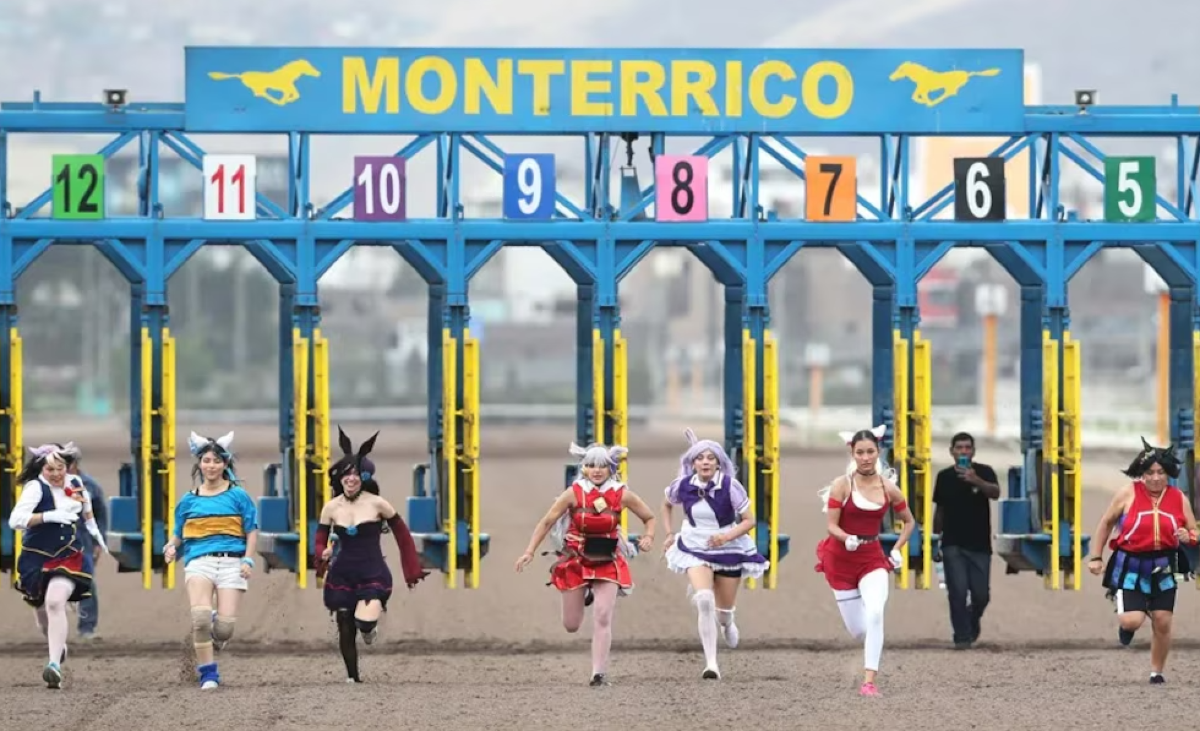
However, perhaps the most significant impact of Uma Musume isn’t just in the games or anime, but the effect it’s having in Japan and now around the world regarding horse racing. Racecourses are starting to see crowds again, and the streaming viewership of races has been increasing in recent years. This phenomenon has been fueled by Cygames, which began advertising at Japanese and American derbies to promote their game, but now the racecourses themselves are also encouraging it. Across Asia, there has been a series of cosplay races on real tracks that went viral and have even reached our continent: the first Uma Musume cosplay race took place in Peru on February 27, and I assure you it won't be long before they happen at the Palermo Racetrack.
That’s nothing; the actual horses that appear in the game, now retired but still alive and kicking, are objects of adoration among fans. Recently, the terrible conditions in which the thoroughbred Meisho Doto lived went viral, and through a fan-organized campaign, $600,000 was raised for his care. Recently, the mare Haru Urara also passed away, a true icon of her time for her bad temper and poor performance (she lost every race she participated in, and it was believed her tickets brought good luck). Farewell messages came from all over the world.
2026 is the year of the horse, and everything seems to indicate that the racing craze is just beginning. In Argentina, horse racing used to be a passion for the masses, although for our generation it belonged to the semantic field of raspy voices and Legui rum. Will it transform again into a criollo passion with the help of otakus?