IP Wars: The U.S.-China Battle Over Intellectual Property
Intellectual property is no longer just a commercial issue, but a matter of national security. The U.S. uses the “Special 301” as a political tool to crack down on piracy. China is filing more and more patents. In this war over the intangible, whoever controls IP controls the power.

4 de abr. de 2026 — Eddie Fitte

In the United States, intellectual property has ceased to be just a chapter in commercial law and has integrated into the doctrine of national economic security. When a country's competitive advantage relies on pharmaceutical patents, software, technological standards, and global entertainment, protecting rights is no longer a moral issue: it's a strategic one.
That's why safeguarding it, in the age of e-commerce, with a borderless cyberspace teeming with intellectual properties, has become a central mission. The challenge isn't how to protect the intangible, but how to impose scarcity on something that can be infinitely copied in the digital universe.
If ICE exists to limit migration (through the IPR Center, it's the 'enforcement arm' that conducts raids and arrests), Special 301 serves as the 'political brain' that points out where the problems lie. It's an annual report from USTR (the Office of the United States Trade Representative): a radar that classifies countries (Priority Watch List, Watch List), lists 'market access challenges,' and leaves a public mark that enables diplomatic pressure.
Special 301 is like the most wanted list but at the country level. It doesn't point out individuals: it labels economies. It identifies which countries 'allow' mass piracy or lack strong laws, and puts the issue on the agenda. When Washington wants to move from pointing fingers to coercion, another tool comes into play: Section 301, the legal mechanism to open investigations into 'acts, policies and practices' and, if the case progresses, enable concrete trade measures (tariffs, restrictions, suspension of benefits).
Special 301 is like the most wanted list but at the country level. It doesn't point out individuals: it labels economies. It identifies which countries 'allow' mass piracy or lack strong laws.
It may seem like a distant conflict, too technical. But let's suppose, for example, that a Brazilian wants to watch the Manchester derby, City versus United, comfortably from his living room laptop. The official broadcast is only on a paid platform. It costs almost as much as a ticket to see Flamengo from the stands. He feels frustrated about paying, and in a WhatsApp group, someone shares the apk for Magis TV, which is of Chinese origin. He connects it to the TV, downloads an app, and the signal appears. The commentary sounds slightly compressed, the image has a one-second delay, but it works.
In that living room, there are no hackers or mafias. There's no ideology. There's only a widespread feeling that football is too expensive and that the internet always offers a shortcut.
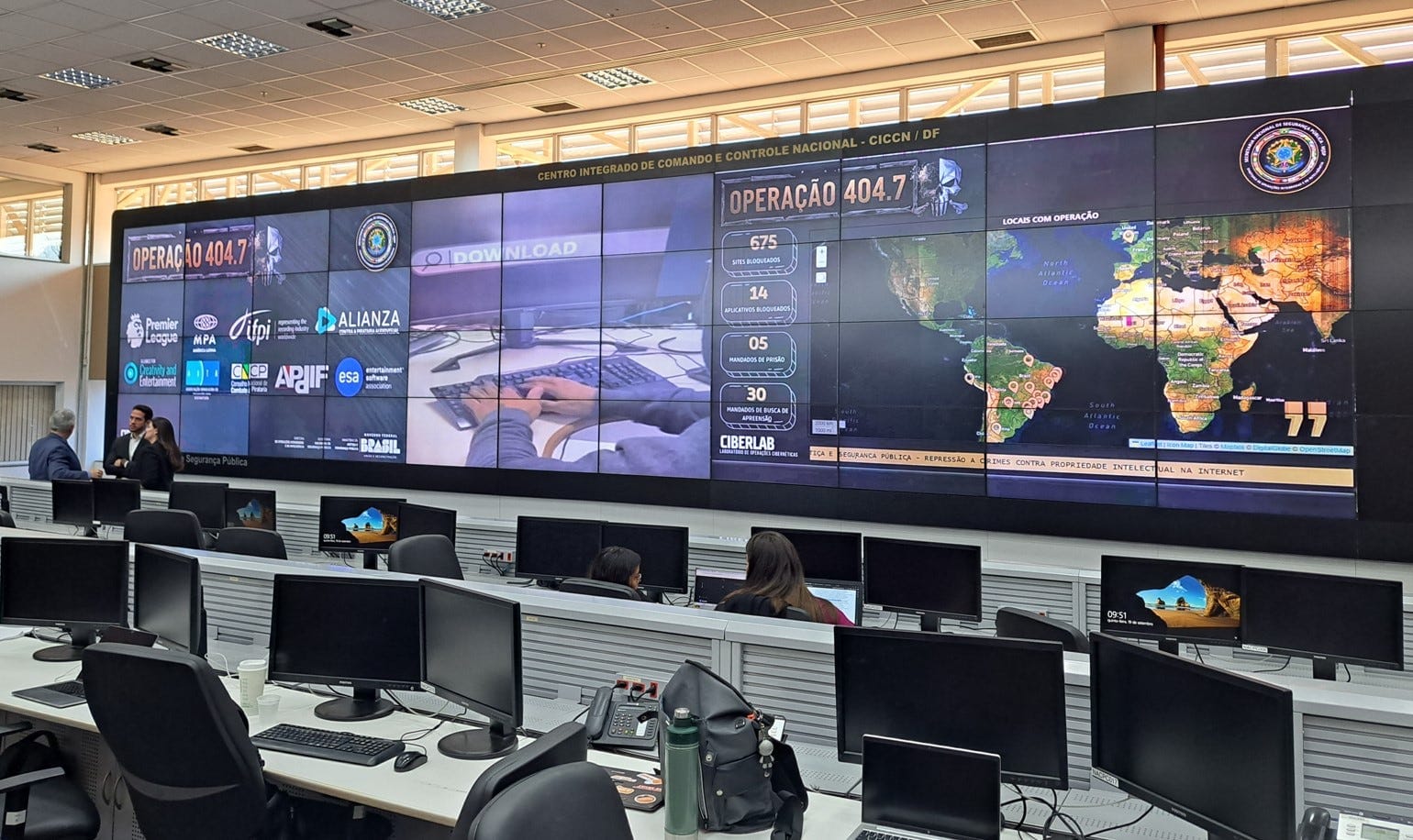
What isn't visible in that domestic scene is that, while the match is on, a state laboratory in Brazil called Ciberlab coordinates simultaneous raids against digital piracy networks. The operation is called 404, like the HTTP error that appears when a page no longer exists.
Page not found.
The metaphor is clear: if the content is illegal, the link must disappear.
Since 2019, Operation 404 has blocked thousands of sites and applications, de-indexed domains, executed dozens of court orders, and coordinated arrests in Brazil, Argentina, and other countries in the region. In its phase 7, in 2024, it took 675 sites and 14 apps offline, with arrests on both sides of the border. In phase 8, in 2025, it involved six Latin American countries and cooperation with the United Kingdom, with the United States as an observer.
Magis TV, that Chinese giant that offered Hollywood's big hits in a sort of digital all-you-can-eat, has always been on the radar. Because piracy has ceased to be a marginal issue. It has become a coordinated front of digital security. That's why it receives this level of attention: there's a lot at stake.
Brazil is under scrutiny from the United States following the initiation of a Section 301 investigation in July 2025, examining practices in digital trade, electronic payments, tariffs, intellectual property, and deforestation. The country is on the 'Watch List' of the 2025 Special 301 Report due to concerns over intellectual property. Its recidivism in this matter has been closely monitored in the United States.
On July 18, 2025, the Office of the United States Trade Representative (USTR) initiated a Section 301 Investigation titled “Brazil's Acts, Policies, and Practices (Docket No. USTR-2025-0043). 'Brazil has failed to effectively address the widespread importation, distribution, sale, and general use of counterfeit goods, modified video game consoles, illicit streaming devices, and other devices intended to circumvent protective measures. Counterfeiting remains widespread because law enforcement raids are not followed by sanctions or remedies with a deterrent effect, nor by a long-term disruption of these illicit trade practices,' the report states.
Since 2019, Operation 404 has blocked thousands of sites and applications, de-indexed domains, executed dozens of court orders, and coordinated arrests in Brazil, Argentina, and other countries in the region.
The scene of the pirated match may seem trivial. But it condenses a structural tension: digital culture operates through circulation; the intellectual property system operates through exclusivity.
Each pirated broadcast is an unauthorized copy. Each copy erodes a business model based on exclusive rights. Official estimates speak of over nine billion reais annually in losses associated with digital piracy. The main illegal sites generate millions in advertising.
Operation 404 articulates state police, regulatory agencies like Anatel and Ancine, cooperation with the Premier League, the Motion Picture Association, and foreign authorities. It's not an isolated raid. It's a permanent infrastructure.
 Soldan
Domains are blocked, apps are removed, and servers are frozen. Essentially, transnational orders are being executed. In fact, Phase 8 was presented as Brazil's largest international action against piracy in its entire history.
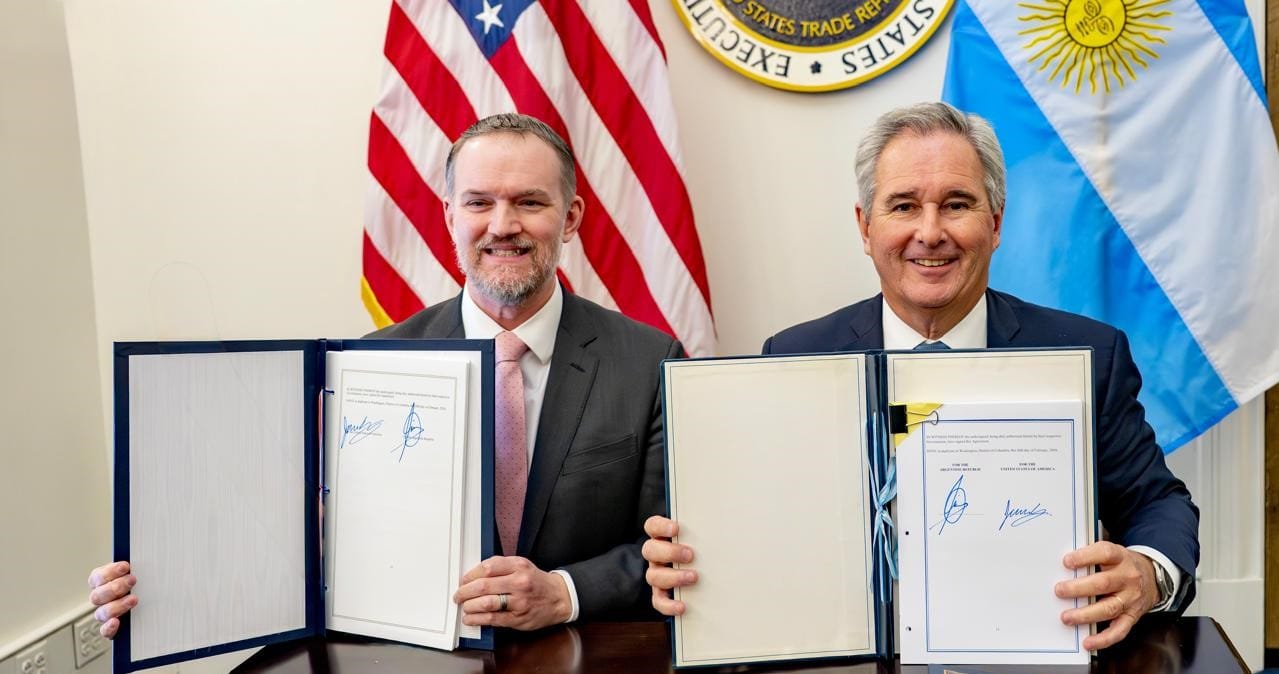
Decades ago, the United States understood that its main competitive advantage is not steel or soybeans. It's the control over intangible assets: film, software, pharmaceutical patents, technological standards. That's why, when Argentina signs the Reciprocal Trade and Investment Agreement between the Argentine Republic and the United States of America (ARTI), signed in Washington on February 5, 2026, intellectual property takes center stage. In Annex III, the text obliges Argentina to maintain 'a robust standard of protection' and to establish effective civil, criminal, and border enforcement systems, including specific measures against infringement in the digital environment.
It's not just about protecting brands. It's a kind of guerrilla warfare over the intangible that has now, to make matters worse, moved and intensified in cyberspace, where we must combat and deter pirates navigating those waters.
The Special 301 Report 2025 also places China on the Priority Watch List and states that, despite some progress, serious and structural concerns regarding intellectual property persist. The report claims that China has not fully implemented its commitments under the Phase One trade agreement with the United States, 'maintains long-standing issues in technology transfer, trade secret protection, counterfeiting, online piracy, patent policies, and bad-faith trademark registrations,' and continues to apply 'measures that condition market access on the transfer or local development of intellectual property.'
When the report details 'long-standing issues,' it seems to be referring to cultural matters that have evolved over time. In the West, copying is often associated with fraud or degradation. In China, the shanzhai phenomenon introduced another logic: copying as accelerated learning, as creative adaptation, as productive homage. It implies a culture of 'deconstruction' and rapid transformation, where copying is playful, subversive, and often improves upon the original, challenging Western intellectual property.
Decades ago, the United States understood that its main competitive advantage is not steel or soybeans. It's the control over intangible assets: film, software, pharmaceutical patents, technological standards.
For years, Shenzhen was a symbol of that dynamic. Replicated devices, 'inspired' brands, electronics assembled at breakneck speed. The world accused; China produced.
The narrative seemed binary: the United States invents, China copies, or worse, steals. Up to this point, the conflict over intellectual property seems like a pop culture dispute. Series, soccer, streaming, the morality of 'to pay or not to pay' and the grand theater of everyday piracy with the memory of anti-piracy ads on VHS tapes from the 2000s.
But if one looks at IP as a system, something else emerges: an economic control regime that decides who can manufacture, sell, copy, export, research, and charge for every step. That's why intellectual property sneaks into trade agreements and the economic security agenda. Not as a footnote, but as a condition.
The point is not the technicality; it's the map: IP has shifted from being 'copyright' to being a power infrastructure.
Intellectual property is the system that turns ideas into defendable assets. It doesn't just refer to movies or songs: it organizes who can use an invention, who can sell under a name, who can copy a work, and who can exploit knowledge without publishing it. That's why it's worth thinking of it as a system with different fronts, each with its object and mode of enforcement: patents, trademarks, copyright, trade secrets, and also design and appearance when the form itself sells.
Patents are temporary monopolies on inventions: they allow you to exclude others in exchange for revealing the method, and they serve as a barrier to entry in sectors where technical detail is worth more than advertising. Trademarks are industrial trust turned into a sign: they fight against 'similarity,' and today that battle takes place on platforms, catalogs, logistics, and payments, not just at the fair. Copyright regulates the copying and distribution of works (and also software and databases), and in the digital world, it is contested in links, streams, APKs, and increasingly in discussions about datasets and AI.
 Mariano Vilar
And the area that is growing the most is that of trade secrets: the valuable information that remains unpublished because sharing it would be like giving it away. Formulas, models, processes, algorithms, data, plans. Here, the defense is not just legal; it also involves security: internal controls, audits, access monitoring, and when it escalates, border and economic intelligence. In this context, the New Balance case serves as a thermometer: China is starting to act like a country that also needs to protect its brands. It's not a romantic issue but a reputational one, about self-protection. If you want to export creativity, you have to discipline your own market and, above all, control your own troops. Some things need to stop happening or, at the very least, stop happening in plain sight.
Agtech is agricultural technology. Basically: food. Innovation in agriculture mixes data, software, biotechnology, and predictive models. Much of this is not patented. It's kept under wraps. Because patenting means publishing. And publishing, in certain businesses, is like inviting your competitors to copy you with a bibliography.
In 2017, Haitao Xiang, a scientist, was working for Monsanto and its digital unit, The Climate Corporation. He resigned, and the corporate protocol was activated: exit interview, activity audit, access review, download tracking. The suspicion arose within the company when signs appeared that he might have taken sensitive material.
From there, the State got involved, but not as a whimsical scriptwriter. In the United States, Customs and Border Protection (CBP) has special powers at the border. A CBP officer explained to the FBI the 'border search exception,' a rule that allows belongings to be searched without a warrant in the context of an international crossing, and that also applies to electronic devices. The key was this: Monsanto could not seize anything. CBP could. That's why the case moved to the point where the State had operational advantage: the airport.
 Juan Ruocco 🧙♂️
With that information, a 'lookout' was placed, an alert so that if Xiang tried to leave the country, he would be intercepted. When he appeared at O'Hare and was about to board, they stopped him at the jetway (the walkway before entering the plane). They searched his luggage and seized several items, including a micro SD card. That's where what made the case symbolic appeared: files marked as confidential, trade secrets, downloaded in the early hours before the flight. The main asset was a technical document of 86 pages called Nutrient Optimizer, presented as the blueprint for the most valuable piece of FieldView, the system that recommended how much nitrogen to apply to a field to optimize yield and costs.
The company claimed that this development took thousands of hours and hundreds of millions of dollars, and that someone with internal knowledge could give a competitor a huge advantage in building an equivalent product. The most interesting point of the case is not the intrigue of espionage, but the mechanics: when what you are protecting is a secret, the dispute stops being just civil and becomes a mix of corporate compliance, cybersecurity, and border issues.
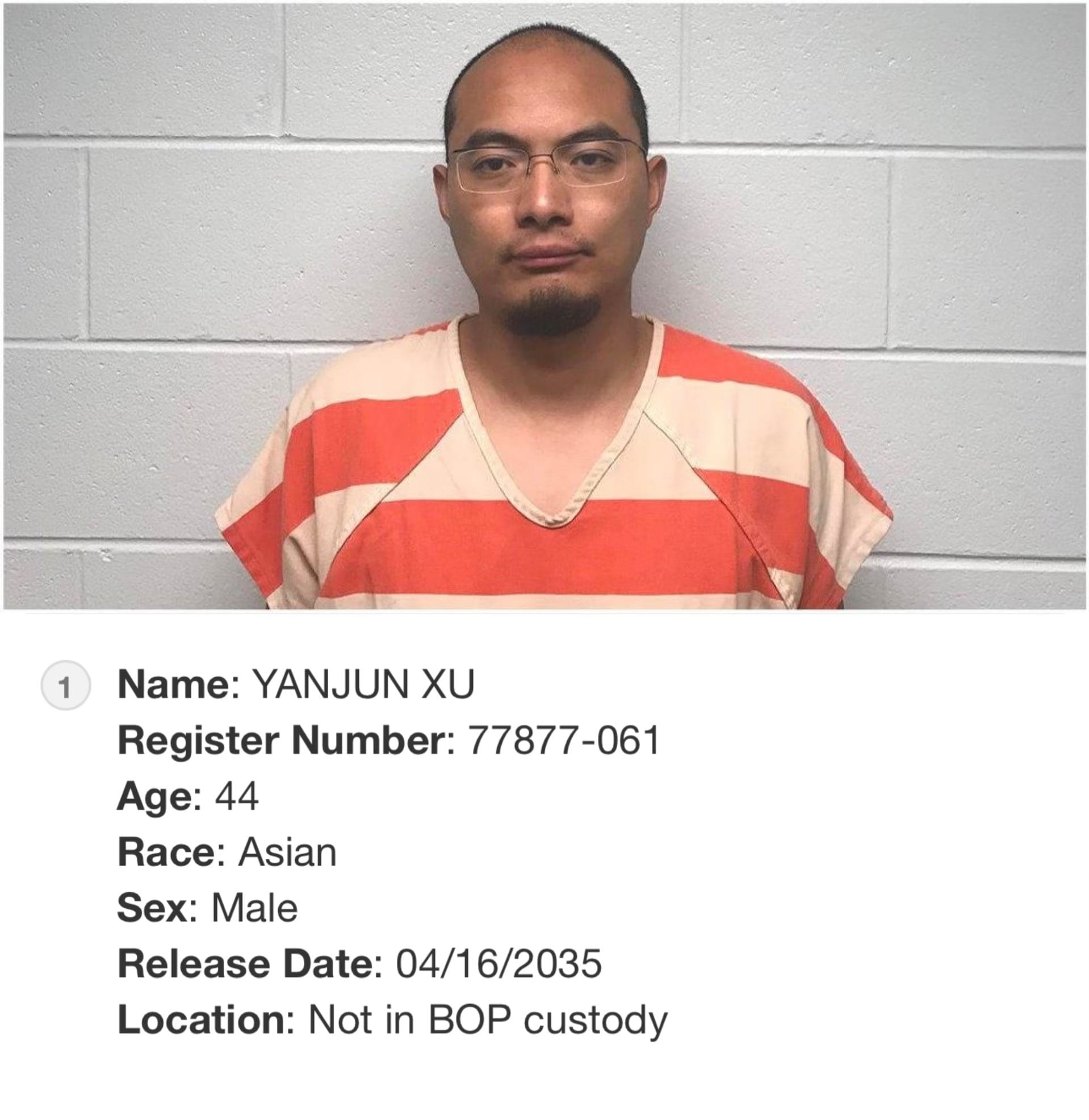
The cases of Xu Yanjun, an official from the Chinese Ministry of State Security convicted in the U.S. for industrial espionage against GE Aviation, and Ji Chaoqun, the student in Chicago who collected profiles of scientists and engineers for Chinese intelligence, tell the same story from two scales: above, the extraction of critical technology; below, the ant work to identify talent and open doors.
But China, not so slowly, is changing its role. For decades, its advantage was industrial capacity. Total factory, speed, scale. In that scheme, copying was an 'external' problem or a tolerable gray area. But when a country starts to generate its own IP, copying becomes an internal risk. That's where the need for real enforcement, courts, deterrent damages, and control of secrets comes in.
Now, the U.S.-China competition is already discussed as leadership in innovation, standards, and jurisdictions, not as 'IP protection' in the abstract.
China has started to toughen its internal enforcement: harsher penalties, campaigns against infringements. This shift makes sense as state policy. China needs its own market to believe in intellectual property and for the world to believe that China can guarantee rights. In practical terms: when a country starts to generate its own IP, copying stops being a useful gray area and becomes a domestic risk. The former imitator, if it wants to export creativity, must stop tolerating what was once convenient.
China has started to toughen its internal enforcement: harsher penalties, campaigns against infringements. This shift makes sense as state policy. China needs its own market to believe in intellectual property.
The war for the intangible has ceased to be a moral debate about piracy. It's a fight for infrastructure. Who sets the technological standard, who collects the license fees, who has the legal advantage to impose conditions, who controls platforms, who can shut down a link, who can search a device at the border. The conflict is no longer limited to football or TV series: it includes advanced semiconductors, industrial secrets, battery designs, and strategic software. When Washington restricts exports of chips or manufacturing equipment, it's not just doing 'foreign trade.' It's defending a technological advantage that is also applied intellectual property, turned into control.
But that story has changed pace. China has stopped being just the world's workshop and has started to compete as a powerhouse of intangibles: it patents more, invests more, produces exportable technology, and seeks to play the standards game, where fees can be collected without the need to manufacture everything. At that point, the war becomes symmetrical. It's no longer 'they copy and we invent.' It's 'both invent, both protect, both litigate, and both want to collect.' And when the conflict reaches that level, IP functions as an invisible border: it delineates who enters, who pays, and who stays out.