Vancouver to Rosario: Could Argentina Replicate Canada's Industrial Cannabis Model?

28 de oct. de 2025 — Fernán Gizzi
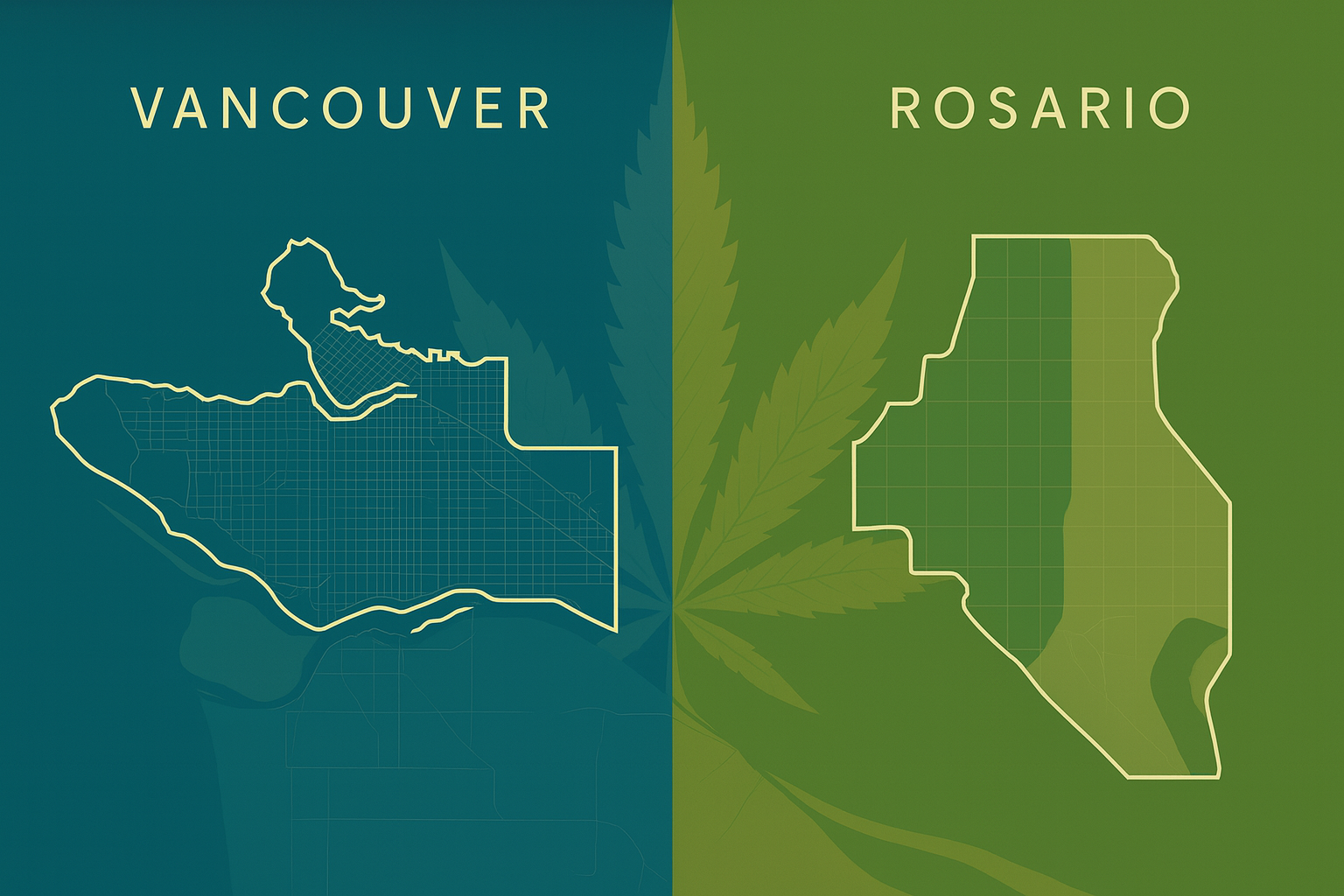
In the foggy and wet streets of Vancouver, in the Downtown neighborhood, a characteristic smell runs through the air. The fog of the humid landscape mixes with the scent of cannabis –call it weed, pot, or a joint– sold legally and safely, with precisely dosed products.
Like Odysseus in his adventures back to Ithaca, we grow and lift the veil of ignorance. This piece aims to reveal a latent opportunity in the productive heart of Argentina: the size of the cannabis industry, how much revenue comparable markets generate, and why we could do better. We'll look at data, strategy, policy –and the occasional joke. Shall we draw Odysseus' bow?
In the state of British Columbia –where I had the pleasure of residing for a few months– cannabis stores flourish; there are approximately 500 stores in the province. You'll find them in every sizable city. Particularly in Vancouver there's a cannabis store between a Chinese supermarket and an Indian fast-food place. What's more, these stores can be found even on the campus of one of the best universities in the world, the University of British Columbia (UBC).
Walking down University Boulevard, I came across an interesting sign: "Weed Dispensary". Upon entering, with curiosity, I ran into a young Peruvian who was running the establishment. With a knowing smile, we paused to chat in Spanish about his work, the permits and permits and inspections he had to comply with, and his advice for consumers. I left with some very potent cannabis gummies, deep in thought.
The store was no exception but part of a vibrant ecosystem: Vancouver celebrates cannabis in all its forms. There are boutique places like Inspired Cannabis' House of Brands, which functions almost like a museum of brands; lounges like The Dab Lounge and elegant spaces in iconic neighborhoods like Water Street Cannabis in Gastown. It is estimated that the province of British Columbia generates more than 1.44 billion dollars annually. In 2024, it reported more than $4.32 billion in regulated sales. Cannabis tourism is even promoted, with varied proposals such as cannabis cafés and visits to production sites, consolidating Vancouver as a global cannabis hub.
"Why can't we do these kinds of ventures in my place?", I thought as I walked back. What stops us from farming on a large scale, selling, offering more jobs and being able to tax that? How much do we miss by not taking advantage of everything our country has related to this sector? Not just the know-how of local growers, but also market dynamics and innovation. Some answers to these questions can be found in this article (which, for the moment, is only available in Spanish. This new text seeks to add arguments towards that horizon: a new green pill.
What if Rosario were Vancouver
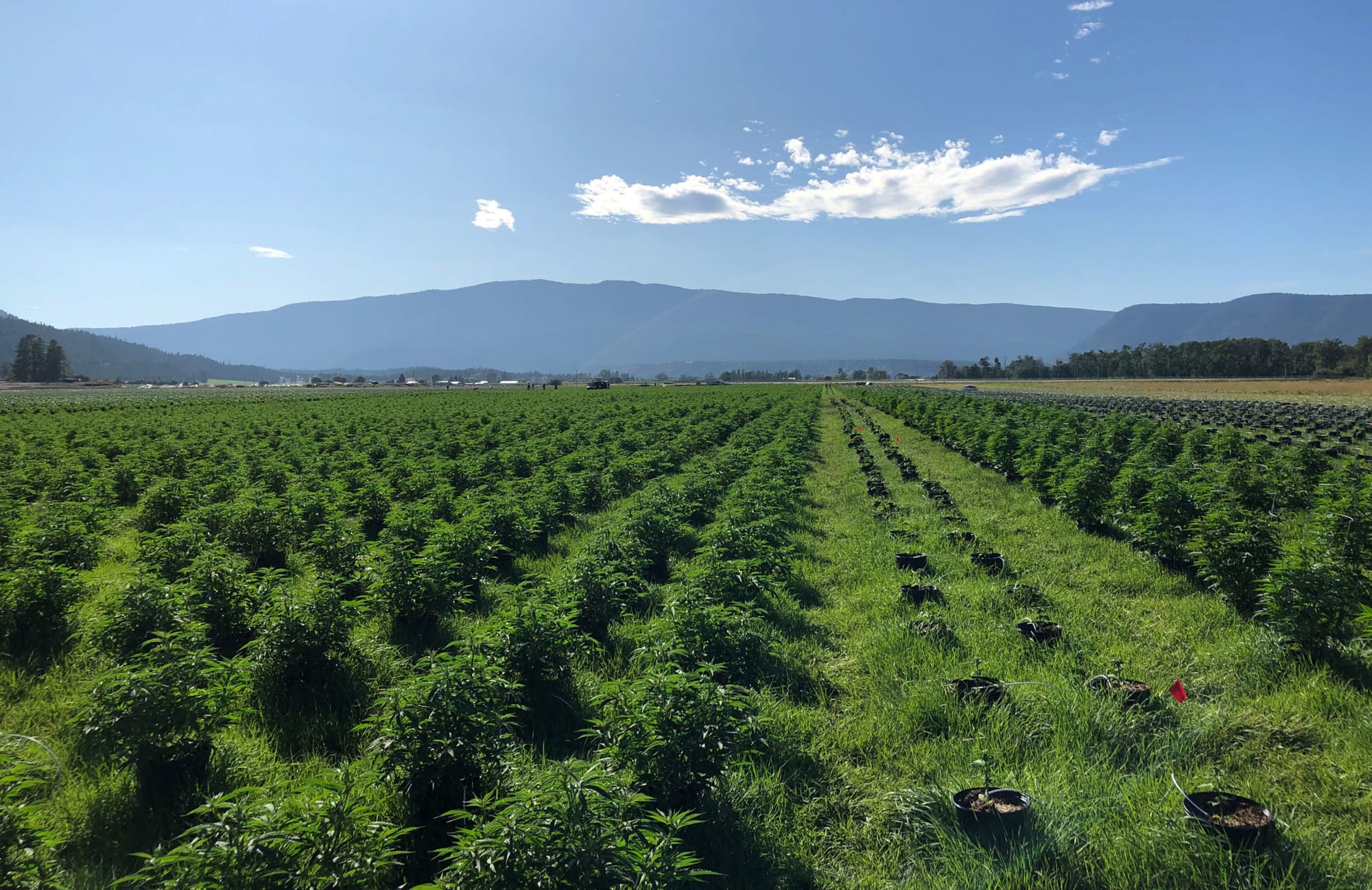
We return to Vancouver, a deeply multicultural university city, set on a large body of water that moderates temperatures and keeps humidity high; it rarely snows. Does it sound similar to any from Argentina? That's right, I'm talking about the city of Rosario, in the invincible province of Santa Fe. Sound like any Argentine city you know?
Vancouver covers about 115 km². It's home to about 2.6 million people (including Greater Vancouver) and accounts for ~7.5% of Canada's GDP.
Rosario covers about 180 km². It's home to about 1.9 million people (Rosario Metropolitan Area) and accounts for ~3.9% of Argentina's GDP.
According to INDEC and Canadian government reports, neither Vancouver nor Rosario are the cities that contribute the most to their country's economy. At best, they rank third or fourth in contribution. Being very lax, we could compare them. How much could a similar province be generating in our country, imagining an industry as mature as in Vancouver –which could take us years–?
This article is a big "What if...", so in order not to overcomplicate it, I'm going to use a simple and powerful spell: simple rule of three. I am going to consider that Argentina's total Gross Domestic Product (GDP) in 2025 will be around USD 650 billion. The legal cannabis market represents 1.7% of the country's GDP in Canada, applying that share to Argentina and using Rosario’s share of national GDP, we'd be looking at roughly $430 million flowing into the regional economy. A figure to consider.
Cannabis Use Data in Argentina
Let's talk about consumption. To what extent do we use cannabis in Argentina? Is there a market and consumers to attract? Are customers loyal? Do new ones appear? All these questions cannot be answered, at least as we would like, due to the problem of illegality: the lack of accurate information. A great advantage of legalization is registration, data generation, cross-referencing..., what we crazy big data people like, compulsive chart-makers. Never more true than "information is power": being able to know how much you really consume translates into how much you can earn by selling a product, how much you are willing to pay for it and, consequently, how much it costs to produce it; and also how many people consume and how much but, above all, how much tax revenue the state could collect through this sector. And that’s the gist.
Let's use the data from the National Survey on Consumption and Care Practices (ENCoPraC) 2023/2024. There are three key pieces of information in that survey:
• 1 in 5 people tried marijuana at least once;
• 10.3% of those who reported consumming cannabis used it in the last year (6.7%, if the sample is reduced to the last month);
• the number of men who used marijuana is double that of women.
If we consider that the Argentine population is 45.8 million, we are talking about 2.7 million users in the last 30 days. Can you imagine 25 Michigan Stadiums full of relaxed people listening to Pink Floyd while eating chocolate?
Something very important to note is that these questions are specifically about non-therapeutic consumption, that is, serious, adult and responsible consumption. And why do I say responsible? Because the same survey shows that the vast majority (80%) of users take precautions. They consume in safe places, stay hydrated, pace their intake, avoid mixing substances, plan their consumption days, and seek information. Added to this, the survey shows that the prevalence of consumption is higher in households with higher educational attainment. Very different from that image of uncontrolled bursting that they always sold us.
This shows the existence of a large market, ready to be taken advantage of, which is being supplied by an informal economy, outside the law, without quality or quantity controls. How is this ecosystem formed? What percentage is exchanged between friends as a barter or gift? How much is sold to acquaintances or strangers? There is too much interesting information that is lost by not recording this economy. Especially in quality: knowing what the gold standard looks like lets us set quality benchmarks and aim to meet them, homogenize the THC and CBD concentrations in production, catalog, systematize and refine.
The Problems of Prohibition
Despite all this, numbers are not enough: we need strategies, measures and policies, which in the end are what allows the change. Searching for knowledge and experts on the subject, I met someone very dedicated: Mariano Furlotti Barros, graduate in Political Science and master in Public Policy, who confesses to 421 that cannabis policies occupy much of his heart. In addition, he completed the first diploma in medicinal cannabis taught in Rosario and, as if that were not enough, his thesis on public policies focuses on Reprocann, Argentina's medical-use program (you can read more about it in this article in Spanish).
"As a general overview, the Argentine legal framework on cannabis is based on three laws: the Drug Law No. 23,737, the Medical Cannabis Law No. 27,350 and the Industrial Hemp and Medicinal Cannabis Law No. 27,669. But the founding milestone of the ban occurs in the Single Convention on Narcotic Drugs of 1961. There, a table is constructed where certain substances that are limited to the prohibition are cataloged according to the degree of danger. It was decided to leave some to free will –such as tobacco or alcohol– and regulate others", says Furlotti.
"Cannabis is prohibited. Medicinal use was recently allowed, but it was first classified as a substance that had neither medicinal nor therapeutic use; It was "potentially addictive". This, without any medical or pharmacological criteria, but rather for a political issue. "This vision reminded me of what I heard from people who defined themselves as apolitical or from that entity that does not like politics. What a coincidence: none of them consider themselves politicized, but they all have the same opinion." Soft power is most effective when dressed incognito, without leaving a trace. Let's continue.
"The story is long. Then there is another convention, in '71, where synthetic drugs are included. Between 1961 and 1971, Raphael Mechoulam, an Israeli chemist, isolated THC. So it is also prohibited as a substance. The investigation advances and the ban goes hand in hand. And then there is another convention, in '89, which is already the convention against illicit trafficking."
Furlotti points out that the main problem with past policies was a diagnostic error and the lack of honest debate on the comprehensive legalization of cannabis: "In this way, a frontal and sincere debate is avoided regarding whether or not cannabis should be illegalized. Meanwhile, Law No. 27,669, which I am almost convinced was approved unanimously in the Senate of the Nation. That law aims to develop the hemp industry. Hemp can be used to make many materials, fabrics, bricks. Even national hero Manuel Belgrano made a proposal to use it like this. What's more, it is said that the sails of the ships with which Columbus crossed into America were made of hemp. And the parachutes used by American soldiers in World War II were also made of hemp.
Mariano highlights that prohibitionism has failed globally, generating more consumption, poorer quality drugs and a shift towards other actors –truly dangerous– who act in the illegal economy. When I asked Furlotti what can be done now, in a very pragmatic way he told me that we cannot articulate any type of magic: we have to look for a spell according to the situation and realistic; that is, move forward with something achievable and that can last over time. Something that allows us to reliably measure adult consumption. And we go back to the beginning, we bite our tail like an ouroboros: for that, building reliable datasets is key.
Mariano proposes cannabis social clubs as a viable model to keep consumers away from the illegal market and strengthen regulated access: "What works best, in my opinion, are the clubs. Uruguay passed the law in 2013 and the State is only beginning to sell what it produces at the end of 2017. During all that time, those who met the demand were the clubs and the homegrowers. So, maybe the good thing about clubs is that there are people who do that work, people who know and receive some compensation, even when it's non-profit".
Local Actors and Regional Autonomy
After the talk with Furlotti I was full of information, but the local actor was still missing. What organized activities are taking place today in Santa Fe? So I had the pleasure of chatting with representatives of AUPAC, a non-profit organization that holds workshops open to the community, accompanies patients and growers, and promotes endless activities related to the topic.
Although there is a national law, Santa Fe has its own legislation, a no small milestone: Law 13,602, which approves the use of medicinal cannabis with coverage from IAPOS –the provincial public-sector health insurer– for specific conditions. To think about a provincial law that enables the growth of an industry, having this history of provincial emancipation is promising.
Within AUPAC's current activities there are also important institutional links. Clinical research groups with which results are presented at medical conferences, developing in-house lines with the Faculty of Agrarian Sciences from Zavalla and even efforts in conjunction with the Faculty of Biochemical and Pharmaceutical Sciences to provide access to a service for the analysis and characterization of cannabis resins for individual cases. All this shows that, even in the local trench, there are serious and academically supported articulations.
Furthermore, AUPAC states that the fight is not only to enable a market, but to change a paradigm: end the illegality of a substance that always punishes the weakest link –marginal consumers– and never the big players in drug trafficking. They propose a shift towards harm-reduction policies: accompany problematic consumption, dismantle prejudices and, from there, start a thriving industry.
And although it may seem impossible in this political context, hope is not dead: in several parties there are already approaches to the issue and in the provincial Chamber of Deputies the debate on cannabis projects is being reinvigorated. Listening to them, I realized something: when I talked to different actors, they all had something in common. What they all shared was drive –to organize, to pool efforts, to learn, and, above all, to work. And that, in a context of overexploitation and low salaries, is worth gold. Intrepid people who put their time into a new project, who invest capital to build a greenhouse, who risk, lose, but continue. In the end, those who endure are the ones who make things happen. Beyond numbers, trends and strategies, you cannot measure that "capital of desire". And yet, it weighs a lot.
Drawing the Bow
Upon returning from his journey, Odysseus is the only one who can draw the bow. In doing so, he reveals his identity and eliminates, arrow by arrow, those who claimed the throne of Ithaca. I'm not saying we have to take down our opponents, but these arguments can be our projectiles to pierce entrenched speeches. Passing data is important. Cultural counter-narratives matter. Does it sound naive? Maybe, but I don't care. I am not sure that mass militancy will be enough to change reality; It is necessary, yes, but sometimes it is more effective to occupy decision-making positions or convince those who occupy them. We are missing a green pill. Or maybe what is missing is that agent who is in charge of putting the pen; one who has a voice, a vote and who, in his granted representativeness, fulfills his role.
What is certain is that there is a great market, work and fundraising opportunity; not only for the invincible province of Santa Fe, but for the entire country. We have the demand ready, the experience in cultivation and even other businesses that support growers. What stops us? The opinion of some curmudgeons? Off-the-books money that prefer informality? Tangled between campaigns and psyops, this article falls short of those questions. We are left to normalize recreational consumption, refute the legend of the burst consumer and craft the first practical step towards a green horizon.