What I Learned Being Evangelical for Three Years

21 de ene. de 2020 — Juan Ruocco 🧙♂️
This article carries a personal weight. One of the strangest decisions I ever made was to join an evangelical church. Although "join" is an understatement because I was actually involved for three years, got baptized by immersion (in a beautiful inflatable pool), became a youth "leader" and a missionary. At the time I had my reasons for doing it but they're beside the point. At the same time I started studying at UBA, took the CBC and the first year of Philosophy. With the cognitive curiosity that defines me, I began reading theology, which led me to the monumental texts of Paul Tillich and Hans Kung.
I read the entire Bible, read about the formation of the biblical canon, exegetical studies on the New Testament, and a book or two about the historical figure of J. Christ. There came a point where my self-taught education clashed head-on with the teachings of the church I belonged to. Without much fuss, I left. This article is far from being a mockery or an attempt to discredit the religious beliefs of those who choose to devote their lives to that institution. It is merely an attempt to explain, in broad strokes, how an average evangelical church works.
Introduction
The participation of evangelical churches in the debate over the legalization of abortion was what catapulted them to the center of the public stage. Until then, the little that was known about them came from three sources. First, from certain evangelical sectors that, since the 1980s with Pastor Gimenez at the helm, occupied the fringe time slots of Argentine television. Second, from some books or articles, rather sporadic, in various media about the phenomenon; I remember the book "Cristo llame ya! cronicas de la avanzada evangelica en la Argentina" by Alejandro Seselovsky from 2005. The third source of information about evangelicals is the national survey on religious beliefs and attitudes, conducted by the Secretariat of Worship together with Conicet every ten years. It is the most reliable statistical data we have.
The active participation of evangelical churches in blocking the non-punishable abortion bill revealed to a large portion of society a previously overlooked aspect of evangelicals, namely their capacity for mobilization and political engagement. Not partisan politics but politics understood as the collective action of a group to influence public opinion and the direction of social affairs.
More recently, two other processes fueled interest in evangelicals. On one hand, the support that Jair Bolsonaro, president of Brazil, received from this group during his candidacy, and on the other, the prominence this sector gained when Luis Fernando Camacho, president of the civic committee of Santa Cruz, entered the Palacio Quemado, seat of the Bolivian government, carrying a Bible and a Bolivian flag after Evo Morales resigned the presidency of that country.
As a result of these events, alarms went off across the entire progressive, left, center-left spectrum and beyond, about whether something similar could happen in Argentina. Crisis published a series of articles trying to understand the phenomenon from a sociological perspective. This article can be read as an appendix to that one.
What are evangelicals?
First let's address the institutional considerations. The best way to understand Christianity is to see it as a tree with many branches. This tree has a main trunk without significant bifurcations until the 11th century, when the first division between Catholics and Orthodox was born. While both churches are differentiated, neither considers the other a "heresy" -- they coexist. After the Protestant Reformation, a new branch was born, which was declared heretical by Catholic orthodoxy but took hold strongly. Christianity was and will always be, among other things, a dispute over the name -- that is, a branch claiming to be the only true branch. From the Protestant branch came the Lutherans, Anglicans, Calvinists, and a few others. And from those branches, just a few years ago, the evangelical traditions were born: Methodists, Pentecostals, Plymouth Brethren, and so on. These are merely the latest leaves on the tree, and the ones called "evangelicals." Most of these churches are autonomous but maintain some coordination through federations; among the best known in our country are ACIERA, FAIE, and FECEP.
Jehovah's Witnesses are not evangelicals, as they differ entirely in their beliefs about J. Christ. Mormons are not evangelicals either, the New Apostolic Church is not, and the Universal Church of the Kingdom of God has a complex status. While in its fundamental beliefs it seems to share similarities with evangelicals, the level of fetishism it has toward various objects (the discharge mantle, the water of the Jordan, etc.) and an excessively mercantile relationship with its faithful, mean that most evangelical churches do not consider them their own. In our country, all churches and religions that are not Catholic must register in the national registry of worship as stipulated by Law 21745 of 1978 and Decree 2037/79, both published under the military dictatorship.
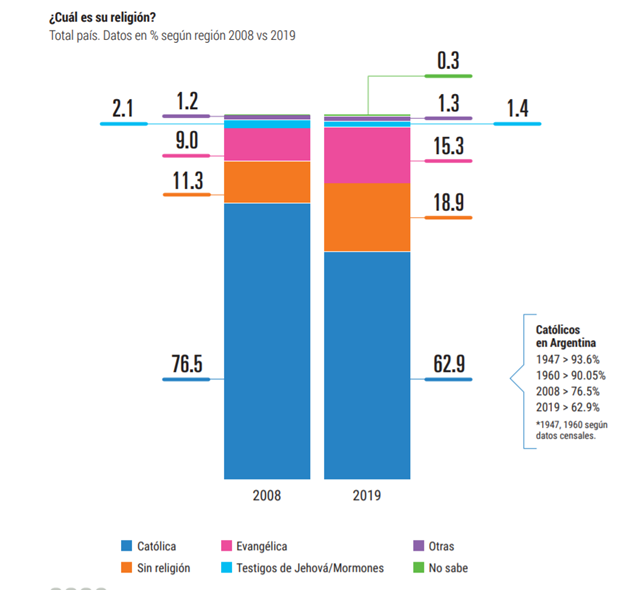
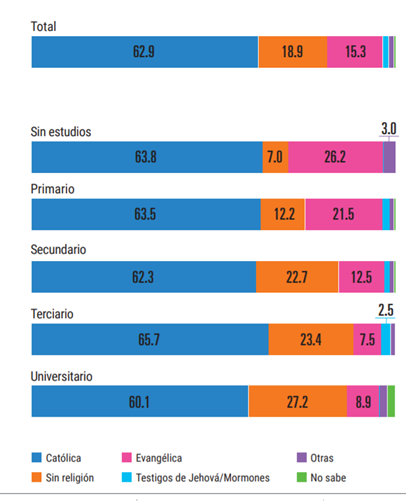
Evangelicals are a social group that has been growing in influence for more than three decades but went unnoticed by the intelligentsia. This growth is reflected in the six-point increase since 2008, going from representing 9% of the population to more than 15%. A six-point increase in eleven years.
My fundamental hypothesis for this article is that the growth of the evangelical phenomenon can be explained by their set of beliefs and how these influence their way of acting.
Evangelicals vs Catholics
Part of the lack of awareness in Argentina about the evangelical/Protestant tradition has to do with the fact that until not too many years ago, the religion that had hegemonized Christianity in Argentina was Catholicism. For us, those born in the territory south of Paraguay, being Catholic and being Christian were almost synonymous. In fact, I got to know evangelicals through a personal and random circumstance: I was expelled from a high school halfway through my fourth year and the only school with the same curriculum that would take me was an evangelical school, ECEA.
This relationship between Catholicism and evangelicalism helps us draw the first difference. While religions have influence over society, there is a crucial difference in how that influence is exercised. On one hand, the Catholic Church, at least in our country, functions as a "backdrop" -- that is, a kind of common and popular worldview that does not demand too much of its faithful, beyond some annual mass attendance, venerating a saint, et cetera. Catholicism, except in a small fraction, does not have a militant ideology. And it didn't need one, until recently, because it was the hegemonic religion of the country, the one that had beaten all the rest, so much so that it appears in the second article of the national constitution:
Article 2 -- The Federal Government supports the Roman Catholic Apostolic faith.
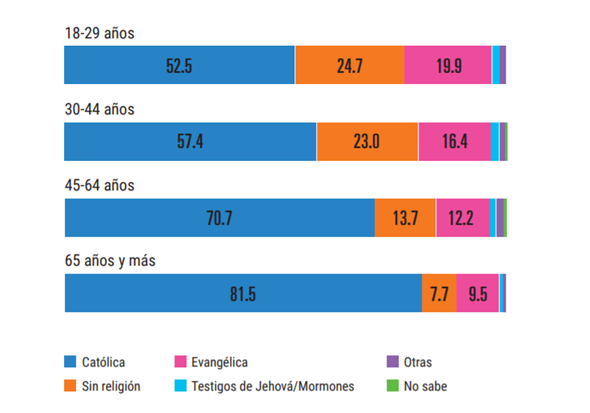
While today Catholicism retains influence because it occupies institutional positions, the reality is that its militant base is greatly diminished, at least in our country. It even has severe problems training new priests. Obviously this has to do with a constant secularization process we are going through in many parts of the world, where the church has been losing its capacity to be the main structure of education. A fact we can corroborate when we see the age breakdown of religious beliefs. While among those over 65 only 7.7% say they are atheist, that number triples when we go to the 18-44 age bracket.
The Catholic Church's main asset in countries where it is the majority, like Argentina, is that its ideological/philosophical system became the standard worldview of a large percentage of the population. The Argentine belief system is largely constituted by the teachings of the Catholic Church, which had a phenomenal domestication apparatus, based on baptism, parishes, schools, children's education, scout groups, Catholic Action, and other institutions. But with the advance of secular culture and the church's own relaxation of its rituals or demands on the faithful, its firepower diminished. As Peter Sloterdijk says, society is no longer educated by the state, Catholicism, or the Enlightenment intellectuals, but by mass media (TV, the internet, video games, everything that stimulates the desiring-machine).
Evidence of this kind of "popular philosophy" that Catholicism has become can be seen in certain rituals that persist in everyday Argentine life: Christmas, Holy Week, the pilgrimage to Lujan, San Cayetano, the cult of the Virgin Mary, and the proliferation of saints outside orthodoxy (Gauchito Gil, la Difunta Correa, or San la Muerte). A relative but undeniable presence in the popular fabric. Even the fact that the country's biggest cultural mass phenomenon, the Indio Solari concerts, is called a "misa ricotera" (Ricotero mass), somewhat reveals the standardized nature of Argentine Catholicism. However, despite being the standard philosophy of the Argentine people, the number of faithful is declining: it went from 76.5% in 2008 to 62.9% in 2019. If the same trend continues, in ten years it would be barely above 50%. A very striking number considering that Catholicism had no significant rivals for more than 500 years.
Unlike its Catholic counterpart, the evangelical church exerts influence over its members in a much more direct way, so much so that it can be characterized as an active minority. It went from 9.0% in 2008 to 15.3% of the population in 2019. This significant increase is undoubtedly due to the militant nature of the average evangelical. For evangelical churches, belonging demands commitment. This is reflected in the numbers, where we can see that 53% of the evangelicals surveyed said they go to the temple at least once a week compared to 12% of Catholics. If we do all the necessary calculations, based on a population of 40,000,000 people, the total number of how many evangelicals and Catholics go to the temple at least once a week comes out the same, a number close to 3 million. But with the difference that 60% of the country says it is Catholic and only 15% says it is evangelical. This is what I mean when I say it is an "active minority."
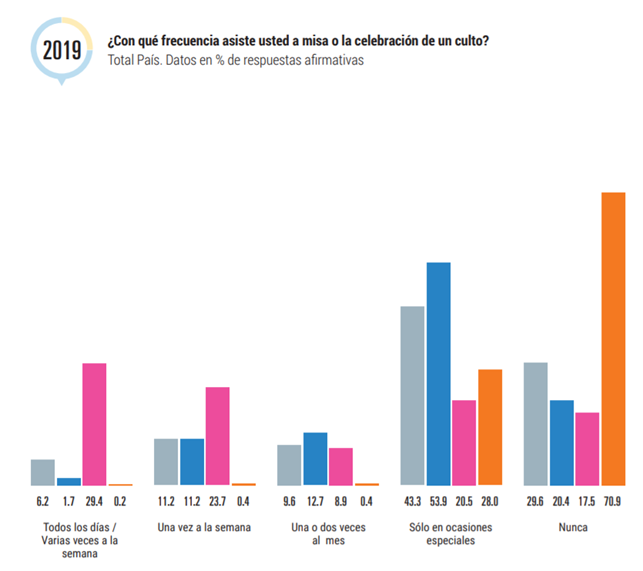
This can be explained, in part, by the fact that "passive" members of a church are not usually well regarded by the rest of their community. A good evangelical Christian attends worship every Sunday (the evangelical version of mass, which also features a choir, drums, and electric guitar), participates in some cell group (support and Bible study groups), and if well committed does some additional activity. Also, if they are young, on Saturday nights they go to the youth group (whose function is to keep the younger ones together, help them find a partner, and keep them from the sin of "going out dancing"); if they are old they go to the seniors' group, and if they are children they participate in "Sunday school" on Sundays, like Bart Simpson.
Decentralization
Evangelical churches are a subset of the Protestant church. I could spend hours describing all the ramifications and denominations that exist in non-Catholic, non-Orthodox Christianity, but I would bore you too much. For those who want to do so, you can go to this Wikipedia article. The main thing to understand is that Protestants do not answer to the authority of the Pope. It's as if they kept the principles of Christianity but founded a new organization, and for that reason, for several centuries, they were branded as heretics. Technically it was the second fork of Christianity -- the first had been the Orthodox Church. Furthermore, this dispute has as its backdrop the struggle between papal power, which still represented the emperor's power, and the power of the princes, who demanded a certain national autonomy. Luther was the one who provided the doctrine that the supreme authority of the church should be the prince, not the pope. This allowed the princes to rebel against the papacy. So much so that, as a vestige of that era, the Anglicans -- the English Protestants -- have the King as the head of their church. This is also important because it begins to outline the ties that would be woven between Protestantism, incipient nation-states, and capitalism, which we will review later.
Churches are easier to reproduce. Since they don't need authorizations from overly large and bureaucratic institutions, they can open new meeting and worship spaces in almost any location. Moreover, in the event of a conflict between a pastor and their leadership, the pastor can go their own way and start a new church. As happens with bees when a queen leaves the hive and builds another colony, division in the evangelical church is a tool of reproduction.
This is because, unlike the Catholic Church where respect for verticality, apostolic succession, canon, and papal authority is of utmost importance, in the evangelical church a principle of individual fidelity to Christ prevails, which is above respect for the church as an institution. Furthermore, for evangelicals, any place can be a church: a living room, an unused shop, a banquet hall. The church is its members, not the building. Evangelical communities sustain themselves through tithing; in this way, when a church starts operating, it has a structure proportional to what its members can attract. As the church grows in the number of people, it gains access to more money and can therefore improve the sound system, have more pastors (some are full-time, paid by the congregation, and others are part-time and ad honorem), a better venue, and thus attract more people. In that sense, a kind of positive loop is created that makes the church grow organically.
Grassroots Work
One of the advantages that decentralization provides is that it allows a much more flexible type of organization and therefore more capillary -- that is, with greater reach because it can better penetrate the interstices. This works perfectly for the evangelical church to fulfill the missionary mandate bequeathed by J. Christ himself, as the scriptures affirm in Matthew 25:35-36.
Then the King will say to those on his right, Come, you who are blessed by my Father; take your inheritance, the kingdom prepared for you since the creation of the world.
For I was hungry and you gave me something to eat, I was thirsty and you gave me something to drink, I was a stranger and you invited me in, I needed clothes and you clothed me, I was sick and you looked after me, I was in prison and you came to visit me.
While for Protestant doctrine salvation is only through God's grace, all of this, which can be translated as "social work," is of vital importance. That is why the work of evangelical churches in prisons, with addiction recovery, and in the slums is so common. What we call "social work" is almost an obligation for those who participate in the church, as well as a tool for gaining new members. It is no coincidence that it is in the sectors with the least completed education where the evangelical church is most representative, since that is also where it focuses its efforts most heavily.
The Protestant Work Ethic
Perhaps the most disruptive factor evangelical churches have is that their growth modifies the cultural norm of the country where they establish themselves. A substantial part of the evangelicals' success is that the conversion they propose to people implies a radical modification in their lives, since to be part of the church one must adopt its strict moral code. And this has two consequences. The first is that it introduces, more or less deliberately, what Max Weber called "the Protestant work ethic." That is, the idea that work is a fundamental and guiding principle of life, and advancement up the income pyramid a tangible form of God's blessing. A doctrine also sometimes called the theology of prosperity, which most evangelical churches, in one form or another, uphold. In this way, the church molds participants to be active members of society. It does this by deploying a series of technologies of the self to improve the subjects' performance in society. Evangelical literature is a clear example of this, and the book "The Purpose Driven Life" is the paradigm. These books usually have a daily devotional structure (one chapter is read per day) that explains what purpose God prepared for each person in their life. Often the book is read simultaneously across the entire church, and in a month or two they complete the "devotional" journey. By the time the book is finished, the reader should already know what they need to do to live a "fulfilling" life. This type of strategy is recurrent and is one of the most effective ways the church has to pass down doctrine.
The "conversion" process is, ultimately, an evangelical psychopolitics. As a result of conversion, life must "transform." And this miraculous transformation is nothing more and nothing less than following the church's moral code, which can be more or less strict depending on the denomination but is generally similar: no premarital sex, be heterosexual, be obedient to ecclesiastical authority, don't lie, don't use substances (cigarettes, alcohol, drugs), don't steal, and a long et cetera. Thus, the imperative of conversion creates a series of socially "apt" people, suited to be productive. It provides an order, a sense of purpose, that for people deeply marginalized from any kind of social support works in a quasi-"miraculous" way. That is why it is so common to hear testimonies that seem like carbon copies: "I used to be an X and now the Lord blesses me" where X is any "sin." It is like constant life coaching.
The second consequence is that church participants will have a shared worldview regarding issues on the public agenda. And this is where everything gets a bit more complex. As we said above, evangelical churches are a subset of the Protestant tradition. Within this we can find Calvinists, Lutherans, Anglicans, Waldensians, and others. All of these currents are more "historical" and have a progressive mentality. The main difference with the evangelical subset is that the latter tend to defend literal interpretations of the Bible, which is why they are also called fundamentalists.
And this is the core of the problem. If the Bible is interpreted literally, we have a problem, because it becomes a (not very good) book of cosmology, biology, and morality. Too much for a single book. If we read the Bible literally, the universe was created in six days, all of humanity descends from Adam and Eve, and the Ten Commandments were written by God in person. This last point is the most problematic of all. I don't mean to say the others aren't, but in an era of flat-earthers and vaccine deniers, the fact that there are people who cannot understand how evolution works is no longer so unusual. Beyond that, the problem with believing that God handed down a unique legal framework for human behavior A.K.A. "the Ten Commandments," completely forecloses reflection, discussion, and questioning of any human action and/or legal system. If morality -- that is, what is good and what is bad -- is determined by God, no reform is possible, and let's not even talk about being able to hold a more or less critical stance. This is the fundamental problem of evangelical expansion. To see how an essentialist philosophical idea determines social thought, let us look at the impact of the idea that God created only two genders with the corresponding notion of what a "typical family" should look like.
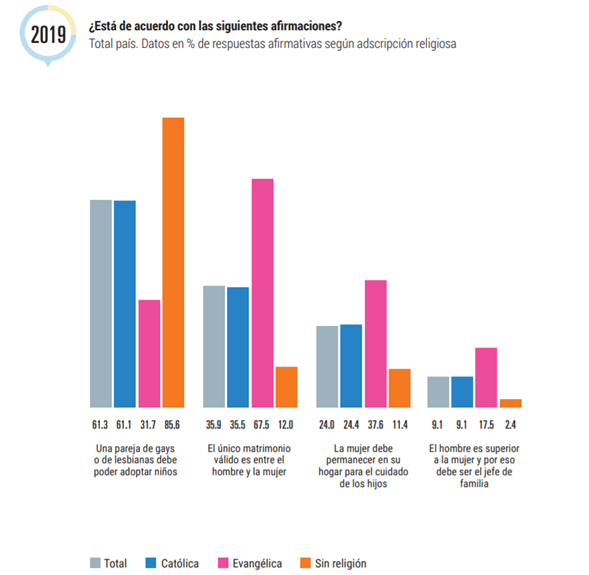
As the chart shows, in a population where the idea of God guides their life, anything that has a divine origin enjoys a special epistemic status. If social issues are included among those categories, then believers can only deduce that certain things are the way they are because God made them so. Hence the strong rejection of same-sex marriage and consequently of comprehensive sex education (ESI).
We deduce from these two points that the changes in the cultural fabric brought about by the advance of fundamentalist evangelical churches are, at the very least, problematic.
Church and "the World"
Another of the foundational dichotomies is the idea that "the world" is the enemy of believers, supported by the literal interpretation of James 4:4.
You adulterous people! Don't you know that friendship with the world means enmity against God? Therefore, anyone who chooses to be a friend of the world becomes an enemy of God.
The radicalization that participating in an evangelical church demands is not attractive at first sight, as it requires many sacrifices depending on whether the church is more liberal or more orthodox. If the church is very moralistic, not only are alcohol, tobacco, and nightclubs forbidden, but also non-Christian music, and even the most radical ones may prohibit movies, video games, and non-Christian books. But the churches compensate for this lack of worldly entertainment with entertainment generated by their own cultural industries:
While the main activities that a Catholic identifies as part of their religious life are praying, talking to deceased loved ones, reading the Bible, and confessing or taking communion; for evangelicals the main activities are: praying, reading the Bible, listening to religious music, and listening to or watching religious programs on radio, TV, or the internet.
While for Catholics all their religious activities are oriented toward worship, for evangelicals two of the four most common activities are oriented toward entertainment. Although the evangelical church demands a sacrifice in separating from "the world," it compensates with the same products but created with Christian content. In this way it manages to provide a palliative for the believer while resolving a serious problem the Catholic Church has, which is how to reconcile religion and entertainment. Something it did very well in the Middle Ages but that seems not to have gone as well after the Renaissance.
The Christian creative industries are a billion-dollar industry, with their production center in Nashville, United States. This makes capitalism and religion compatible, in addition to sacralizing culture, which increases the separation between civil society and evangelical activism.
Conclusions
It is undeniable that the growth of the evangelical population is associated on one hand with their ability to work in a decentralized manner and focusing their action on people marginalized by the economy and politics. In that context, evangelicals have an advantage because their life and their religious mission coincide. Thus we have the perfect combination for a highly viral meme, in the words of philosopher Curtis Yarvin. Evangelicalism is a virus very well adapted to our times whose positive payload is the establishment of a Protestant work ethic and a strong identification with the countries that profess it.
A careful reading of the survey on religions also shows not only the growth of evangelicals, but also the same growth among the "non-religious," which grew seven points in eleven years, even surpassing the growth of the evangelical boogeyman. This tells us two things: on one hand, the sustained decline of Catholicism as the standard of belief in Argentine culture; on the other, the rise of two opposing poles: non-religious and Christian fundamentalists. The non-religious double starting from the completed secondary education level, which tells us that the more education, the greater the chance of being atheist.
Thus, Argentina is moving toward a very important transformation of its cultural heritage. On one hand, the rise of Christian fundamentalism and on the other, a non-believing pole of secular, educated people who are pro-choice, pro-minority rights, and pro-drug decriminalization.
Quite a mess.