Yarvin, Houellebecq, Land, Fisher: Political Readings of Lovecraft
Since 2008, the New Right has adopted Cthulhu as a metaphor –but cosmic horror is just as useful for thinking through reactionary and revolutionary movements alike.

5 de dic. de 2025 — Dante Sabatto
“Cthulhu may swim slowly, but he always swims to the Left,” the neoreactionary thinker Curtis Yarvin once stated. It’s one of those phrases that circulate in the political subcultures born after 2008, that great chronically online, terminally nerdy, shitposting movement we now call the “New Right,” a concept that has been solidified for more than a decade.
Theorists who traded academia for a blog like sweeping generalizations and assigning political identities to things that don’t have them. Another well-worn example comes from Peter Thiel: “Crypto is libertarian, AI is communist.”
With his declaration, Yarvin was referring to a supposed irreversible drift of societies toward progressivism. In a way, he’s not that far from what Martin Luther King Jr. had in mind when he said that the arc of the moral universe “is long but bends toward justice.” In fact, it’s so close it almost reads like plagiarism. What changes, of course, is the evaluation: MLK said it with hope, Yarvin with nihilism.
But beyond that, the phrase is interesting in itself: why does the NRx theorist—part of what’s called the “Dark Enlightenment”—choose to personify the political becoming of society with the name Cthulhu?
Probably because it’s an immediately recognizable reference for his readers. That unpronounceable name is a creation of H. P. Lovecraft, a “cursed” writer who founded a radically new way of imagining horror. The being in question is alien, impossibly ancient, sleeping in the infinite depths of the ocean and always threatening to wake. As a metaphor, it’s useful for describing the impersonal structures that govern our lives: external to human concerns, sometimes invisible, yet terrifyingly powerful.
Lovecraft’s work has always been fertile ground for thinking about politics. First, because it contains a politics: it’s very clearly there in Lovecraft’s eugenicist worldview, for whom horror ultimately resides in some form of racial degeneration or the violation of a pure order. But there’s also something else: almost ninety years after his death, we keep going back to Dunwich and Innsmouth, to the Shoggoths and Nyarlathotep, to develop political ideas that are reactionary and revolutionary, conservative and even progressive. In this century—the Lovecraft century—Cthulhu can belong to the Left or to the Right.
Why so much interest in a pulp horror author, a writer of commercial, popular fiction whose ideas were, in many ways, extravagant? Why do fascists and communists alike reach for a guy who despised Hitler because he gave eugenics bad press? That’s what I want to think through in this text, using three keywords: realism, exteriority and alienation. Each of these axes knots together debates and disputes over the legacy of cosmic horror, not only as literature but also as a tool for intervening in the present.
Realism: This World or Another?
The quote from Yarvin that opens this essay might seem curious. After all, everyone “knows” that Lovecraft is right-wing—not just because of his personal views, but because that’s the canonical political reading of his work. As I said above, I want to challenge that univocal, one-way reading of cosmic horror, but it’s also true that, for the most part, he has been read as a kind of secret godfather of reactionary thought.
Within that lineage, the most popular Lovecraftian is probably Michel Houellebecq. In his essay H. P. Lovecraft: Against the World, Against Life, the French writer delivers a powerful plea in favor of a political use of Lovecraft’s work. Houellebecq published the text in 1991, well before completing his own turn to reaction, though he was never all that far from it. In his account, cosmic horror becomes a weapon aimed at political correctness and right-thinking intellectuals—not because Lovecraft offers clear, programmatic arguments in that direction, but because he carries a certain passion: hatred.
The essay describes Lovecraft as sunk in radical contempt for existence, a kind of infinite pessimism about the possibility of the good. Houellebecq defines this stance as an “anti-realism.” What he’s talking about is a radical confrontation with the usual discourse of accepting reality “as it is”: life has no meaning, but neither does death. In between there is only suffering. What Lovecraft offers, what constitutes his radical anti-realism, is an uncompromising rejection of the value system that tells us reality deserves to be defended. We find his morality repugnant—and we should—because what he embodies is an immense negativity.
When it came out, Houellebecq’s essay caused a sensation. Probably because no one had condensed so clearly an intuition many readers already shared: that “there is something non-literary about Lovecraft,” or rather, something more than literary—namely, something political. Today, his ideas may seem a bit obvious, perhaps underdeveloped. Yes, cosmic horror places us “against the world, against life.” But: in favor of what?
A possible counter to Houellebecq is the American philosopher Graham Harman, author of a book on cosmic horror that openly confronts the thesis of anti-realism in its very title: Weird Realism. Harman’s operation isn’t all that interesting at a strictly literary level (it basically consists in taking a huge list of textual examples to turn Lovecraft into an exponent of his own philosophical theory, Object-Oriented Ontology). But his tactical move is revealing. Instead of placing Lovecraft “against” reality, Harman discovers in him a tendency to describe reality in an estranged, de-familiarized way. What we see in his stories is not an escape from the real, but a strange kind of realism.
Still, it’s not entirely clear how that squares with the obvious hatred his fiction expresses for life and for the cosmic order itself.
Someone who can offer a few clues is Mark Fisher. In his unjustly neglected book The Weird and the Eerie, he situates Lovecraft as the first great exponent of a literary form he calls “the weird” (and we’re currently in the middle of a boom of a new generation working in that mode, the so-called New Weird). In the chapter he devotes to Lovecraft, Fisher finds a way around the problem realism poses for him: he describes Lovecraft’s stance as a kind of hypernaturalism, an expanded sense of what the material world contains, and goes so far as to suggest that this is, fundamentally, an oeuvre about trauma.
This isn’t trauma in the familiar, individual-psychological sense, but on a transcendental scale: experience itself appears torn because reality is traversed by “a kind of transcendental shock”—or, we might say, a cosmic one.
Contradicting Houellebecq, Fisher argues that what Lovecraft despises is not the world as such, but “the mundane.” He isn’t against the world, he’s against this world—in defense of a stranger one. So we move from a political hypothesis, Houellebecq’s anti-realist Lovecraft, to an ontological hypothesis, Fisher and Harman’s weird materialist Lovecraft. And yet this second reading, even if it doesn’t directly fuse with reactionary diatribes against progressivism, has some very interesting political consequences of its own.
Exteriority: Cthulhu and Capital
When Fisher reads in Lovecraft a cosmological thesis about transcendental trauma, what is he thinking of? Probably some of the debates he took part in during the 1990s as a member of the Cybernetic Culture Research Unit (CCRU), a research collective that combined heterodox Marxism, occultism, cybernetics and cosmic horror into a particularly strange cocktail. Its best-known figure is Nick Land, who forged much of his philosophy (and his much less known fiction) in direct dialogue with Lovecraft. But we shouldn’t overlook the Iranian writer Reza Negarestani, who wrote a work of theory-fiction in which oil appears as a kind of Lovecraftian Great Old One, and developed a philosophy of “geotrauma,” a kind of psychoanalytic reading of the Earth’s geological history.
All of this is to say that Lovecraft is perhaps the main inspiration behind what we now call accelerationism. Moving away from Houellebecq’s rather petty skirmishes over political correctness in France, many authors saw in cosmic horror a key for thinking about capitalism.
Let’s start at the beginning. The reason Nick Land turns to Lovecraft’s fiction is that it offers an escape not so much from realism as from anthropocentrism—from the egocentric, human-scaled view of the world. What Land is interested in is the possibility of transcending the limits of human reason and experience, and finding ways of accessing material reality in itself. In Lovecraft, he finds a way of staring into the abyss. As Fisher explains so well, these stories often stage an encounter with a radical Outside, something completely beyond human scale and human experience that nonetheless irrupts within us—as in The Shadow over Innsmouth, where the narrator discovers that the incomprehensible Deep Ones are already part of his lineage, literally in his blood.
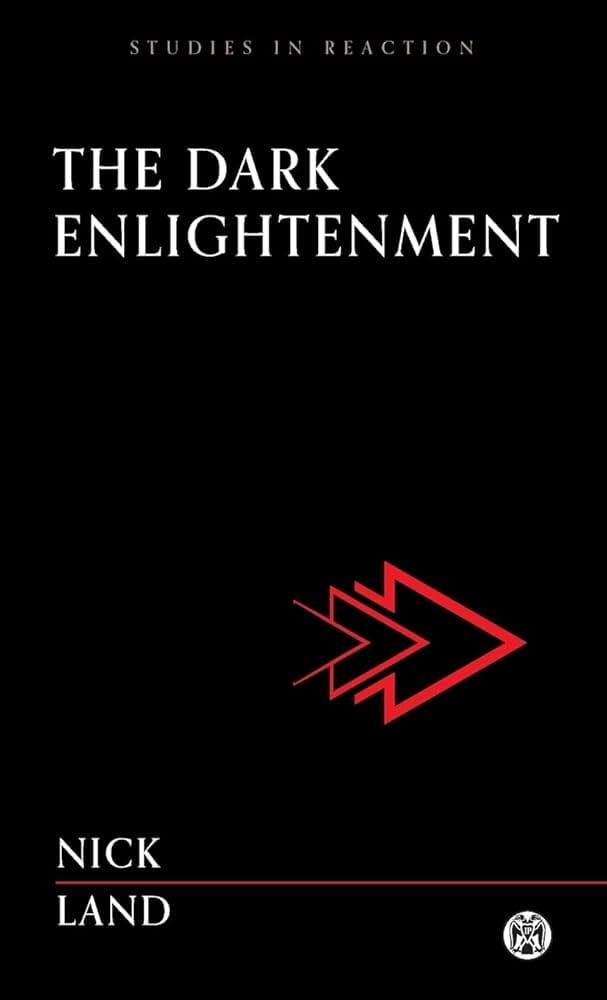
Only later, having abandoned the Marxist Left for the reactionary Right, does Land connect this reading to his understanding of Capital. The point is to think the economic order as fundamentally anti-human: an infinite, impersonal structure he describes as literally alien.
A good way of grasping this is to think of the Shoggoths in At the Mountains of Madness: beings almost bereft of reason or agency, colossal amoebas without form or meaning. In the account the explorers uncover, these creatures were originally a kind of slave caste, pseudo-animals serving the Elder Things, only to eventually rebel and consume their masters. Land reads this as a strict allegory of technocapital: an idiotic entity, without will or consciousness, that nonetheless becomes the subject of history and ends up dominating humanity. Today, you could swap that role out for AI and the myth would barely need to change.
We thus move from an anti-realist Lovecraft to a thoroughly anti-humanist one. But faced with a cosmos that is completely alien to the human race and capable only of causing it suffering, what exactly can be done?
Alienation: Pessimism and Lines of Escape
It’s not hard to find analogies with alienation in Lovecraft’s work. In fact, they appear in an oddly literal form: time and again, his characters discover that they themselves are aliens, that they are the product of miscegenation with non-human beings, that they do not belong to themselves but are the objects of strange cosmic forces. A way of reading the world like that can only be pessimistic: all there is is estrangement, pain, impotence. Lovecraft frequently runs into a contradiction here: is the cosmos he constructs genuinely indifferent to humanity, or actively malevolent and opposed to it?
In the latter case, we’d be dealing with a reinstatement of anthropocentrism: even as victims, we would once again occupy the center of the stage. Some readers have tried to locate a possible humanism in Lovecraft. Harman, for instance, suspiciously notes that the human characters in these stories always manage to harm the Great Old Ones in some way—bite them, wound them—even if they never truly defeat them. In Weird Realism, he wonders whether there couldn’t be, just as there is cosmic horror, a form of cosmic love, equally strange and alien but reversing pain into pleasure. In a similar vein, I’m reminded of an old video essay that proposed a queer reading of Lovecraft; the videogame Night in the Woods plays with something similar.
Others refuse to abandon Lovecraft’s critique of humanism. For them, what’s interesting is precisely the line of flight it offers: the possibility of fleeing all the values and moral premises we’ve learned to accept. To the extent that cosmic horror situates itself at the limit of experience, almost beyond all reason or sense, it confronts us with the meaninglessness of reality and forces us to go further. Politically, that tends to fling us toward radical positions: from psychosis to fascism there is sometimes only one step. Land is perhaps the best example of this: in a kind of extended episode, he moved to Shanghai and began to worship Capital as an apocalyptic Great Old One. The problem is that many of these readings end up circling back to Houellebecq’s banal anti-progressivism, obsessing over things like inclusive language or welfare policies—mundane matters, all too mundane.
A different alternative is proposed by the philosopher Eugene Thacker, author of three books on “horror and philosophy,” and the horror writer Thomas Ligotti. Their approach to cosmic horror centers not on humanist resistance or psychotic escape, but on a different passion: pessimism.
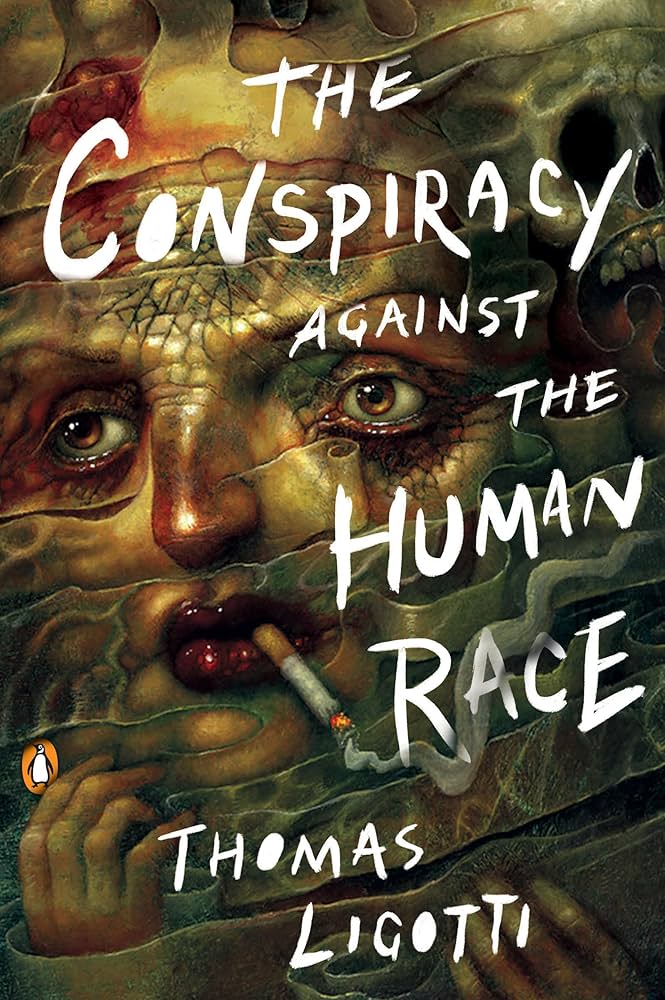
Ligotti has an essay titled The Conspiracy Against the Human Race, where he argues that consciousness is an error—a glitch in evolution that is only capable of producing suffering. Thacker, for his part, speaks of a cosmic pessimism, a refusal to believe in any order furnished with meaning. Both begin from Lovecraft, from his alien understanding of the human condition.
What they discover in the Cthulhu Mythos, however, is that not all pessimisms are the same. There are pessimisms that can sink us into helplessness, bring everything to a halt, force us to surrender. But there are also pessimisms that do the opposite: instead of demobilizing us, they mobilize us.
Because what Lovecraft understands—and what Houellebecq, Land and many others understand through him—is that it is essential to free ourselves from our illusions about the cosmos. Only if we stop believing that things have some meaning compatible with the human, and can face the absolute contingency of our position in the world, can we truly be free. Under that hyper-materialist, alienated, essentially weird condition, we might lose many of the things we used to recognize as “ours.” But, as happens to the narrator of Innsmouth, that loss may very well be worth it.
In Lovecraft’s own words:
“Now all my stories are based on the fundamental premise that common human laws and interests and emotions have no validity or significance in the vast cosmos. (…) To achieve the essence of real externality, whether of time or space or dimension, one must forget that such things as organic life, good and evil, love and hate, and all the other local attributes of a small and temporary race called ‘humanity’ have any existence at all… But when we cross the line into the limitless and hideous unknown—the shadow-haunted Outside—we must remember to leave our humanity and our earthliness at the threshold.”