Pokémon: The origins and Heyday of the Highest-Grossing Franchise in History
Thirty years ago, the doors opened to the most prolific and successful fictional world in history: Pokémon. Dozens of games, hundreds of episodes and movies, billions of cards and stuffed animals, and even pregnancy tests.

8 de feb. de 2026 — Ezequiel Vila
"Hello everyone! Welcome to the world of Pokémon!" With those simple words, Professor Oak opened the doors 30 years ago to one of the most prolific and successful fictional worlds in history. On February 27, 1996, after years of hard work, Pocket Monsters: Green (ポケットモンスター 緑) and Pocket Monsters: Red (ポケットモンスター 赤) were released in Japan for the Game Boy, Nintendo's portable console, just as it was nearing the end of its novelty cycle. Since then, we too have lived in the world of Pokémon, as our reality was quickly transformed, and the ecosystem of video games, animation, and culture as a whole would never be the same again. Indeed, Pokémon may have been the final blow that broke down the Western wall, flooding the globe with kawaii and quirky products that continue to this day.
Bug Catchers
However, Pokémon started out as just the dream of two friends who were gaming enthusiasts and wanted to shake things up. In 1982, Satoshi Tajiri and Ken Sugimori began publishing a dōjinshi (what we would call a fanzine) called Game Freak, where Tajiri wrote reviews and game guides, and Sugimori illustrated them. The publication primarily focused on arcade games, dissecting them to document enemy patterns, stage secrets, and bugs they encountered. Tajiri's obsession with this classification endeavor gave the fanzine a considerable circulation in Tokyo and its surroundings, which, combined with the explosive moment of video game development in Japan, led to Game Freak eventually becoming a video game development studio, signing contracts with companies like Namco and Nintendo to create commissioned games. But the endgame for these nerdy Japanese (who were later joined by musician Junichi Masuda) was always to create their own game, specifically a project that had obsessed Satoshi Tajiri since childhood: an RPG that didn’t revolve around knights, wizards, and adventures in pseudo-medieval realms, but rather explored the connections between nature and the advancement of computers, between urban and rural Japan, which was gradually disappearing with the technological economic miracle. Ultimately, Tajiri was telling his own story: that of a child born in the post-war era who witnessed how a traditional and slow-paced society began to develop a symbiotic relationship with gadgets that accelerated it to another speed. As a child, his main hobby was wandering the fields and forests of Machida (an area in Tokyo) collecting insects that he stored in jars. In a way, he wanted to recreate that experience for children who could no longer enjoy life close to nature. Thus, in 1990, the development of Capsule Monsters began, a game about exploring caves, forests, and paths populated by collectible and exchangeable fantastic creatures! One of Satoshi Tajiri's major inspirations was the arrival of the Game Boy in 1989 and, in particular, its link cable: beyond competitive play (like Tetris), Tajiri saw it as a way to encourage sociability. This vision led him to become a protégé of Shigeru Miyamoto, who mentored him during development and reportedly suggested launching the game in two versions with exclusive creatures to reinforce this exchange. It wasn't until 1996 that Pokémon Red and Pokémon Green were released, fully utilizing the Game Boy's resources. With 151 Pokémon, an adventure set in the Kanto region (a real region in Japan), and a turn-based combat system, the game introduced the central idea of capturing, training, and trading monsters that we all know today.
Who's that Pokémon?
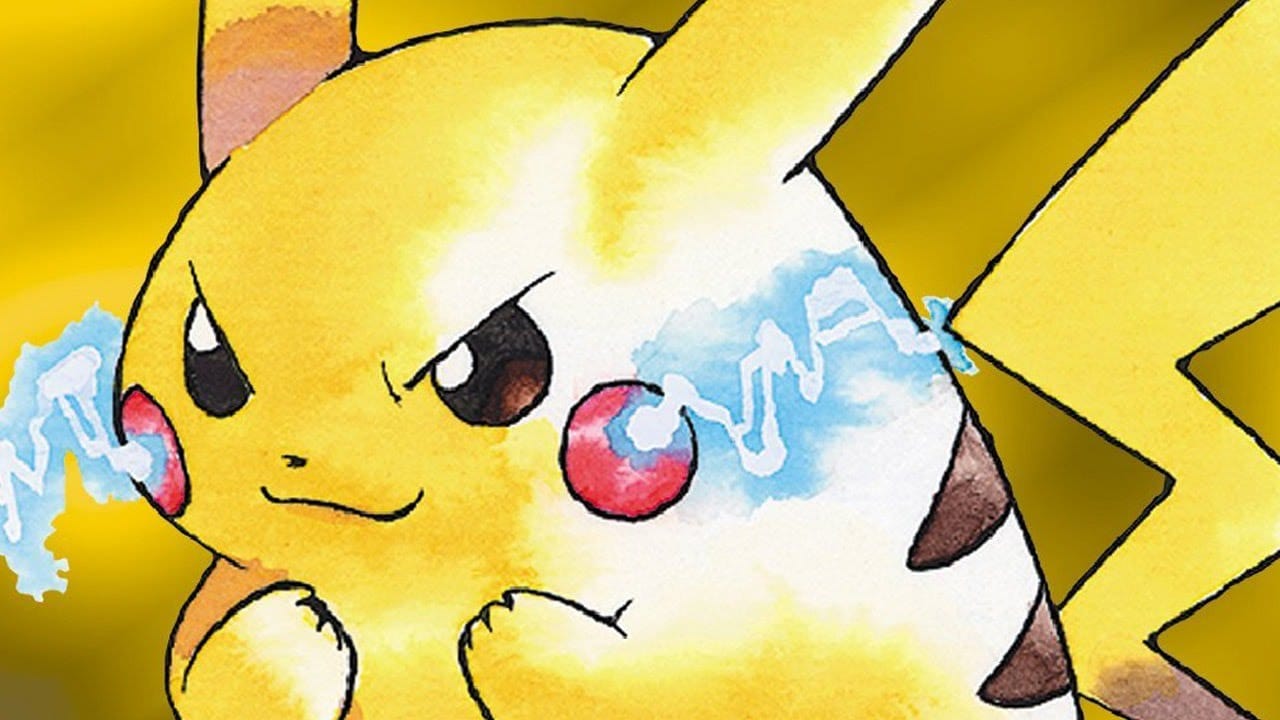
But this inspiration would have meant nothing without the decisive factor that led to the success of the game launches: the Pokémon themselves. It's easy to identify that the original designs in Ken Sugimori's concept art were heavily inspired by kaijus, monsters that could go claw to claw with Godzilla or Mothra. The problem was that this image of colossal and unleashed power worked well as an aspirational goal for players towards the end of the game, but it didn't quite fit with the serene beginning in a sleepy little town. Thus, the team sought to broaden the design spectrum, attempting to create some monsters that were cuter and friendlier. With this goal in mind, Sugimori brought in Atsuko Nishida, one of the designers who was working on porting games at Game Freak to pay the bills while the dream game stretched deadlines. Out of nowhere, without even sketching on paper, Nishida created in pixels the first design of a round little rodent, inspired by the shape of a daifuku (a Japanese rice cake) and the cheeks of a squirrel, topped off with a lightning bolt tail. The design was an immediate hit among the team, who named it “Pikachu” after the onomatopoeias “pika-pika,” which in Japanese refer to a flash of light, and “chu,” the syllable that identifies the squeak of a mouse. History was being made in a 56x56 pixel grid. Atsuko Nishida remains part of the Pokémon team and is confirmed to be responsible for the designs of Bulbasaur, Squirtle, Charmander, the evolutionary line of Eevee, Dratini, Zorua, Cinccino, Alolan Raichu, and many more.
Now, anyone who has played the games knows that Pikachu is not the protagonist and isn’t even one of the three starter Pokémon with which the adventure begins. Kōji Nishino (the guy who inspired the design of Snorlax) mentioned in interviews that he loved Pikachu so much that he decided to hide it as a low-probability encounter in one of the game's early forests, making it a more special Pokémon and in a way, “keeping it for himself.” But it backfired, as the rumor began to spread from mouth to mouth, and quickly the yellow mouse became the most popular of the initial 151 monsters.
I gotta catch 'em all!
Just a few months after the release of the Game Boy games, in October 1996, the franchise took its first step outside the world of video games: Pokémon Trading Card Game. Unlike other TCGs, like Magic, the Pokémon card game was specifically designed for kids, which is why it featured a much simpler and easier-to-learn set of rules, with less strategic potential but also much more accessible. The game was designed by Creatures Inc., with key figures like Tsunekazu Ishihara (producer and architect of the project), Kouichi Ooyama, and Atsushi Nagashima, who understood that the TCG needed to reflect the collection and trading component of the franchise. In fact, the act of trading cards replicated exactly the social experience that the video games proposed through the Game Boy's link cable. Gotta catch 'em all! A brilliant and spectacular hook to sell a ton of cards. The collecting aspect in Pokémon TCG is actually enhanced by the importance that Creatures Inc. always placed on the art of the cards, which aim to depict Pokémon in naturalistic situations, related to their environment in scenes rich with layers of meaning, rather than treating them as mere “figures” from the game against a backdrop.
Needless to say, bringing a deck of cards to the schoolyard is much easier than doing so with a battery-operated Game Boy, so the card game was crucial in hooking millions of kids around the world into the Pokémon craze. The TCG has sold over 50 billion cards today, making it the best-selling TCG, surpassing Magic, which has a much stronger competitive scene but doesn’t appeal as broadly to collectors.
Your franchise is evolving!
If almost anything that sells decently in Japan has an anime, the success of the games quickly caught the attention of producers and animation studios. In 1997, alongside OLM Inc., the Pokémon anime hit the TV screens in Tokyo. Directed by Kunihiko Yuyama and Masamitsu Hidaka, the anime followed the story of Satoshi (Ash in the West) and his quest to become a Pokémon Master alongside his faithful friend Pikachu, who they logically decided would be the mascot of the anime given its enormous popularity and proven potential (later proven) to sell plush toys. The Pokémon anime is not a direct adaptation of the games, but rather a reinterpretation following the story of Satoshi, a cocky, headstrong, somewhat goofy character. The tone of the original series is extremely bizarre and features self-contained stories in a rather classic style, interwoven with tropes of Japanese humor, partly thanks to Hidaka's television experience, who was also a hilariously charming alcoholic who never underestimated the child audience. His main contribution is undoubtedly Team Rocket, who, far from being the heavy mafia types from the games, are portrayed in the anime as two loser members of the organization, extremely caricatured and with a taste for dressing up way too much.
The anime, however, would be etched in popular memory due to the unfortunate incident on December 16, 1997, during the airing of episode number 38, Dennō Senshi Porygon (Computer Warrior Porygon), in which a few seconds of rapidly flashing red and white animation caused seizures in hundreds of Japanese children, some of whom had to be hospitalized. This controversy was the last thing the Pokémon brand needed to go global through news reports and spark even more interest from people around the world. And as an unintended consequence, it put so much pressure on the bureaucrats at OLM Inc. that Masamitsu Hidaka was basically able to do whatever he wanted with the script of Mewtwo Strikes Back, the first and acclaimed movie that presents a Promethean tragedy with Pokémon. Watch it again.
Technology is incredible!
Perhaps the most striking aspect of Pokémon as a concept, and something that remains relevant today, is the desire to create a utopian narrative in which nature and technology can coexist in harmony (despite their occasional conflicts and tensions). What could have been the basis for an apocalyptic tale or the premise for a cartoon in the style of Captain Planet, where cool kids fought against the advance of computers with their portable dragons, instead gave rise to a horizon to contemplate. Pokémon are fully integrated into the fabric of society: in addition to being companions or “pets,” many of them contribute to value generation as part of the production chain: just as there are Pokémon farms, there are also police Pokémon or even Pokémon that work in construction or hospitals. Humans, in turn, care for the well-being of Pokémon and often their natural habitats as well.
In each of the settings from the first game, we can see the intersection between nature and urban life, with its balances and imbalances: an abandoned space like an old power plant is reclaimed by wild Pokémon, while others, like the safari zone, are constructed by humans to shelter them. Conflicts can reach a local or cosmic scale, but at the end of the day, what prevails (a bit corny, yes) is a fatalistic humanism, where the care of the community takes precedence. That’s why everyone loves Pokémon, because they are cute little critters that, in their very existence, hold the promise of a better world.
It's super effective!
After dozens of games, hundreds of episodes and movies, billions of cards, countless plush toys, pens, pregnancy tests, and even their own amusement park (opening in just a few days), Pokémon today is nothing less than the highest-grossing franchise in the world. This positions it ahead of kids like Mickey Mouse and his friends, the entire Marvel universe, the whole Star Wars galaxy, and even surpassing the reigning queen of selling cute trinkets to date, Hello Kitty. It’s estimated that Pokémon has generated $115 billion since its launch, almost double that of the second place, Mickey, with $62.5 billion. Not to mention the small detail that the other mouse has been around since 1928.
Far from being satisfied with that, this year Pokémon Pokopia is set to release, a sort of Animal Crossing with Pokémon, with a confirmed launch date of March 5, and speculation is rife that the 10th generation of pocket monsters (which now total 1025) will debut in October.
Even so, not everything is rosy. The reception of the games in recent years has been mixed, and the franchise itself has begun to make changes. In fact, some competitors are starting to successfully challenge it in the realm of pets involved in street fights, as was the case with the recent Palworld. The anime has also undergone several transformations, with the latest perhaps being the most resonant, when the finally champion and Pokémon Master Ash Ketchum retired from adventures and made way for a new official Pokémon series with a new protagonist and new characters, including a Pikachu that is no longer… the Pikachu.
Pokémon has every argument to claim its place at the top of the entertainment industry for a long time, and perhaps the torch of showbiz has definitively passed from the West to the East. And maybe the initial spark, that honesty of a duo of nerds creating a fanzine and a drunken showrunner infusing existential questions into a kids' cartoon, is starting to fade. But for better or worse, everything seems to indicate that these 30 years are just the beginning.