Black Mountain College: An Educational Model for Rethinking Today’s Universities?
Black Mountain College was the epicenter of polymathy, the only educational experiment of the 20th century that used interdisciplinary chaos as a method. A radical model of education that, today, in the midst of the AI era, is once again necessary.

7 de abr. de 2026 — Julio Alonso
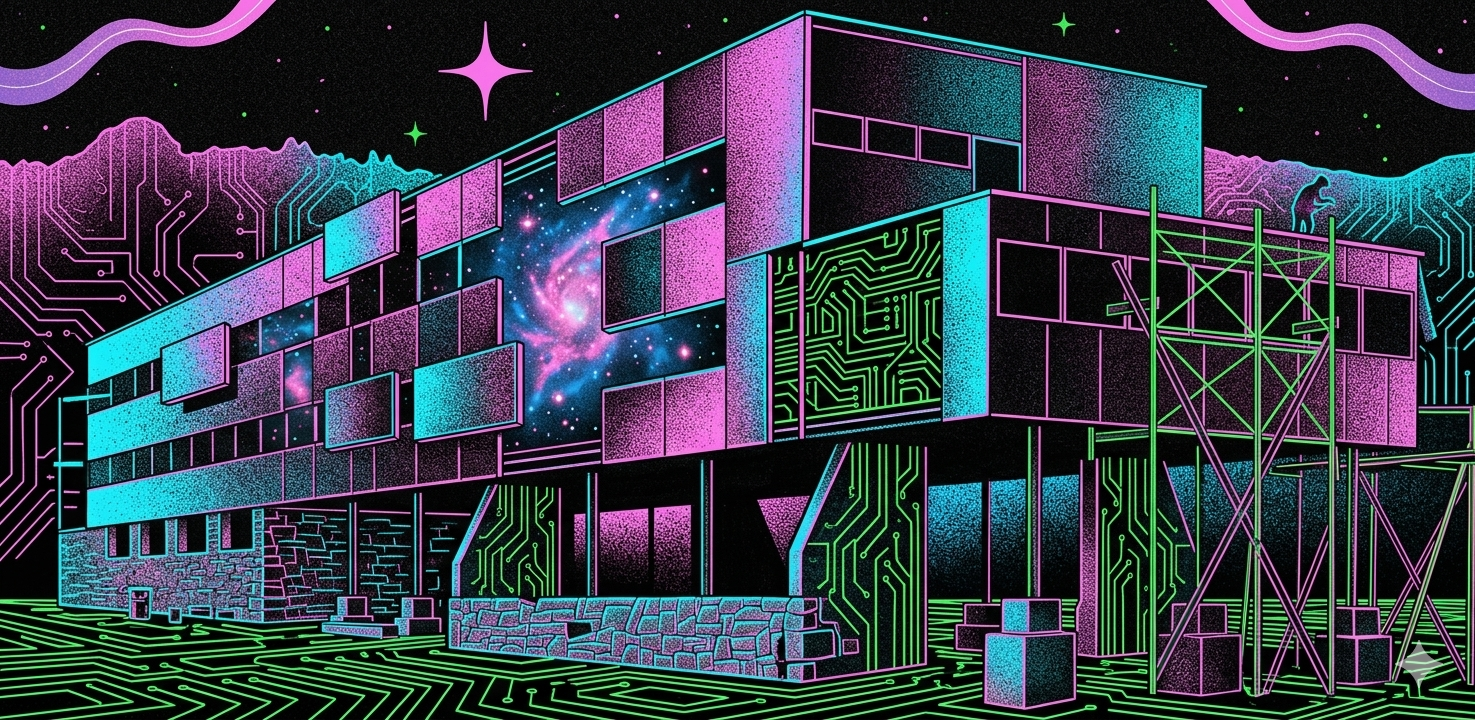
No one who set foot on the Blue Ridge Mountains of North Carolina in the 1940s could have imagined that in this remote corner of the southern United States, something more like a utopia than a university was in operation. Black Mountain College opened its doors in 1933 and closed them in 1957, leaving behind just twenty-four years of history and a list of alumni that defies any statistical logic: Robert Rauschenberg, Merce Cunningham, John Cage, Buckminster Fuller, Franz Kline, Willem de Kooning, Charles Olson. It was not an elite institution. It had no endowment, no buildings of its own, and not even formal accreditation for much of its existence. Instead, it had an idea.
Forget about the Bauhaus as a direct reference: although Josef Albers arrived from there in 1933, fleeing Nazism with his color exercises and material philosophy, what was built at Black Mountain was something different and more radical. The Bauhaus was German, modernist, obsessed with the synthesis of art and industry. Black Mountain was American, pragmatic, obsessed with something more diffuse and ambitious: the formation of the complete human being. Its first rector, John Rice, was a follower of John Dewey and believed that the classroom was not the only place where education happened, but merely one of the many spaces where it could occur. The farm, the workshop, the dining hall, the theater rehearsal, the library, the political discussions between students and professors who lived together without formal hierarchy: all of that was part of the curriculum.
One student could learn musical composition with John Cage in the morning, work on building a geodesic dome with Buckminster Fuller in the afternoon, and discuss poetry with Charles Olson after dinner.
Without a rigid disciplinary structure, without departments, without mandatory credits in the conventional sense, the College functioned as an ecosystem where knowledge crossed boundaries that were insurmountable at other universities. One student could learn musical composition with John Cage in the morning, work on building a geodesic dome with Buckminster Fuller in the afternoon, and discuss poetry with Charles Olson after dinner. It wasn't multitasking or superficial curiosity: it was something we would today call, using the vocabulary that Alejandro Piscitelli revived for the 21st century, the formation of a polymath.
Options like these are what Piscitelli describes in his book Polymaths: the anti-disciplinary profile of the worker of the future (Santillana, 2023) when he talks about the urgent need to train professionals capable of bridging the gap between the sciences and the humanities, between doing and thinking, between mathematics and philosophy. His central argument is that the BANI world (brittle, anxious, non-linear, incomprehensible) cannot be navigated by specialists encapsulated in their disciplines, but by people capable of exercising what he calls a "zoom epistemology": entering and exiting different levels of analysis, connecting seemingly disconnected domains, operating in complexity without reducing it. Black Mountain College didn't have that vocabulary, but it had the practice.
 Mariano Vilar
As early as 1933, Rice understood that the student was the center of education, not the content. This Copernican inversion (which today sounds like a cliché but was scandalous in the American academic context between the wars) involved minimizing hierarchies between teachers and students, involving both in the management of the institution, and betting on the creative process as a method of knowledge. Albers summarized it another way: what mattered was not what the student produced but what they learned while producing it. Mistakes were welcome. Uncertainty was too.
The result was a breeding ground for what we would today recognize as lateral thinking, anti-disciplinary innovation, and, in Piscitelli's terms, the active cultivation of polymaths. Cage arrived at Black Mountain not knowing exactly what he was going to do and ended up composing 4' 33'', his most famous and most misunderstood work, in which silence is the music. Rauschenberg arrived without a solid artistic background and ended up inventing the combine paintings, objects that were neither sculpture nor painting nor installation but all three simultaneously. Fuller came with his geometries and left behind a geodesic dome that the students built with him, learning engineering while they learned to collaborate with each other.
The polymath is not simply someone who knows many things. They are someone who can connect them, who can think at the edges of disciplines where there is still no established language, where knowledge is provisional and the question is worth more than the answer.
The pedagogical dimension of Black Mountain College cannot be separated from its political dimension. It was deliberately a holocratic institution in a historical context where hierarchy was the natural order of things. It made decisions collectively, with students and professors on equal footing in assemblies. It had no president but a rector who could be challenged and questioned. This climate of horizontality was not just a facade: it was the condition for what happened to occur. Radical creativity needs environments where mistakes are not punished and where authority is not the final word.
Here appears a tension that Piscitelli also addresses in his book and cannot be ignored: the polymath is not simply someone who knows many things. They are someone who can connect them, who can think at the edges of disciplines where there is still no established language, where knowledge is provisional and the question is worth more than the answer. This requires an education that few institutions are willing to offer because it is costly, inefficient from an industrial perspective, and difficult to evaluate with standard metrics. Black Mountain attempted it and succeeded for twenty-four years. The price was its own survival: it closed in 1957 due to lack of funding.
 Mariano Vilar
One of the lingering questions after studying Black Mountain College is whether it was an unrepeatable miracle or a model to emulate. The uncomfortable answer is that it was both. The conditions that made it possible (a small group of extraordinarily committed individuals, a crisis context that unleashed creative energies, a remote location that fostered community out of necessity) are hardly replicable on a larger scale. But the pedagogical logic that underpinned it—the belief that true knowledge emerges from the intersection of disciplines and the integration of theory and practice, art and science, thought and action—this logic is transferable.
Translating its pedagogical proposal to the present means confronting an educational system that continues to be organized exactly the opposite: by isolated departments, by accumulated credits, and by increasing specialization from ever younger ages. Piscitelli points this out precisely when he describes the need to "fundamentally redesign the institutions that train professionals, starting with universities." Black Mountain didn’t wait for the system’s permission to do that. It operated on the margins, with few resources and a lot of conviction, and in the process produced a concentration of artistic and intellectual innovation that still defies explanation within the conventional frameworks of the sociology of education.
The jobs that will survive automation are, to a large extent, those that require exactly what Black Mountain trained for: the ability to synthesize, thinking at the edges, and the skill to connect domains that the market keeps separate.
Eighty years after the closure of Black Mountain College, we find ourselves at a moment where the question that institution sought to answer has returned with renewed urgency. Artificial intelligence is reshaping the landscape of professions in ways that no disciplinary specialization can fully anticipate. The jobs that will survive automation are, to a large extent, those that require exactly what Black Mountain trained for: the ability to synthesize, thinking at the edges, and the skill to connect domains that the market keeps separate. It’s not nostalgia that draws us back to that experiment in North Carolina. It’s the need to find genealogies for what today presents itself as novelty.
It’s tempting, and also necessary, to close with a question that Piscitelli almost explicitly poses and that Black Mountain College makes urgent: What kind of institutions do we want to build to educate the people who will live in the world that is already arriving? They didn’t have the answer, but they had something more valuable: the willingness to experiment without guarantees, to accept failure as part of the method, and to bet on collective intelligence over individual authority. They closed without having resolved their financial issues, but they left behind something more enduring than any building: a way of thinking about education that, whenever the world becomes complicated, seems inevitable once again.